

Think of your law firm's website as its digital front door. It’s often the very first interaction a potential client has with your practice, and in that split second, they’re making a judgment call about your credibility, professionalism, and expertise. A great website isn't just about looking good; it's a carefully crafted tool designed to build trust and guide visitors from simply browsing to picking up the phone.
Your Firm’s Digital First Impression
In the legal world, first impressions are everything. Long before a potential client reads a testimonial or calls your office, they’ve landed on your website. In those first few seconds, an opinion is formed. Does this firm look professional? Are they competent? Can I trust them with my sensitive legal issue?
This digital handshake is critical. It can be the start of a new client relationship or the reason they click away to a competitor. Your website is your hardest-working asset, operating 24/7 to answer questions, build confidence, and make a compelling case for why your firm is the right choice. In such a crowded market, that first impression has to count.
The Modern Client Expectation
Today's clients do their homework. They come to your site looking for answers, reassurance, and a clear path forward. If your website is confusing, outdated, or slow, it creates instant friction. It subtly communicates a lack of attention to detail—hardly a quality anyone looks for in their legal representation.
Your site has to be built around their needs. From experience, we know clients are looking for a few key things:
- Easy Navigation: Can they find your practice areas, lawyer bios, and contact details without having to think about it? It should be effortless.
- Clear Messaging: Your value proposition needs to hit them right away. Who do you help, and what problems do you solve? Be direct.
- Proof of Expertise: This is non-negotiable. Testimonials, case studies, and detailed attorney profiles provide the social proof that builds immediate credibility.
Standing Out in a Competitive Market
The Australian legal market is tough. A recent report highlighted that 71% of midsize law firms are zeroing in on client satisfaction as their primary growth strategy. That tells you everything you need to know about where the focus is. With the industry growing by only 0.3% over the past five years, a powerful online presence isn't just nice to have—it's essential for survival. You can dig deeper into these findings in the 2025 Australian midsize law firm priorities report.
For agencies and law firms aiming to build a site that truly stands out, working with a specialist can make all the difference. Partnering with a white label WordPress agency, for example, gives you access to years of technical know-how without the cost of a full-time in-house team. This ensures the website isn't just a pretty face; it's secure, fast, and built to perform. Of course, understanding the investment is a key part of the process, and you can learn more about what goes into the cost of website design here.
Designing an Intuitive Client Journey
Let’s be honest: when someone lands on your website, they’re probably stressed, short on time, and looking for answers. Fast. If they can't figure out where to go in a few seconds, they're gone. That's why great law firm website design is all about removing friction and creating a clear, intuitive path that guides a visitor from a state of uncertainty to taking action.
It all starts with two concepts that sound technical but are really just common sense: User Experience (UX) and Information Architecture (IA). Think of UX as the overall feeling someone gets using your site—is it easy and reassuring, or confusing and frustrating? IA, on the other hand, is the logical structure behind it all, making sure information is exactly where people expect to find it. Get these two right, and you’ll start building trust before a client even reads a single word about your services.
The first impression happens in a flash, and it almost always follows a predictable pattern of judgment, trust-building, and finally, action.
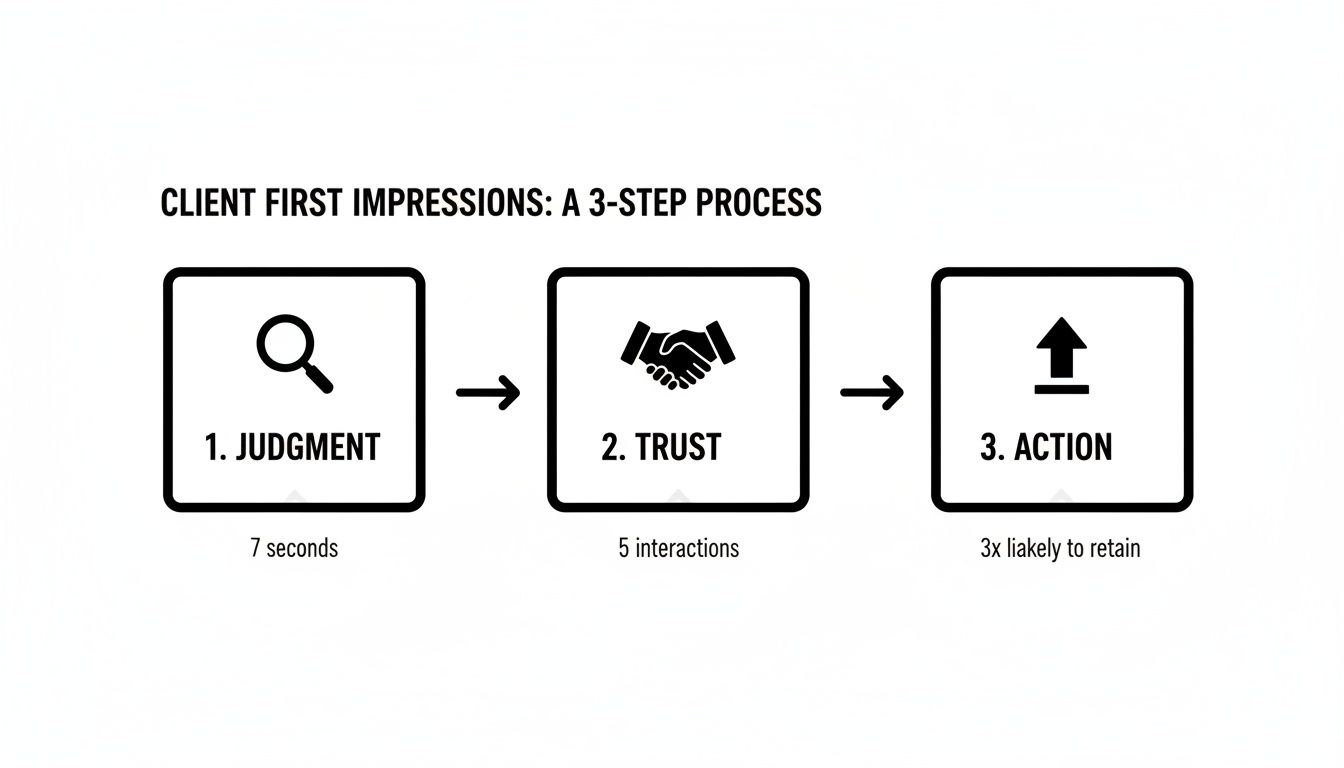
This flowchart really nails down just how quickly a potential client moves from simply looking at your design to making a snap judgment about your firm's credibility.
Mapping the Client's Path
Before you even think about design mockups, you have to map out the journey for your different types of visitors. The path for someone frantically searching for a criminal defence lawyer is completely different from that of a business owner carefully researching commercial litigation firms.
Put yourself in their shoes. What does each person need first? The individual facing criminal charges needs immediate contact information, a clear "call now" button, and a heavy dose of reassurance. The business owner? They’re more likely looking for proven expertise, detailed case studies, and impressive attorney profiles.
Your website’s structure has to serve these completely different needs with simple, logical navigation.
Building a Logical Information Architecture
A solid IA organises your website’s content in a way that just feels right to the user. The goal is simple: a visitor should land on any page and instantly know where they are and how to find what they're looking for next.
For most law firms I've worked with, a winning structure usually includes these elements:
- A Clear Top-Level Menu: This is your prime real estate. It should feature the main destinations like Practice Areas, About Us, Our Team, Blog/Resources, and Contact Us. No clever labels, just clarity.
- Logical Practice Area Groupings: If your firm handles diverse areas of law, group them in a way that makes sense. For instance, 'Personal Law' could house family law and estate planning, while 'Business Law' covers corporate and commercial matters.
- Intuitive Sub-Menus: Use simple dropdowns to guide users to more specific pages without creating a cluttered mess. Under 'Our Team', you can list individual solicitor profiles.
A well-structured website anticipates a client's questions and provides the answers before they even have to search. This proactive approach is the hallmark of a truly client-centric firm and a massive differentiator in a crowded market.
For digital agencies building these sites, this is where a specialist partnership can be a game-changer. A white label WordPress designer can take your IA blueprint and turn it into a seamless, responsive, and highly effective user pathway. This kind of WordPress outsourcing in Australia allows agencies to deliver top-tier results without needing a dedicated expert in-house. They know precisely how to build everything from complex mega-menus for large firms to simple, elegant navigation systems that perfectly match a boutique firm's brand.
By focusing on the client journey from the very beginning, you’re doing more than just building a website. You’re crafting a digital experience that builds confidence and turns anxious visitors into actual clients. It's a strategic investment that shows potential clients you understand their needs and are ready to help from the very first click.
Content That Establishes Authority and Trust

A sharp design might catch a potential client’s eye, but it’s your words that will convince them you’re the right choice. The content on your website has to do the heavy lifting—it needs to prove your expertise and build a foundation of trust long before anyone picks up the phone. This is how you turn a simple online brochure into a client-generating powerhouse.
Forget the dense legal jargon. The real key is to create content that speaks directly to a visitor's immediate anxieties and urgent questions. Use clear, straightforward language that educates and empowers them. When someone feels they understand their situation better after visiting your site, they start to see you as a trusted advisor, not just another solicitor.
Crafting Pages That Connect and Convert
Every single page on your website has a job. Whether it's telling your firm's origin story or detailing your legal specialities, each piece of content must guide the visitor one step closer to making contact. Unfortunately, generic or poorly written pages can completely undermine an otherwise brilliant design.
To build out a persuasive online presence, every law firm needs a non-negotiable set of core pages. Getting these right is the first, most critical step.
Essential Pages for a High-Converting Law Firm Website
This table breaks down the crucial pages your website must have, what each one should achieve, and the key elements to include. Think of it as your blueprint for turning visitors into clients.
| Page Type | Primary Goal | Key Content Elements |
|---|---|---|
| Homepage | Make an immediate, credible first impression and direct traffic. | Clear value proposition, prominent calls-to-action (CTAs), social proof (testimonials/awards), easy navigation. |
| About Us / Firm Story | Build a personal connection and communicate your firm's "why". | Firm's mission and values, the story behind its founding, what makes your approach different. |
| Lawyer Profiles | Humanise your team and build trust in individual expertise. | Professional headshots, detailed biographies, qualifications, personal approach to law, direct contact info. |
| Practice Area Pages | Demonstrate deep expertise and address specific client problems. | Detailed explanation of the legal area, common issues faced by clients, your specific process, relevant case results. |
| Case Results / Victories | Provide tangible proof of your ability to deliver positive outcomes. | Anonymised summaries of successful cases, outlining the problem, your strategy, and the final result. |
| Testimonials / Reviews | Showcase social proof from satisfied clients. | Authentic client quotes (with photos if possible), video testimonials, embedded reviews from Google or Avvo. |
| Blog / Resources | Establish authority and capture organic search traffic. | Helpful articles answering common legal questions, analysis of new laws, guides for potential clients. |
| Contact Us | Make it incredibly easy for potential clients to get in touch. | Multiple contact methods (form, phone, email, map), clear office hours, links to social media. |
Having this structure in place ensures a visitor can find exactly what they need to feel confident in your abilities.
For agencies managing these builds, partnering with a white label WordPress designer can be a game-changer. A professional website designer in Australia brings the expertise needed to structure these pages for maximum impact, making sure the design and content work together seamlessly to build that all-important authority. This frees up your team to focus on nailing the client’s core messaging.
Back It Up: Showcasing Proof of Your Success
Words are one thing, but proof is what truly seals the deal. You have to back up your claims of expertise with tangible evidence of your track record. In law office website design, social proof isn't just a nice-to-have; it's a necessity.
This is where you show, not just tell.
Your website must answer the silent question every visitor is asking: "Can this firm really solve my problem?" Case results and testimonials provide a direct, powerful answer.
Make sure you weave these trust-building elements throughout the entire site:
- Detailed Case Results: Where ethically permissible, share anonymised summaries of successful cases. Briefly outline the client's problem, the strategy you put in place, and the positive outcome you delivered.
- Authentic Client Testimonials: Feature quotes or even short video testimonials from past clients. Don't just bury them on one page; sprinkle them strategically on your homepage, practice area pages, and lawyer profiles.
- In-Depth Articles and Resources: A blog or resource centre filled with genuinely helpful content positions you as a thought leader. Writing about recent legal changes or answering common questions not only demonstrates your expertise but is also fantastic for SEO.
Converting Visitors with Ethical Design and Trust Signals
When it comes to a law firm's website, trust isn't just a nice-to-have; it's the entire product. People don't land on your site by accident. They’re often in a vulnerable position, looking for a professional advocate they can depend on. Your website has to instantly show them they’ve found the right place.
This is where you move beyond just having a good-looking site. You need to combine tangible trust signals with a rock-solid commitment to ethical marketing. It’s about turning a sceptical visitor into someone who feels confident enough to pick up the phone. Think of these elements as the digital equivalent of a firm handshake—small details that build a powerful, immediate sense of credibility.
Displaying Clear Signals of Trust
Strategically placed trust signals are your website’s validators. When someone sees them, it subconsciously ticks a box, confirming your firm’s legitimacy. Without these, even the slickest design can feel a bit empty.
Here are some of the most effective signals I’ve seen work time and time again:
- Professional Memberships: Showing you're part of the local bar association or other respected legal organisations is non-negotiable. Pop those badges in the footer or a sidebar where they're always visible but not screaming for attention.
- Awards and Recognitions: If your firm or its solicitors have been recognised by publications like Best Lawyers or Doyle's Guide, don't be shy. Feature these logos on the homepage or create a dedicated page to showcase your accolades.
- Media Mentions: Have you been quoted in the news or featured in an article? An "As Seen In" section with logos from media outlets adds serious authority and positions you as an expert in your field.
- Transparent Processes: Be upfront about what happens during an initial consultation. Is it free? What will you cover? Getting rid of the unknowns helps lower a potential client's anxiety and makes them much more likely to reach out.
Navigating the Tightrope of Ethical Marketing
Building trust is one thing, but for law firms, it has to be done within the very strict ethical guidelines governing legal advertising. One wrong move won't just hurt your reputation; it could land you in serious hot water professionally. Your website has to be a shining example of integrity.
This is a minefield for agencies and their law firm clients. A marketing tactic that’s standard practice in e-commerce could be a major violation in the legal world. It’s a huge reason many agencies choose to outsource WordPress development in Australia to partners who live and breathe these nuances. Getting a WordPress expert in Australia involved from the start ensures all the necessary compliance features are baked right into the technical build.
Every single claim made on your website must be verifiable and presented in a way that isn't misleading. You're aiming to build a persuasive digital presence that enhances your firm's professional reputation, not put it at risk.
Essential Ethical and Legal Compliance
To protect your firm and build genuine client trust, your website must incorporate several key compliance elements. These aren't just legal boxes to tick; they show visitors that you respect their privacy and operate with complete transparency.
Your ethical design checklist should absolutely include:
- Clear Disclaimers: Every law firm site needs a disclaimer stating that the content is for informational purposes only and doesn't create a solicitor-client relationship. A link in the footer is the standard, and correct, place for this.
- Robust Privacy Policy: You must have a comprehensive privacy policy that clearly explains what data you collect (e.g., through contact forms) and how you use and protect it. This is a non-negotiable legal requirement under Australian privacy law.
- Adherence to Advertising Rules: Know your local Law Society or Bar Association's rules on advertising inside and out. These often include restrictions on using terms like "specialist" unless you hold formal accreditation, and they almost always prohibit promising a specific outcome.
- Secure Contact Forms: Any form that collects a potential client’s information must be secured with HTTPS. This encrypts their confidential data and is a fundamental part of protecting their privacy.
By weaving these trust signals and ethical guardrails directly into your law office website design, you create an online space that doesn't just attract new clients but also truly reflects the high standards of your practice.
Winning the Local Search Battle with SEO

When someone needs a lawyer, their search is almost always local. They aren’t just typing “lawyer” into Google; they’re searching for “family law solicitor in Parramatta” or “commercial litigation firm near me.” This is the local search battleground, and for a modern law firm, winning here is absolutely non-negotiable.
An effective local Search Engine Optimisation (SEO) strategy is what gets your firm front and centre when these high-intent searches happen. It’s all about being visible to the right people, in the right place, at the exact moment they need you. If your local presence isn't strong, you're practically invisible to your most valuable potential clients.
Mastering On-Page Local SEO
The first place to start is your own website. Optimising the content on your pages involves targeting the keywords real clients are using when they look for legal help in your specific service areas. It's a mix of smart keyword research and creating genuinely helpful content.
Forget just targeting broad terms like "lawyer Sydney." You need to get much more specific and tap into the phrases that signal a client's immediate need.
Think along these lines:
- Practice Area + Location: "Estate planning lawyer Perth"
- Problem-Based + Location: "Unfair dismissal lawyer Melbourne CBD"
- "Near Me" Variations: "Criminal defence solicitor near me" (Google will handle the location part)
Once you've zeroed in on these keywords, weave them naturally into the fabric of your site—your page titles, headings, service descriptions, and blog posts. This is how you tell search engines exactly what you do and where you do it.
The Power of Google Business Profile
Your Google Business Profile (GBP) is easily your most powerful local SEO tool. It's that information box that pops up in Google Maps and on the side of search results, and it’s often a potential client’s very first interaction with your firm. A neglected profile is a massive missed opportunity.
An optimised Google Business Profile is like having a premium, free advertisement at the top of Google. It provides instant credibility and makes it incredibly easy for clients to find your location, read reviews, and call you directly from the search results page.
To turn your GBP into a client-generating machine, you need to be meticulous:
- Complete Every Section: Fill out every single field with accurate, current information. That means your exact address, phone number, hours, and a link to your website.
- Select Precise Categories: Don't just pick the generic "Law firm." Choose the most specific categories that describe what you do, like "Family law attorney" or "Criminal justice attorney."
- Actively Solicit Reviews: Positive reviews are a huge ranking factor. Encourage satisfied clients to leave feedback, and make a point of responding to all reviews—both good and bad.
Technical Performance as an SEO Foundation
All the keyword research in the world won't save you if your website is slow, clunky, and broken on mobile. Technical performance is the bedrock of any solid SEO strategy. Google prioritises sites that deliver a fast, seamless user experience because that's what users demand.
A slow-loading page is a conversion killer. If your site takes more than three seconds to load, a huge chunk of potential clients will simply give up and head to a competitor. In the same way, a site that isn't perfectly responsive on a smartphone is alienating the majority of users who start their legal search on mobile. For a deeper understanding of how to build this authority, you can explore our guide on effective link building strategies for law firms.
For agencies managing these builds, this is where partnering with a white label WordPress agency becomes invaluable. These specialists focus on the complex back-end work of WordPress speed optimisation Australia, security, and mobile responsiveness. They handle the technical heavy lifting, creating the fast, secure, and reliable foundation every successful local SEO campaign needs to thrive, letting you focus on strategy.
10. A Technical Checklist for a Flawless Launch
With the design and content all signed off, it’s time to get into the technical nitty-gritty before the new site goes live. This isn't just about flicking a switch and hoping for the best. It’s a methodical run-through to make sure the site is secure, fast, and reliable right out of the gate. A clean launch is the first step towards a great client experience and solid search engine performance.
Honestly, this process begins long before launch day. It starts with choosing the right hosting environment. I almost always recommend managed WordPress hosting for law firms. It’s a smart investment because you get a secure, optimised server environment built specifically for the platform, taking a lot of the technical headaches off your plate.
Pre-Launch Essentials
Before you even think about making the site public, there's a final round of critical checks. Think of this as the last quality assurance gate; it’s where you catch any lingering issues before they can affect a potential client or tarnish the firm's reputation.
Your pre-launch checklist should absolutely cover these bases:
- SSL Certificate Installation: Make sure HTTPS is enabled everywhere on the site. This encrypts any data submitted through contact forms—vital for client privacy—and it’s a non-negotiable ranking factor for Google.
- Cross-Browser and Device Testing: The site needs to look and work perfectly on all the major browsers like Chrome, Safari, and Firefox. And don’t forget to test on every device type, from big desktop monitors down to tablets and smartphones.
- Form Functionality: Test every single contact form, lead magnet download, and call-to-action button. Seriously, every single one. Confirm that the submissions actually go through and land in the right person's inbox.
- Broken Link Scan: Use a tool to crawl the site for any broken internal or external links. These are frustrating for users and can ding your SEO efforts.
A smooth launch is the direct result of a rigorous pre-launch process. For digital agencies, this is where partnering with a white label WordPress maintenance service proves its worth. They manage this entire technical checklist, ensuring a professional, error-free deployment every time.
Launch Day and Post-Launch Monitoring
On launch day itself, the main event is updating the DNS records to point the domain to the new server. But once the site is live, the work isn't over. There are a few immediate post-launch steps needed to track performance and get the site on Google’s radar.
As soon as the new site is live, you must:
- Submit the Sitemap to Google Search Console: This is how you tell Google, "Hey, my new site is here, come and index it!" It's crucial for getting your pages to show up in search results.
- Set Up Analytics: Install Google Analytics or another tracking tool. You need to start gathering data on visitor behaviour, where your traffic is coming from, and which pages are converting from day one.
- Implement a Backup Solution: This is your safety net. Configure regular, automated backups of the website’s files and database to protect against data loss or a security breach.
- Ensure Accessibility Compliance: Run one last check against the Web Content Accessibility Guidelines (WCAG) to confirm the site is usable for people with disabilities.
This technical side of things can get complex, and a platform like WordPress offers powerful capabilities that go far beyond simpler website builders. If you're still weighing up the options, understanding the core differences is key, which we explore in our detailed comparison of WordPress vs Squarespace.
By working through this checklist methodically, you’re not just launching a visually impressive website. You’re deploying a technically sound, secure, and high-performing foundation that will build client trust and support your firm's growth from the moment it goes live.
Got Questions About Law Firm Websites? We've Got Answers
Kicking off a new website project always brings up a lot of questions. We get it. To help you feel confident moving forward, we’ve put together some straightforward answers to the questions we hear most often from lawyers and marketing managers.
So, How Much Does a Professional Law Firm Website Actually Cost?
The honest answer? It varies—a lot. You could get a simple, template-based site off the ground for a few thousand dollars. On the other hand, a completely custom-built website with all the bells and whistles can easily climb into the tens of thousands.
But focusing only on the price tag is missing the point. The real question should be about the return on your investment. A well-built website isn't just an expense; it's a powerful asset that brings in new clients, boosts your search rankings, and fuels your firm’s growth for years to come. This is especially true for firms that require custom WordPress development in Australia to meet specific functional needs.
Does My Law Firm Really Need a Blog?
Without a doubt, yes. A consistently updated blog is one of the single most effective marketing tools you have. It's a huge factor in getting your site to show up when potential clients search for the specific legal terms you want to be known for.
It's not just about SEO, though. A blog is your platform to prove you know your stuff. You can dive deep into niche legal topics, offer genuine help to people researching their problems, and establish your firm as the go-to authority. Plus, search engines love fresh content, and a blog is the perfect way to provide it.
What are the "Must-Have" Features for a Law Firm Site?
Of course, you need the basics like lawyer bios and detailed practice area pages. But to actually turn a visitor into a paying client, you need more than just good content. There are a few technical features that are absolutely non-negotiable for any modern law firm website.
Think of these as the foundation of a high-performing site:
- Flawless Mobile Experience: Your site has to work perfectly on a phone. No exceptions. Most people start their search for a lawyer on their smartphone, and a clunky mobile site is an instant turn-off.
- Speed is Everything: If your site takes longer than two seconds to load, you're losing people. They'll just hit the back button and go straight to your competitor.
- Crystal Clear Calls-to-Action: Don't make people guess what to do next. Big, obvious buttons like "Book a Consultation" or "Download Our Free Guide" are essential for guiding visitors toward contacting you.
- Secure Contact Forms: Every form on your site must be protected with HTTPS. It’s crucial for protecting sensitive client information and building trust from that very first click.
Ready to build a high-performing website that drives growth for your agency's law firm clients? White Label WordPress provides expert, scalable WordPress and Shopify development that guarantees your profit margins and delivers exceptional results. Learn how we can become your trusted technical partner today.