
In Australia, you can expect a basic website design to cost anywhere from $2,000 to $5,000. If you're after something more complex, like a custom-built or e-commerce site, the price tag can easily climb from $5,000 to over $25,000. The final figure really comes down to what you need, the features involved, and who you partner with to build it.
Decoding Website Design Prices in Australia
Trying to figure out website design prices can feel a lot like buying a car without a sticker price. Are you looking for a reliable run-around, a functional ute, or a high-performance sports car? Each one serves a different purpose and, naturally, comes with a completely different price.
Websites are the same. They fall into distinct categories based on their complexity and what they're built to do, which directly shapes the investment required.
For agencies, getting a firm grip on these price brackets is essential. It's not just about giving clients accurate quotes; it’s about structuring projects that are actually profitable. The scope of work is what ultimately dictates the cost, whether you're bringing in a WordPress developer or a Shopify expert.
The Car Analogy for Website Costs
A really effective way to explain this to clients (and even get your own team on the same page) is the car analogy. It breaks down a pretty technical subject into tiers that just make sense.
-
The Sedan (Brochure Site): This is your standard, dependable website. It's perfect for showing off services, giving people your contact details, and just looking professional online. Think of it as a solid, template-based build that gets the job done without any fuss.
-
The SUV (E-commerce Site): This one is built for a specific job—moving products. An e-commerce site needs powerful features under the hood, like product catalogues, secure payment gateways, and inventory management. It’s more complex and requires specialised skills, much like an SUV needs a beefier engine and chassis.
-
The Sports Car (Custom Build): Now we're talking about a high-performance machine, built from the ground up for a very specific purpose. A custom website involves unique design, bespoke features, and tricky integrations. It delivers an incredible user experience but demands a serious investment in time and expertise.
At its core, website pricing reflects the amount of time, skill, and customisation required to achieve a specific business goal. A simple online brochure needs less engineering than a global e-commerce platform.
This way of thinking sets the stage for a more detailed chat about what really drives the costs. For a closer look at the numbers, you can explore this detailed guide on Australian website design cost.
To give you a clearer picture, the table below summarises these general price brackets.
Australian Website Design Price Brackets at a Glance
This table breaks down the typical costs you'll see in Australia for different types of website projects, giving you a quick reference for quoting and planning.
| Website Type | Typical Price Range (AUD) | Best For | Key Features |
|---|---|---|---|
| Brochure/Informational | $2,000 – $7,500 | Small Businesses, Startups, Service Providers | 5-10 pages, contact form, mobile responsive, basic SEO setup. |
| E-commerce | $5,000 – $25,000+ | Online Retailers, Subscription Services | Product listings, shopping cart, payment gateway, inventory management. |
| Custom Development | $15,000 – $50,000+ | Tech Startups, Enterprises, Custom Platforms | Bespoke UI/UX, unique functionality, API integrations, high scalability. |
As you can see, the jump in price is directly tied to the complexity and the specialised features required for each tier.
The Core Factors That Drive Up Website Costs

Trying to understand why website design prices vary so much is a bit like getting a suit made. The fabric itself has a price, but the final cost grows with every custom measurement, premium button, and bit of intricate stitching. In the world of web design, those "stitches" are the specific features and custom functions that turn a basic template into a serious business tool.
As an agency, you need to get a firm grip on these cost drivers. It's not just about quoting projects accurately; it's about explaining the value behind your price tag to a client. Each factor adds another layer of complexity, demanding specialist skills and more development time, which naturally pushes up the final investment.
Custom Design vs Template-Based Approaches
The first big decision that shapes a project's budget is whether to go with a pre-made template or a completely custom design. This choice really sets the scene for everything that follows, from cost to the site's final potential.
-
Template-Based Websites: Think of these as a high-quality, off-the-rack suit. They're built on solid platforms like WordPress or Shopify using pre-designed themes. They get you up and running quickly and affordably but don't offer much wiggle room for unique branding or special features. They're a great fit for startups or businesses with pretty standard needs.
-
Custom-Designed Websites: This is your bespoke, tailor-made option. Every single element, from the user interface (UI) to the user experience (UX), is designed and built from scratch to hit specific business goals. You get complete creative freedom and can build in unique functionality, but it takes a lot more time from a skilled wordpress developer australia or a shopify expert australia, which means a higher price tag.
E-commerce Functionality and Complexity
The moment you need to sell products online, the project's complexity shoots up. A simple brochure site and a powerful e-commerce platform are two entirely different animals, and their costs reflect that.
A basic online store might just need product pages and a straightforward checkout. But for a more serious e-commerce operation, you’ll be looking at sophisticated features that add layers of development work, such as:
- Custom product filters and smart search functions.
- Integration with inventory management systems and shipping provider APIs.
- Customer account portals with order history and wish lists.
- Subscription or recurring payment models.
Each one of these features needs a specialist like a woocommerce developer australia or a shopify liquid developer australia to build, test, and securely implement it, which adds directly to the project's bottom line.
Page Count and Content Creation
It might seem obvious, but the sheer size of a website is a huge cost factor. A simple five-page site is a world away from a 50-page corporate build with detailed service sections, case studies, and a sprawling blog.
More pages mean more time spent on design, development, and plugging in all the content. And speaking of content, creating it—the copywriting, photography, and videos—is often an extra cost that clients forget to budget for. Top-notch, SEO-optimised content is vital for a site to perform well, but it definitely adds to the overall bill.
The opportunity for agencies that can expertly manage these factors is massive. Consider that only 41% of Australian SMBs have professional websites, yet those that do report 25% business growth. Partnering with a white label agency lets you offer high-quality custom builds at competitive prices, bridging that gap between a risky freelancer and a pricey in-house team. You can explore how white label services transform agency pricing to see how this model works.
The true cost of a website isn’t just in its visual design; it’s in the strategic architecture, custom functionality, and ongoing support required to make it a successful business asset.
Ultimately, every single element, from a basic contact form to a complex CRM integration, adds to the final price. By understanding these core drivers, your agency can put together detailed, transparent proposals that clearly justify your pricing and build client trust right from the start.
How to Choose the Right Agency Pricing Model
Deciding how to price your work is a tightrope walk. You need to protect your agency's bottom line, but clients need clarity and confidence in what they're spending. If you get this balance wrong, you'll either watch your profits evaporate due to scope creep or deal with anxious clients who feel like they're writing a blank cheque.
Let's break down the three most common ways agencies charge for their work: fixed-price, hourly, and retainers. Each has its place, and knowing when to use which is a skill in itself. A straightforward wordpress website design australia is often perfect for a fixed fee. But a messy, complex project like a large-scale shopify migration australia? That's where the flexibility of an hourly rate becomes essential.
The Fixed-Price Model: Predictability vs. Risk
A fixed-price model is simple on the surface: you agree on one price for a specific set of deliverables. Clients love this because it's predictable. They know exactly what the final bill will be before the project even kicks off, which gives them immense peace of mind.
This model works brilliantly for projects you've done a million times before—think a standard five-page brochure site or a basic e-commerce build. The scope is clear, and the process is second nature to your team.
But here’s the catch. The model's greatest strength is also its biggest risk. If the project's scope starts to stretch and expand—that dreaded "scope creep"—your profit margins can vanish. Suddenly, your team is logging extra hours that you can't bill for. To make fixed-price work, you absolutely need an iron-clad project brief and a contract that spells out precisely what happens when a client asks for something extra.
The Hourly Rate Model: Flexibility vs. Uncertainty
Charging by the hour gives you and your client maximum flexibility. It's the go-to model for projects where the path forward isn't clear from the start. Think complex builds with lots of unknowns, or ongoing work like chasing down bugs and making small improvements over time. A classic example is a wordpress bug fix australia—you never know if it's a 30-minute fix or a five-hour deep dive until you get under the hood.
For agencies, the upside is huge: you get paid for every single minute your team works. The financial risk of scope creep is completely off the table.
For clients, however, it can be nerve-wracking. An open-ended hourly project can feel like it has no ceiling, causing budget anxiety. To make this work, you need to be militant about time-tracking and communicate with obsessive transparency. Regular updates and clear reporting are non-negotiable for keeping the client comfortable and the relationship strong.
The best agency-client relationships are built on pricing that just makes sense for the job at hand. A fixed fee offers security for predictable work, while hourly rates provide the agility needed for complex, evolving projects.
The Retainer Model: Partnership and Ongoing Value
With a retainer, a client pays you a set amount each month for ongoing access to your team and services. This is the perfect structure for building long-term partnerships. It’s ideal for services like wordpress maintenance australia or continuous shopify support australia, where the client needs you in their corner month after month.
For your agency, retainers are the holy grail: predictable, recurring revenue that smooths out the feast-or-famine cycle. For the client, it means they have a dedicated expert on call for updates, support, and strategic advice without having to approve a new quote for every little thing.
This model thrives on trust. It works best once you've already established a solid relationship, moving you from a one-off project provider to an essential part of their team.
How White Label Services Help You Control Costs and Guarantee Margins
Juggling website design pricing in-house can feel like a constant battle against the unknown. Developer salaries, unexpected project delays, and those nagging technical glitches can torpedo your profits, fast. A project that looked great on paper suddenly becomes a low-margin nightmare. But top agencies have a secret weapon that completely changes how they manage costs and lock in profitability.
Partnering with a white label wordpress agency or a white label shopify agency is the game-changer. Suddenly, development isn't a fluctuating overhead cost; it's a fixed, predictable investment. That simple shift gives you pinpoint control over your expenses, letting you know your exact profit margin before you even send the proposal.
This isn't just about saving a few dollars—it's a powerful strategy for growth. You get immediate access to specialised talent, like an expert woocommerce developer australia, without the headache and expense of hiring.
Transforming Your Cost Structure
The traditional agency model is often weighed down by heavy, fixed overheads. You're paying developer salaries, benefits, and software licenses whether you have one project on the go or ten. This creates a constant pressure to keep the pipeline full, and your profitability can swing wildly from month to month.
White label web development flips this entire model on its head.
- From Variable to Fixed Costs: You pay a clear, set price for each project. This predictability is golden—it means you can calculate your markup and secure your profit margin right from the start.
- Eliminate Developer Overhead: Forget about payroll, superannuation, training costs, and eye-watering software subscriptions. Your agency can operate leaner and react faster.
- Pay-As-You-Go Scalability: You only pay for development when you have a paying client. This lets you scale your business up or down in a heartbeat to meet demand, all with zero financial risk.
By handing off the technical heavy lifting to a trusted agency wordpress partner australia, you free up your team to focus on what they do best: client strategy, sales, and building relationships. This strategic shift is crucial for sustainable growth. To dig deeper into this, you can learn about the benefits when you outsource digital marketing and development.
Adopting a white label model is like switching from owning a fleet of expensive, high-maintenance vehicles to using a reliable, on-demand car service. You get all the capability without any of the ownership headaches.
The Financial Advantage in the Australian Market
The case for a white label partnership gets even stronger when you look at the numbers in the Australian market right now. In 2025, a standard small business website in Australia typically costs between $5,000 and $10,000. This price tag reflects our high cost of living and a projected 27% increase in IT hiring for Q1 2025, which is pushing senior developer rates to an eye-watering $120-$180 per hour.
For most agencies, keeping an in-house team at those rates just isn't sustainable.
This is where outsourcing to a specialist wordpress development australia provider creates a massive opportunity. By paying a fixed, lower fee to a white label partner—often 40-70% less than standard market rates—you can resell that service at full agency prices. You lock in a substantial profit from day one. To get a better feel for the local landscape, discover more insights about the Australian website design market on titanblue.com.au.
Gaining a True Strategic Edge
At the end of the day, using a white label wordpress designer or a white label shopify expert is about more than just the bottom line. It’s about building an agency that's more resilient, scalable, and ultimately, more profitable.
- Access to Specialised Expertise: Need a complex Shopify app integration or some tricky custom WordPress development? A white label partner gives you a deep bench of specialists ready to go.
- Faster Project Turnaround: These teams live and breathe development. Their refined processes mean they can deliver high-quality websites much faster than most in-house teams can manage.
- Focus on Growth Activities: When you’re not bogged down in the technical weeds of a project, you can pour your energy into what actually grows your agency: winning new clients and crafting brilliant strategies.
This approach completely transforms your agency’s capacity. You can confidently take on bigger, more complex, and more lucrative projects, knowing you have the technical firepower to deliver incredible results every single time—all while protecting your profit.
Pricing a Real World Website In-House vs White Label
Theory and general numbers are one thing, but let's get practical and see how website design prices really stack up in the real world. We'll walk through a common project to see the difference: building a 10-page website for a hypothetical Melbourne-based electrician.
This is a classic showdown between the traditional in-house agency model and the much leaner white label approach. By putting the costs side-by-side, you'll see exactly how outsourcing can protect your margins and massively simplify your operations.
The In-House Agency Model
When you build a website with your own team, the final price you quote the client has to cover a lot more than just the developer's time. It needs to absorb salaries, project management hours, software subscriptions, and a slice of all your agency's overheads—think rent, power, the lot.
Let's break down the work for our electrician's 10-page site:
- UX/UI Design: Your in-house designer spends 20 hours mapping out user journeys and crafting the visuals.
- Development: Your salaried wordpress developer australia is on the tools for 40 hours, building the site, hooking up the CMS, and making sure it's fully responsive.
- Project Management: A PM dedicates 15 hours to juggling client comms, keeping the team on track, and handling quality control.
- SEO Setup: An SEO specialist spends 5 hours on the foundational work, like keyword research and technical setup.
When you factor in Australian developer salaries (which can average around $120/hour once you add overheads), plus your PM and designer's time, the internal cost to your agency can easily hit $9,000 to $12,000. To turn a decent profit, you’re looking at quoting the client north of $15,000.
The White Label Partner Model
Now, let's look at the exact same project through a different lens: a white label partnership. Instead of juggling multiple internal resources and tracking every billable hour, you get a single, fixed price from your white label wordpress development partner.
Your partner takes care of all the technical heavy lifting—design, development, and the initial SEO groundwork—for one predictable fee. For a 10-page site like our electrician's, a specialist partner might charge a flat rate of around $4,000 to $6,000.
This completely changes the financial equation for your agency:
- Predictable Cost: You know your exact cost of goods before you even write the proposal. No more guesswork.
- Guaranteed Margin: You can add your desired markup to that fixed fee with absolute confidence. Charging the client the same $15,000 suddenly leaves you with a much healthier, more reliable profit.
- Reduced Overhead: You've just eliminated the need for a full-time developer's salary and all the associated costs, slashing your agency's operational burn rate.
This approach gives you a clear and repeatable path to profitability on every single web project. For agencies wanting to scale up their offerings without scaling up their payroll, looking into ecommerce website development services through a partner can be a game-changing growth strategy.
The chart below shows just how different the cost and profit potential is between the two models.
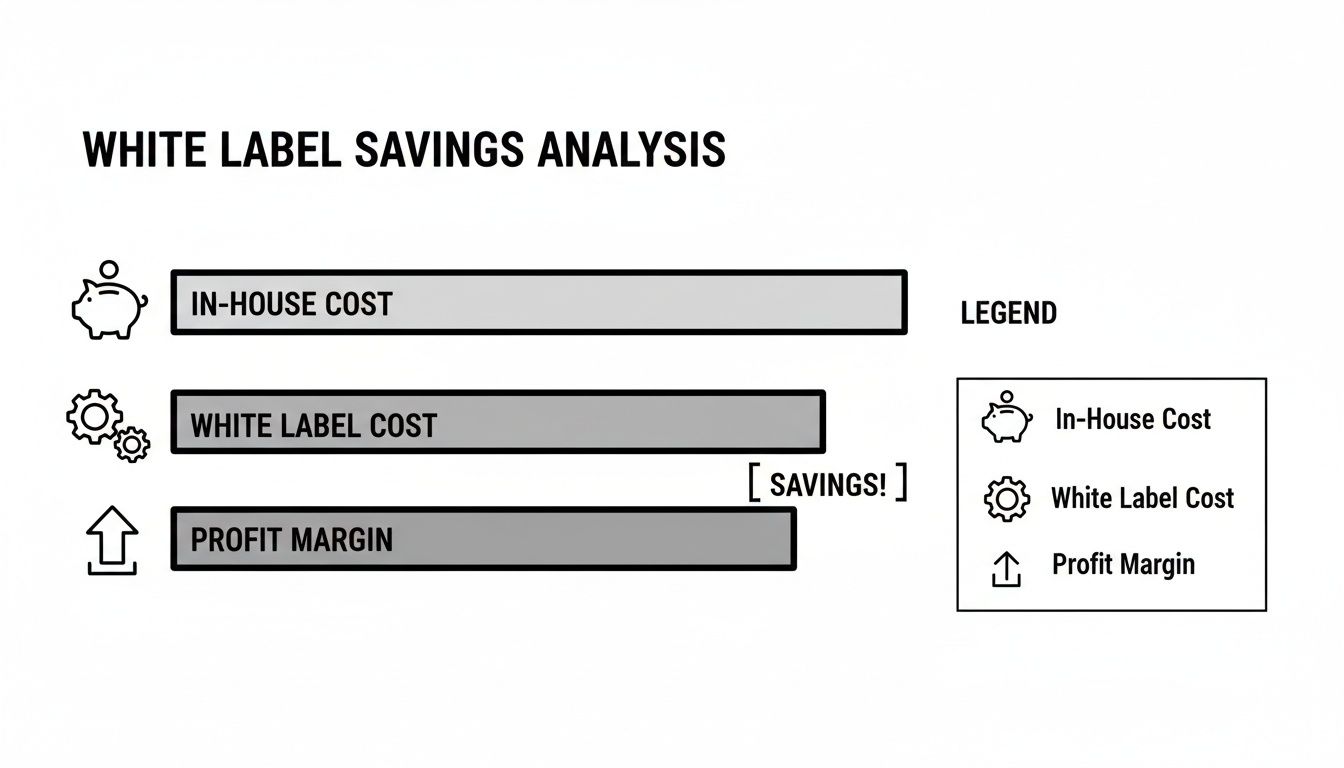
As you can see, the white label model dramatically cuts your direct project costs, paving the way for a much bigger and more secure profit margin.
To make this even clearer, here’s a sample breakdown of the costs and margins for that same project.
Cost Comparison In-House vs White Label Model
| Project Task | In-House Model Cost (AUD) | White Label Model Cost (AUD) | Notes |
|---|---|---|---|
| UX/UI Design (20 hrs) | $2,400 | Included | White label fee is all-inclusive for standard projects. |
| Development (40 hrs) | $4,800 | Included | All build and testing is handled by the partner. |
| Project Management (15 hrs) | $1,800 | $750 (5 hrs) | Your PM role shifts to client liaison, not technical management. |
| SEO Foundation (5 hrs) | $600 | Included | Basic on-page and technical setup is part of the package. |
| Total Agency Cost | $9,600 | $4,750 | Using an all-in white label fee of $4,000 + reduced PM time. |
| Client Price | $15,000 | $15,000 | The price to the end client remains the same. |
| Gross Profit | $5,400 | $10,250 | The profit margin more than doubles with the white label model. |
This table shows it in black and white: you can deliver the same high-quality website to your client for the same price, but you walk away with nearly double the profit.
By shifting from a variable in-house cost structure to a fixed white label fee, you move from hoping for profit to guaranteeing it. This financial certainty allows you to focus on client acquisition and strategic growth.
This practical comparison makes the business case for outsourcing crystal clear. It transforms website development from a potential financial headache into a reliable and highly profitable revenue stream, setting your agency up to scale smarter, not harder.
Common Questions About Website Design Pricing
Let's be honest, figuring out website design prices can feel like navigating a minefield, both for your agency and your clients. Getting the answers right is fundamental to building trust, setting expectations that don't lead to disappointment, and making sure every project actually turns a profit.
To wrap things up, I’ve put together some straight-shooting answers to the questions we hear all the time in the Australian market. Think of this as a way to solidify the key ideas we've covered, with a focus on how partnering with a white label wordpress agency can solve a lot of the headaches around pricing and resources.
How Much Should a Simple WordPress Site Cost in Australia?
For a straightforward, brochure-style WordPress website—think 5 to 10 pages—you're typically looking at a price range between $2,000 and $7,500 here in Australia. This usually gets you a professional design based on a solid template, full mobile responsiveness, a contact form, and the basic on-page SEO essentials.
So, what pushes a project from $2,000 closer to $7,500? It almost always comes down to customisation. If a client wants unique graphics, needs specific plugins integrated, or has a mountain of content to be migrated, the cost naturally climbs. This is exactly where a white label wordpress designer becomes a game-changer for an agency. You get a fixed, wholesale cost for a top-notch build, which lets you price the project for your client with confidence, knowing your profit margin is locked in.
What Are the Hidden Costs I Need to Budget For?
The initial design and build price is just the tip of the iceberg. A number of ongoing and often overlooked costs can catch clients by surprise if they aren't flagged early on. As an agency, being transparent about these isn't just good practice—it's essential for a healthy client relationship.
Here are the usual suspects to be upfront about:
- Website Hosting: You can't have a website without it. Good, secure hosting will generally run anywhere from $15 to $100 a month, depending on how much traffic the site gets.
- Domain Name Registration: This is an annual fee, usually a small one, around $15 to $30 a year for a standard .com.au domain.
- Premium Plugins and Themes: While the WordPress and Shopify ecosystems are full of free tools, the really powerful features often come from premium versions. These usually involve annual subscriptions that can range from $50 to over $300 per tool.
- Ongoing Maintenance: A solid wordpress maintenance australia plan is non-negotiable for keeping a site secure, backed up, and running smoothly. This typically costs between $50 and $500 per month.
- Content Creation: This is a big one. Professional copywriting, photography, and video are often budgeted for separately and can easily add thousands to the overall investment.
The most successful web projects are always the ones where the client understands the total cost of ownership, not just the upfront design fee. Being clear about ongoing expenses is the mark of a truly professional agency.
Why Do Website Prices Vary So Much Between Agencies?
The massive difference you see in website pricing often boils down to three things: overheads, expertise, and process. An established wordpress web design company australia with a big in-house team, a slick city office, and a portfolio as long as your arm will naturally charge more. They have to, just to cover their operational costs.
On the other end of the spectrum, a smaller agency or a wordpress freelancer australia might offer a much lower price. The trade-off, however, can be a lack of robust processes, dedicated support, or the specialised skills needed for a more complex project. This is precisely the gap where a white label partnership makes perfect sense. By working with a white label wordpress agency, you can offer the deep expertise and efficiency of a large team but at a much more competitive price, simply because you aren't carrying their overheads. It's the best of both worlds—top-tier quality for your client and healthy profits for you.
How Can My Agency Offer Competitive Pricing Without an In-House Developer?
This is probably the biggest challenge facing growing agencies today, especially when you look at the salary of a skilled wordpress developer australia. The solution isn't to bite the bullet and hire; it's to rethink your business model from in-house execution to strategic partnership.
Partnering with a provider of white label web development wordpress services is, without a doubt, the most effective way forward. This model gives you instant access to an entire team of specialists without the crippling costs of salaries, super, and training. You get a fixed, wholesale price for the development work, which you can then mark up to a competitive retail price for your client.
This approach lets you:
- Jump into the Market Immediately: Start offering professional web development services tomorrow, without the six-month headache of building a team.
- Lock in Your Profitability: You know your exact costs before you even write the proposal. This completely removes the risk of a project blowing its budget and killing your margin.
- Scale Up or Down Effortlessly: You can take on as many web projects as you can sell, without ever being bottlenecked by your own team's capacity.
Ultimately, this strategy transforms your agency from a service provider with high, rigid costs into a flexible, scalable business that can compete with anyone on both price and quality.
Ready to eliminate the guesswork from your website design pricing and guarantee your profit on every project? At White Label WordPress, we provide Australian agencies with expert, fixed-price WordPress and Shopify development. Focus on your clients while we handle the code. Explore our white label partnership program and start building more profitably today.