
Pricing web design is a tricky business, and let's be honest, most agencies are getting it wrong. The heart of the problem is simple: you can't charge what you're worth if you don't actually know what you're worth. For too many Australian agencies, pricing is a gut-feel reaction, not a business strategy. This leads to a painful cycle of slashing prices to win work, watching profits evaporate thanks to scope creep, and riding the unpredictable feast-or-famine rollercoaster.
Why Most Agency Web Design Pricing Is Flawed

Many digital agencies are walking a tightrope between profit and loss. It's rarely a talent issue; it's almost always a pricing issue. The fundamental problem is a massive gap between the price tag and the actual value being delivered. This disconnect shows up in a few common, and very damaging, habits.
Just pulling a number out of thin air or copying what the agency down the road charges is a guaranteed race to the bottom. This completely ignores your agency's unique skills, your overheads, and the specific results you get for your clients. You end up looking like a commodity, forced to fight on price instead of your expertise.
Common Pricing Traps for Agencies
Charging by the hour feels safe, but it actively punishes you for being good at your job. As your team gets faster and more efficient, you literally earn less for the same outcome. It also invites clients to micromanage your invoices, questioning every 15-minute block, which is a fast track to a sour relationship.
On the flip side, undercharging just to land a new client might feel like a short-term win, but it sets a terrible precedent. You're telling the market—and that new client—that your work isn't worth much. This attracts clients looking for a bargain, not a partner, and these are often the same projects that become sinkholes for your time and money once all those "quick little changes" start piling up.
The real cost of poor pricing isn't just the lost revenue on one project. It's the burnout of your team, the dip in quality when you're stretched too thin, and the inability to invest back into your own agency's growth.
A smarter, more strategic approach is non-negotiable. It starts with a clear-eyed look at your actual costs, defining the value you provide, and then building a pricing structure that protects your profitability. For many agencies, the first step is making your expenses predictable.
Take, for example, partnering with a provider of white label WordPress development here in Australia. This immediately gives you a fixed, known cost for the build. No more guessing how many hours your team might sink into a project; you have a hard number to work with. This changes everything.
- Establish a clear cost baseline: You know your exact expenses before you even write the proposal.
- Guarantee your profit margin: You can add your markup with confidence, knowing your costs are locked in.
- Focus on value-selling: With the cost side of the equation handled, your energy can go into explaining the project's true business value to the client.
When you shift from reactive, hopeful pricing to a strategic system, you stop being just another service provider. You become a profitable, scalable, and far more resilient business partner.
Calculate Your True Costs to Guarantee Profit
Pricing web design projects can feel like a shot in the dark, but it shouldn't be. Profitable pricing isn't about plucking a number from the air; it's a direct result of knowing exactly what it costs you to deliver the work. Before you can even think about quoting a client, you need a rock-solid understanding of every single dollar that goes into a project.
This goes way beyond just the hours your team spends on design and development. The real culprits that eat into your profit margins are the hidden costs—the monthly software subscriptions, the non-billable hours spent on sales calls and writing proposals, and even a portion of your office rent. These are all genuine business expenses, and every project needs to pull its weight in covering them.
Uncovering Direct and Indirect Project Expenses
Every project has two types of costs: direct and indirect. Direct costs are the easy ones to spot, like a developer’s wages for the time they spend on a specific build. Indirect costs, often called overheads, are the general expenses of running your agency—think accounting fees, insurance, or that fancy coffee machine.
To get your true cost, you have to attribute a slice of those overheads to each project. A straightforward way to do this is to add up your total monthly overheads and divide that figure by the total number of billable hours your team can realistically work. This gives you an hourly overhead rate you can add to your direct costs, making sure every project helps keep the lights on.
The White Label Advantage: Predictable Costs
One of the most unpredictable variables in any project budget is development time. A sneaky bug or a feature request that’s more complex than it first appeared can completely blow out your estimated hours, turning a profitable job into a costly mistake. This is where partnering with a white label WordPress agency becomes a seriously smart financial move for Australian agencies.
Instead of gambling on the variable cost of an in-house developer, outsourcing gives you a fixed, predictable cost. You know right from the start that the development for a standard five-page WordPress site will cost you a set amount, say $2,000 AUD. Suddenly, your cost calculation is no longer a guessing game; it’s simple maths.
By locking in your single largest project expense, you build your pricing on a foundation of certainty. Profit is no longer something you hope for at the end of a project—it becomes a calculated, deliberate part of your strategy from the moment you send the proposal.
This approach works hand-in-glove with the financial perks of using open-source platforms. For instance, WordPress sites in Australia can cost up to 44% less overall than sites built on proprietary platforms, and businesses often spend 15-30% less on ongoing agency support. When you pair this inherent efficiency with the fixed costs from a white label partner, you can offer competitive pricing while protecting your own healthy margins. You can read more about this in our guide to understanding website design costs.
Establishing Your Break-Even Point
Once you've added up all your direct costs, allocated your indirect overheads, and factored in the fixed fee from your white label provider, you have your break-even point. This is the absolute minimum you have to charge just to cover your expenses on that project. Every dollar you charge above this number is pure profit.
Let’s run through a quick example:
- White Label Development Cost: $2,000
- Your Project Management Time (10 hours @ $50/hr): $500
- Allocated Agency Overheads: $300
- Sales & Admin Time (4 hours @ $50/hr): $200
Your total cost for this project—your break-even point—is $3,000. This number is your floor. Knowing it is a superpower. It allows you to price with confidence, negotiate without giving away the farm, and build a pricing system that guarantees you make money on every single project you deliver.
Choose The Right Pricing Model For Your Agency
Once you've got a handle on your costs, the next piece of the puzzle is deciding how you're going to charge for your work. Your pricing model is much more than just a way to send an invoice. It frames the entire client relationship, sets expectations from the get-go, and is the ultimate driver of your agency's profitability. Picking the right one is a strategic call that needs to adapt to the project, the client, and what you’re trying to achieve.
Honestly, there’s no single “best” model. The most successful agencies I know are flexible, switching between fixed-price, hourly, value-based, and retainer agreements to match the situation. It’s all about maximising value for the client while protecting your own margins.
The flow chart below breaks down the fundamental journey from tallying up your project costs to banking your final profit.
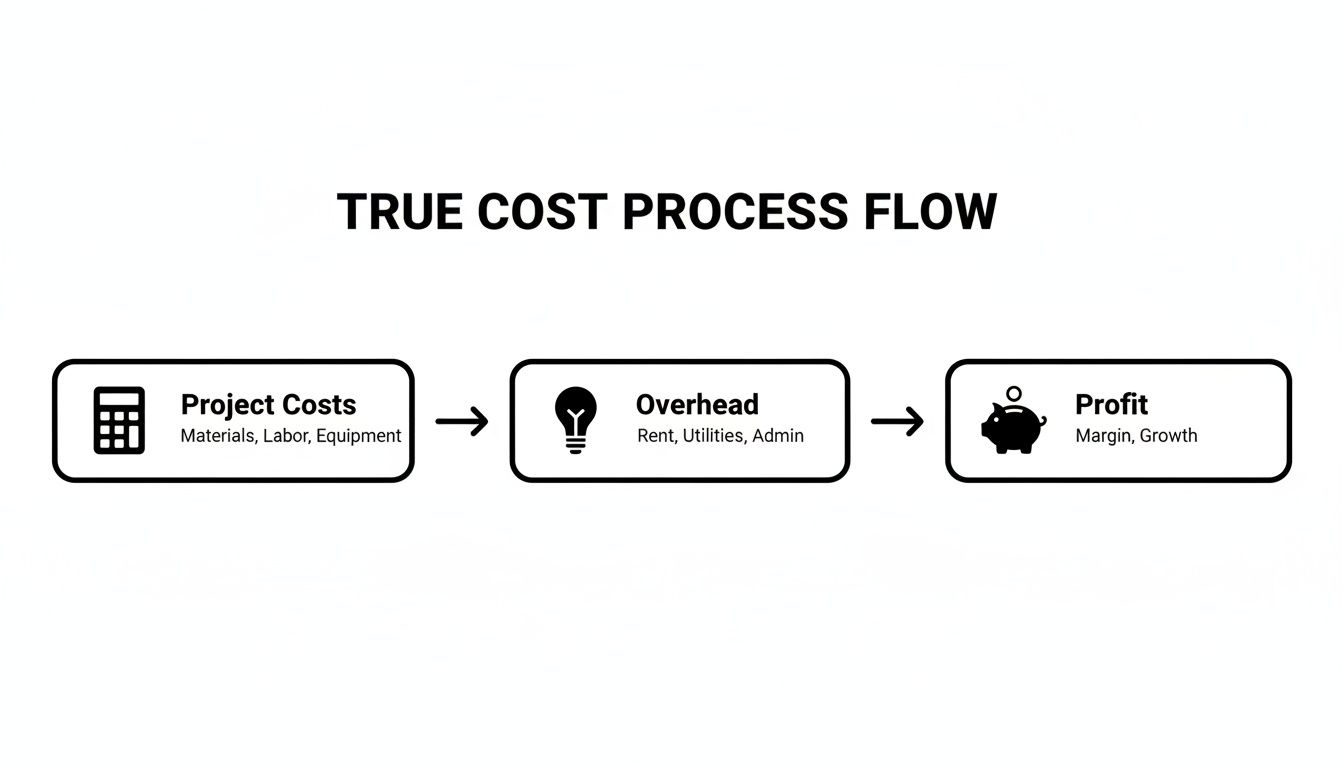
As you can see, profit isn't just what's left over at the end. It’s a deliberate outcome that starts with accurately calculating every single cost—both project-specific and business overheads.
Picking the right pricing structure can feel daunting, but it really boils down to understanding the pros and cons of each. Let's break down the four main models so you can see which one fits best for different scenarios.
Comparing Web Design Pricing Models
| Pricing Model | Best For | Pros for Agency | Cons for Agency |
|---|---|---|---|
| Fixed-Price | Standardised projects with a very clear scope (e.g., 5-page brochure sites, landing pages). | Rewards efficiency—if you finish early, your profit margin goes up. Easy to quote and sell. | Scope creep is a major risk. Any extra work not in the original agreement eats directly into profit. |
| Hourly Billing | Projects with an unclear scope, ongoing support, or consultative work. | Guarantees you're paid for all time spent. Low risk for the agency. | Punishes efficiency. Can create client friction over timesheets and discourages innovation. |
| Value-Based | High-impact projects where your work directly drives significant, measurable business results for the client. | Highest profit potential. Positions your agency as a strategic partner, not just a service provider. | Requires deep discovery, confidence in delivering results, and a more complex sales process. |
| Retainers | Ongoing services like website maintenance, SEO, content creation, or support. | Creates predictable, recurring monthly revenue. Fosters long-term client relationships. | Can be challenging to define scope and demonstrate ongoing value month after month. |
Ultimately, the best agencies use a mix of these models. A fixed-price build can easily transition into a monthly retainer for maintenance and marketing, giving you the best of both worlds.
A Closer Look at Each Model
Fixed-Price Projects
The fixed-price (or project-based) model is as straightforward as it gets: you quote one flat fee for a very clearly defined scope of work. It’s a favourite for a reason—it offers predictability for both you and the client, which is perfect for most standard website builds.
This is the absolute ideal model to use when you partner with a white label WordPress designer. Why? Because your biggest cost—the actual development—is also fixed. This means you can calculate your final profit margin with total certainty right from day one. No nasty surprises.
- When to Use It: Perfect for projects with a locked-in scope, like a standard 5-page business site, a dedicated landing page, or a basic WooCommerce store setup handled by a woocommerce developer in Australia.
- Agency Pro: You’re directly rewarded for being efficient. If you or your partners knock the project out faster than planned, your profit margin gets a nice boost.
- Client Pro: They love the budget certainty. They know the total investment upfront, which makes approval much easier.
The absolute key to making fixed-price projects work is an iron-clad scope of work document. Any grey area or ambiguity is a direct threat to your bottom line.
Hourly Billing
Charging by the hour often feels like the simplest route, but it's one you should approach with caution. It’s really best saved for situations where the scope is a complete unknown, the work is purely consultative, or the project involves lots of unpredictable, ongoing tasks.
Hourly rates actively punish efficiency and can create a lot of friction with clients who start picking apart every timesheet. You're essentially shifting all the project risk onto them, which can damage trust if you don't manage it carefully.
Think of hourly billing as a specific tool for a specific job, not your default setting. It’s brilliant for troubleshooting technical issues, handling a wordpress bug fix, or for initial discovery phases where you’re still figuring out the full project scope. If a client keeps asking for “just one more little change” outside the main project, billing them hourly for that extra time is the fair way to go.
Value-Based Pricing
Now we're getting into the advanced (and potentially most profitable) model. Instead of basing your price on your costs or the hours you spend, you price your services on the tangible business value you deliver to the client. This one simple shift completely changes the conversation from "How much for a website?" to "How much revenue will this new website generate for my business?"
A classic example is a complex shopify development australia project for an established e-commerce brand. If your work on shopify conversion optimisation and a custom theme is projected to increase their annual sales by $200,000, then charging $20,000 for the project isn’t just reasonable—it’s a no-brainer. Your fee becomes a small investment for their massive return.
To pull this off, you have to be confident in your ability to produce measurable results. It requires deep-dive discovery sessions to truly understand the client's business goals and a rock-solid proposal that clearly connects your work to their bottom line. For any agency serious about moving upmarket and landing bigger clients, mastering value-based pricing is non-negotiable.
Retainer Agreements
Retainers are the holy grail for building a stable, predictable agency with recurring revenue. In this model, a client pays you a fixed fee every month for a set amount of work or for ongoing access to your expertise. This is the perfect structure for services like website maintenance, ongoing SEO, or regular content updates.
Many agencies bundle their web development with other marketing services. If you're looking to expand your offerings, you might find it helpful to learn more about how to outsource digital marketing to build out compelling retainer packages.
For instance, you could offer a "Growth Retainer" that includes WordPress maintenance, two blog posts per month, and on-page SEO tweaks. This creates a much stickier client relationship and finally gets your agency off the rollercoaster of constantly hunting for the next one-off project.
How To Build Profitable Web Design Packages
Alright, you've nailed down your costs and picked a pricing model that works for you. Now for the fun part: turning all that theory into tangible, sellable web design packages that clients will actually understand and want to buy. This is where you stop selling hours and start selling clear, valuable solutions.
The key is to create tiered packages that speak directly to different types of clients. Think about the businesses you serve. A brand new startup has wildly different needs (and a different budget) than an established local business looking to grow, or a larger company needing complex integrations. Your packages should reflect that reality.
Structuring Your Tiers
A classic three-tier structure works wonders because it leverages a powerful psychological principle called "price anchoring." When you present three options, clients tend to gravitate towards the middle one. It feels like the safest, most balanced choice.
Here’s a practical way to frame your packages for the Australian SME market:
-
The "Startup Launchpad": This is your entry-level offering. It’s perfect for new businesses needing a professional, clean online presence—fast. Think a sharp, template-based wordpress website design australia with 5-7 core pages (Home, About, Services, Blog, Contact). The goal here is speed, affordability, and getting them in the game.
-
The "Business Accelerator": Your most popular package. This is for established businesses ready to generate leads and drive sales. It might involve a semi-custom WordPress or Shopify build, foundational on-page SEO, key integrations like a CRM or email marketing tool, and more in-depth strategy.
-
The "Enterprise Scale": Your premium, custom solution. This is for larger clients with specific needs, like custom wordpress development australia, headless commerce, or advanced functionality. Pricing for this tier is almost always custom, but having it listed positions you as a high-capability agency.
Your packages are more than just a list of features. They are a story about growth. Each tier should represent a clear step up, showing clients a pathway from where they are to where they want to be.
A Look at the Numbers
Let's make this real. When you're using a white label partner, you have the advantage of knowing your core costs upfront. This makes building profitable packages incredibly straightforward. You simply calculate your cost, add your project management and overhead, and then apply your target markup.
A healthy markup for white label web development is typically between 2.5x to 4x your cost. This covers your strategic input, client management, sales efforts, and, of course, your profit.
Here’s a table outlining what this could look like for your agency, with realistic numbers for the Australian market.
Sample Web Design Packages For Australian SMEs
This table gives you a concrete blueprint for structuring your own offerings. These aren't just random numbers; they reflect a strategy that balances market rates with guaranteed agency profit, especially when leveraging the cost-efficiency of a white label web development wordpress partner.
| Package Tier | Included Features | Example White Label Cost (AUD) | Recommended Client Price (AUD) |
|---|---|---|---|
| Startup Launchpad | 5-7 page template-based WordPress site, mobile responsive design, basic contact form, social media links. | $1,500 – $2,000 | $4,000 – $6,000 |
| Business Accelerator | 10-15 page semi-custom site (WP or Shopify), blog setup, foundational SEO, lead capture forms, basic e-commerce. | $3,000 – $4,500 | $8,000 – $12,000 |
| Enterprise Scale | Fully custom design, advanced integrations (CRM, ERP), headless commerce, multi-language support, user accounts. | $7,000+ (Custom Quote) | $20,000+ (Custom Quote) |
As you can see, the model is simple: fixed costs allow for predictable, healthy margins. This is a far more stable and scalable approach than billing by the hour and hoping for the best.
The Power of White Label in Pricing
Using a white label partner fundamentally changes your pricing power. In Australia, hiring a freelance WordPress developer can cost anywhere from $30 to $120 AUD per hour, with full projects easily hitting $1,500 to over $10,000. By using a white label wordpress service with a fixed project fee, you eliminate that huge variable. A site that costs you a flat $1,500 from a partner can be confidently packaged and sold to a client for $4,000 to $6,000. Find out more about the cost-benefit analysis of hiring WordPress developers in this detailed breakdown.
This model lets you scale your web design services without the crippling overhead of employing a full-time in-house development team, whose salaries can average $80,000 to $120,000 AUD per year before you even factor in benefits.
Don't forget to build recurring revenue into your packages. Every website needs ongoing care. An upsell to a monthly maintenance plan is a natural next step and an easy sell. You can learn more about how to structure these offerings in our guide to WordPress maintenance services. This transforms a one-off project into a long-term client relationship and a predictable income stream for your agency.
Protect Your Profits From Scope Creep
You've done the hard work: calculated your costs, picked a pricing model, and put together some killer packages. The client loves your quote, the contract is signed, and the project is officially a go. But this is where the real challenge begins—protecting that carefully planned profit margin from the slow, silent death of scope creep.
Scope creep is the classic agency nightmare. It rarely arrives as a huge, unreasonable demand. Instead, it starts with a seemingly innocent request: “Can you just add one more page?” or “Could you tweak that feature a little bit?” On their own, they’re small asks. But when they pile up, they can completely derail your timeline and vaporise your profit, turning a dream project into a frustrating, unpaid slog.
The answer isn't to become a difficult, inflexible partner. It’s all about being incredibly clear from the very beginning. Your proposal and contract are your most powerful tools in this fight. They aren’t just sales documents; they are the constitution for your project, setting the rules that protect both you and your client.
Crafting an Iron-Clad Proposal and Contract
A great proposal does more than just list a price. It needs to serve as a detailed project roadmap, leaving absolutely no room for confusion or assumptions. Think of it as the ultimate source of truth for what's included and, just as importantly, what isn't.
Your contract then takes that crystal-clear roadmap and makes it legally binding. To avoid future headaches and protect your bottom line, here are the non-negotiable clauses you have to include.
Itemise Every Single Deliverable
Get painstakingly specific. Don’t just write "5-page website." Instead, list the exact pages: Home, About Us, Services, Blog, and Contact. If you're building a Shopify store, "e-commerce functionality" is far too vague.
Break it down with this level of detail:
- Setup of up to 10 initial products (including image uploads and description formatting).
- Integration with Stripe and PayPal payment gateways.
- Configuration of standard shipping zones for Australia.
- Shopify theme development based on the approved Figma design mockups.
This granularity makes it instantly obvious when a new request falls outside the original agreement. There’s no grey area.
Clearly Define Revision Rounds
This is one of the biggest black holes for your time. Without clear limits, a client can get stuck in an endless cycle of minor changes, and you're the one paying for it. Your contract must state the exact number of revision rounds included for each major stage.
A fair and common structure is to offer two rounds of revisions at the design stage (e.g., for the mockups) and one round of revisions after the initial development build is complete. Anything beyond that requires a formal change request.
This approach actually helps the client, too. It encourages them to consolidate their feedback and be more decisive, making the whole process more efficient for everyone.
The Change Request Process: Your Safety Net
No matter how thorough your plan is, clients will always have new ideas mid-project. And that’s okay! New ideas can be great, as long as you have a clear, professional process for handling them. Your contract must outline exactly what happens when a client asks for something new.
This process should be simple but firm:
- Formal Request: The client must submit the new request in writing (email is perfect). This creates a paper trail.
- Impact Assessment: Your team evaluates how the change will affect the project's timeline, resources, and budget.
- Quote and Timeline: You issue a formal "Change Order" document. This details the additional cost and any necessary extension to the project deadline.
- Written Approval: Work on the new feature absolutely does not begin until the client has signed off on the Change Order and, if necessary, paid a deposit.
This simple system turns a potentially awkward conversation into a standard business procedure. It frames new requests not as a problem, but as an opportunity for the client to enhance their project for an agreed-upon investment.
Setting Expectations Beyond the Contract
While your contract is your legal backstop, great project management is your daily defence. You need to continually reinforce the project's boundaries, starting from the very first kickoff meeting.
Make a habit of referring back to the agreed-upon scope in your weekly updates. If a client brings up a new idea on a call, your go-to response should be, "That's a fantastic idea. It's just outside the current scope, so let me get that written down and I'll work up a Change Order for you to review."
This consistent communication trains your clients to understand how you work. It shows you're organised and professional, and that you're managing their investment responsibly. When you combine a bulletproof contract with disciplined project management, you ensure the price you quoted is the profit you actually bank.
Answering Your Top Web Design Pricing Questions
When it comes to the nitty-gritty of pricing, a lot of questions pop up. Let's tackle some of the most common ones I hear from Australian agency owners, reinforcing the strategies we've already covered so you can price with confidence.
How Should I Price Ongoing Website Maintenance?
Ongoing maintenance is your secret weapon for creating predictable, recurring revenue. The best way to sell this is with a retainer model. Seriously, ditch the ad-hoc hourly billing for maintenance—it's a nightmare for your cash flow and leaves clients guessing about their costs.
A much better approach is to offer three clear tiers for your wordpress maintenance australia plans. First, figure out your monthly cost from your white label wordpress support partner. Then, add a healthy markup. I typically aim for somewhere between 150-250%.
Here’s how you could structure it:
- Basic Care Plan: Think of this as the essential insurance policy for their website. It should cover the non-negotiables: core software updates, daily backups, and security monitoring.
- Growth Plan: This includes everything from the Basic plan, plus a small bank of hours—maybe 1-2 hours a month—for content updates, small design tweaks, or general wordpress website support australia.
- Performance Plan: This is your premium offering for clients who are serious about results. It has all the above, plus proactive services like wordpress speed optimisation australia, uptime monitoring, and priority support.
This tiered system makes the value crystal clear for the client, boosts their lifetime value, and, most importantly, gives your agency a stable financial foundation.
Is It A Good Idea To Show Prices On My Website?
Absolutely. I'm a big advocate for displaying "starting at" prices on your agency's website. It’s one of the most efficient things you can do.
Think of it as a bouncer for your sales pipeline. It instantly filters out prospects who aren't a good fit, saving you from wasting hours on discovery calls with people whose budgets just don't match your value. It’s a sign of respect for both their time and yours.
Putting a starting price of, say, $5,000 AUD for a standard brochure site or a basic shopify store setup immediately positions your agency in the market and sets clear expectations.
But you still need flexibility. For your high-end custom builds, simply use a "Request a Custom Quote" call-to-action. This hybrid approach lets you efficiently capture qualified SME leads with your packages while keeping the door wide open for those larger, more lucrative enterprise projects.
What Is A Fair Markup For White Label Web Development?
When you're working with a partner for white label wordpress development, a profitable and sustainable markup is typically in the 150% to 300% range. Another way to think about it is a 2.5x to 4x multiplier on your direct cost.
Let's say your agency wordpress partner in Australia quotes you $2,500 for a semi-custom build. You should be quoting your client somewhere between $6,250 and $10,000.
It's crucial to remember that you're not just reselling code. Your price reflects all the value you bring to the table. This includes:
- Project strategy and in-depth discovery
- Client communication and relationship management
- Quality assurance and rigorous testing
- Your expert content and shopify seo australia guidance
Your markup is the fee for this essential strategic layer. It’s what transforms a technical build into a genuine business solution that gets results for your client. Never, ever devalue that contribution—price it accordingly.
At White Label WordPress, we empower Australian agencies to deliver high-quality web projects with guaranteed profit margins. By providing reliable, fixed-cost WordPress and Shopify development, we handle the technical execution so you can focus on strategy and client relationships. Find out how we can help your agency grow.