
Website maintenance is everything you do to keep your website healthy and running smoothly after it goes live. Think of it as the ongoing care that ensures your site stays secure, up-to-date, and performing at its best. It involves a consistent schedule of security checks, software updates, and performance monitoring to stop problems like downtime, hacking, or slow speeds from hurting your business.
Why Consistent Website Care Is Not Optional
Imagine your brand-new website is a high-performance car you’ve just driven off the lot. It’s shiny, fast, and works perfectly. But if you skip the regular oil changes, tyre rotations, and engine checks, it won't be long before it starts underperforming, and you’re eventually hit with a massive repair bill.
A professional website maintenance service is like your digital mechanic. They handle all the behind-the-scenes work to make sure your online presence remains a dependable asset, not a ticking time bomb. Without this consistent upkeep, even the most stunning website will start to fall apart. It's simply not a "set and forget" investment. Technology moves fast, new security threats pop up every day, and software quickly becomes outdated. For businesses in Australia, whether you need a Shopify expert or a custom WordPress solution, ongoing care is vital.
The Three Pillars of Website Maintenance
At its heart, website maintenance is built on three crucial pillars. Each one protects and improves your digital storefront in a different way, and together they show why this is such a fundamental business investment.
- Security: This is all about proactively defending your site from hackers, malware, and data breaches. It means running regular security scans, managing your firewall, and applying security patches as soon as they’re available. A single breach can destroy your brand's reputation overnight.
- Performance: This pillar focuses on making sure your site loads fast and gives every visitor a great experience. Key tasks include database optimisation, compressing images, and monitoring uptime. A slow website kills sales; studies have shown that just a one-second delay in page load time can slash conversions by 7%. For platforms that power online stores, Shopify conversion optimisation is a key part of this process.
- Updates: This is the routine, but vital, task of updating all the software that runs your site. This includes the core platform (like WordPress or Shopify), your theme, and any third-party plugins or apps. Outdated software is the most common way hackers get in.
To better understand what a typical maintenance plan covers, here’s a breakdown of the core tasks and why they matter.
Core Components of a Website Maintenance Plan
| Maintenance Task | Primary Purpose | Business Impact of Neglect |
|---|---|---|
| Software & Plugin Updates | Security & Functionality | High risk of being hacked through known vulnerabilities. |
| Regular Backups | Disaster Recovery | Complete data loss in case of a crash or hack. |
| Security Monitoring | Threat Prevention | Undetected malware or breaches can lead to data theft. |
| Uptime Monitoring | Availability | Lost revenue and customer trust every minute your site is down. |
| Performance Optimisation | User Experience & SEO | Poor search rankings and high bounce rates from slow speeds. |
| Database Optimisation | Speed & Efficiency | A bloated database can slow down your entire site over time. |
These tasks aren't just technical chores; they're essential for protecting your investment and ensuring your website continues to deliver results. This is particularly true for agencies looking to provide these services through white label web development WordPress partnerships.
A website is a dynamic tool, not a static brochure. Its health directly impacts customer trust, search engine rankings, and your bottom line. Proactive maintenance ensures it continues to generate value long after its launch day.
Ultimately, paying for website maintenance is about smart risk management. The potential cost of doing nothing—lost sales from downtime, a tarnished reputation from a security breach, or terrible search rankings from a slow site—is far greater than the predictable monthly cost of professional upkeep. It’s how you make sure your most important marketing asset keeps working for you, not against you.
What's Actually in a Comprehensive Maintenance Plan?
When you sign on for a professional website maintenance service, you're not just buying a vague sense of security. You're investing in a structured, proactive schedule of care. A good plan isn't about sitting around waiting for something to break; it's a constant rhythm of daily, weekly, and monthly tasks designed to stop problems before they even start.
Think of it like having a property manager for a high-end commercial building. They don't wait for the roof to start leaking before they inspect it. They're up there regularly, checking for weak spots, making sure security systems are running, and keeping the whole place clean and functional. Your website is a digital asset that needs exactly the same kind of diligent oversight to protect its value and keep it working flawlessly for your customers.
This proactive process is the key to keeping your digital storefront secure, fast, and reliable. It’s all about preventing threats, ensuring pages load in a snap, and making sure all the complex moving parts of your site are working together as they should.
This map breaks down the core pillars of any solid maintenance strategy.
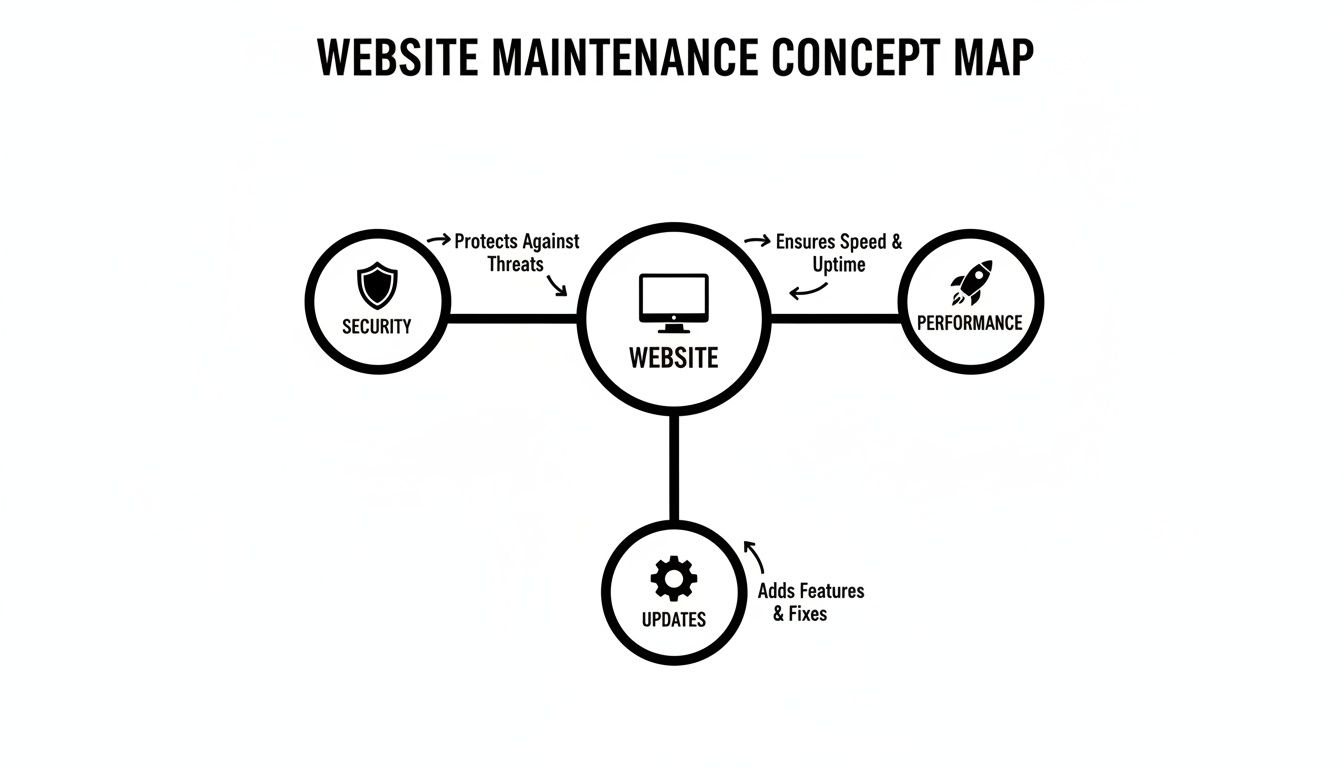
As you can see, a healthy website depends on a constant cycle of robust security, zippy performance, and timely updates. Let's break down what that looks like in practice.
The Daily Non-Negotiables
Some tasks are just too critical to put off. These are the daily habits that form the foundation of a reliable maintenance plan, ensuring your site can bounce back from any disaster and is being watched like a hawk.
- Daily Off-Site Backups: Your website's data is its most valuable asset, period. Any decent plan must include automated daily backups stored somewhere safe and completely separate from your web hosting, like on a secure cloud server. This means if your site ever gets hacked or the server has a meltdown, a clean, recent version can be restored in minutes, not days.
- Continuous Uptime Monitoring: Every minute your site is offline, you're potentially losing sales and eroding customer trust. Uptime monitoring tools are like a tireless security guard, checking your website every few minutes, 24/7. The moment it goes down, your maintenance provider gets an instant alert to jump in and fix the problem—often before you or your customers even realise there was an issue.
The Weekly and Monthly Cadence
Building on those daily checks, a recurring schedule of deeper maintenance keeps the site optimised and defended against new threats. This is where a skilled WordPress developer in Australia or Shopify expert gets under the hood and performs the technical tune-ups that keep everything running in peak condition. A Shopify agency in Australia will have this process down to a fine art.
These scheduled tasks are crucial for platforms like WordPress and Shopify, covering updates to the core software, themes, and any third-party plugins or apps. Letting these fall behind is like leaving your front door wide open—outdated code is one of the main ways hackers get in.
A well-maintained website is a secure website. Proactive updates and regular security scans aren't just 'best practices'; they're essential defences against a digital world full of ever-evolving threats.
It’s no surprise that the Australian web hosting services market—the very foundation these operations are built on—is projected to hit around AUD $4.07 billion. With a projected growth of 11% CAGR, the demand for reliable, high-performance infrastructure is clear. The best providers handle all this back-end work seamlessly, giving their clients total peace of mind. You can dig into more details about Australia's web hosting market growth. This growing market also fuels the need for web development Australia services.
Essential Performance Tuning Tasks
Beyond just security and updates, a comprehensive plan actively works to make your site faster. This isn't just a nice-to-have; it directly impacts your user experience and how well you rank on Google. Effective WordPress speed optimisation in Australia is a specialist skill.
Here are a few key performance tasks that should be on the list:
- Database Optimisation: Over time, your website's database gets clogged with digital junk—old post revisions, trashed comments, and temporary data. This clutter slows your whole site down. Regular optimisation is like a deep clean that keeps your database lean, mean, and fast.
- Regular Speed Checks: Using tools like GTmetrix or PageSpeed Insights, your provider will regularly test how quickly your site loads. This helps them spot and fix performance bottlenecks before they start frustrating your visitors.
- Security Scans: Weekly or monthly malware scans dig through your site’s files, hunting for any malicious code or vulnerabilities. It's all about catching threats early and dealing with them long before they can do any real damage.
This systematic approach ensures every piece of your site, from security protocols to page speed, is constantly being watched over and improved.
Cracking the Code on Website Maintenance Pricing in Australia
Trying to pin down the cost of website maintenance can feel like chasing a moving target. But once you break it down, the pricing models are usually quite simple. In Australia, what you'll invest to keep your site running smoothly comes down to two things: how complex your website is and how much hands-on care you actually need.
Think of it like car servicing. A quick tune-up for your daily runabout isn't going to cost the same as a full service for a high-performance European car. It’s the same logic for websites. A simple blog just doesn’t have the same demands as a massive Shopify store that’s processing hundreds of orders every day. The more moving parts your site has—features, plugins, custom code, high traffic—the more work is needed to keep it secure and fast, and the price will reflect that. A project requiring a woocommerce developer in Australia for a complex store will naturally have higher maintenance needs than a simple brochure site.
Let’s look at the common ways providers package their services.
The Three Main Pricing Models
When you start shopping around for a maintenance provider, you’ll almost always run into one of these three pricing structures. Each one strikes a different balance between cost, flexibility, and predictability, designed to fit different types of businesses.
-
Hourly Ad-Hoc Rates: This is your classic "pay-as-you-go" option. You get billed an hourly rate for work as it comes up. It’s a decent fit for businesses with super simple sites that almost never change, or for a one-off emergency. The big catch? It’s completely reactive. You're only fixing things after they break, and those urgent fixes can get expensive, fast.
-
Monthly Retainers: For any business that relies on its website, this is the way to go. You pay a set amount each month for a bundle of essential services—think daily backups, security scans, software updates, and often a block of support time. This proactive approach means someone is always looking after your site, and you have a predictable cost you can budget for.
-
Custom Packages: If you're running a large e-commerce operation, a complex corporate site, or have strict industry compliance rules to follow, a standard package probably won't cut it. A custom plan is built from the ground up to match your exact needs, offering a much higher level of dedicated support and specialised tasks.
What Pushes the Price Up or Down?
So, what are the factors that actually determine the final figure? A few key things will place your website on the pricing scale. For instance, the maintenance required for a Shopify store with multiple currencies and custom-built apps is a world away from a simple online boutique. This is where you might need a dedicated Shopify developer in Australia.
The Australian market reflects this variety. You’ll see prices ranging from $200 to over $5,000 per month. For most established businesses and e-commerce stores, you can expect professional plans to start from around the $1,000 monthly mark. It's a growing field, too, with the broader Australian IT services market expected to grow at a compound annual growth rate (CAGR) of 12%.
Choosing a maintenance plan is an investment in stability. The right plan moves you from a reactive, stressful "break-fix" cycle to a proactive strategy that protects revenue and builds customer trust.
Finding the Sweet Spot on Value
At the end of the day, you want a plan that gives you everything you need without paying for extras you’ll never touch. A small local business can do brilliantly on a basic monthly retainer. On the other hand, a growing WooCommerce store will need a more comprehensive package that includes things like performance optimisation and priority support to keep sales flowing. Whether you hire a WordPress developer in Australia or a Shopify expert, the goal is value.
To get a better idea of what you should get for your money, you can dive into our detailed guide on the real website maintenance cost.
For digital agencies, getting a firm grip on these pricing tiers is crucial for building a profitable white-label maintenance service. By partnering with a specialist, you can offer expert care to your clients under your own brand. This lets you set a competitive retail price, lock in a healthy margin, and transform a technical task into a steady stream of recurring revenue for your agency. This strategy is central to WordPress outsourcing in Australia.
How to Choose the Right Maintenance Partner
Picking a partner to look after your website is a huge decision. In many ways, it's just as crucial as choosing the team who built it in the first place. This partner isn't just running updates; they're the guardians of your most important digital asset, responsible for keeping it fast, secure, and online.
Getting it right means you can sleep at night, knowing your investment is protected. But a poor choice can quickly spiral into a nightmare of costly downtime, security breaches, and endless frustration.
Your decision shouldn't just come down to who has the lowest price. You're looking for a genuine partner—a team whose technical skills, communication style, and way of doing business fits with yours. This is all about trust, and that trust has to be earned through proven expertise and clear, honest communication from day one. Many businesses find success with a digital agency outsourcing Australia partner.

Evaluating Technical Expertise and Platform Specialisation
First things first: do they actually know your platform inside and out? A team that’s brilliant with Shopify might be completely lost when it comes to fixing a tricky WordPress bug. A true WordPress expert in Australia gets the little details—they know which plugins clash, how to optimise a server for performance, and what makes the whole ecosystem tick. Similarly, a Shopify expert in Australia understands the nuances of Liquid, apps, and theme customisation.
Look for proof of their skills. Can they show you a portfolio of sites they maintain on your platform? Do they have case studies or client references you can speak to? Don't be shy about asking some pointed questions. "What would you do if my site was hacked?" or "How would you handle a total site crash?" Their answers will tell you everything you need to know about their real-world experience.
Communication and Reporting Transparency
You should never have to wonder what’s being done to your site. Clear, consistent communication is an absolute must-have. A good partner will send you regular reports that are easy to understand, detailing exactly what they've been working on and why it matters.
These reports should clearly lay out:
- Updates Completed: A simple list of all WordPress, Shopify, plugin, or theme updates they’ve applied.
- Security Scans: The results from their latest malware and vulnerability checks.
- Performance Metrics: Key stats like site speed and uptime percentages.
- Backups: A clear confirmation that your site backups were completed successfully.
A maintenance agreement is more than a service—it's a partnership. The best partners are proactive communicators who make you feel informed and secure, not left in the dark wondering if your site is protected.
Analysing the Service Level Agreement
The Service Level Agreement (SLA) is the most critical part of your contract. This is where verbal promises become legally binding commitments. It’s the document that spells out exactly what you can expect in terms of support, uptime, and how quickly they’ll jump into action when you need them.
Pay close attention to these key details in any SLA:
- Guaranteed Uptime: Look for a rock-solid commitment of 99.9% uptime or higher.
- Response Times: How quickly will they acknowledge your support request? This is usually tiered, with faster times for emergencies (e.g., 1 hour) and slower times for minor questions (e.g., 8 hours).
- Resolution Times: Beyond just responding, what’s their target for actually fixing the issue?
- Emergency Procedures: Is there a clear, documented plan for what happens if your site gets hacked or the server goes down after hours?
For agencies, this is doubly important. You're putting your clients' websites—and your own reputation—in someone else's hands. Properly vetting a partner's SLA is a fundamental part of successful digital marketing outsourcing. If a provider has a vague SLA, or worse, none at all? That’s a massive red flag. Walk away.
The Agency Playbook for White Label Maintenance Services
For any digital agency, the project-to-project revenue cycle can feel like a feast-or-famine rollercoaster. You celebrate landing a big new website build, only to face the quiet spell that follows launch. Offering website maintenance is the single best way to flatten that curve, turning one-off projects into predictable, long-term client relationships. This is your playbook for building a profitable maintenance service without hiring a single new developer.
The secret? A smart strategy called white label maintenance. In this model, your agency resells expert technical services from a specialised partner, but under your own brand. Think of it like this: a dedicated white label WordPress agency handles all the gritty, behind-the-scenes work—the updates, security scans, and performance tweaks—while you maintain the client relationship and build a stable recurring income. It's the ultimate way to scale your offerings and become indispensable to your clients. A white label Shopify agency can do the same for your eCommerce clients.
Structuring Your White Label Offerings
First things first, you need to package your services into simple, easy-to-grasp tiers. Your goal isn't to drown clients in technical jargon; it's to present clear solutions that solve real business problems. From my experience, a three-tiered approach works wonders.
- The Essentials Package: This is your entry-level, "peace of mind" plan. It covers the absolute non-negotiables: daily backups, uptime monitoring, core software updates, and basic security checks. It’s the perfect fit for small businesses with straightforward brochure websites.
- The Growth Package: This will likely be your most popular offering. It includes everything in the Essentials plan, but adds proactive performance tuning, more advanced security monitoring, and a chunk of monthly support time for small content edits or bug fixes. It's tailor-made for growing businesses and smaller eCommerce stores.
- The Premium Partnership: This is your top-tier plan, designed for high-traffic eCommerce sites or businesses running complex web applications. On top of everything else, this includes priority support, updates on a staging site, and regular strategic reviews. You're no longer just a vendor; you're their digital partner.
This tiered structure makes it easy to upsell clients as their needs grow, simplifies your sales pitch, and makes calculating your profit margins a breeze.
Pricing for Profitability
With your packages defined, pricing is refreshingly simple. Your white label partner gives you a wholesale cost for each tier, and you add your markup to set the retail price for your client. This gives you complete control over your profitability.
Below is a look at how this can play out in the real world.
White Label Maintenance Profit Margin Scenarios
Here are some example pricing structures that show just how profitable reselling white label website maintenance can be for your agency.
| Package Tier | White Label Cost to Agency | Suggested Retail Price to Client | Monthly Profit Per Client | Annual Profit Per Client |
|---|---|---|---|---|
| Essentials | $70 / month | $150 / month | $80 | $960 |
| Growth | $150 / month | $350 / month | $200 | $2,400 |
| Premium | $300 / month | $700 / month | $400 | $4,800 |
As you can see, the numbers add up quickly. Just ten clients on the Growth package could generate an extra $24,000 in pure annual profit for your agency, all with virtually zero extra operational work on your part. That’s serious fuel for growth.
Streamlining Your Client Onboarding
A slick, professional onboarding process is crucial. It sets the right expectations and proves your value from day one. When you sign up a new maintenance client, the handover needs to feel seamless.
Typically, your white label partner will need secure access credentials for the website’s hosting and admin dashboard. It’s a good idea to create a standardised, secure online form to collect this from your clients. Once you pass these details along, your partner takes over the technical setup—configuring backups, installing security scanners, and setting up monitoring. Your job is to keep the client in the loop and introduce them to the support process, cementing your role as their trusted point of contact.
Crafting the Perfect Sales Message
Selling maintenance isn’t about listing technical tasks. It’s about selling outcomes. Your clients don’t really care about database optimisation; they care about a fast website that turns visitors into customers. They don’t lose sleep over security patches; they worry about protecting their business's reputation and their customers' data from hackers.
So, frame your sales pitch around these core business benefits:
- Protection: "Think of us as your website's 24/7 security guard. We protect your investment from threats so you can focus on running your business."
- Performance: "Our ongoing performance tuning ensures your site stays fast, giving users a great experience that boosts conversions and helps your SEO."
- Peace of Mind: "You'll never have to worry about a technical glitch or a broken website again. We've always got your back."
A professional website can be a significant investment, making maintenance an easy sell when positioned as the insurance policy that protects it. This is a great way for a partner web agency in Australia to add value.
For an agency, every website launched without a maintenance plan is a missed opportunity. White label services turn that opportunity into your most reliable revenue stream, building client loyalty and predictable growth.
Ultimately, offering WordPress maintenance services through a white label partner isn't just an add-on; it's a fundamental shift in your business model. It moves you from being a transactional project provider to becoming a long-term, strategic partner—securing your agency's financial future one recurring plan at a time. The same applies to white label Shopify support in Australia.
It’s Time to Safeguard Your Digital Future
We’ve covered a lot of ground in this guide, but the core message is simple: professional website maintenance isn't just another business expense. Think of it as an essential investment in the long-term health and success of your most important digital asset.
Consistent, proactive care is what lays the foundation for solid security, lightning-fast speed, and the kind of reliability that builds real trust with your customers. From the nitty-gritty of daily tasks to understanding how maintenance plans are priced here in Australia, it all points to one thing—your website needs ongoing attention to thrive.
For any business owner, choosing the right maintenance partner is about protecting your digital future. It means swapping the stressful, reactive cycle of 'break-fix' for a smart, proactive strategy that keeps your online presence working hard for you, day in and day out. A well-cared-for site is your best tool for winning and keeping customers.
A Clear Path Forward for Agencies
If you run a digital agency, the takeaway is even more critical: offering white label WordPress maintenance in Australia is a powerful strategic move. It's your ticket to building a stable, recurring revenue stream, creating stickier client relationships, and growing your business without the headache of building a massive in-house technical team.
By partnering with a specialist for white label WordPress support, your agency can deliver expert-level care under your own trusted brand. You own the client relationship and build incredible loyalty, while we handle all the complex technical heavy lifting behind the scenes.
This isn't just about adding a new service; it's about transforming one-off projects into valuable, long-term partnerships. It frees you up to do what you do best—focusing on brilliant strategy, design, and marketing—while adding a highly profitable and in-demand service to your offerings. This makes you more than just a WordPress web design company in Australia; you become a long-term partner.
By bringing in a white label Shopify agency partner, you can confidently support top-tier eCommerce clients, grabbing a bigger slice of the market and becoming absolutely indispensable. For agencies, the path to predictable, scalable growth starts right here, by making expert maintenance a core part of what you do.
Still Have Questions? Let's Clear a Few Things Up
Diving into website maintenance can bring up a lot of questions, whether you're a business owner or running a digital agency. We get it. Here are some of the most common queries we hear, answered straight up to help you make the right call for your website.
How Often Does My Website Actually Need Maintenance?
For most business sites running on something like WordPress or Shopify, a monthly plan is the sweet spot. This cadence is perfect for keeping on top of crucial software updates, security scans, performance tweaks, and backups without going overboard.
Now, if you're running a busy e-commerce store or a site with custom features—like something a specialised WooCommerce developer in Australia might build—you'll probably want to bump that up to weekly checks. When sales are on the line, you can't afford any downtime. At the bare minimum, every single website should have daily automated backups and 24/7 uptime monitoring. That’s your non-negotiable safety net against disaster.
Can't I Just Do This Maintenance Stuff Myself?
Look, you can absolutely handle basic things like adding a new blog post. But true website maintenance goes much, much deeper than that. Trying to do it all yourself is a bit like trying to service your own car—you might be able to change the oil, but you'll likely miss the critical engine diagnostics that a mechanic is trained to spot.
Professionals are dealing with the tricky, behind-the-scenes work:
- Security Hardening: This isn't just about a strong password. It's about locking down your site to fend off brute-force attacks and malware.
- Database Optimisation: Over time, your site's database gets bloated and messy. We go in and clean it up to keep everything running smoothly and quickly.
- Fixing Conflicts: Ever updated a plugin and watched your site break? We know how to troubleshoot and resolve those conflicts without causing chaos. This is where a WordPress bug fix in Australia service comes in handy.
- Performance Tuning: It’s about more than just fast hosting. We fine-tune server settings and code to squeeze every last drop of speed out of your site.
Going the DIY route often ends in a broken site, a security breach, or just hours of your life you'll never get back. For any business that takes its online presence seriously, professional WordPress website support in Australia is an investment, not an expense.
What on Earth Is a Service Level Agreement (SLA)?
Think of a Service Level Agreement (SLA) as the formal handshake in your maintenance contract. It's where your provider puts their promises in writing, outlining exactly what they commit to delivering. It’s all about accountability.
An SLA is your guarantee. It turns vague promises about "great support" into concrete commitments on response times, uptime, and emergency handling, so you know exactly what to expect.
When you're reading an SLA, keep an eye out for specifics like a guaranteed uptime percentage (you want to see 99.9% or higher), clear response times for support tickets, and a defined plan for how they'll handle a crisis.
How Does White-Label Maintenance Work for My Agency?
White-label WordPress maintenance is a game-changer for digital agencies. It lets you offer expert website support to your clients, all under your own brand, creating a steady stream of recurring revenue without having to hire a single new developer.
Here's the simple version: You partner with a specialised white-label WordPress agency that does all the technical heavy lifting in the background. You buy their services at a wholesale price, mark it up, and sell it to your clients. We do the work, you manage the client relationship and reap the rewards. It's the smartest way to scale your offerings and become absolutely essential to your clients, especially for WordPress developers for agencies in Australia.
Ready to build a reliable, profitable new revenue stream for your agency? At White Label WordPress, we provide expert, behind-the-scenes WordPress and Shopify support that you can sell under your own brand. We handle the technical work so you can focus on growing your client relationships. Learn more about our white label partnerships.