
When clients ask "how much does a website cost?", it's the digital equivalent of asking "how much does a house cost?". The honest answer is always, "it depends." In Australia, a professionally built website isn't a simple off-the-shelf product with a fixed price tag; it's a spectrum of investment.
You could be looking at a starting point of around $5,000 for a sharp, clean brochure site. On the other end, a sophisticated e-commerce platform with custom integrations could easily climb past $50,000. The final figure is a direct reflection of the project's complexity, the depth of design work, and the sheer scope of development required.
Deconstructing Australian Website Construction Costs
Let's stick with the house analogy because it’s a perfect fit for explaining website costs to clients. A one-bedroom granny flat and a five-bedroom architectural marvel are both "houses," but nobody expects them to cost the same. The size, materials, and custom features are what drive the price, and it's exactly the same for websites.
Breaking it down this way often helps clients grasp the different moving parts:
- Hosting is the Land: This is the digital plot of land where your website will be built. It has to be secure, reliable, and big enough to handle your traffic, just like a physical property.
- Design is the Architectural Blueprint: Are we working from a pre-made floor plan (a template) or bringing in an architect for a completely custom UI/UX design? The custom route creates a unique identity but naturally requires a bigger investment upfront.
- Development is the Construction: This is the actual building process—the coding, the integrations, the plumbing. From framing the walls (backend development) to installing the kitchen appliances (feature integrations), the more complex the build, the more skilled labour you'll need.
Understanding the Investment Tiers
Here in Australia, the cost of top-tier local talent is a significant factor in these figures. For a small business, a professional website build usually falls somewhere between AUD $5,000 and $25,000 for the initial project alone.
Once you add in the non-negotiables like hosting, ongoing maintenance, and third-party software integrations, that first-year total often lands closer to $8,000-$35,000. This range covers a wide variety of needs, from a basic 3-5 page custom site starting at $3,500, all the way up to a premium 10+ page build that can push $50,000. For a more granular look, you can find a solid breakdown of Australian website development costs on codewave.com.
Here’s a quick overview to help you get a sense of the market.
Estimated Website Construction Costs in Australia at a Glance
This table provides a quick summary of typical project costs based on website complexity, helping agencies benchmark their own pricing.
| Website Type | Typical Page Count | Estimated Cost Range (AUD) | Best For |
|---|---|---|---|
| Brochure / Small Business Site | 3 – 10 | $3,500 – $10,000 | Startups, local businesses, or professionals needing a simple online presence. |
| Corporate / Business Site | 10 – 25 | $10,000 – $25,000 | Established businesses needing lead generation, detailed service pages, and CMS control. |
| Small E-commerce Site | 10 – 50 | $8,000 – $30,000 | Retailers starting with a basic online store on platforms like Shopify or WooCommerce. |
| Large-Scale E-commerce Site | 50+ | $30,000 – $80,000+ | Businesses with large product catalogues, needing custom features and advanced integrations. |
| Custom Web Application | Varies | $50,000 – $150,000+ | Companies needing unique functionality, a bespoke platform, or complex backend systems. |
These numbers provide a realistic baseline for what businesses can expect to invest in the Australian market.
For agencies, mastering this conversation is crucial. It’s not just about giving a client a number; it’s about explaining the value baked into every line item, from the first wireframe to the final deployment.
Having this foundational knowledge is key to setting clear, realistic expectations. Every decision has a ripple effect on the final cost, whether it's opting for a straightforward Shopify setup or diving into a custom WordPress build with complex API integrations. This context is what allows you to justify your pricing and show why a strategic partnership, like working with a white label wordpress agency, can be a complete game-changer in a high-cost market like ours.
Unpacking the Core Cost Drivers
When you present a website proposal, the final number on the page is really a summary of many different moving parts. To properly explain the website construction cost, you need to lift the bonnet and show the client what's inside. Think of it like building a custom home – the total investment is the sum of the land, the blueprints, the materials, and the labour. Breaking it down this way helps you clearly communicate the value you're delivering.
This flowchart maps out the core phases of a website project using that same house-building analogy, from laying the foundations with hosting to the actual construction work of development.
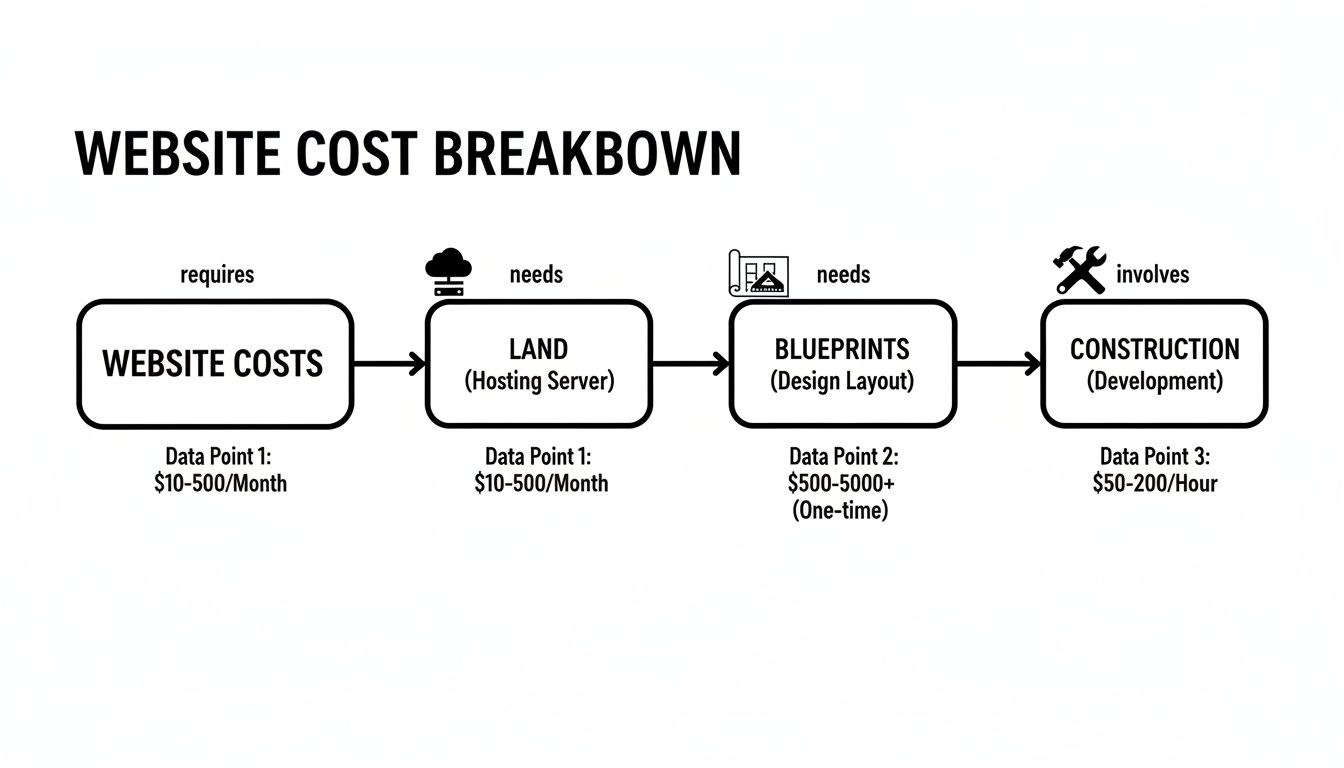
Each of these stages—hosting (the land), design (the blueprints), and development (the build)—is a critical layer that contributes directly to the final project cost.
Custom Design vs Templates
The first big decision you and your client will make is whether to go with a pre-built template or a completely custom design. A template is a bit like a display home: it’s quick, affordable, and gives you a solid, reliable starting point. The trade-off is that you're limited in how much you can change, and the site might end up looking a bit like others out there. A simple template tweak might only add a few hundred dollars to the job.
A custom design, on the other hand, is like hiring an architect to draw up bespoke plans. This involves a much deeper dive into the user experience (UX) and user interface (UI), resulting in a unique digital presence that’s a perfect fit for the client's brand. It’s a far more intensive process, full of wireframes, mockups, and feedback loops, which bumps up the price but delivers a truly one-of-a-kind result.
The choice between a template and a custom design is the single biggest factor influencing the "design" portion of your quote. One is about speed and efficiency; the other is about creating a distinct brand identity and an optimised user journey.
Development Complexity
Once the design gets the green light, development begins. This is where the complexity of the "build" really starts to influence the cost. A simple brochure website with a handful of static pages and a basic contact form is pretty straightforward. The coding is minimal, and the functionality is standard.
But the moment you start adding interactive elements, custom features, or slick animations, the technical requirements ramp up. For example, a standard contact form might take an hour to set up. A multi-step booking system that needs to check real-time availability? That could take a skilled wordpress developer australia dozens of hours of specialised work. Every new layer of complexity adds to the development timeline and, naturally, the cost.
Choosing Your Content Management System (CMS)
The platform you build on is the foundation for the entire project. In Australia, the two heavyweights are WordPress and Shopify, and each serves a different purpose. WordPress is the ultimate all-rounder, flexible enough to power anything from a simple blog to a sophisticated web application. That versatility, however, can sometimes mean more development time is needed to get things just right. A detailed look at different platforms can help guide your clients; we've even compared them in our WordPress vs Squarespace guide.
Shopify is built from the ground up for e-commerce, making it a more streamlined choice for online stores. Its out-of-the-box features are fantastic, but if a client wants heavy customisation, you'll often need a skilled shopify liquid developer australia to tweak the theme or build new functionality from scratch.
E-commerce Functionality
Adding a "buy now" button instantly dials up a project's complexity. A basic e-commerce setup involves getting payment gateways connected, creating product pages, and figuring out shipping rules. Just getting these fundamentals in place can add thousands to the baseline website construction cost.
The price tag climbs higher with more advanced features. You might need to account for:
- Inventory Management Systems: Syncing online stock levels with a physical store.
- Subscription Models: Setting up recurring payments and customer accounts.
- Custom Product Configurators: Letting customers design or personalise their own products.
Learning how to build an ecommerce website that meets specific business needs shows just how much these features can influence the final cost.
Third-Party Integrations
Websites today don't operate in a silo. They need to talk to other business tools, like a Customer Relationship Management (CRM) system, an email marketing platform, or accounting software. Getting these different systems to communicate through an Application Programming Interface (API) is specialised work.
A simple Mailchimp sign-up form is a very basic integration. But connecting a website to a client's custom inventory system or a third-party logistics provider is a whole different ball game. Every API has its own set of rules and documentation, and making sure data flows smoothly requires expert development, adding another significant variable to your final quote.
The Australian Developer Market: In-House vs Outsourcing
One of the biggest factors blowing out a website construction cost budget in Australia is the price of local talent. Deciding whether to build your own team or outsource web development australia isn’t just a simple preference—it's a massive strategic decision with huge financial consequences for any digital agency.
Let's be blunt: the Aussie market for skilled web developers is both competitive and seriously expensive. High demand and a strong economy mean our local rates are way above what you'd find in many other parts of the world. This talent premium directly feeds into every single quote your agency puts together.
The True Cost of an In-House Team
Hiring a full-time developer might seem like the most straightforward path, but their salary is just the tip of the iceberg. The real figure you need to look at is the total cost of ownership, and that number tells a much bigger story.
Beyond their annual wage, you have to factor in a whole list of extra expenses that really stack up:
- Recruitment Costs: Think job board fees, recruiter commissions, and all the hours you and your team will spend interviewing. This can easily run into the thousands before you’ve even hired someone.
- Superannuation: The mandatory 11% contribution is a significant and non-negotiable addition to your payroll.
- Benefits and Leave: This covers paid annual leave, sick days, public holidays, and potentially other perks you offer to stay competitive.
- Overhead: You’re on the hook for their gear (laptops, monitors), software licenses, a desk in your office, and ongoing training to keep their skills sharp.
When you tally it all up, the actual cost of a single in-house developer can be 30-40% higher than their base salary. This saddles your agency with a hefty fixed cost you have to cover every month, regardless of whether you’re slammed with ten projects or just ticking over with one.
The Strategic Alternative: Outsourcing
This is where outsourcing comes in as a powerful alternative. It lets your agency tap into top-tier development talent without the crippling overhead of a permanent team. The white label WordPress or white label shopify model, in particular, can be a game-changer. Instead of hiring an employee, you partner with a specialised development team that works under your brand.
This completely flips your cost structure from fixed to variable. You only pay for development work when you have a project that needs it, tying your costs directly to your revenue. It's a fundamental shift that protects your cash flow and seriously boosts profitability.
By partnering with a white label agency, you're essentially renting an entire expert development team for the exact time you need them. You get the skills without the long-term financial ties and recruitment headaches.
A Tale of Two Projects: A Cost Comparison
Let’s run through a common scenario for an Aussie agency: a medium-complexity custom WordPress project.
Scenario A: The In-House Developer
You hire a mid-level wordpress developer australia at an average salary of $100,000. After you add super, benefits, and overhead, their true annual cost to your business is closer to $135,000. That breaks down to about $11,250 per month.
If this project takes six weeks to complete, the developer's time alone has cost you around $16,875—and that’s before you even account for any delays or scope creep.
Scenario B: The White Label Partner
You take the same project brief to a white label WordPress agency. They give you a fixed, wholesale quote of $7,000 for the entire build. Your cost is locked in and totally predictable from day one.
You can then confidently quote your client $15,000, locking in a healthy $8,000 profit margin without any of the risks or overhead that come with an employee.
This contrast makes it clear why outsourcing is so much more than a simple cost-cutting exercise. It’s a strategic move to manage risk, protect your margins, and ensure profitability. With local hourly developer rates in Australia sitting between $70-$140, this becomes even more critical. These rates can easily push complex projects well over the $30,000 mark, a reality reinforced by the projected 27% growth in IT hiring for 2025. You can dig deeper into these numbers by checking out the latest website development cost analysis on spdload.com.
For any agency looking to scale, the choice is pretty clear. Outsourcing to a white label web development wordpress partner gives you the agility to take on more work, offer a broader suite of services (from a wordpress bug fix australia to a full shopify migration australia), and ultimately, protect your bottom line in a very expensive market.
Using White Label Development to Maximise Profit
For any digital agency in Australia, juggling the high website construction cost of local talent can feel like walking a tightrope. This is where you can fundamentally change your business model, turning web development from a risky, unpredictable expense into a reliable and seriously profitable service.
The secret? Partnering with a white label development team. Instead of sinking money into the heavy overheads of an in-house team, you bring on a specialised development agency that works behind the scenes, completely under your brand. It’s a simple switch, but one that completely rewires your finances and opens up a whole new world of growth.
How the White Label Model Actually Works
The concept is brilliantly straightforward. Your agency wordpress partner australia gives you a fixed, wholesale price for a project—whether that's a custom WordPress theme or a full-blown Shopify store build. This number becomes your cost of goods sold. It's locked in, predictable, and simple.
From there, you just add your markup and present the final retail price to your client. This single step rips all the guesswork out of quoting. You know your exact profit margin before a single line of code is written, which means scope creep can't sneak in and steal your revenue.
Think of it this way: you're no longer selling your team's finite and expensive hours. Instead, you're selling a finished product with a guaranteed margin. It makes development completely scalable.
This strategic pivot means you can stop losing sleep over developer downtime or a project hitting an unexpected technical snag. That risk now belongs to your partner—a team whose entire business is built around delivering quality projects efficiently and on budget. For a closer look at this model, you can check out the benefits of white label WordPress and see how it’s empowering agencies just like yours.
A Real-World Profit Scenario
Let's break this down with a project you’ve probably quoted before: a custom shopify development australia build for a local retailer who’s ready to grow.
- The Client's Brief: They need a Shopify store for 20 products, a custom theme that matches their brand, an integration with their inventory system, and a popular email marketing app set up.
- The White Label Quote: You take the brief to your white label partner. They review the scope and come back with a fixed wholesale price of $5,000. That's it. Your total development cost is locked.
- Your Quote to the Client: With your cost fixed at $5,000, you can confidently quote the client $12,000. This covers the development and accounts for your agency's own value-add, like project management, client comms, and strategy.
- The Result: The expert white label Shopify agency builds the site, and it's delivered to the client under your brand. The client is over the moon with their new store, and your agency walks away with a $7,000 profit. All without hiring a single developer or managing any of the technical headaches.
This isn't just about making money. It's about making predictable money. You've protected your margin, delivered a fantastic result, and freed up your internal team to focus on what they do best.
The Strategic Edge Beyond Just Cost
While guaranteed profit margins are a huge win, the strategic advantages of a white label partnership are what truly fuel long-term agency growth. It’s about more than just numbers; it’s about becoming more competitive in the Australian market.
Here are the core benefits you unlock:
- Instant Scalability: Need to take on ten projects next month? No problem. A white label partner acts as your on-demand development team, letting you scale up or down instantly without the pain of hiring and firing.
- Access to Niche Experts: Suddenly need a woocommerce developer australia for a tricky subscription site? Or a wordpress speed optimisation australia pro to fix a client's sluggish blog? Your partner gives you a deep bench of specialists on speed dial, no recruitment fees required.
- Lower Operational Risk: By outsourcing the technical work, you hand off the risks of project delays, budget blowouts, and technical gremlins. Your partner manages that stress, protecting your agency’s reputation and bottom line.
- Freedom to Focus on Growth: When you aren't stuck in the weeds of managing development, you can focus on the activities that actually grow your agency: building client relationships, refining your strategy, and winning new business.
At the end of the day, white label development isn't just an outsourcing tactic; it's a powerful business strategy. It allows you to offer a complete suite of expert web services, lock in your costs, guarantee your profits, and build a much more resilient and scalable agency.
Planning for Ongoing Website Costs and Maintenance
The final invoice for the initial build is far from the end of the story. A website is a living asset, not a one-time purchase, and overlooking its ongoing needs is a huge mistake for both clients and agencies. The initial website construction cost is just the entry ticket; keeping the site secure, fast, and functional requires continuous investment.
For agencies, this is where one-off projects can blossom into predictable, recurring revenue. Offering structured maintenance packages isn’t just an upsell; it’s a vital service that protects your client’s investment and cements your role as their long-term digital partner. You get to move from being a project vendor to an indispensable part of their team.
Essential Post-Launch Services
A good maintenance plan is all about being proactive, not reactive. It’s about preventing problems before they ever happen. Skipping these tasks is like buying a brand new car and never getting it serviced—it’ll run fine for a while, but you know a breakdown is just around the corner.
At a minimum, any solid support package should cover these fundamentals:
- Secure Hosting: A reliable and secure server is the bedrock of any healthy website. It's non-negotiable.
- Software Updates: Regularly updating the CMS core (like WordPress), plugins, and themes is crucial for patching security holes and keeping everything playing nicely together.
- Performance Monitoring: Keeping a close eye on site speed and uptime is essential for a great user experience and protecting those hard-won SEO rankings.
- Regular Backups: Automated, off-site backups are your get-out-of-jail-free card. They allow for a quick recovery when the worst happens.
- Technical Support: Having a dedicated contact for clients to ask questions or get help with minor tweaks offers incredible peace of mind.
These aren't nice-to-haves; they are absolutely fundamental to a website’s health and longevity.
Structuring and Pricing Maintenance Packages
The secret to selling maintenance is to keep it simple and demonstrate clear value. Most agencies find success by offering tiered packages—think "Basic," "Business," and "Premium" plans. This lets clients pick a level of support that fits their budget and technical comfort zone.
For instance, a basic plan might just cover weekly updates and monthly backups. A premium plan could layer on performance optimisation, security scanning, and a block of monthly support hours. A typical wordpress maintenance australia package for a small business might range anywhere from $80 to $300 per month, all depending on the level of service. You can get a better sense of this by exploring the average website maintenance cost in Australia.
For an agency, the real power of maintenance packages is in the recurring revenue. A client paying $150 per month generates $1,800 in predictable income annually from a single project, completely transforming your cash flow.
Using White Label Partners for Maintenance
Let’s be honest, managing the technical upkeep for dozens of clients can quickly become a massive time-drain, pulling your team away from design, strategy, and sales. This is exactly where a white label WordPress agency becomes an invaluable partner.
By outsourcing maintenance, you can offer expert-level support without the overhead of an in-house technical team. Your white label wordpress support partner handles all the nitty-gritty backend work—the updates, the backups, the security checks—while you own the client relationship and collect the recurring revenue. It's the smartest way to build a profitable maintenance service, protecting your margins and letting you scale this income stream without adding a single person to your payroll.
Your Top Questions About Website Costs, Answered
Talking about money is often the trickiest part of any website project. To help you navigate those conversations with confidence, we've pulled together some of the most common questions we hear from agencies and their clients.
Why Is There Such a Huge Price Range for Websites in Australia?
You’ve probably seen quotes ranging from a few thousand dollars to tens of thousands, and it's confusing. The massive price difference comes down to three things: custom vs. template design, feature complexity, and crucially, the high cost of local Australian developer talent.
Think of it this way: building a simple 5-page brochure website is like building a kit home—it's relatively straightforward. On the other hand, a 50-product Shopify store with custom inventory management and third-party app integrations is like architecting a custom mansion. Every unique feature, bespoke design element, and line of code adds to the project's timeline and, therefore, its cost.
The bottom line is that you're paying for expertise and time. A simple build is quick and straightforward, while a complex e-commerce platform with custom integrations is a major construction project requiring specialised skills and hundreds of hours.
How Can Our Agency Quote a Fixed Price Without Losing Money?
Quoting a fixed price feels like a gamble, right? If you’re using in-house developers or freelancers, one unexpected bug or a bit of scope creep can completely wipe out your profit margin.
The most reliable way for an agency to offer a fixed price is to partner with a white label web design australia provider. They give you a set wholesale price for the entire project, up front. You just add your markup and present that final, fixed number to your client. This shifts the risk of project blowouts from your agency to your partner, locking in your profit from day one.
What's a Reasonable Budget for a Small Business WordPress or Shopify Site?
For a professionally built, custom-designed website for a small business in Australia, you should be looking at a starting budget of around $5,000–$10,000 for a high-quality WordPress site.
If e-commerce is the goal, a Shopify store with initial product setup and a professional design will typically cost between $8,000 and $25,000+. The final figure really depends on how many products you have and the complexity of the features needed. While templates can lower these costs, a custom build gives you a unique brand presence and a much better foundation for future growth. Agencies can tackle these projects profitably by working with partners like a white label Shopify agency to keep development costs predictable.
At White Label WordPress, we help Australian agencies deliver brilliant web projects while guaranteeing their profit margins. By partnering with us for your WordPress and Shopify development, you remove the risk, get on-demand access to expert developers, and free up your team to focus on what they do best. See how our white label solutions can reshape your agency’s bottom line by visiting us at https://whitelabelwordpress.com.au.