
So, what does a website actually cost to build in Australia? It’s a bit like asking, "How much does a house cost?" A simple granny flat isn't in the same ballpark as a sprawling, architect-designed mansion.
In the same way, a basic business website might start around $4,000, while a complex eCommerce store can easily climb past $25,000. The final figure all comes down to the project's complexity.
Demystifying The True Cost Of Website Creation In Australia
For digital agencies, quoting a website isn't just about plucking a number out of thin air. You're framing the value of a critical, revenue-generating asset for your client. The upfront investment has a direct line to the quality, performance, and conversion power of the final product.
When you move beyond a simple cost-plus model, you start positioning your agency as a strategic partner, not just another vendor.
Getting a handle on the typical project tiers is the first step. It helps you build accurate proposals, set realistic client expectations from day one, and make sure the budget actually aligns with their business goals.
A Starting Point For Project Scoping
To give you a practical framework, let's break down the common project categories you'll encounter. This overview helps you quickly classify a potential project before you get into the nitty-gritty details that really shape the final quote.
If you want to go deeper on the quoting process itself, you can explore our detailed guide on website design costs.
Australian Website Creation Costs At A Glance
Here’s a quick summary of what Australian agencies can expect to budget for different tiers of website projects. This table gives you a solid starting point for those initial client conversations.
| Project Tier | Estimated Cost (AUD) | Typical Timeline | Best For |
|---|---|---|---|
| Basic Brochure Site | $4,000 – $8,000 | 2–4 Weeks | Startups and small businesses needing a professional online presence. |
| Small Business Site | $8,000 – $15,000 | 4–8 Weeks | Growing businesses requiring lead generation, blogs, and integrations. |
| eCommerce Store | $12,000 – $25,000+ | 8–16 Weeks | Businesses selling products online with secure payments and inventory systems. |
| Custom Web Application | $25,000 – $100,000+ | 12+ Weeks | Companies needing bespoke functionality, databases, and unique user experiences. |
As you can see, the scope of work dramatically influences both the cost and the time required to deliver a quality result.
Investing In Quality For Measurable Returns
It's always tempting for clients to hunt for the cheapest deal, but that approach often backfires, leading to poor performance and lost opportunities. For a professional wordpress development australia project, Australian businesses should be prepared to invest between AUD $4,000 and $12,000 for a standard site.
More sophisticated projects, naturally, can range anywhere from AUD $6,000 to over $25,000. Here’s a powerful statistic to share with your clients: a custom WordPress site with 10-15 pages, built to professional standards, can deliver conversion rates 3-4 times better than a cheap, template-based alternative.
A website is an engine for growth, not a static brochure. The initial investment in quality design and development pays dividends through higher engagement, better search rankings, and increased conversions.
To get a full picture of the financial commitment involved, this resource breaks down exactly how much you need to build and manage your website. Arming yourself with this knowledge is key for any agency that wants to provide transparent, value-driven proposals and set every client project up for success.
What Actually Drives the Cost of a Website?
Ever wondered why one agency quotes $5,000 for a new website while another quotes $25,000? It can feel like a massive, confusing gap, but trust me, it’s not just random numbers. The final price tag is a direct reflection of the time, skill, and resources needed to hit a client’s specific goals.
Think of it like building a house. You can get a pre-fab kit home, which is fast and affordable. Or you can hire an architect to design a custom home from the ground up, perfectly suited to your land and lifestyle. Both are houses, but the investment, process, and final result are worlds apart. Websites are exactly the same. Getting a handle on these variables is the key to scoping projects properly and explaining your pricing with confidence.
Custom Design vs. A Pre-made Template
Right out of the gate, the biggest fork in the road is the design approach. Is the client looking for a unique, tailored experience, or is a solid, off-the-shelf template good enough?
- Template-Based Design: This is the budget-friendly option. We take a pre-built theme and customise it with the client's logo, colours, and content. It's quicker and cheaper, but the trade-off is limited flexibility. The site might end up looking a bit like others out there.
- Custom Design (UI/UX): This is where we start with a blank canvas. The process involves wireframing, prototyping, and crafting a completely unique user interface (UI) and user experience (UX). It’s a much bigger investment, but you get a website that perfectly captures the brand's essence and is built specifically to guide visitors towards the client's goals.
A custom design isn't just about making things look good; it's a strategic exercise. For a WordPress web design company Australia-based agencies partner with, this is the stage where we turn business objectives into a visual journey that gets real results.
The Scope and Scale of the Project
It sounds simple, but the sheer size of a website is a huge cost factor. A straightforward five-page site for a local plumber is naturally going to be less expensive than a 50-page corporate behemoth with detailed service sections, case studies, and team bios.
Every single page needs design attention, content to be added, and basic on-page SEO. More pages mean more hours, which directly translates to a bigger budget. And it’s not just about the number of pages, but how complex they are. A simple "Contact Us" page is a walk in the park compared to a dynamic portfolio page with filterable categories for different projects.
All The Bells and Whistles: Functionality and Custom Features
This is where the budget can really start to climb. A basic website is like a digital brochure—it just displays information. But modern websites are powerful tools that can perform complex tasks, and that's where the real value comes in.
The true worth of a website isn't just in how it looks, but in the business problems it solves. Whether it’s automating bookings, generating leads, or educating customers, custom functionality is what turns a simple online presence into a hard-working business asset.
Every special feature you add requires specialist development, rigorous testing, and careful integration. Think about the work involved in these common requests:
- eCommerce Functionality: To sell products online, you need payment gateway integrations, inventory tracking, a secure checkout, shipping calculators, and more. A WooCommerce developer Australia-based agencies rely on will need to build this system to be robust and secure.
- Booking and Scheduling Systems: A must-have for service businesses. This involves setting up calendars, managing appointment availability, and handling payments automatically, saving the client countless hours.
- Membership or Subscription Portals: Putting content behind a paywall means building user login systems, managing recurring payments, and setting up different access levels for members.
- Interactive Tools: Things like custom quote calculators, interactive maps, or product configurators are fantastic for engaging users, but they demand serious development time to get right.
- Third-Party Integrations: Need the website to "talk" to other software? Connecting it to a CRM like HubSpot, an email platform like Mailchimp, or accounting software like Xero requires expertise with APIs to make sure data flows smoothly.
Each of these adds another layer of complexity. For instance, setting up a basic Shopify store is one thing. Getting a Shopify Liquid developer to add custom subscription logic is a whole different ball game. Scoping these features accurately from the start is absolutely crucial for giving a realistic quote and delivering a website that truly works for the client.
Comparing Your Sourcing Options: Freelancer Vs In-House Vs White Label
For any growing digital agency, deciding how to build websites is just as important as landing the clients in the first place. Your delivery model directly hits your profit margins, your ability to grow, and even your reputation. When it comes to the real cost of creating a website, you really have three main paths: hiring a freelancer, building your own in-house team, or partnering with a white-label specialist.
Each option comes with its own set of trade-offs. The right choice for your agency depends on a careful balance of cost, control, risk, and where you want to be in the next few years. Let's dig into the practical pros and cons of each approach.
The Freelancer Route
Hiring a freelancer is often the first step agencies take when they need to offload technical work. Platforms like Upwork and Fiverr make it super easy to find someone with a specific skill, like a wordpress freelancer australia-based agencies might tap for a quick fix or a small project.
The biggest draw here is the low upfront cost and flexibility. You pay on a per-project basis, so you’re not locked into the long-term commitment of a full-time salary. However, this path is riddled with risks, especially when dealing with complex or high-value client projects. Reliability can be a real gamble—if your freelancer goes dark mid-project, it's your agency left holding the bag and trying to salvage the client relationship.
The In-House Team Approach
Building an in-house team gives you the ultimate control. You have dedicated staff who live and breathe your company culture, making communication and project management feel seamless. This is the gold standard for agencies with a steady, high volume of development work that can justify the significant overhead.
But the costs are steep. It’s not just about salaries; you have to factor in recruitment fees, training time, benefits, software licences, and new hardware. This heavy fixed cost can quickly become a dead weight during quieter months, making it a much less agile option for agencies with a fluctuating workload.
The White-Label Partnership Advantage
The third option, and often the smartest for scalable growth, is partnering with a white label wordpress agency. Think of it as getting the best of both worlds: the cost-efficiency of a freelancer combined with the expertise and reliability of a seasoned in-house team. Suddenly, you have access to an entire team of specialists without any of the associated payroll headaches.
This flowchart helps picture how project complexity can guide your sourcing decision.
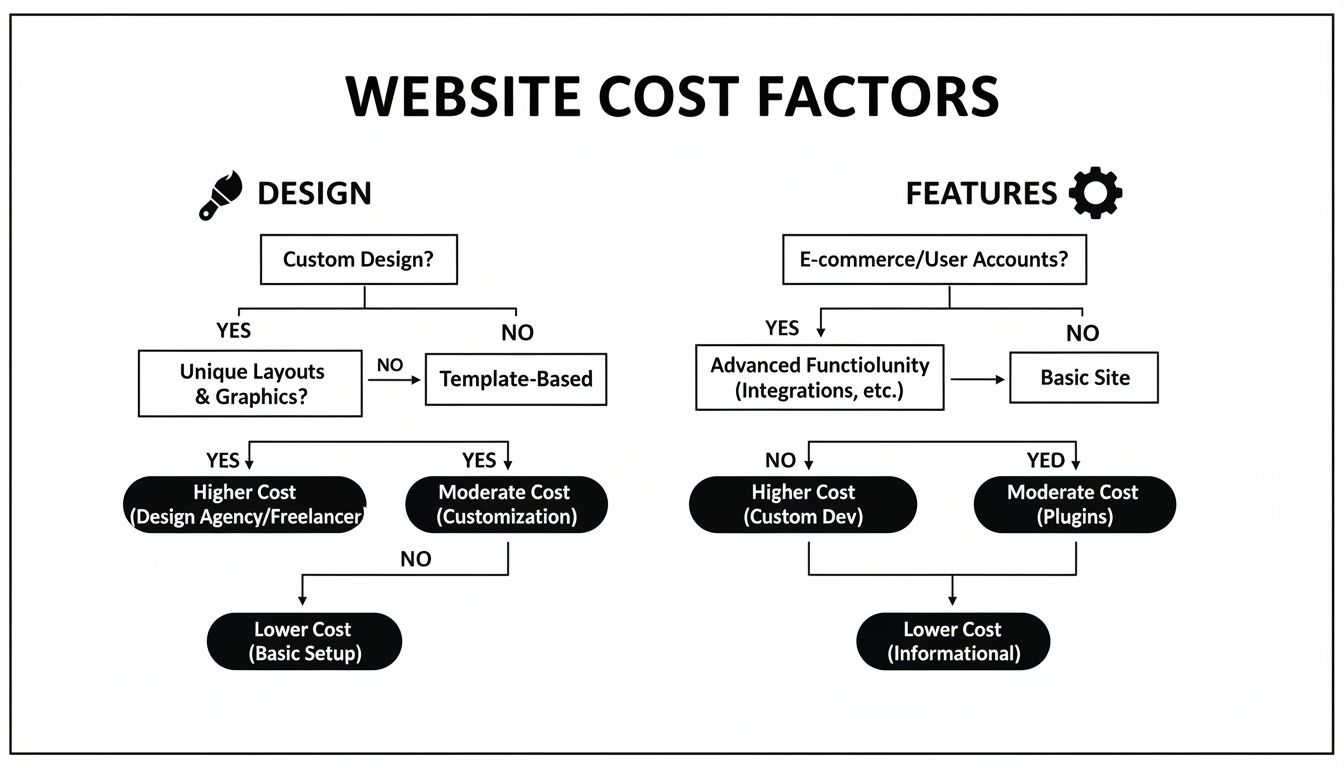
As the chart shows, the more a project leans towards custom design and complex features, the more critical it becomes to have a reliable, expert team in your corner.
A white label shopify expert or WordPress developer acts as a silent, invisible extension of your own team. They handle the heavy lifting on the technical build, while you focus on managing the client relationship—all under your agency's brand. This model lets you instantly expand your service offerings, taking on anything from simple brochure sites to projects requiring an ecommerce developer australia-level of expertise. You can confidently sell services you don’t have the skills for in-house, knowing a trusted partner will deliver quality work every time.
"A white-label partnership liberates your agency to focus on its core strengths—strategy, sales, and client relationships. By outsourcing the technical execution, you eliminate production bottlenecks and create a predictable, profitable, and scalable business model."
Geography can also make this model incredibly appealing. For instance, a custom wordpress development australia-wide might cost around AUD $20,000, which is very competitive compared to the USA (around USD $30,000). By partnering with a local Australian white-label provider, you can secure healthy, guaranteed profit margins while still offering fantastic value to your clients.
To see which path truly aligns with your agency's goals, it helps to compare them side-by-side.
Comparing Delivery Models For Agency Growth
| Factor | Freelancer | In-House Team | White Label Partner |
|---|---|---|---|
| Upfront Cost | Low | Very High | None |
| Ongoing Cost | Variable (per project) | High (salaries, overheads) | Predictable (per project) |
| Scalability | Low | Slow & Expensive | High & Instant |
| Reliability | Low to Medium | High | High |
| Control | Medium | Very High | High (with the right partner) |
| Expertise | Niche & Specific | Limited to team's skills | Broad & Deep |
| Management | High (constant oversight) | High (HR, project management) | Low (partner manages their team) |
Ultimately, this comparison shows that the white-label model is about smart delegation. You're using the expertise of specialists to grow your business without taking on the financial risk or management burden of hiring. For a deeper look into the specifics, check out our guide on white-label website development for ecommerce solutions. Making this strategic choice is often the key that unlocks sustainable, profitable growth for an agency.
Uncovering The Hidden Costs Of Website Ownership
The quote you give a client for a new website is just the price of entry. The real cost for website creation goes far beyond launch day. For any website to remain a secure, high-performing asset, it needs continuous investment—a crucial detail that often gets glossed over in the initial excitement of a new project.
Think of it like buying a car. The sticker price is just the beginning. You still have to budget for petrol, insurance, registration, and regular servicing to keep it safely on the road. A website is no different. Being upfront with clients about these ongoing expenses from the very start positions your agency as a transparent, long-term partner, not just a one-off builder.
The Non-Negotiable Recurring Expenses
A few foundational costs are absolutely essential for keeping any professional website online and functioning properly. These aren't optional extras; they're the basic operational requirements for having a digital presence.
- Domain Name Registration: This is the website's address on the internet (like yourbusiness.com.au). It’s an annual fee, usually modest, but completely non-negotiable.
- Quality Web Hosting: This is the plot of digital land where the website "lives." Skimping on hosting often leads to painfully slow speeds and weak security, so investing in a quality provider is critical for performance.
- SSL Certificate: This encrypts the data flowing between a user's browser and the website, giving you that little padlock icon in the address bar. It's a must-have for security, building trust with visitors, and it's a known ranking factor for Google.
These three items form the baseline for website ownership. Without them, a site simply can't function correctly or securely, making them a key part of any realistic budget.
Premium Tools And Ongoing Maintenance
Beyond the basics, most modern websites rely on premium software and regular tune-ups to deliver actual results. These costs can vary wildly depending on the site's complexity, especially for powerful platforms like WordPress and Shopify.
The ongoing wordpress maintenance australia can be a significant part of its total cost of ownership. Monthly expenses can range from AUD $50-$150 for a simple site to well over AUD $2,000 for a complex e-commerce platform. On top of that, you have hidden expenses like the domain name (AUD $15-$50 annually), premium plugins (AUD $50-$500 annually), and security solutions (AUD $200-$1,000 annually).
This is where a proactive approach pays dividends.
Ongoing website maintenance isn't an expense; it's an insurance policy. It protects your client's investment against security threats, performance degradation, and the costly downtime that can cripple a business.
Regular maintenance makes sure all software is up-to-date, security holes are patched, and the site keeps running smoothly. To get a better handle on these ongoing infrastructure expenses, exploring the best cloud cost optimization tools can be a smart move to help reduce these hidden costs.
The Case For Maintenance And Support Retainers
This is where your agency can provide enormous value while building predictable, recurring revenue. Instead of leaving clients to fend for themselves, offering a maintenance and support retainer ensures their digital asset is always protected and optimised.
A solid support package should cover the essentials:
- Regular Backups: Creating secure, off-site copies of the website, just in case the worst happens.
- Software Updates: Keeping the core platform (like WordPress), themes, and plugins updated to patch security vulnerabilities.
- Security Monitoring: Actively scanning for malware and any suspicious activity.
- Performance Checks: Making sure the site stays zippy and responsive for users.
By bundling these services, you shift the conversation from a one-time project fee to a long-term partnership focused on their success. This not only protects your client's investment but also solidifies your agency's role as their essential digital guide. For a deeper dive, check out our guide on understanding the true website maintenance cost.
How To Maximise Profit With White Label Web Development
For any growing digital agency, thinking about the cost for website creation goes way beyond just quoting a client. It's really about building a delivery model that’s both profitable and scalable. This is where a white-label partnership can be a game-changer, letting you shift your energy from managing technical headaches to maximising your profit on every project.
When you bring a white label wordpress or Shopify partner into the mix, you get to sidestep the huge costs and admin drain of hiring an in-house team. You instantly cut out expenses like recruitment, salaries, benefits, and the constant need for training, which lets you run a much leaner, more agile agency.
The Simple Maths Of Profitable Reselling
The beauty of a white-label partnership is just how straightforward the money side of things is. It’s all built on a clear, predictable cost structure, which means you can lock in your profit margin right from the start. It completely removes the guesswork and risk that so often come with web development projects.
Let’s walk through a common scenario. Say your client needs a new eCommerce store. You reach out to your white label shopify agency partner, and they give you a fixed quote of $5,000 for the entire build. That number is your cost of goods sold—it's simple and transparent.
With that cost locked in, you can confidently go to your client with a proposal for $10,000. The moment they sign off, you’ve secured a $5,000 gross profit before anyone has even written a single line of code. Your partner handles all the technical heavy lifting, while you focus on the client relationship and bank a very healthy 50% margin.
This model transforms website development from a resource-intensive service into a high-margin, scalable product. You only pay for what you sell, ensuring every project is profitable by design.
This approach gives you a predictable financial outcome every time. You're no longer exposed to the classic agency risks of projects blowing their budget or timelines stretching out, which can absolutely destroy your profits when you’re managing an in-house team or flaky freelancers.
Instantly Broaden Your Service Offerings
One of the biggest perks of partnering with a specialist is how it immediately expands what your agency can do. You can start saying "yes" to a much wider variety of client requests without having to hire a single new person.
Got a client who needs a tricky wordpress development australia solution that other agencies might shy away from? Not a problem. Your partner has the chops to handle it. What about another client asking for a complex shopify migration australia-wide? You can quote for it confidently, knowing you have a specialist team ready to deliver a flawless result.
This opens up a few key pathways for growth:
- Take on Larger Projects: You can now pitch for more ambitious and lucrative builds that were previously out of your league.
- Serve More Diverse Clients: By offering solutions for both WordPress and Shopify, you can cater to a much broader slice of the market.
- Add Recurring Revenue Services: You can easily resell white label wordpress maintenance australia-wide, creating a stable, ongoing income stream from clients you already have.
By outsourcing the technical work to a white label wordpress agency, you're essentially renting an entire expert development team whenever you need them. This agility allows you to scale up or down based on your sales pipeline, keeping you profitable whether you have one project on the go or ten.
Focus On High-Value Agency Growth
At the end of the day, the white-label model gives you back your most valuable resource: your time. When you offload the nitty-gritty of project management and technical development, your team can concentrate on the activities that actually grow the business.
Instead of getting bogged down in bug fixes or arguments over scope creep, your team can put its energy where it really counts:
- Strategy and Consulting: Giving clients the high-level advice that builds strong, lasting relationships.
- Sales and Business Development: Getting out there and winning new, high-quality clients.
- Marketing and Client Services: Looking after your existing accounts and finding opportunities to add more value.
Working with a trusted agency wordpress partner australia-based companies recommend lets you focus on your business, not just in it. You’ll be building a smarter, more profitable agency that can scale without the usual growing pains of hiring and infrastructure costs.
Common Questions About Website Creation Costs
Trying to get a handle on the financial side of building a website can feel a bit like navigating a maze. There are so many moving parts that affect the final price tag. To help clear things up, I've put together answers to the questions I hear most often from agency owners and their clients. My goal here is to demystify the numbers and show why investing in quality from the start is always the smart play for long-term, measurable results.
Each answer is short, sharp, and actionable. The idea is to give you the confidence to build transparent, value-packed proposals that make sense to your clients and get every project started on the right foot.
How Much Should A Small Business Website Cost In Australia?
For a professionally built small business website in Australia, you should be budgeting somewhere in the range of $4,000 to $12,000. This is a realistic investment that covers all the essentials for a solid online foundation, whether it’s built on WordPress or Shopify.
So, what does that price tag actually get you? Typically, it includes:
- A custom-branded design that genuinely reflects the business’s personality.
- Up to 15 professionally structured pages (think Home, About, Services, Contact, etc.).
- Full mobile responsiveness, so the site looks and works perfectly on any device.
- Foundational on-page SEO to give the site a fighting chance of being found on Google.
A word of warning: be very wary of rock-bottom prices. If a quote seems too good to be true, it almost certainly is. Those cheap-as-chips sites often come with a hidden cost—think sluggish performance, glaring security holes, and a much bigger bill down the track to fix all the things that inevitably go wrong.
Why Is A Custom Website More Expensive Than A Template?
Think of it like buying a suit. You can grab one off the rack, and it’ll do the job. Or, you can have one tailored. The tailored suit is crafted to fit you perfectly, it reflects your personal style, and it’s made from quality materials that are built to last.
A custom website offers the same kind of strategic advantage over a generic template.
- A Unique Brand Experience: It’s a one-of-a-kind design that makes a memorable first impression and sets the business apart from the competition.
- An Optimised User Journey: Every button, image, and line of text is placed with purpose, guiding visitors towards a specific goal, like making a purchase or filling out a form.
- Superior Performance: Custom sites are built with clean, efficient code. They’re faster and more reliable than template sites, which are often bloated with clunky, unnecessary features.
- Future-Proof Scalability: A custom build is designed to grow with the business, making it much easier to add new features as needs change.
The key is to frame custom wordpress development australia as an investment in a client’s digital future, not just another business expense. You’re building a powerful asset designed for long-term growth.
Can I Get A Website Built For Under $1,000?
Technically, yes. You could use a DIY website builder or hire an unvetted offshore freelancer and get something online for under a grand. But for any serious business, it's a path loaded with risk. This approach always means cutting corners in ways that can seriously damage a brand's credibility and end up costing a fortune to fix later.
A cheap website often becomes the most expensive marketing mistake a business can make. The initial savings are quickly erased by lost revenue from poor user experience, security breaches, and the eventual cost of a complete rebuild.
The trade-offs are impossible to ignore:
- Generic, Unprofessional Design: The site will look like a thousand others, doing nothing to build trust or authority.
- Weak Security: These sites are low-hanging fruit for hackers, putting customer data and the business's reputation at risk.
- Zero Meaningful Support: When something inevitably breaks, there’s often no one to call for a quick, effective fix.
- Limited Functionality: The site will simply lack the tools needed to actually generate leads or sales.
What Is The Cost Difference Between WordPress And Shopify?
This is a great question, and the answer isn't as simple as comparing the initial build price. While the upfront development costs for a WordPress and a Shopify site might look similar, their long-term cost structures are worlds apart.
WordPress is all about flexibility and ownership. A custom wordpress development australia project might have a higher initial cost, and ongoing expenses can add up from premium plugins, themes, and quality hosting. The payoff? You get complete control over every single aspect of the site, with no ongoing platform fees.
Shopify offers a more all-in-one, predictable package. Hosting, security, and support are all bundled into a monthly subscription, which makes budgeting a lot simpler. However, transaction fees can eat into profits, and the costs for specialised apps or hiring a shopify expert australia for serious customisation can get pretty steep as a business grows.
Ultimately, the right choice comes down to the client’s business model, their technical comfort level, and their plans for the future. A service-based business might be a perfect fit for WordPress, while a product-focused startup could be better off with Shopify's streamlined ecosystem.
At White Label WordPress, we empower your agency to deliver high-quality, profitable web projects without the overhead. By partnering with us, you gain access to a dedicated team of WordPress and Shopify experts, allowing you to scale your services and secure guaranteed profit margins on every build. Learn how our white label solutions can accelerate your agency’s growth today.