

At its heart, white label is a simple concept: one company creates a product or service, and another company rebrands it and sells it as their own. It’s a powerful, behind-the-scenes partnership that lets you offer expert solutions to your clients without having to build them from the ground up.
This model is a game-changer for agencies looking to instantly expand their capabilities and say "yes" to more client demands, from custom WordPress development Australia to full-scale Shopify store builds.
What White Label Actually Means for Your Agency
Let's ditch the business jargon for a minute. Imagine you own a fantastic local bakery. You're known for your amazing customer service, your beautiful branding, and your delicious cakes.
But instead of building your own flour mill from scratch—a hugely expensive and complicated process—you partner with a specialist miller. They provide you with top-quality, unbranded flour, and you use it to bake the goods that your customers know and love.
Your customers get a consistently brilliant product from a brand they trust, and they never need to know about the expert miller working tirelessly in the background. That, in a nutshell, is how white label services work for a digital agency.
The Core Concept in Action
In this scenario, your agency is the bakery, and your white label partner is the expert miller. They could be a team of specialised WordPress developers, e-commerce gurus, or SEO pros. They handle the heavy lifting and technical production, delivering a polished website or campaign that you can proudly present to your client under your own banner. This is the essence of white label WordPress development and white label Shopify development.
The key takeaway is this: Your agency always owns the client relationship and the branding. The white label partner is a silent, invisible extension of your team, delivering expert work that makes you look good.
This strategic setup lets you offer in-demand services that might be outside your core skill set. You can instantly become a full-service agency, whether as a WordPress agency Australia or a Shopify agency Australia, without the massive overheads of hiring, training, and managing new in-house teams.
Ultimately, to define white label is to define a model for smart, scalable growth. It’s about focusing on what you do best—client strategy, marketing, and building relationships—while relying on a trusted partner web agency Australia to handle the complex execution.
The Strategic Benefits of a White Label Partnership
Knowing what ‘white label’ means is one thing, but understanding how to use it strategically is what will really kick your agency into high gear. This is about more than just offloading tasks. It’s a fundamental shift that reshapes your agency's ability to grow, boost profits, and stay agile—especially here in the competitive Australian market.
Partnering with a white label provider gives you instant access to a team of specialists, but without the crippling overheads. Just think about the real cost to hire WordPress developer Australia or a Shopify developer Australia. A white label partnership sidesteps all of that, freeing up your capital to invest where it matters most: client strategy, marketing, and growing your business.
Secure Predictable Profit Margins
One of the biggest wins in a white label model is the financial predictability. Projects are almost always quoted at a fixed, wholesale cost. This means you can add your desired markup with total confidence, knowing your exact profit margin before the project even begins. The days of scope creep eating away at your revenue are over.
This setup transforms your technical delivery from a potential cost headache into a reliable profit centre. No more guessing billable hours or absorbing the cost of unexpected development snags—you operate with complete certainty.
A white label partnership lets you sell high-value technical services with a guaranteed return. It gives you the financial confidence to chase bigger, more complex client accounts without shouldering all the technical risk yourself.
White labelling has become a cornerstone for Australian digital agencies looking to scale without the baggage of a large in-house team. The numbers tell a compelling story. Industry insights show that 73% of agencies globally now use white label services to expand their offerings, with a big slice of that right here in Australia.
In fact, local agencies that outsource web development Australia through white label partners report 2.3 times faster growth and see 20% higher margins than those who keep everything in-house. For an agency owner, this is huge. You can mark up costs by a healthy 40-60% while dodging recruitment expenses that can easily top AUD 100,000 per developer each year.
Instantly Expand Your Service Offerings
Imagine this: a client asks for a complex custom WordPress development project or a full Shopify migration. Instead of hesitating, you can confidently say "yes" tomorrow, even if your team has never touched an e-commerce site before.
That's the power of a white label partnership. It lets you bolt on a whole new suite of technical services to your portfolio overnight, from handling a tricky WordPress bug fix Australia to offering comprehensive woocommerce developer Australia solutions.
This kind of agility gives you a serious competitive edge. You can meet your clients' evolving needs on the spot, positioning your agency as the one-stop strategic partner they can't do without. It means you finally stop turning away lucrative projects just because they fall outside your team's current skillset.
White Label vs Private Label vs Reselling Explained
You’ve probably heard the terms 'white label', 'private label', and 'reselling' thrown around, sometimes even used interchangeably. But for an agency, they represent three very different paths, and picking the wrong one can lead to some serious strategic headaches. Getting the distinctions right from the start is key to figuring out how you want to grow.
Let’s start with white label. Think of it as a ready-made, high-quality service that you can buy off the shelf and put your own brand on. A great analogy is a top-tier bakery that buys expertly made, unbranded cake layers from a specialised supplier. The bakery then adds its own unique frosting, decorations, and packaging. The supplier sells the same high-quality layers to other bakeries, but each one turns it into their own signature creation.
That’s exactly how white label WordPress development or white label Shopify works. You’re not building the development team or the processes from the ground up; you’re simply branding a proven, expert service as your own. It’s all about speed and efficiency.
Defining Private Label
Now, private label is a different beast altogether. This is where you commission a provider to create a service or product exclusively for your agency. Going back to our bakery, this would be like asking the supplier to develop a unique, secret flour blend just for you. No other bakery can get their hands on it.
This route gives you a completely unique offering and total control, but it comes at a price. Expect higher costs and a much longer lead time because everything is being built from scratch, just for you. It's a truly bespoke solution.
A simple way to think about it: White label is a 'one-to-many' model where a single service is sold to multiple agencies. Private label is a 'one-to-one' model where a unique service is created just for you.
Understanding Reselling
Finally, there's reselling, which is the most straightforward of the bunch. You’re simply selling another company's branded product or service. Your agency acts as an authorised third-party vendor, like a local electronics shop selling a Sony TV. You don't change the branding or the product; you just facilitate the sale and take a cut.
Each model has its place. But for agencies looking to bolt on new services quickly and scale up without losing brand integrity, the white label model strikes the perfect balance between customisation and convenience.
To make it even clearer, let's look at a side-by-side comparison. This should help you pinpoint which model aligns best with your agency's immediate and long-term goals.
Comparing Partnership Models: White Label vs Private Label vs Reselling
| Attribute | White Label | Private Label | Reselling |
|---|---|---|---|
| Branding | Your agency's brand is applied to a pre-existing service. | Your agency's brand is on a service built exclusively for you. | The original provider's brand remains visible. |
| Exclusivity | The service is not exclusive and is sold to other agencies. | The service is 100% exclusive to your agency. | The product is not exclusive; you are one of many resellers. |
| Customisation | Limited customisation within the existing service framework. | High degree of customisation to your exact specifications. | No customisation is possible. |
| Speed to Market | Very fast. You can start selling almost immediately. | Slow. Requires a full development and production cycle. | Fast. You can start selling as soon as the agreement is signed. |
| Cost | Lower upfront cost, as development is shared. | High upfront investment for exclusive development. | Minimal to no upfront cost. |
As you can see, the right choice really depends on your priorities: speed, exclusivity, brand control, or cost. For most agencies aiming for scalable growth, white labelling offers an unbeatable combination of benefits.
How White Label WordPress and Shopify Development Works
It’s one thing to understand the concept of white labelling, but what does it actually look like day-to-day? In a nutshell, it’s a process designed to make your agency look like a well-oiled machine, capable of handling complex builds with ease. The whole system hinges on a single, powerful rule: you own the client relationship, while your partner handles the technical heavy lifting completely behind the scenes.
Think of your white label provider as an extension of your own team—a specialised, silent department you can call on whenever you need. You're in the driver's seat for all client communication, project scoping, and strategy. Once the plan is set, you simply pass the detailed brief to your WordPress freelancer Australia or Shopify expert. They become your secret weapon, building the project to your exact specifications without ever speaking to your client.
This structure means you maintain 100% brand control. From your client's perspective, they're dealing with one agency: yours. They see a stunning, high-quality website delivered on schedule, all under your trusted brand. It's a model that lets you confidently take on ambitious projects, even if you don't have a developer on staff.
The Typical Project Lifecycle
The journey from a client saying "yes" to the final website handover is surprisingly simple. A good white label partner will slot right into your existing workflow, adapting to your processes to make the whole experience feel like you’re just delegating to an internal team member.
Here’s a breakdown of how a project usually unfolds:
- Client & Discovery: Your agency lands the new client. You run the discovery sessions, digging into their goals, technical requirements, and brand vision.
- Briefing Your Partner: You bundle up all the project assets—wireframes, design files (like Figma or Adobe XD), functional specs, and key deadlines—into a comprehensive brief for your partner.
- Behind-the-Scenes Development: Your partner’s team gets to work. They handle all the coding, development, and technical problem-solving, keeping you in the loop with regular progress updates.
- Internal Review & QA: Once the build is complete, the partner conducts their own rigorous quality assurance checks before handing it over to you for your review.
- Revisions & Final Polish: You provide your feedback, and the partner makes the necessary tweaks. This loop continues until the site is pixel-perfect and aligns with your client's vision.
- Client Handover: You present the finished product to your client as your own work. Your partner can even supply training documents or support materials, all branded with your agency’s logo.
This process keeps the roles crystal clear: you manage the client, they manage the code. The infographic below helps illustrate how this differs from other common partnership models.
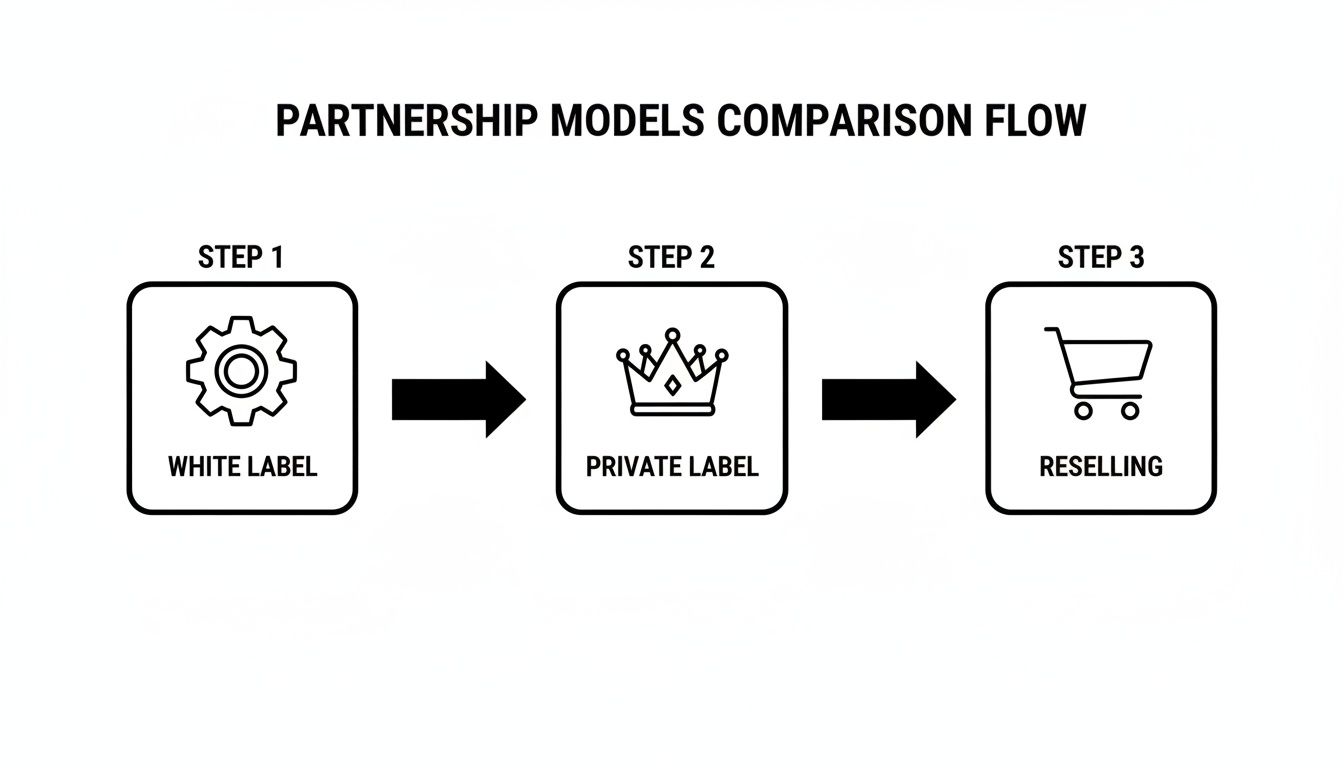
As you can see, white labelling offers a balanced approach, giving you the branding power of a private label product with the operational ease of reselling. For agencies aiming to scale efficiently, it’s often the perfect middle ground. For a deeper dive into how this all comes together, check out our detailed guide on white label WordPress partnerships.
Finding the Right Australian White Label Partner
Choosing the right partner is hands-down the most critical decision you'll make. Get it right, and you'll accelerate growth, simplify your operations, and look like an absolute rockstar to your clients. Get it wrong, and you're in for a world of chaos, a damaged reputation, and a serious drain on your time and money.
Vetting potential white label providers here in Australia demands a practical, no-nonsense approach. This isn't just about finding a team that can build a website; it’s about finding a genuine operational partner who gets the agency model and is truly invested in your success. Your checklist needs to go way beyond a quick glance at their portfolio.
Evaluate Their Technical Portfolio and Processes
Let's start with the fundamentals: their technical skills. Don't just look at the shiny, finished websites. You need to dig deeper into their expertise. A partner who claims to specialise in white label WordPress or Shopify development should have a diverse portfolio packed with successful, real-world projects to back it up.
Get ready to ask some pointed questions about their process:
- What does your quality assurance (QA) protocol look like? A solid QA process is non-negotiable. It must include multi-device testing, performance checks, and security audits. Anything less is a red flag.
- How do you manage projects and communication? Look for established systems. Do they use dedicated project managers? What are their communication channels—Slack, Asana, a project portal? You need a partner committed to regular, clear updates.
- Can you show me case studies with tangible results? Pretty pictures are nice, but they don't pay the bills. Look for hard evidence that their work helped a client hit specific goals, like a jump in conversions or a faster site speed.
A portfolio shows you what they can do. Their process reveals how they actually do it. This is where you separate the true professionals from the pack.
Scrutinise Communication and Australian Presence
Having your partner in the same time zone is a massive advantage. The ability to jump on a quick call during your own business hours to sort out an urgent issue is honestly priceless. Clear, timely communication is the bedrock of any successful partnership.
A provider’s responsiveness during the vetting process is often a direct reflection of how they will communicate once a project is underway. If they are slow to respond or provide vague answers now, expect more of the same later.
On top of that, a comprehensive Service Level Agreement (SLA) isn't just a "nice to have"—it's an absolute must. This document should clearly lay out expectations for project timelines, communication response times, support procedures, and how issues get resolved. Without a detailed SLA, you’re just running on assumptions, and that’s a recipe for disaster. This is a crucial step when you decide to outsource digital marketing or development work.
Clarify Pricing and Partnership Structure
Finally, you need to make sure their pricing model is transparent and aligns with your agency’s need for predictable profit margins. Most reputable providers will offer fixed-project pricing, which lets you mark up the cost with confidence. Be very wary of vague estimates or hourly rates that can easily spiral out of control with scope creep.
Ask them straight up how they view the partnership. A true partner is invested in your growth and acts more like a strategic advisor, not just a hired hand. They should be keen to discuss strategy, propose solutions, and work with you to get the best possible outcome for your clients.
Common Mistakes to Avoid in White Label Relationships
While the upside of white labelling is huge, a good partnership doesn't just happen. It takes work. A few common missteps can easily derail a project, leading to blown budgets, missed deadlines, and a hit to your agency's reputation. Knowing what to watch out for from the get-go is the key to building a partnership that’s both profitable and stress-free.
The biggest culprit? Scope creep. It's that classic tale of a project's requirements ballooning well past what was originally agreed upon. It often starts with a series of small, "can you just…" client requests that, one by one, eat away at your profit margins and put a real strain on your relationship with your production partner.
Poor communication is another partnership-killer. When briefs are fuzzy, emails go unanswered for days, and feedback is all over the place, you create a recipe for frustration and expensive rework. The whole system relies on a smooth, constant flow of information between your agency, your partner, and back again.
Overlooking Brand Consistency
Finally, a surprisingly common mistake is forgetting to give your partner a solid set of brand guidelines. If they don't have a crystal-clear picture of your client's visual identity and tone of voice, the end result can feel disjointed and off-brand. This completely defeats the purpose of white labelling, which is to deliver a seamless product that looks and feels like it came straight from your in-house team.
Getting ahead of these problems is all about being proactive.
- Create an Ironclad Statement of Work (SOW): Before a single hour is logged, get everything in writing. Document every deliverable, every feature, and exactly how many rounds of revisions are included. This SOW becomes the project's bible, protecting both you and your partner from scope creep.
- Establish Clear Communication Protocols: Decide how you'll communicate upfront. Will it be a dedicated Slack channel or a project management portal? Set clear expectations for response times and schedule regular check-ins to keep everyone aligned.
- Provide a Detailed Brand Kit: Don't make your partner guess. Hand them everything they need: logos, colour codes, font files, and examples of the brand's tone of voice. The more detail you give them, the closer the final product will be to the vision in your head.
Think of your white label provider as a strategic partner, not just a task-doer. When you build the relationship on open communication and well-defined processes from day one, you set the stage for a long-term, mutually successful arrangement.
Your White Label Questions, Answered
Jumping into a white label partnership can feel like a big step. It’s only natural to have a few questions before you commit. Here are the answers to the questions we hear most often from agency owners across Australia.
How Will I Handle Client Communication?
You’re always in the driver's seat. Your white label partner works behind the scenes, completely invisible to your client. Think of them as a silent extension of your own team.
You’ll be the one and only point of contact for your client. You pass on the brief and any feedback, and your partner provides you with the updates to share. This setup ensures you maintain full control over the client relationship and your brand's reputation.
Can I Trust the Quality Will Meet My Standards?
This is a big one, and rightly so. The success of a good white label provider is directly linked to your own, so they are just as invested in quality as you are. A top-tier white label wordpress agency lives and dies by the quality of the work they produce for you.
Before signing anything, do your due diligence. Dive deep into their portfolio, ask for detailed case studies, and really pick apart their quality assurance (QA) process. The right agency WordPress partner in Australia will work to your exact standards, delivering a final product you'll be proud to call your own.
A core part of any professional white label partnership is a rock-solid Non-Disclosure Agreement (NDA). This is a legal guarantee that protects your agency's and your client's sensitive information, ensuring complete confidentiality from the very beginning.
Is My Client's Data Kept Private?
Without question. Signing a comprehensive Non-Disclosure Agreement (NDA) is a mandatory first step. It's not just a formality; it’s a legal commitment that binds your partner to keep all of your agency’s and your client's information strictly confidential.
Any professional provider will insist on this as a standard part of their onboarding. It’s a critical document that provides peace of mind for everyone involved.
Ready to grow your agency with predictable profit margins and none of the hiring headaches? White Label WordPress is the expert, silent development partner you've been looking for. Discover our white label WordPress and Shopify solutions today!