

Outsourcing your digital marketing isn't just about saving a few dollars; it's one of the sharpest strategic moves a competitive agency can make. For many, it's about gaining immediate access to specialised talent, turning what used to be capacity roadblocks into genuine opportunities for growth with services like custom WordPress development or Shopify SEO. It's the key to confidently taking on complex, high-value projects that might have previously seemed out of reach.
Why Smart Australian Agencies Outsource Digital Marketing
Any agency owner will tell you it's a constant juggling act between keeping clients happy, managing your team's workload, and actually turning a profit. The old-school approach of hiring in-house specialists for every single marketing discipline just isn't cutting it anymore. It’s too slow, far too expensive, and leaves you with a rigid team structure that can't adapt quickly.
That’s precisely why a growing number of Australian agencies are flipping the script. They're no longer seeing outsourcing as a backup plan, but as their primary strategy for smart, sustainable growth.
This shift can fundamentally change how your agency operates. Instead of getting bogged down in the day-to-day technical grind, your senior people are freed up to focus on what really moves the needle: building stronger client relationships, crafting brilliant overarching strategies, and winning new business.
Access Niche Expertise Instantly
Let's play out a common scenario. A fantastic, high-value client comes to you needing a complex WooCommerce site, but your team are geniuses at design and branding, not back-end development. In the past, you might have had to say no. Now, you can partner with a white label WordPress agency.
Just like that, you have a team of seasoned woocommerce developer australia experts ready to execute the project flawlessly, all under your brand's banner. You end up delivering an exceptional result, the client is thrilled, and you’ve just expanded your service offerings without hiring a single person.
This model works across a whole range of digital needs:
- Complex Shopify builds are taken care of by a dedicated
shopify agency australia. - Urgent WordPress issues are quickly sorted by a
wordpress bug fix australiapartner. - Ongoing site care and updates are seamlessly handled through
white label wordpress maintenance australia.
Drive Growth and Profitability
Outsourcing has a direct and immediate impact on your profitability. It effectively turns fixed overheads—think full-time developer salaries, superannuation, and benefits—into variable costs. You pay for the expertise only when you have a client project that requires it, which means every service you sell is profitable from day one.
This leaner, more agile operational model gives small-to-medium agencies a massive competitive advantage.
Before diving deeper, it's worth taking a moment to compare the two approaches side-by-side. This table breaks down the core differences between building everything in-house versus partnering with an outsourced team.
In-House Team vs. Outsourced Partner: A Quick Comparison
| Factor | In-House Team | Outsourced Partner |
|---|---|---|
| Cost | High fixed costs (salaries, benefits, overheads). | Lower variable costs (pay-per-project or retainer). |
| Speed to Market | Slow. Time needed for recruitment, hiring, and onboarding. | Fast. Immediate access to a pre-vetted, skilled team. |
| Expertise | Limited to the skills of your current employees. | Access to a broad range of specialists (e.g., SEO, PPC, Devs). |
| Scalability | Difficult. Scaling up or down requires hiring or layoffs. | Easy. Scale resources up or down based on client demand. |
| Management | Requires direct management, training, and HR oversight. | Managed by the partner; you focus on strategy and client relations. |
| Risk | High. Investment in salaries and training with no guaranteed ROI. | Low. Minimal upfront investment; tied directly to revenue. |
As you can see, the outsourced model offers a level of financial and operational flexibility that's incredibly difficult to replicate with a purely in-house structure. It allows you to be more responsive to both market opportunities and client needs.
The trend is undeniable. Digital marketing outsourcing in Australia is on a serious upswing, driven largely by SMEs searching for more efficient ways to get results. The industry here grew by a staggering 7.6% in the last year alone, with smaller businesses fuelling a huge chunk of that demand. You can get more insights into why Australian businesses are embracing outsourcing in 2025.
By adopting this model, your agency can remain nimble, boost its profitability, and concentrate on what truly defines your value: being a strategic growth partner for your clients.
Choosing Your Ideal Outsourcing Model
Deciding to outsource is a big step, but the real work starts when you have to pick the right kind of partner. This decision will make or break the whole venture.
You've got a few different paths you can take, from hiring a lone contractor to partnering with a fully-fledged firm. Your choice really needs to line up with what you're trying to achieve—whether that's handling a small project overflow or making a serious play to scale your agency.
Let's break down the main options you'll come across: freelancers, big BPO firms, and specialised white-label partners. Each has its place, but picking the wrong one can lead to missed deadlines, shoddy work, and unhappy clients. So, it's vital to know the difference.
This flowchart lays out the fundamental choice: build your own team or outsource to grow?
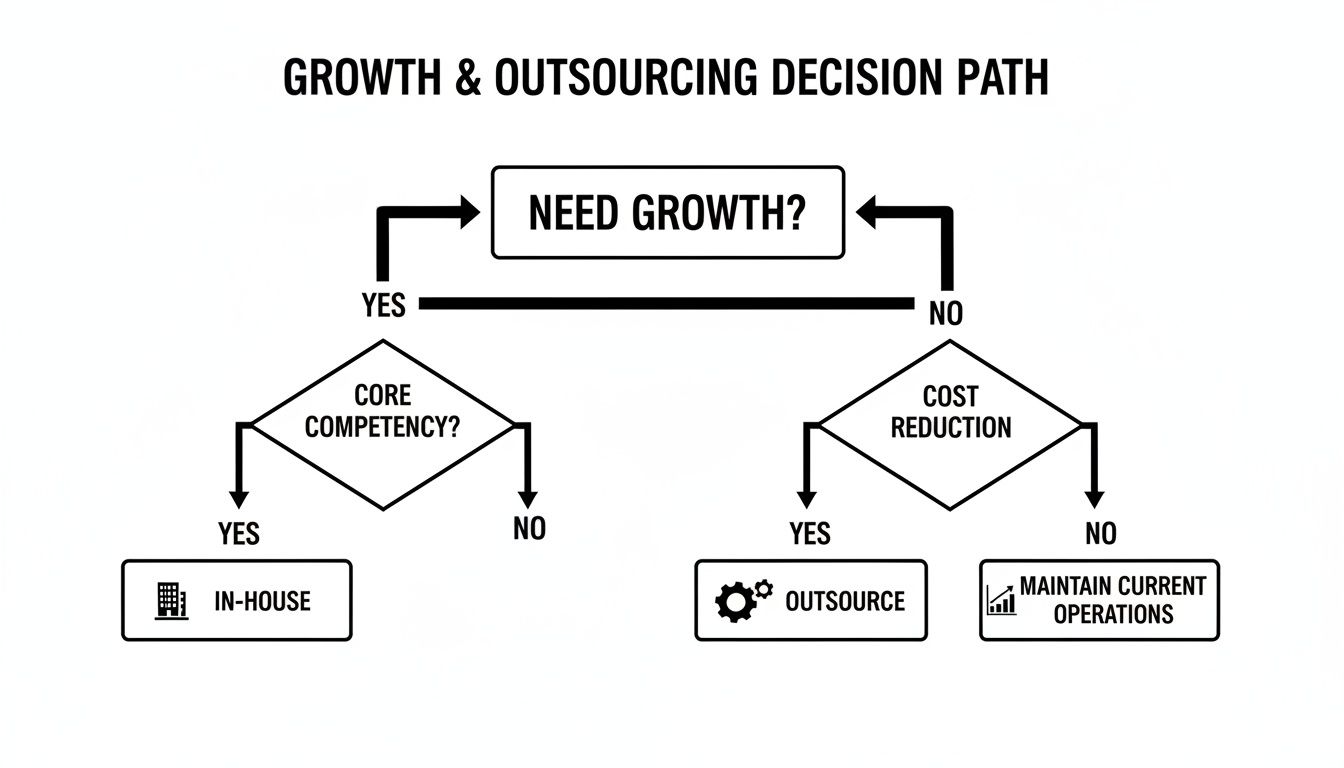
As you can see, when growth is the goal, outsourcing is a direct line to expanding what your agency can do without the growing pains of hiring.
Freelancers: The Solo Specialists
Hiring a freelancer, like a wordpress freelancer australia, can be perfect for those small, well-defined jobs. They’re flexible, usually cost-effective, and great for things like a quick wordpress bug fix australia or updating a bit of content. You’re working directly with a specialist, which is great.
But there’s a catch. Relying on just one person for bigger, ongoing work is risky. What if they get sick, get swamped with other clients, or just don’t have the specific skill set for a more complex task? A major Shopify migration australia or a large-scale custom wordpress development australia project needs more than one pair of hands; it needs a team of designers, developers, and QA testers. A single freelancer just can't offer that.
Key Takeaway: Freelancers are brilliant for tactical, short-term tasks. But for strategic growth and delivering complex projects reliably, their limits on availability and skill diversity can seriously hold your agency back.
BPO Firms: The Volume Players
Your traditional Business Process Outsourcing (BPO) firms are all about volume and efficiency. They're set up to handle huge amounts of repeatable tasks for a low price. While that model works for some things, it often falls short for the kind of custom, creative work that agencies do.
Their jack-of-all-trades approach usually means they lack a deep understanding of specific platforms like WordPress or Shopify. You might find their one-size-fits-all processes are too clunky for your bespoke client projects, resulting in generic work that just doesn't hit the mark.
White-Label Agencies: The Strategic Partners
This is where it gets interesting for agencies that are serious about growth. A white label wordpress agency or an agency shopify partner australia operates as a silent, invisible extension of your team. It’s like having a full development department on standby, but without the overheads.
This model gives you the focused expertise of a specialist combined with the reliability and horsepower of an entire team.
- Deep Platform Knowledge: A partner that focuses on white label wordpress development knows the platform inside and out—way better than a generalist ever could.
- Scalable Resources: Suddenly land a huge woocommerce development australia project? A white-label partner already has the developers, project managers, and QA team ready to jump in.
- Built-in Reliability: Unlike a freelancer, a proper agency has backups. If one developer is away, another takes over, so your projects never grind to a halt.
- Strategic Insight: The best partners do more than just follow orders. A white label shopify expert can offer brilliant advice on things like conversion optimisation or the best apps to use, adding real value to your client strategies.
Ultimately, teaming up with a white label wordpress agency or Shopify specialist empowers you to confidently sell more complex, high-value services. Whether you need ongoing white label wordpress maintenance australia or a brand-new custom build, this model is designed to make your agency’s growth feel effortless. You can explore the different kinds of white-label web development services available to see exactly how they can fill the gaps in your team.
How To Properly Vet a White-Label Partner

Choosing a white-label partner is one of the biggest calls you'll make for your agency. Get it right, and you've got a seamless growth engine. Get it wrong, and you risk damaging client relationships and your hard-earned reputation. A slick website and a confident sales pitch are just the start; you need to dig much deeper to find a genuinely reliable team.
This vetting process isn't about ticking boxes. It's about stress-testing their capabilities, really getting under the hood of their processes, and making sure their team can truly operate as an invisible extension of your own.
Go Beyond the Highlight Reel
Every potential partner will roll out their greatest hits for you. Your job is to look past the polished final products and analyse the skill and process that went into them. Don't be shy about asking the tough, specific questions that reveal their true depth of expertise.
When you're looking at their portfolio, get granular. For instance:
- For a "custom WordPress development" project: "Can you walk me through the custom post types and taxonomies you built for this site? What specific problem were you actually solving with that architecture?"
- For a "Shopify theme development" project: "Did you build this theme from scratch or heavily modify an existing one? Can you show me some of the custom Liquid code you wrote for a specific feature?"
- For a "WooCommerce development Australia" example: "What were the trickiest shipping rules or payment gateway integrations you had to implement on this build?"
How they answer these questions will quickly separate a genuine WordPress expert Australia from a team just assembling pre-made themes. A true expert will light up, eager to talk you through the technical challenges they've overcome.
Evaluate Their Communication and Project Management
Technical chops are vital, but they mean nothing if your partner is a black hole of communication. The entire success of your digital marketing outsourcing hinges on clear, consistent, and proactive dialogue. This is where you need to check their operational maturity.
Ask to see their project management setup. Are they using a professional tool like Asana, Jira, or Trello? If they're still trying to manage complex projects through a messy chain of emails, that’s a massive red flag.
A partner’s communication style during the sales process is often the best you’ll ever get. If they're slow, unclear, or disorganised now, it's only going downhill once they have your business.
Drill down into their actual processes. How do they handle an urgent WordPress bug fix request from a client? What's their standard turnaround time for feedback and revisions? A solid partner will have clear Service Level Agreements (SLAs) for these exact scenarios. If their answers are vague, they probably don't have the structured workflows needed to support an agency at scale.
Conduct a Paid Technical Trial
Honestly, the single most effective way to vet a partner is to give them a real, paid project—even a small one. Reading case studies is one thing, but seeing how they perform under real-world pressure is priceless. We had a partner do exactly this, and you can see how it played out in this white-label WordPress case study.
This trial isn't just about the final product. It’s a test of their entire system.
- Did they provide a clear and accurate quote upfront?
- Was their project brief thorough and did it ask the right questions?
- How did they communicate progress and handle your queries?
- Did they hit the deadline they promised?
- When you got the work back, was the code clean and well-documented?
A small project, like building a custom Shopify section or a specific WordPress feature, is a low-risk way to experience their service firsthand. It's a small investment that could save you from a huge, costly mistake down the track.
Finding the right partner is a serious undertaking. To make it easier, we've put together a checklist of what we look for when bringing on a new white-label team.
Essential Vetting Checklist for Your Outsourcing Partner
| Vetting Area | Key Questions & Actions | Red Flags to Watch For |
|---|---|---|
| Technical Expertise & Portfolio | Ask to see live examples, not just screenshots. Dig into the "how" and "why" behind their technical decisions. Request code samples for review. | Vague answers to technical questions. A portfolio full of template-based sites. Inability to provide code samples. |
| Communication & Project Management | What project management tools do they use? Ask about their process for handling scope creep, feedback, and urgent requests. What are their SLAs? | Managing projects via email or spreadsheets. No clear process for common scenarios. Slow response times during the sales process. |
| Team Structure & Scalability | Who is your dedicated point of contact? Are the developers in-house or outsourced themselves? How do they handle workload increases? | High staff turnover. The salesperson is the only point of contact. Unclear answers about who is actually doing the work. |
| White-Label Process & Confidentiality | How do they ensure their brand remains invisible to your clients? Review their Non-Disclosure Agreement (NDA) and white-label protocols. | No formal white-label process. A weak or non-existent NDA. Hesitation to sign your agency's NDA. |
| Pricing & Value | Is their pricing model clear and transparent? Does it allow for healthy margins for your agency? Do they offer retainers or package deals? | Hidden fees or overly complex pricing. Pricing that is too low to be sustainable (often means cutting corners). |
This checklist isn't exhaustive, but it covers the critical areas that separate the pros from the pretenders. A partner who can confidently answer these questions is one who takes their role—and your business—seriously.
Getting Your Margins Right: How to Profit from Outsourcing

Let's be honest: outsourcing isn't just about expanding what you can offer clients. It’s a powerful lever for growing your agency's bottom line. But that profit doesn't just magically appear. You have to build it into your process from the very first quote.
The fundamental rule of digital marketing outsourcing is simple: you must earn more than you spend. Every time. This means getting comfortable with pricing models and being disciplined about your margins. Without that financial rigour, outsourcing can quickly become a drain on your resources instead of a profit centre.
The good news? With the right framework, you can structure deals that keep your agency healthy while delivering amazing value to your clients.
Understanding the Pricing Models
Your white-label partner will usually have a few ways they price their work. Getting to know the ins and outs of each one is key to quoting accurately and protecting your profit.
- Project-Based Fees: This is a fixed price for a specific scope of work, like a full website build. It’s great for predictability, which makes quoting your clients a breeze. The catch? You have to manage scope creep like a hawk, otherwise, it can eat into your profits.
- Hourly Rates: You’re billed for the exact time spent on a task. This model is incredibly flexible, making it perfect for jobs with a fuzzy scope or ongoing tasks like a quick
wordpress bug fix australia. The risk here is obvious—costs can spiral if you don't keep a close eye on the hours clocked. - Monthly Retainers: You pay a set fee each month for a bundle of agreed-upon services, like ongoing wordpress maintenance australia. Retainers are the holy grail for predictable, recurring revenue, benefiting both your agency and your partner.
We’ve found the most profitable agencies often mix and match. For instance, they might charge a project-based fee for the initial
woocommerce development australiaand then transition the client onto a monthly retainer for support and updates. It’s a brilliant way to build long-term value.
Calculating Your Markup for Maximum Profit
Your markup is simply the difference between what your partner charges you and what you charge your client. The trick is to find that sweet spot—competitive enough to win the job, but high enough to make it worth your while.
Generally, a healthy markup in the agency world is anywhere from 20% to 50%, though this can shift depending on the project's complexity and the client relationship.
Here’s a quick, real-world example:
A client wants a custom Shopify store. Your trusted white label shopify expert quotes you $8,000 for the build.
- Your Cost: $8,000
- Desired Markup: 40% (0.40)
- Markup Amount: $8,000 × 0.40 = $3,200
- Price to Client: $8,000 + $3,200 = $11,200
- Your Gross Profit: $3,200
By doing this simple maths upfront, you've locked in a healthy profit before the project even kicks off.
How to Package and Present White-Label Services
This is critical. You must present the outsourced work as a seamless extension of your own agency's services. Never, ever make it sound like you're just "passing it off."
It's all about branding. Instead of itemising "White-Label SEO" on a proposal, you’d create a branded package like "Our SEO Growth Engine," which just happens to be powered by your partner. This reinforces your agency's value and maintains your position as the expert in your client's eyes.
This kind of strategic packaging is more important than ever. A recent CPA Australia Business Technology Report found that a massive 63% of Australian businesses now have a formal digital strategy. This means the demand for expert support is exploding, fuelling the need for digital agency outsourcing australia as agencies scramble to scale. You can find more takeaways in this report on future marketing trends.
Nailing these financial fundamentals is what separates the agencies that thrive from those that just survive. It turns outsourcing from a tactical choice into a strategic driver of your long-term growth and profitability.
Integrating Your Partner Into a Seamless Workflow

Finding a brilliant white-label partner is a massive win, but let's be honest, that's only half the job. The real magic happens when you bring them into your world so seamlessly they feel less like a contractor and more like an extension of your own team.
Without a solid integration plan, even the most talented partner will feel siloed. That disconnect quickly leads to friction, delays, and, ultimately, unhappy clients. The aim is to completely erase the "us vs. them" mentality right from the get-go.
Setting Up Crystal-Clear Communication Channels
Vague communication is the number one killer of outsourcing partnerships. If your collaboration lives in a messy web of email chains, you’re setting yourself up for failure. You need a central, predictable system for every project-related conversation.
Think of it as your virtual headquarters. The best agencies I've seen create dedicated channels for each client project. This keeps every conversation organised, searchable, and in front of the right eyeballs at the right time.
A couple of methods that work exceptionally well:
- Dedicated Slack or Teams Channels: Set up a private channel for each client. Invite your internal project manager and the key contacts from your partner’s team. It’s perfect for those quick questions, daily check-ins, and sorting out problems on the fly.
- Shared Project Management Boards: Using tools like Asana, Trello, or Jira gives everyone total visibility. Both teams can see task progress, deadlines, and dependencies, which kills the need for those constant "what's the status?" emails.
This structured approach is particularly vital here in Australia. Access to skilled talent is a huge driver for outsourcing locally. In fact, recent surveys show nearly 60% of Australian companies outsource to get specialised skills they can't find or afford to hire full-time. To make that investment pay off, your communication has to be flawless. You can find more on this in these insights about Australian outsourcing trends and wins.
Defining Roles and Writing Bulletproof Briefs
Ambiguity is the enemy of efficiency. For a workflow to be truly seamless, everyone needs to know exactly what’s on their plate. Your internal project manager acts as the bridge—they own the client relationship and translate client needs into concrete instructions. Your partner’s role is pure execution, bringing those instructions to life.
The single most important document in this whole process is the project brief. A weak, flimsy brief guarantees a painful cycle of revisions. A strong one gets the job done right the first time.
Pro Tip: Your briefs should be so ridiculously detailed that a developer who knows nothing about the client could pick it up and know exactly what to build. Never, ever assume your partner can read your mind.
For instance, when briefing a team of WordPress developers for agencies Australia, don't just say, "build a contact page." You need to specify the exact fields, the validation rules for each, which email address submissions should go to, and what the "thank you" message should look and feel like. That level of detail leaves no room for error.
Setting SLAs and Tracking Performance with KPIs
To make sure your partner is delivering consistently high-quality work, you need to formalise your expectations. This means setting Service Level Agreements (SLAs) and tracking success with Key Performance Indicators (KPIs). These aren't just corporate jargon; they are the guardrails that keep your partnership on track.
An SLA is basically a contract that defines the service you expect. It should lock down specifics like:
- Response Times: How quickly will they acknowledge a new request? (e.g., within 4 business hours).
- Turnaround Times: What’s the standard delivery time for a specific task? (e.g., 48 hours for a minor WordPress bug fix).
- Quality Standards: What are the non-negotiable checks that must be passed? (e.g., all code must be commented and mobile-responsive).
Hand-in-hand with SLAs, you need KPIs to measure what’s actually happening. Start tracking metrics like the First-Time Right Rate (what percentage of tasks get approved without revisions?), On-Time Delivery Rate, and Client Satisfaction Scores specifically related to the outsourced work. Reviewing these KPIs together each month lets you celebrate what’s working and tackle any recurring issues before they blow up.
Common Outsourcing Questions for Agency Owners
Jumping into digital marketing outsourcing is a huge step, and it's completely normal to have a few questions swirling around. After all, bringing in a partner is a big deal that requires a lot of trust. Let's walk through some of the most common questions we get from Australian agencies, so you can move forward feeling confident.
How Do I Maintain Quality Control When I Outsource Web Development?
This is probably the biggest concern, and rightly so. Your agency's reputation is built on the quality of your work, and that can't be compromised.
The secret to keeping quality high isn't just about checking the final product; it starts with how you choose your partner. Before committing to anything long-term, I always recommend running a small, paid trial project. This gives you a real-world glimpse into their process, communication, and, most importantly, the quality of their work.
Once you’re working together, it's all about shared systems and clear communication. Create a mutual Quality Assurance (QA) checklist that gets used for every single project. Set up a shared project management board so feedback is transparent and nothing gets lost. For specialised jobs like custom wordpress development australia, make sure your partner has their own thorough QA process in place. It’s their job to catch issues before the work even gets to you.
Is It Better to Hire a Freelancer or Use a White-Label Agency?
This one really comes down to your goals, especially when we talk about growth.
A wordpress freelancer australia can be a great resource for smaller, one-off projects or when you just need a quick fix. They’re flexible, you get direct contact, and it’s a simple solution for a self-contained task.
But if you’re serious about scaling your agency and consistently delivering larger, more complex projects, a white label wordpress agency is the smarter play. You’re not just hiring a person; you’re plugging into a proven system. You get access to a whole team of specialists, established project management, and the kind of reliability a single person just can’t offer. Think about ongoing needs like white label wordpress maintenance australia—an agency ensures someone is always on deck, so you don't have that single-point-of-failure risk if a freelancer gets sick or goes on holiday.
Key Takeaway: A freelancer is an extra pair of hands. A white-label agency is a scalable, reliable extension of your entire delivery team. For sustainable growth, the agency model provides a much stronger foundation.
How Should I Manage Client Communication With a White-Label Partner?
This is where the magic of a good white-label relationship really shines. Your partner should be completely invisible to your client.
You remain the one and only point of contact. Your partner works quietly in the background, allowing you to present everything—from a brand new website to a complex shopify migration australia—as your own team’s work.
Your job is to be the strategic link between the two. You’ll manage the client relationship, take their feedback, and turn it into clear, actionable tasks for your development partner. This setup protects your brand equity and builds your client's trust in you. The key is to have a bulletproof internal communication workflow with your partner so you can get updates quickly and answer client questions without missing a beat.
If you want to dig deeper into the nuts and bolts of how this works, our comprehensive white-label agency FAQ covers a lot of these operational details.
At White Label WordPress, we get the challenges that come with scaling an agency because we work with them every day. We provide Australian agencies with reliable, high-quality white-label WordPress and Shopify development, designed to help you grow profitably without the overheads. https://whitelabelwordpress.com.au