

A great website for a law office is so much more than a polished design. It’s a client-generating machine, and it all starts with a rock-solid strategic foundation. The first step is always to get crystal clear on what "success" actually means for the firm, who their ideal clients are, and how to build a digital experience that speaks directly to their needs and builds trust from the first click.
Building the Strategic Foundation for a Legal Website
Before you even think about colours or fonts, a high-performance legal website begins with a deep dive into strategy. This is where we move past the superficial and tie the entire project to real, tangible business results. After all, a stunning website that doesn't bring in qualified leads is just an expensive digital business card.
This initial phase is all about asking the right questions. I'm talking about detailed interviews with the firm's partners and key stakeholders to uncover what success really looks like. Is the main goal to get high-value leads for their commercial litigation team? Or is it to solidify their reputation as the go-to family lawyers in Sydney? Each of these goals requires a completely different strategic playbook.
Defining Success and Business Goals
First things first, you have to set clear, measurable goals. Vague aspirations like "we want more clients" just won't cut it. You need to dig much deeper.
- Which practice areas are the most profitable and need the most love?
- What does the firm's perfect client look like? (e.g., small business owners, high-net-worth individuals, people in the tech industry)
- What’s the average value of a new client for each of those key practice areas?
- How does the firm get clients now, and where does the website fit into that puzzle?
Getting answers to these questions gives you a clear roadmap. For example, if a firm is chasing more corporate clients, the website's tone, content, and overall feel must scream corporate sophistication—a world away from a site designed for individuals facing criminal charges.
Mapping the Client Journey
Getting inside the head of a potential client is absolutely crucial. Someone looking for a divorce lawyer is in a completely different emotional state than a CFO researching counsel for a corporate merger. Mapping the client journey means creating detailed personas for each key audience you're trying to reach.
Just think about these two very different scenarios:
- The Urgent Individual: Someone just charged with a DUI is probably frantically searching on their phone. They’re stressed, anxious, and need immediate reassurance. They want to see clear contact info and proof that the lawyer knows their stuff in criminal defence. For them, the website journey has to be fast, mobile-perfect, and straight to the point.
- The Deliberate Business Owner: A business owner needing an employment lawyer will take their time. They'll likely browse several websites, read every lawyer's bio, and maybe even download a guide or two. Their journey demands in-depth content, compelling case studies, and clear signals of authority in their industry.
By mapping out these distinct paths, you can design a website that caters to the specific needs and emotional triggers of each persona, guiding them seamlessly towards that all-important initial consultation.
The flow chart below shows how these initial strategic steps—Discovery, Personas, and Blueprint—form the bedrock of an effective law website strategy.
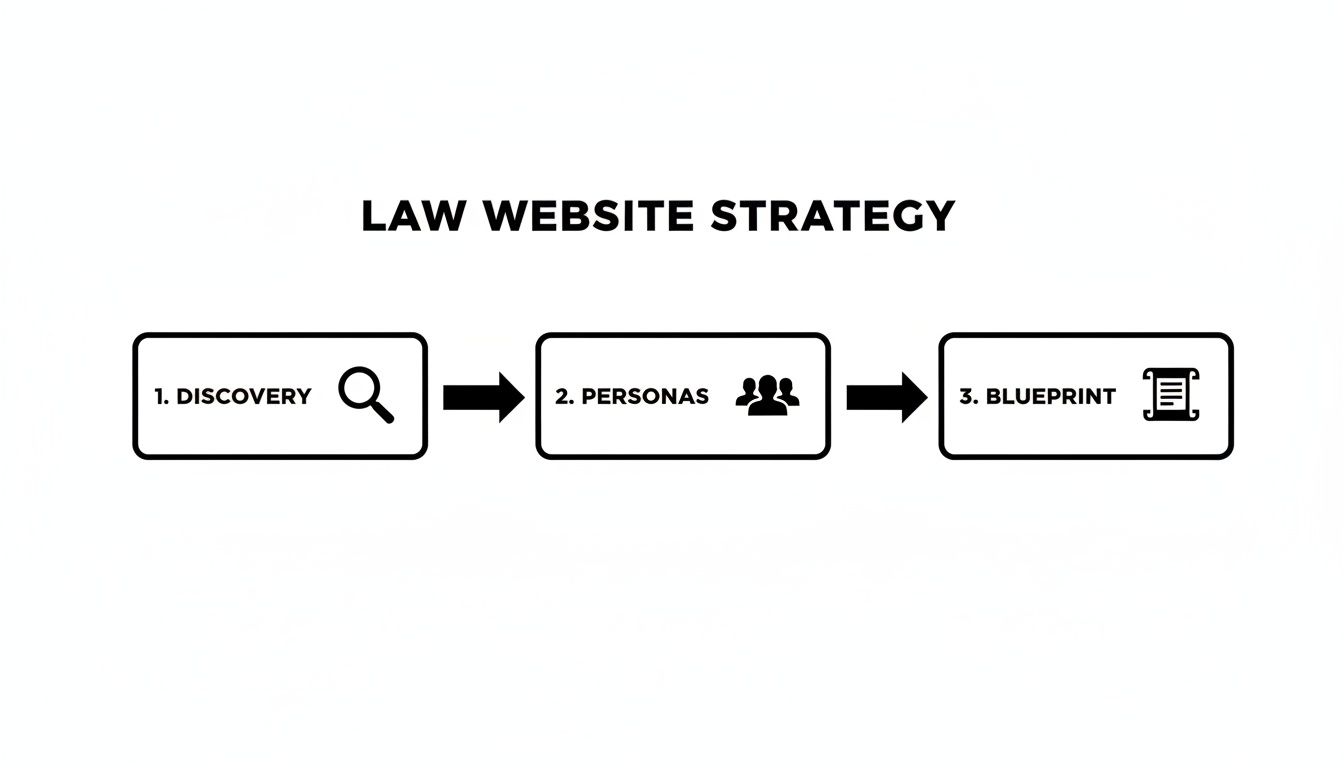
This visual makes it clear: a successful outcome is impossible without first understanding the firm's goals and the client's needs. This alignment informs every single design and development decision that follows, ensuring the final product is a powerful client acquisition tool.
To help structure this process, we use a checklist to ensure nothing gets missed.
Key Discovery Phase Checklist for Law Firm Websites
This table summarises the essential questions and tasks to complete during the initial discovery and strategy phase. Getting these right from the start is non-negotiable for project success.
| Focus Area | Key Questions to Ask | Deliverable/Outcome |
|---|---|---|
| Business Objectives | What are the top 1-3 business goals for this website? Which practice areas are the priority for growth? | A prioritised list of measurable KPIs (e.g., "Increase qualified family law leads by 20%"). |
| Target Audience | Who are the ideal clients? What are their pain points and motivations? What questions are they asking? | 2-3 detailed client personas with demographic, psychographic, and journey mapping details. |
| Brand & Positioning | What is the firm's unique value proposition? What is the desired tone and voice (e.g., aggressive, empathetic)? | A clear brand positioning statement and a one-page summary of brand messaging guidelines. |
| Competitive Analysis | Who are the top 3-5 direct competitors online? What are they doing well, and where are the gaps? | A competitive landscape report highlighting opportunities for differentiation in design, content, and SEO. |
| Content Strategy | What existing content assets can be used? What new content needs to be created to address persona needs? | A high-level content map and sitemap outlining the core pages and their primary purpose. |
| Technical Needs | Are there any required integrations (e.g., CRM, case management software)? What are the key functional requirements? | A list of technical specifications and third-party integration requirements. |
Completing this checklist provides the strategic blueprint, the single most valuable asset in any law office web design project. It ensures every font choice, piece of content, and call-to-action serves a purpose.
And the data backs this up.
In a Thomson Reuters survey of 109 Australia-based law firm clients, 64% reported that a firm's online presence was a meaningful factor in their selection process. This shows a direct line between a firm's digital footprint and its bottom line. You can learn more about these Australian legal market findings to see just how critical this is.
This initial blueprint, born from thorough discovery, ensures you're not just building a digital brochure, but a strategic tool designed to move the firm closer to its most important business goals.
Designing for Credibility and Client Conversion

When it comes to web design for the legal world, everything hinges on one thing: trust. A potential client isn’t just looking for a lawyer; they’re looking for a staunch advocate they can believe in, usually when they’re facing a deeply stressful personal or professional situation. Your design has to instantly communicate professionalism, authority, and empathy.
This is where smart user experience (UX) and user interface (UI) design become your most powerful conversion tools. The aim is to create a clean, modern aesthetic that avoids the tired clichés of gavels and scales of justice. Instead, your focus should be on building a user journey that feels reassuring, straightforward, and confident from the very first click.
The Anatomy of a High-Converting Homepage
Think of the homepage as the digital front door to the firm. You've got only a few seconds to make the right impression and answer three critical questions: What do you do? Who do you help? And how do I get in touch?
A successful law firm homepage is never cluttered. It leads with a strong hero section built around a compelling headline. You need to swap out "Established in 1998" for something that resonates, like "Protecting Your Family's Future." This headline needs to be paired with a high-quality, professional image—not a generic stock photo—that genuinely reflects the firm's ideal client.
The navigation has to be dead simple. Users should find "Practice Areas," "Our Team," and "Contact Us" without a second thought. Every single element must work in concert to remove friction and steer the visitor towards taking the next step.
Building Immediate Trust with Strategic Signals
Trust isn’t just about what you say; it’s about what you can prove. Potential clients are actively searching for signals that validate a firm's expertise and credibility. A key part of effective law office web design is strategically weaving these proof points throughout the entire site.
Your key trust signals should include:
- Detailed Barrister and Solicitor Profiles: Don't just post a headshot and a list of qualifications. Tell each lawyer's story, highlight their specific experience, and share what drives them. This humanises the firm and helps potential clients form a personal connection.
- Genuine Client Testimonials: Feature real quotes from actual clients. If you can get permission, use their full name and a photo. Video testimonials are even better because they convey authentic emotion and build a much stronger rapport.
- Prominent Case Results: Showcasing successful outcomes provides tangible proof that the firm delivers. Get specific about the challenge, the firm’s strategy, and the positive result achieved for the client.
- Awards and Accreditations: Displaying industry awards, bar association memberships, and other professional recognitions acts as third-party validation of the firm's quality and standing.
These elements shouldn't be hidden away. They need to be integrated into the homepage, practice area pages, and lawyer bios, reinforcing credibility at every stage of the user's journey.
One of the most common mistakes I see is burying these crucial trust signals on an "About Us" page. To really have an impact, they must be woven directly into the user's path as they explore the firm's services.
This is where a solid grasp of information architecture really shines. You can learn more about structuring legal content in our comprehensive guide on effective law firm website design.
Designing Practice Area Pages that Convert
While the homepage creates the first impression, the practice area pages are where the real work of conversion happens. These pages need to be structured to educate, reassure, and ultimately persuade a visitor to take action. They must be far more than a dry list of services.
A high-converting practice area page absolutely must:
- Address the Client's Pain Point Directly: Kick things off with an empathetic opening that shows you understand the visitor's problem.
- Clearly Explain the Legal Process: Use plain English, not dense legal jargon, to walk a potential client through what they can expect.
- Introduce the Relevant Legal Team: Feature the lawyers who specialise in that practice area right on the page. This connects the service directly to the expert.
- Include Specific Proof: This is the perfect place for testimonials and case results that are directly related to that specific area of law.
- End with a Clear Call-to-Action (CTA): Give them an obvious next step, like "Schedule a Confidential Consultation" or "Call Us Now for a Free Case Review."
This structure turns a simple service page into a powerful conversion funnel. It guides a user from being problem-aware to actively seeking a solution, with the firm positioned as the perfect guide.
The demand for this kind of digital-first experience is only growing. A recent report from Actionstep, which surveyed nearly 400 Australian midsize law firm professionals, found that a massive 71% cited client satisfaction as a primary growth strategy. This data highlights that a client-focused, easy-to-use website is no longer a nice-to-have; it's a core business requirement. You can read the full report on Australian law firm priorities to get a deeper understanding of this market shift.
Crafting an SEO Strategy for Australian Law Firms

Let's be blunt: a stunning website design is completely pointless if potential clients can't find it. For Australian law firms, a powerful, localised SEO strategy isn't just a nice-to-have marketing tactic; it's the most direct path to clients who are actively looking for legal help right now. If a firm isn't visible on Google, it might as well not exist online.
As an agency, your job is to get beyond the generic SEO advice. You need to build a strategy that targets the very specific phrases people in Australia are typing into search engines when they need a lawyer. This means honing in on lucrative, location-specific practice areas and positioning the firm as a genuine authority. The end goal is a consistent flow of high-intent organic traffic that converts into paying clients.
Mastering Local SEO: The First Battleground
The vast majority of clients a law firm serves will come from their local city or region. This simple fact makes local SEO the most important battleground for visibility. Your top priority has to be dominating the local search results, especially that all-important Google "map pack."
It all starts with the firm's Google Business Profile (GBP). A thoroughly optimised profile for each physical office is a massive ranking signal to Google.
- Nail the NAP Consistency: The firm's Name, Address, and Phone number (NAP) must be exactly the same on the website, its GBP, and every single online directory. No variations.
- Get Specific with Categories: Don't just pick "Law firm." Choose the most precise category, like "Family lawyer" or "Criminal justice attorney."
- Drive Client Reviews: Don't just wait for reviews; actively ask satisfied clients to leave them. A steady stream of recent, positive reviews is one of the most powerful local ranking factors.
- Use Google Posts: Regularly share firm news, articles, or updates using Google Posts. This shows Google the profile is active and provides valuable info to searchers.
Beyond the GBP, you need to build local citations. This means getting the firm listed in respected Australian legal directories and local business indexes. Think of these citations as independent verification of the firm's legitimacy and location, which builds serious authority in Google's algorithm.
Keyword Research and Building High-Value Service Pages
To attract the right people, you have to get inside their heads and figure out what they’re searching for. Good keyword research isn’t about guessing; it’s about uncovering the high-intent, location-based phrases that scream "I'm ready to hire a lawyer."
Forget about broad, vanity terms like "lawyer." You need to target specific, long-tail keywords that capture real user intent.
- 'workplace relations lawyer Melbourne'
- 'conveyancing solicitor Sydney'
- 'best family law firm Brisbane'
- 'no win no fee compensation lawyers Perth'
Once you have these target phrases, the real work begins: building dedicated service pages for each of the firm's core practice areas. These pages must be meticulously structured to rank. That means including the keyword in the URL, title tag, H1 heading, and woven naturally into the copy. The content itself needs to be comprehensive, answering every question a prospective client could possibly have about that service.
One of the most common and damaging mistakes I see is a single "Services" page with a bulleted list of everything the firm does. This is a huge SEO own-goal. Every practice area needs its own detailed, optimised page to stand a chance of ranking for valuable terms.
This focused approach clearly signals to Google that the firm is an expert in a specific legal field, dramatically increasing its chances of ranking at the top for those all-important searches.
Building Content That Screams E-E-A-T
When it comes to legal websites, Google’s concept of E-E-A-T (Experience, Expertise, Authoritativeness, Trustworthiness) isn't just a guideline; it's a strict requirement. Legal advice falls squarely into the "Your Money or Your Life" (YMYL) category, meaning Google holds these sites to an incredibly high standard. Your entire content strategy must be built to prove the firm's credibility.
You achieve this by creating genuinely helpful content that puts the lawyers' expertise on full display.
- Analysis of Legislative Changes: Publish blog posts that break down recent changes in Australian law and explain how they affect the firm’s clients.
- In-Depth Legal Guides: Create comprehensive resources on specific processes, like "A Step-by-Step Guide to Buying Property in Victoria."
- Detailed Author Bios: Lawyer bio pages can't be an afterthought. They need to be rich with detail, listing qualifications, years of experience, notable cases, and any publications.
This kind of content does far more than just target keywords. It establishes the firm as a thought leader and builds immense trust with both potential clients and search engines.
When done right, the results can be massive. For instance, the Australian legal provider Sprintlaw is a fantastic case study, reporting over 1.5 million website visitors by leaning into a strong digital strategy. You can discover more insights from their journey to see what’s achievable. By building your strategy on the foundation of E-E-A-T, you’re not just chasing rankings; you're building a sustainable asset that will attract qualified leads for years to come.
The Technical Build: Security, Accessibility, and Compliance
Putting together a website for a law firm isn't the same as building one for a local cafe. The technical side of things demands a much higher standard, with an absolutely non-negotiable focus on security, accessibility, and legal compliance. For agencies, this is where you prove your real value, delivering a site that's not just fast and reliable but is also a secure digital fortress for the firm.
Getting the technical stack right from the very beginning is the first hurdle. WordPress, with its massive ecosystem and incredible flexibility, is an outstanding choice for law firm websites—but only if it’s configured properly from the ground up. This is where a deep understanding of the platform really pays off. If you’re still weighing up the options, it’s worth digging into a detailed comparison of WordPress vs Squarespace for professional sites to see why WordPress consistently wins for customisation and security.
Choosing the Right WordPress Tech Stack
The foundation of any secure legal website starts with the hosting. Choosing a reputable, secure Australian hosting provider is something you simply can't compromise on. You should be looking for providers that include daily automated backups, proactive malware scanning, and a Web Application Firewall (WAF) as part of their standard package.
Your choice of plugins needs to be just as deliberate. A bloated site loaded with dozens of unnecessary plugins is just a security nightmare waiting to happen. When you're designing a website for a law office, a lean but powerful stack is what you're aiming for.
- Security Plugin: You absolutely must have a premium security plugin like Wordfence or Sucuri. These tools are your front line of defence, providing firewall protection, malware scanning, and monitoring for suspicious login attempts.
- Backup Solution: Never, ever rely solely on your host's backups. A dedicated solution like UpdraftPlus or ManageWP's backup tool gives you an independent, off-site safety net that you control.
- Performance Caching: A fast website builds trust instantly. A well-configured caching plugin, like WP Rocket, is essential for getting page load times under two seconds—a critical factor for both user experience and SEO.
A rigorous update protocol is just as crucial as the initial setup. Outdated plugins are the number one way hackers get in. Offering a monthly maintenance plan to keep the WordPress core, theme, and plugins updated is a vital service for any law firm client.
Essential WordPress Security and Compliance Checklist
To ensure every base is covered, a checklist can be invaluable. It helps guarantee that you’re implementing a comprehensive security posture from the start, rather than trying to patch holes later.
| Component | Action/Requirement | Recommended WordPress Tool/Plugin |
|---|---|---|
| Hosting | Secure, AU-based hosting with WAF and malware scanning. | Managed WordPress hosting like WP Engine or Cloudways. |
| SSL Certificate | Enforce HTTPS across the entire site to encrypt data. | Let's Encrypt (often free with hosting) or a premium SSL. |
| Firewall & Security | Actively block threats and scan for malware. | Wordfence Premium or Sucuri Security. |
| Backups | Daily, off-site, independent backups. | UpdraftPlus, ManageWP, or BlogVault. |
| User Access | Enforce strong passwords and implement 2FA. | Wordfence Login Security, iThemes Security. |
| Updates | Regular updates for WordPress core, themes, and plugins. | Manual updates via a maintenance plan or automated tools. |
| Data Forms | Secure forms and clear consent mechanisms. | Gravity Forms with reCAPTCHA; link to Privacy Policy. |
This checklist isn't just a to-do list; it's a foundational part of your risk management strategy for your client, demonstrating a professional and thorough approach to their digital presence.
Ensuring Web Content Accessibility Guidelines Compliance
Accessibility isn't just a 'nice-to-have' feature; it's a legal and ethical requirement. A website that’s inaccessible to people with disabilities is not only excluding a significant group of potential clients but also exposing the firm to serious compliance risks. The global standard here is to adhere to the Web Content Accessibility Guidelines (WCAG).
In practical terms, this means making sure the website is navigable and understandable for everyone, including people who use screen readers or can only use a keyboard to navigate.
Key areas to focus on are:
- Alt Text for Images: Every single meaningful image needs descriptive alt text so screen readers can explain what it is.
- Keyboard Navigation: All interactive elements—menus, links, buttons, and forms—must be fully usable with just the tab and enter keys.
- Colour Contrast: The contrast between text and its background must be high enough to be readable for users with low vision.
- Logical Heading Structure: Using H1, H2, and H3 tags correctly creates a clear and logical outline of the page for assistive technologies to follow.
Data Privacy and Australian Compliance
Finally, handling any user data requires strict adherence to Australian privacy principles. Every single place a user submits information—from a simple contact form to a detailed case evaluation form—must be secure and transparent.
This starts with implementing SSL encryption across the entire site (HTTPS), which is now a basic expectation for any professional website. More importantly, you must work directly with your client to develop a clear and comprehensive privacy policy. This document needs to spell out exactly what data is collected, how it's used, and where it's stored. All website forms must link directly to this policy, and it's best practice to add a checkbox for users to consent to the terms before they can hit 'submit'.
Building a site that is secure and compliant from day one protects your client, their clients, and your agency.
How to Scale Your Agency With White Label WordPress

Let's be honest: delivering a high-stakes law office web design project is a huge job. Between the stringent security demands, the strategic complexity, and the need for pixel-perfect execution, even the most experienced agencies can find their internal resources stretched to the breaking point.
This is a classic growth bottleneck. You’ve mastered the art of winning clients and mapping out a brilliant strategy, but the technical build itself becomes a major hurdle. It slows everything down and puts a cap on how many projects you can realistically handle.
This is exactly why smart agencies turn to white label WordPress development. It's not just a solution; it's a growth strategy.
Demystifying the White Label Model
The white label concept is brilliantly simple. You collaborate with a specialist development team that handles the entire website build for you, all under your agency's banner. Your client has no idea they're even in the picture. As far as they're concerned, it's your team doing all the impressive technical work.
This setup means you keep complete control over what matters most: the client relationship, the project's direction, and the overall strategy. You're the one leading the charge, while the intricate coding, security hardening, and technical troubleshooting are handled by a dedicated expert partner behind the scenes.
Think of it as having an on-demand, expert development department without the crippling overheads of recruitment, salaries, and management.
The real power of this model is leverage. It gives you the immediate ability to broaden your services, take on far more complex law firm projects, and pour your energy into what you excel at—strategy, growth, and client management.
You can get a better sense of how these partnerships operate by exploring the fundamentals of white label WordPress services and seeing how they help agencies scale profitably.
Finding the Right Agency WordPress Partner in Australia
Making the right choice of partner is everything. They're not all the same, and when you're working in a high-stakes niche like legal web design, you need a team you can absolutely rely on. When you're assessing a potential agency WordPress partner in Australia, there are a few non-negotiables to look for.
Your vetting process should be laser-focused on a few key areas:
- Proven WordPress Expertise: Don't just glance at their portfolio; dig into it. Ask to see examples of complex, custom builds. A team that only churns out simple template sites won't have the chops for the bespoke functionality and robust security a law firm website demands.
- Clear Communication Protocols: How do they manage projects and keep you in the loop? A solid partner will have a structured system and a dedicated contact person. Transparent, consistent communication is the bedrock of any successful white label relationship.
- Airtight Service Agreements: Your agreement needs to spell everything out—scope of work, realistic timelines, revision processes, and all costs. Crucially, it must include a rock-solid non-disclosure agreement (NDA) to protect both your agency and your client.
- Focus on Australian Standards: Working with an Australian-based partner is a massive advantage. They’ll have an innate understanding of local privacy laws, compliance issues, and hosting requirements, which is invaluable for any law office project.
By tapping into the expertise of a specialist partner, you can navigate around those technical roadblocks and scale your agency with genuine confidence. This model is your ticket to delivering top-tier law office web design services, attracting bigger clients, and ultimately building a more profitable and sustainable business.
FAQs: What Your Law Firm Clients Will Ask
Even the most straightforward law firm website project will have its share of questions. Clients (and sometimes your own team) will have queries that pop up along the way. Here are some of the most common ones we see, along with practical answers to keep your project moving smoothly.
What's the One Thing We Absolutely Must Get Right on the Homepage?
It’s easy to get lost in the aesthetics, but the single most critical element is a crystal-clear value proposition paired with an unmissable call-to-action (CTA). The moment a potential client lands on the site, they need to know instantly what the firm does, who it helps, and what to do next.
This isn't the place for subtlety. Think a bold, benefit-driven headline, simple navigation to the core practice areas, and a phone number or "Book a Consultation" button that’s impossible to ignore. All of this has to be "above the fold" – visible without the visitor having to scroll.
How Many Words Do We Need on a Practice Area Page for SEO?
There’s no magic number, but experience shows that comprehensive, high-quality content is what gets results. For a competitive practice area page, you should be aiming for a minimum of 800-1500 words.
The real goal here isn’t just to hit a word count; it's to thoroughly answer every question a potential client might have.
- Explain the legal process in plain English, not jargon.
- Showcase the specific lawyers who handle these cases.
- Add credibility with relevant client testimonials or case results.
And remember, every piece of content needs to be written for local search. Think ‘commercial litigation lawyer in Sydney’ or ‘family law specialist Melbourne’. It also needs to be structured with clear headings so a stressed-out visitor can scan it easily.
Do Lawyer Blogs Actually Work for Bringing in New Clients?
Absolutely, but only if they're done right. A blog is a fantastic tool for building authority and driving organic traffic, but its focus must be on solving client problems, not broadcasting firm news.
Nobody is searching for your latest partner promotion. They're searching for answers to their problems. A post titled 'What Are the First Steps After a Workplace Injury in NSW?' will attract far more qualified leads than a generic company update. Each article should target a specific, question-based keyword and gently nudge the reader towards making contact.
The biggest mistake we see is law firms treating their blog like a press release feed. To make it a client-generating asset, you have to think of it as a resource library that answers the real, urgent questions your ideal clients are asking Google.
Are We Responsible for Writing the Privacy Policies and Disclaimers?
This is a firm "no." Your agency's role is technical implementation, but the legal language itself must come from the client.
You need to make sure the standard legal pages—like a Disclaimer, Privacy Policy, and Terms of Use—are created and linked correctly in the website's footer. However, the law firm is entirely responsible for the content on those pages. Never, ever use a generic template you found online unless the client has personally reviewed and approved every single word.
Building standout websites for law firms takes a specialised skill set. For agencies wanting to scale their operations without taking on the extra overhead, White Label WordPress provides expert development services. We build secure, high-performing websites under your brand, letting you deliver top-tier projects while securing your profit margins. Find out more about how we can help your agency grow.