
When we talk about SEO services for Shopify, we're not just talking about generic search optimisation. We're talking about a specialised game plan built specifically to make your Shopify store more visible on Google, pull in more organic traffic, and ultimately, drive more sales. It digs deeper than standard SEO, tackling the unique quirks of the Shopify platform—things like handling product variants, optimising collection pages, and using specific apps to iron out technical kinks.
Putting your money into these services is a direct investment in your store's long-term health, profitability, and standing in the market.
Why SEO is a Non-Negotiable Investment
Look, launching a beautiful Shopify store is a fantastic first step. But in the crowded world of e-commerce, it's only the beginning. Without a consistent flow of the right kind of visitors, even the most gorgeous online shop is like a boutique tucked away in a quiet laneway with no sign.
A smart SEO strategy is what moves your store onto the high street. It puts your products right in front of the people who are actively searching for what you’re selling. This isn’t about just sprinkling a few keywords here and there; it’s about turning your Shopify store from a passive online catalogue into a powerful, revenue-generating engine. By methodically improving your site’s technical health, content, and authority, you build a sustainable source of traffic that doesn’t depend on a constantly growing ad budget.
Surviving a Crowded Marketplace
The need for a sharp SEO strategy is especially critical here in Australia. Shopify's huge popularity has created an incredibly competitive space where getting seen is everything. As of 2025, Shopify powers around 150,000 websites in Australia, placing us third globally behind the US and UK.
This explosion in growth means competition is fierce. Smart businesses know that organic search is the lifeblood of e-commerce, driving 77% of all website traffic and 68% of purchases. This contributed to a massive AU$56.07 billion in mobile commerce revenue alone in late 2024. To really get a handle on what works, you need to delve deeper into the latest Shopify SEO trends.
Think of SEO as an essential growth lever, not just another marketing expense. While paid ads deliver instant traffic, they stop the moment you stop paying. A strong organic presence, built through expert SEO, becomes a compounding asset that delivers qualified leads and sales for years to come.
Before we dive deeper, let's quickly summarise the core challenges and the direct business impact of a solid SEO strategy.
Table: Shopify SEO at a Glance The Business Impact
| Challenge Without SEO | Solution with SEO Services | Business Outcome |
|---|---|---|
| Low Visibility & Traffic | Keyword targeting & on-page optimisation | Increased organic traffic from high-intent shoppers |
| Poor User Experience | Technical SEO & site speed improvements | Better engagement, lower bounce rates & higher conversions |
| Outranked by Competitors | Authority building & strategic link acquisition | Improved search rankings for valuable product terms |
| Wasted Ad Spend | Content marketing & topical authority building | Reduced reliance on paid channels, higher ROI |
Ultimately, a well-executed SEO strategy transforms your Shopify store from an expense into a valuable, revenue-generating asset that works for you around the clock.
The Financial Imperative of Ranking High
Every single position you climb in Google's search results directly impacts your bottom line. The top result gets the lion's share of all clicks, which means if your competitor outranks you for a high-value term like "organic baby clothes australia," they are scooping up most of the customers ready to buy.
Professional SEO services for Shopify are designed to tackle this challenge head-on. A specialist will typically focus on:
- Finding high-value keywords your ideal customers are actually typing into Google.
- Optimising product and collection pages to perfectly match what users are looking for.
- Building your store’s authority and trust through quality backlinks and great content.
- Fixing technical glitches unique to Shopify that could be quietly hurting your rankings.
By investing in a targeted strategy, you’re plugging your store directly into the multi-billion dollar Australian e-commerce market, making sure you claim your rightful piece of the pie.
Understanding the Three Pillars of Shopify SEO
To really get how SEO services for Shopify can drive more sales, it helps to see the strategy as being built on three core pillars: Technical SEO, On-Page SEO, and Off-Page SEO. Each one has a specific job, but they all work together to get your store ranking higher and in front of more customers.
A great way to think about it is to imagine you're running a physical, brick-and-mortar shop.
Technical SEO is your building's foundation and infrastructure. It’s making sure the shop is structurally sound, easy for delivery trucks (or search engine crawlers) to get to, and a breeze for customers to navigate. If the doors are locked or the aisles are a mess, it doesn't matter how amazing your products are—nobody can buy them.
On-Page SEO is your in-store merchandising. This is how you artfully arrange your products on the shelves, create clear signage for your aisles, and design eye-catching displays. It’s all about guiding customers straight to what they’re looking for and convincing them that they've found the perfect item.
Off-Page SEO is your shop's reputation around town. Think word-of-mouth referrals, glowing reviews in the local paper, and mentions from popular local bloggers. These signals build trust and authority, telling everyone that your store is the place to be and encouraging more people to stop by.
This diagram helps visualise how investing in your Shopify store's SEO directly fuels the entire cycle of growth.
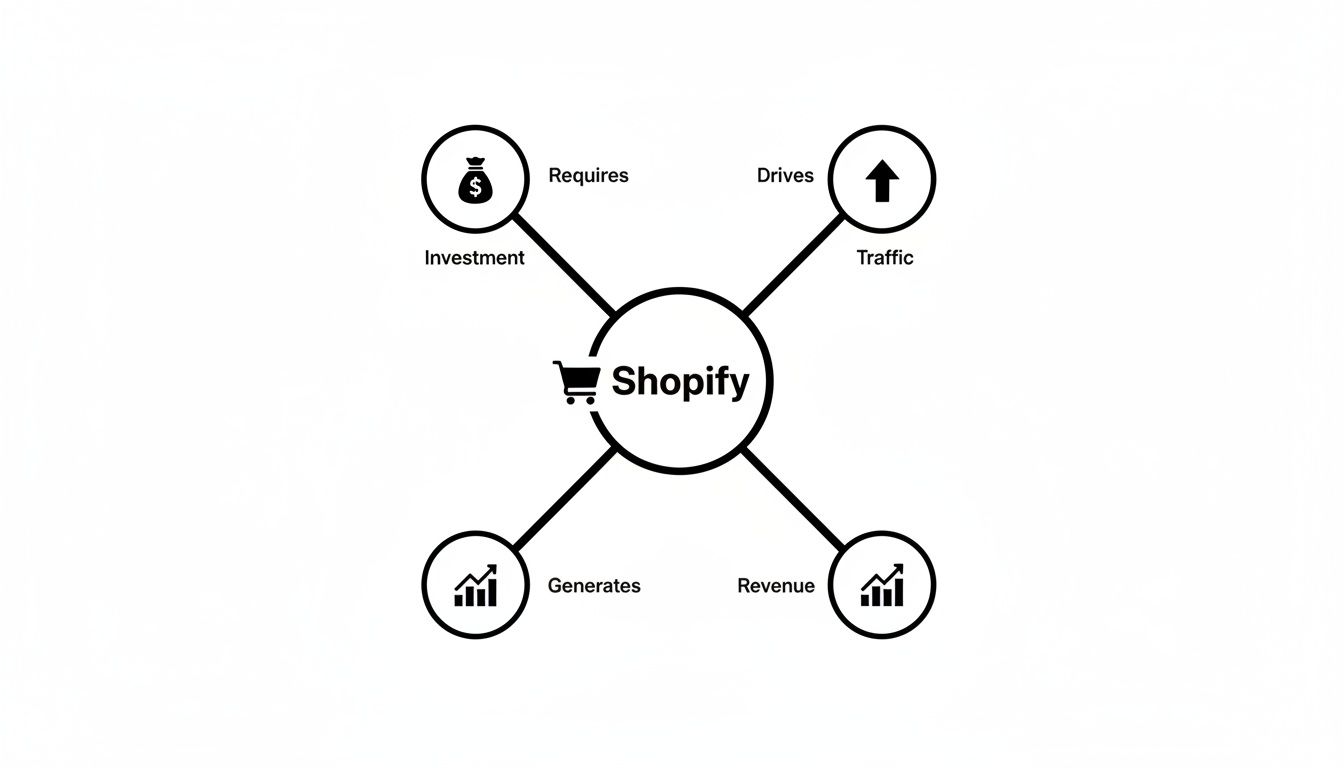
As you can see, a smart investment in your Shopify platform is the engine that drives everything. It leads directly to more traffic and, ultimately, more revenue in your pocket.
Pillar 1: Technical SEO
Technical SEO covers all the crucial behind-the-scenes work that makes your Shopify store easy for search engines like Google to find, understand (crawl), and list (index). It might not be the most glamorous part of the job, but it’s absolutely essential. If Google can't make sense of your site, even the best products and content will stay hidden.
Here are a few core tasks involved:
- Improving Site Speed: Nobody waits for a slow website. A technical audit will sniff out and fix things like clunky code or oversized images to make sure your pages load in a flash.
- Mobile-Friendliness: A huge chunk of online shopping happens on a phone. While Shopify themes are built to be mobile-friendly, customisations can sometimes mess things up. We make sure your store looks and works perfectly on any screen.
- Fixing Crawl Errors: This is about playing detective to find and fix broken links (404 errors) or any other roadblocks that stop search engine bots from exploring every page of your site.
A fast, technically sound website is the foundation of all successful SEO campaigns. Google's Core Web Vitals are a clear signal that user experience is a primary ranking factor, and technical health is the key to a positive experience.
Pillar 2: On-Page SEO
Once your store's foundation is solid, it's time to focus on what's actually on the pages. On-page SEO is the art of optimising your product pages, collection pages, and blog posts to be as relevant and persuasive as possible for both real people and search engines.
This is where sharp keyword research comes into play. You need to know the exact words and phrases your customers are typing into Google and then weave them naturally into your content.
Key on-page activities include:
- Keyword Optimisation: Placing your target keywords in page titles, meta descriptions, headings, and product descriptions where they make the most impact.
- Content Creation: Ditching the generic manufacturer descriptions and writing unique, helpful copy that sells. This also means creating blog posts that answer customer questions and catch them early in their buying journey.
- Internal Linking: Thoughtfully linking from one page on your site to another helps search engines map out your site's structure and passes authority between your pages, making the whole site stronger.
Pillar 3: Off-Page SEO
Off-page SEO is everything you do outside of your own website to boost your rankings. At its core, it’s all about building your store’s authority and credibility in the eyes of Google and other search engines.
The biggest piece of this puzzle is backlink acquisition. A backlink is simply a link from another website to yours. When a trusted, reputable site links to your store, it’s like a vote of confidence, telling Google your content is valuable.
But not all links are created equal; a link from a well-known industry blog is worth far more than one from a random online directory. The best strategies use a mix of tactics, and you can learn more about what high-quality link building services look like in our detailed guide.
When all three of these pillars work in harmony, they create a powerful and sustainable growth engine for your Shopify store. If you neglect one, the others will suffer. But get them right, and you'll set yourself up for long-term organic success.
Your Technical SEO Checklist for a Flawless Shopify Store
Think of a fast, clean, and well-structured Shopify store as the foundation of any solid SEO campaign. Technical SEO is the engine room of your e-commerce business—it’s all the behind-the-scenes work that makes it dead simple for search engines to find, understand, and rank your product pages.
While it might sound intimidating, it all boils down to one simple goal: making it effortless for Google to do its job.
When you bring in expert SEO services for Shopify, they don't just tinker with keywords. They meticulously audit and fine-tune your site’s technical health from the ground up. This checklist covers the critical tasks that turn a standard Shopify setup into a high-performance ranking machine.
Optimise Site Speed and Core Web Vitals
In e-commerce, speed is money. Seriously. A one-second delay in your page load time can lead to a 7% drop in conversions. That’s why a technical SEO specialist always prioritises site speed, focusing on Google's Core Web Vitals—the key metrics that measure real-world user experience.
Key actions for speed optimisation usually include:
- Compressing Images: Using modern formats like WebP and ensuring file sizes are as small as possible without turning your product photos into pixelated messes.
- Minifying Code: Stripping out unnecessary characters and spaces from CSS, JavaScript, and Liquid files to reduce their size.
- Leveraging a CDN: Using a Content Delivery Network to serve your site's files from servers closer to your customer, which dramatically cuts down load times.
These aren't just minor tweaks; they directly influence how Google sees your store's quality and, ultimately, where you land in the search rankings.
Tidy Up Your Site Architecture and URLs
A logical site structure is like a clear, well-lit map for both your customers and search engine crawlers. The problem is, Shopify's default settings can sometimes create long, clunky URLs, especially for products that live inside multiple collections.
A clean URL is a signal of trust and relevance. A simplified URL structure not only helps search engines understand page hierarchy but also improves the user experience, making it easier for shoppers to navigate your store.
An SEO agency will often implement strategies to simplify these URL paths wherever they can. The aim is to create short, descriptive URLs that contain the primary keyword, helping Google instantly figure out what the page is about. A well-organised site also ensures your most important pages are just a few clicks from the homepage, signalling their importance to search engines.
Implement and Validate Schema Markup
Schema markup is a special kind of code you add to your website that helps search engines understand your content on a deeper level. For a Shopify store, this is an absolute game-changer. It’s the magic behind the "rich snippets" you see in search results—things like star ratings, pricing, and stock availability appearing right under your page title.
These rich snippets make your listings pop, which can significantly boost your click-through rates. A professional Shopify SEO agency will make sure your site has:
- Product Schema: To display price, availability, and review ratings.
- Review Schema: To showcase those valuable aggregate star ratings from customers.
- Organisation Schema: To clarify your brand's details, such as your logo and contact information.
This structured data turns a standard search result into a compelling, informative ad for your product. Getting this right is a crucial step in any comprehensive e-commerce website development strategy.
Resolve Duplicate Content and Canonicals
Shopify's structure can, without you even realising it, create duplicate content issues. For instance, a single product can often be reached via multiple URLs if it exists in different collections. This confuses search engines, forcing them to guess which page is the "real" one they should rank.
To fix this, SEO experts use canonical tags. A canonical tag is a small snippet of HTML code that points search engines to the one true version of a page you want to show up in search results. By properly implementing these tags, you consolidate all your ranking power into a single, preferred URL, stopping your own pages from competing against each other. This is especially vital for managing product variants and collections, ensuring your SEO efforts aren't being diluted across a dozen identical pages.
Creating On-Page SEO and Content That Actually Converts
Once your store's technical foundations are solid, it's time to shift focus to what your customers and Google actually see: the words and images on the page. This is where on-page SEO and content creation come into play. It’s less about code and more about crafting an experience that doesn't just attract visitors, but genuinely guides them toward that "add to cart" button.
Think of your content as your best salesperson, working tirelessly around the clock. It's there to answer questions, build trust, and ultimately, close the sale.
Capturing Buyer Intent with Smart Keyword Research
Great e-commerce keyword research isn’t just about chasing terms with high search volumes. The real magic lies in understanding and capturing buyer intent—the why behind a person's search. A seasoned Shopify SEO expert knows how to spot the subtle differences in language that signal someone is just browsing versus ready to buy.
For Shopify stores, we can split search intent into two crucial categories:
- Informational Intent: People are in research mode, looking for answers. Think "best running shoes for flat feet" or "how to clean leather boots." These are gold for creating helpful blog content that builds authority.
- Transactional Intent: The user has their wallet out. Searches like "buy Nike Pegasus 40 Australia" or "shopify developer australia" show a clear desire to purchase. These are your money-making keywords, and they belong squarely on your product and collection pages.
By mapping the right keywords to the right pages, you meet customers at the exact moment they need you.
Writing Product Descriptions That Sell
One of the most common missteps on Shopify is simply copying and pasting the generic manufacturer descriptions. This is a huge missed opportunity. Not only does it create duplicate content issues that can drag down your rankings, but it completely fails to connect with your customer on a human level.
Your product description is your digital sales pitch. It should do more than list features; it must translate those features into tangible benefits that solve a customer's problem or fulfil a desire.
A product description that truly sells will:
- Lead with a benefit-driven headline that immediately grabs attention.
- Use sensory and persuasive language to help shoppers imagine themselves using the product.
- Weave target keywords naturally into the copy, headings, and bullet points.
- Break up text with bullet points so people can quickly scan the key features.
- Answer common questions before they're even asked, removing any friction to purchase.
This isn't just about ticking an SEO box; it's a direct line to improving your conversion rate.
Transforming Collection Pages into Powerful Landing Pages
Your collection pages are some of the most valuable pieces of real estate on your entire site. All too often, they're left as a simple grid of products with zero context. An experienced Shopify agency knows how to transform these pages into powerful, organic landing pages.
The trick is to add unique, keyword-rich introductory text right above the product grid. This content should set the scene, explain what the collection is all about, and guide the user on what to look for. For example, a "Men's Winter Jackets" collection could feature an intro discussing different materials, warmth ratings, and styling tips.
This simple addition turns a basic product listing into a valuable resource. It allows the page to rank for broader, more competitive search terms, pulling in customers who are just starting their shopping journey. It’s a core tactic in any effective strategy delivered by top-tier SEO services for Shopify.
How to Choose the Right Shopify SEO Partner
Picking the right partner to handle your Shopify SEO services is a huge business decision, not just another vendor to check off a list. It directly impacts your bottom line and growth trajectory. With a sea of agencies and freelancers all promising the number one spot on Google, it’s easy to get lost, waste your budget, and miss out on real opportunities.
Whether you're an e-commerce brand looking to hire an agency, or a digital agency that needs to broaden its service offering, the rules of the game are the same. You need a partner who gets the unique challenges of the Shopify ecosystem, stays laser-focused on revenue, and is completely transparent. Let's walk through how to vet a potential partner and explore the powerful advantages of the white label model.
Vetting Potential Partners: The Non-Negotiables
Before you even think about signing a contract, it's time for some serious due diligence. You need to look past the slick sales pitches and dive into the proof. A genuinely good partner will not only expect this but will have all the answers ready for you.
Here’s your essential checklist:
- Proven Shopify Case Studies: Don't just ask if they've worked with Shopify stores; ask for specific examples. You want to see hard evidence of increased organic traffic, better rankings for transactional keywords, and, most importantly, a tangible lift in online sales.
- Transparent Reporting and Communication: Find out exactly how they measure success. A trustworthy partner provides regular, clear reports that tie their work directly to your key performance indicators. The focus should be on metrics that matter, like organic conversion rates and ROI, not just traffic volume.
- A Focus on Revenue-Driven Goals: Their entire strategy should revolve around your revenue. They need to be able to articulate precisely how their technical SEO fixes, content marketing, and link-building will lead to more sales—not just vanity metrics.
Understanding the White Label Advantage
For digital, marketing, and creative agencies, the big challenge is often delivering specialised services like Shopify SEO without the massive overhead of building an in-house team. This is exactly where a white label Shopify agency becomes your secret weapon. Think of a white label partner as a silent, expert extension of your own team, delivering top-tier work under your brand.
The white label model is about so much more than just outsourcing tasks; it’s about instantly plugging a specialised, scalable department into your business. This allows an agency to offer expert-level Shopify SEO services with guaranteed profit margins, sidestepping the financial risk and management headaches of hiring full-time staff.
This approach provides a clear path to growth. Australian businesses are projected to spend a massive $1.5 billion on SEO services in 2025, which is a 12% jump from 2024. With the average small business setting aside $1,200 monthly for SEO, the demand is undeniable. For agencies, partnering with a white label provider is the smartest way to capture a piece of this market. You can offer clients proven expertise while keeping full control over the client relationship and your pricing. You can read more about these Australian SEO spending trends at localdigital.com.au.
Comparing SEO Provider Models In-House vs Agency vs White Label
To make the best call, it helps to see how the different options stack up side-by-side. While each model has its place, the white label solution presents a compelling case for agencies that are serious about scalable growth and predictable profits. For a deeper dive, you can explore how to effectively outsource digital marketing in our detailed guide.
Let's break down the three main models to see which one aligns best with your business goals.
| Factor | In-House Team | Direct Agency | White Label Partner |
|---|---|---|---|
| Cost Structure | High fixed costs (salaries, benefits, tools) | Variable monthly retainer or project fees | Predictable, fixed cost per project for resale |
| Expertise | Limited to the skills of your hires | Access to a broad team of specialists | Instant access to a dedicated Shopify SEO team |
| Scalability | Slow and difficult; requires hiring | Can scale, but may involve contract changes | Seamlessly scales up or down with your client load |
| Profit Margin | N/A (cost centre) | Variable, dependent on agency pricing | Guaranteed and predictable; you set the markup |
| Focus | Divided across internal priorities | Focused on their direct clients | Focused solely on delivering results for your agency |
Ultimately, the right choice is a partner who not only delivers outstanding results but also slots perfectly into your business model. They should empower you to grow your agency profitably and with total confidence.
Measuring SEO Success with KPIs That Matter
Investing in SEO services for Shopify is pointless if you're only tracking vanity metrics. Forget about chasing website clicks or a flurry of social media likes. The real measure of success is the cold, hard impact on your bottom line.
To make sure your SEO partner is actually delivering, you need to focus on Key Performance Indicators (KPIs) that directly map to business growth. It's time to stop getting lost in confusing dashboards and start looking at the numbers that genuinely matter.
The goal here is to get past the simple "more traffic" mindset. The real question should always be, "Is this traffic actually converting into sales?" Any transparent SEO provider, including a white label Shopify partner, will build their reporting around the KPIs that answer this question, loud and clear.
Core KPIs for E-commerce SEO
To get an accurate read on the health and profitability of your SEO campaign, your reports need to shine a spotlight on metrics tied directly to revenue. These are the KPIs that paint a clear picture of what's working and where things need a tune-up, making sure your investment is paying off.
Think of it as your essential e-commerce SEO scorecard. It must include:
- Organic Traffic Growth: This is your baseline—the number of visitors coming from non-paid search results. But it’s only half the story. It needs to be looked at next to conversion data to ensure you’re attracting qualified buyers, not just window shoppers.
- Organic Conversion Rate: Here’s where it gets interesting. This is the percentage of your organic visitors who actually make a purchase. A rising conversion rate is a fantastic sign that your SEO is pulling in the right crowd—people who are ready to buy.
- Average Order Value (AOV) from Organic Search: This KPI tells you the average amount each organic customer spends. If your AOV is climbing, it often means you're ranking for more valuable, product-specific keywords that attract customers willing to spend more.
- Organic Revenue: The bottom line. This is the total sales generated directly from your organic search traffic. It’s the most straightforward measure of your SEO campaign's financial contribution.
Tracking and Reporting Excellence
A top-tier agency that provides Shopify SEO in Australia will have your tracking sorted from day one, usually with meticulous setup in Google Analytics 4 (GA4). They’ll configure e-commerce events properly so that every single organic sale is attributed correctly, giving you a crystal-clear view of performance.
A great SEO report doesn't just dump data on you; it tells a story. It should connect the dots between the work done—like a technical fix or a new blog post—and the tangible movements in your core KPIs, explaining the 'why' behind the numbers.
At the end of the day, the most critical metric of all is your Return on Investment (ROI). It’s a simple calculation: take the revenue from organic search, subtract the cost of your SEO services, and then divide that figure by the cost of the services. A positive ROI is the definitive proof that your SEO isn't just another marketing expense—it’s a powerful engine for profitable growth.
Got Questions About Shopify SEO? We've Got Answers
We get asked a lot of questions about getting a Shopify store to rank. Here are some of the most common ones we hear from store owners, marketing managers, and fellow agencies.
How Long Until I Actually See Results?
Look, anyone promising you overnight success is selling snake oil. While you might see some quick wins from technical fixes in the first few weeks, the real, needle-moving results usually start to show up around the 4-6 month mark.
Think of it like building a house. The technical fixes are the foundation—essential, but not the whole picture. It takes time for search engines to properly crawl and index those changes, for new content to start gaining traction, and for your backlink profile to mature. SEO is a marathon, not a sprint, but it builds a powerful, long-term asset for your business.
Can I Just Do My Own Shopify SEO?
You absolutely can, and you should! Things like writing compelling product descriptions or creating a blog post are great places to start.
But where a professional service comes in is the strategy, the high-powered tools, and the sheer amount of time it takes to do it right. An expert knows the technical pitfalls of the Shopify platform and can build a comprehensive strategy that a busy store owner simply doesn't have the bandwidth for. If you're serious about growth, bringing in a Shopify SEO expert is less of an expense and more of an investment in your store's future.
Isn't SEO Just SEO? Why Does Shopify Matter?
While the fundamentals of SEO—good content, quality links, technical soundness—are universal, Shopify has its own unique quirks. A generalist SEO might not know how to handle the duplicate content issues that pop up from product variants or how to best structure collections and tags for search engines.
It's a specialised field. You need someone who knows the platform inside and out, from the best apps to use (and which ones to avoid) to the nuances of Shopify’s URL structure. That's the kind of focused expertise a dedicated Shopify agency in Australia brings to the table, and it can make all the difference.
Ready to give your store the expert SEO treatment it deserves? White Label WordPress delivers specialised white label Shopify services that drive serious traffic, increase conversions, and guarantee profit margins for your agency.