

Let's be blunt: in today's legal market, a subpar website isn't just a missed opportunity—it's a liability. Your firm’s website is your digital front door, and for many potential clients, it’s the very first impression they'll have of your practice. It has to be professional, trustworthy, and built from the ground up to convert visitors into genuine, qualified leads.
Your Website Is Your Most Critical Asset
Think of your website as more than just a digital brochure. It’s the primary engine for your firm's growth, the guardian of your reputation, and a tool for making your operations more efficient. In a market where every click can mean a new client, a strategic online presence is directly tied to your bottom line and the trust you build.
An outdated, slow, or confusing site actively pushes potential clients away. People expect seamless digital experiences, and if they don't find one with you, they'll find it with your competitor down the street. On the flip side, a high-performing website gives you a massive advantage, helping you stand out in crowded legal markets like Sydney and Melbourne and cementing your firm as the authority in its field.
The Foundation of Client Trust and Growth
Your website is the central hub where you attract your ideal clients, showcase your expertise, and make your intake process a breeze. This is where people—often in a state of distress—come looking for answers. They’re evaluating your credibility and deciding if you're the right team to handle their sensitive legal issues. A professional design, clear messaging, and intuitive navigation are the absolute basics for building that initial confidence.
The numbers don't lie. In the competitive Australian legal market, 71% of midsize firms are zeroing in on client satisfaction as their main growth strategy. That client-first mindset has to extend online, especially when 53% of mobile users will ditch a site if it takes longer than three seconds to load. We've seen firsthand that firms investing in responsive, user-friendly design experience growth that mirrors the 3.2% firm-wide increase in demand. The link between a great digital presence and business success is undeniable. You can dig deeper into these trends in the 2025 Australian Midsize Law Firm Priorities Report.
A law firm's website is its most important salesperson. It works 24/7, never sleeps, and is often the deciding factor between a client contacting you or moving on to a competitor.
This guide is for agencies and firms ready to get serious about building websites that actually work. We're going to move past the superficial stuff and get into the essential components that turn a standard website into a powerful client acquisition machine.
Core Pillars of a High-Performing Law Firm Website
To build a site that delivers real, measurable results, you need a solid foundation. We've found it comes down to four interconnected pillars. Get these right, and everything else falls into place. Each one is crucial for turning your digital presence into a powerhouse.
| Core Pillars of a High-Performing Law Firm Website |
| :— | :— | :— |
| Pillar | Objective | Key Impact |
| Strategy | Define goals, ideal clients, and competitors. | Ensures every design and content decision is data-driven and aligned with business growth. |
| Experience | Build trust through intuitive design and clear content. | Cultivates credibility and guides visitors seamlessly from discovery to consultation. |
| Visibility | Attract qualified traffic through SEO and local search. | Dominates search results, making your firm the go-to choice for clients in your area. |
| Compliance | Ensure security, accessibility, and legal adherence. | Protects client data, builds trust, and mitigates legal risks. |
Nailing these four areas is the difference between a website that just sits there and one that actively grows your firm. They work together to create a seamless journey that attracts the right people and convinces them you're the only choice.
Laying the Strategic Foundation for a Winning Website
A high-performing law firm website isn't just about sharp design and a slick logo. The real work, the work that turns a website from a digital brochure into a client-generation machine, starts long before anyone even thinks about colours or code. It all begins with a solid digital strategy. Without this blueprint, you're essentially flying blind, building something that might look impressive but fails to deliver what a law firm actually needs: more clients.
The first move is to ditch vague goals like "get more leads." That's not a strategy; it's a wish. A real objective sounds more like this: "increase qualified consultation requests for our family law practice by 30% within six months." See the difference? That level of clarity puts the entire project on rails, focusing every decision on a measurable business outcome.
Who Are You Actually Talking To? Defining Client Personas
Law firms don't serve everyone. They serve specific people with very specific, often urgent, legal problems. You have to get inside their heads. This means developing detailed client personas for each key practice area, going way beyond simple demographics.
Think about a firm that handles both corporate litigation and family law. The ideal clients for these services are worlds apart. The corporate client could be a CTO in Melbourne worried about an IP dispute, while the family law client might be a parent in Perth navigating a tough custody battle. Their fears, their motivations, and what they need to see from a lawyer are completely different.
Getting this right dictates the website's tone, its imagery, and the entire user journey. The CTO needs to see commercial savvy and a track record of winning complex cases. The parent needs to feel understood and reassured, looking for clear, empathetic guidance through a difficult time.
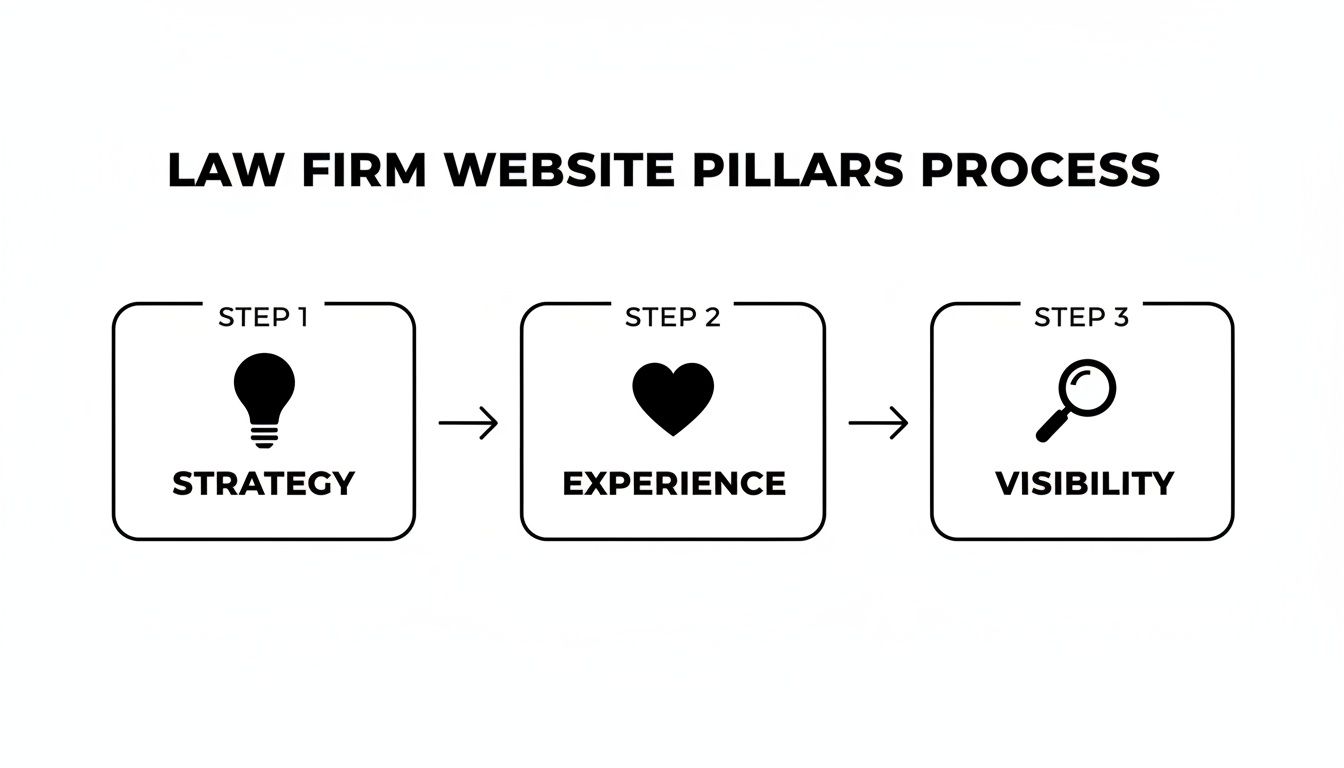
This process visualises how a well-thought-out strategy is the foundation that supports the entire user experience and visibility plan. Get this first step wrong, and the other pillars will crumble.
Mapping the Path from Search to Signature
Once you know who you're talking to, you need to map out their journey. A potential client's path through the website should feel intuitive and seamless, gently guiding them from their first panicked Google search right through to making contact.
It usually looks something like this:
- Awareness: They find the firm through a search like "commercial litigation lawyers Sydney."
- Consideration: On the site, they dig into the relevant practice area pages, check out the lawyers' bios, and scan case results to see if the firm has the right kind of experience.
- Decision: Convinced, they look for the next step. A clear, easy-to-find call-to-action button to book a consultation makes this final step effortless.
Each stage of this journey requires the right content and design cues to build trust and keep the momentum going.
Sizing Up the Competition
Your client’s firm doesn’t exist in a bubble. A proper competitor analysis isn't about copying what others are doing; it’s about finding the gaps and opportunities they've missed. Take a hard look at the top-ranking firms in your client's city and practice areas.
I see agencies make this mistake all the time: they only look at a competitor's homepage. You have to go deeper. Dissect their entire digital footprint—their service pages, blog content, how they handle calls-to-action, and especially their mobile experience. What are they doing well that you can learn from? And more importantly, where are they dropping the ball?
Dig into their websites with these questions:
- What's their core message? Is it clear and compelling?
- How are they using social proof like testimonials or case studies?
- Is their site actually usable on a phone? A staggering 61% of people will ditch a site if they can't find what they need right away on mobile.
- What keywords are they ranking for that you’re not even targeting yet?
This upfront strategic work is absolutely non-negotiable. It ensures the law firm web design is built on a foundation of data and clear business goals, not just aesthetics. By investing in strategy first, you set the stage for a website that doesn't just look professional, but becomes an active asset for the firm's growth.
For agencies, this is where you prove your value and set realistic expectations. Bringing in a trusted white label WordPress designer at this stage can also be a game-changer, ensuring the strategic vision is sound and technically achievable from the get-go.
Designing an Experience That Builds Trust
When someone is looking for a lawyer, they're often in a vulnerable spot. Trust isn't just a nice-to-have; it's everything. A law firm's website is far more than a digital brochure. It’s the very first handshake, the initial vibe check that can make or break a potential client relationship before it even begins. Your design choices need to show a visitor, instantly, that they’ve found a professional, empathetic, and authoritative team.
This all starts with making the site dead simple to get around. No one should ever have to hunt for the information they need. Think clear, logical paths to your team's profiles, detailed practice area pages, and tangible proof that your firm gets results. If someone needs a family lawyer, they should be able to find that section in a click, not get lost in a sea of corporate litigation content.

Translating Legal Expertise into Client Confidence
One of the most common pitfalls I see is law firms writing content for other lawyers. Your website's copy needs to connect with real people. That means dropping the dense jargon and translating complex legal ideas into clear, reassuring language that focuses on the problems you solve for them.
This same people-first thinking applies to your visuals. High-quality, professional photos of your actual legal team are a must. It puts a human face on the firm and makes your lawyers feel approachable. Generic stock photos? They do the opposite, creating a sense of distance and eroding the very trust you’re working so hard to build.
Your website's design must answer a client's unspoken questions: "Do you get my problem?", "Can I trust you to handle this?", and "Are you the right people for me?" Every single element should work together to give them a resounding "yes."
Let’s not forget the Australian legal market is incredibly concentrated. There are roughly 13,000 practising lawyers in major firms, with 40% based in Sydney and almost 50% in Melbourne and Brisbane combined. This density makes a strong online presence crucial. Your website has to serve your local area but also be capable of reaching beyond the city limits to tap into the 9.3% demand growth we’re seeing across major practices. As highlighted by data from Pirical.com, a mobile-friendly, trustworthy site can turn this urban concentration into a nationwide opportunity.
The Power of Social Proof and Credibility Markers
Telling people you're great is one thing; showing them is what really counts. Weaving social proof throughout your site is one of the fastest ways to build that instant credibility.
Focus on featuring these elements front and centre:
- Client Testimonials: Written quotes are good, but video testimonials are gold. Seeing and hearing from a real, satisfied client creates an emotional connection that text just can’t replicate.
- Case Results: Showcase your track record. You don’t need to breach confidentiality—just provide clear, concise summaries of the challenges you’ve overcome and the successful outcomes you’ve secured for clients.
- Awards and Credentials: Displaying bar association memberships, industry awards, and certifications works. These visual badges act as powerful third-party endorsements of your firm's expertise.
When you combine clear language, professional visuals, and compelling proof, you transform a standard website into a genuine trust-building machine. It tells potential clients they've found a credible, capable advocate they can count on.
Choosing the Right Platform to Build On
The technical nuts and bolts of your website also have a massive impact on the user experience. A slow, clunky, or insecure site will immediately make a potential client second-guess their decision. That’s why your choice of content management system (CMS) is so foundational.
Platforms like WordPress give you the flexibility and power to build a truly custom, professional experience. Its massive ecosystem means you can integrate crucial features like secure client portals or sophisticated intake forms—things that are vital for a modern law firm. To see how it stacks up, check out our guide on WordPress vs Squarespace for professional websites. Making the right platform choice from the start ensures your site can grow with the firm, delivering a seamless and trustworthy experience for years to come. For firms considering e-commerce functionality, a woocommerce developer in Australia can seamlessly integrate secure payment systems.
Attracting Clients with Smart SEO
A stunning website that no one can find is like a billboard in the desert. For a law firm, being visible isn't just a nice-to-have; it's the only way to connect your expertise with the clients who desperately need it. This is where a sharp, targeted search engine optimisation (SEO) strategy becomes your most powerful marketing tool. It’s how you get your firm in front of the right people at the precise moment they’re searching for help.

The entire foundation of good SEO for a law firm is built on understanding client intent. You have to get inside the head of someone facing a legal issue. They aren't just typing "lawyer" into Google. Their searches are specific, localised, and often driven by a sense of urgency. Your job is to meet them right there with content that signals to search engines that your firm is the most relevant answer to their problem.
This all starts with deep keyword research—figuring out not just the high-volume terms but, more importantly, the specific long-tail phrases that signal a user is ready to make a call.
Mastering Keyword Research for Your Practice Areas
Think of keywords as the exact language your clients are using to describe their problems. Your website needs to speak that language fluently. It’s a delicate balance between targeting broad, competitive terms and zeroing in on those highly specific, intent-driven phrases.
For example, a broad keyword is something like:
- Commercial litigation Sydney
But a much more specific, long-tail keyword looks like this:
- Urgent legal advice for commercial lease dispute Melbourne
That second search query shows a completely different level of intent. That person needs help, and they need it now. When you create content that specifically answers these detailed searches, you attract visitors who are far more likely to become paying clients. Tools like Ahrefs or SEMrush are invaluable here, helping you discover what people are actually searching for and how hard it will be to rank for those terms.
On-Page SEO Essentials for Law Firms
Once you've identified your target keywords, the next step is to weave them strategically into your website's pages. This isn't about clumsy keyword stuffing; it’s about creating high-quality, genuinely helpful content that naturally incorporates your key phrases.
Pay close attention to these key on-page elements:
- Title Tags and Meta Descriptions: These are your website's sales pitch in the search results. They need to be compelling, include the page's primary keyword, and make someone want to click.
- Practice Area Pages: Every single practice area needs its own dedicated page. These pages must thoroughly explain the services you offer, detail the types of cases you handle, and answer common questions clients have.
- Lawyer Bios: Believe it or not, these are often the most visited pages on a law firm's site. Optimise them with each lawyer’s specific areas of expertise and location to build both authority and local relevance.
A classic mistake we see is lumping everything under a generic "Services" page. To rank effectively, you absolutely need detailed, individual pages for 'Family Law', 'Criminal Defence', and 'Estate Planning'. Each page has to stand on its own as a comprehensive resource, proving your firm is an authority on that topic.
Dominating Local Search Results
For most law firms, the client acquisition battle is won or lost at the local level. Someone in Adelaide isn't looking for a lawyer in Brisbane. That’s why local SEO is completely non-negotiable.
Your Google Business Profile (GBP) is your single most important local SEO asset. It's that information panel that pops up in Google Maps and the local search results. A fully optimised profile is essential—it needs your correct address, phone number, hours, a list of services, and plenty of high-quality photos.
Beyond your GBP, a steady stream of positive client reviews is crucial. Reviews are a massive trust signal, not just for potential clients but for Google’s algorithm too. Make it a habit to encourage satisfied clients to share their experiences online. Finally, consistent local citations—mentions of your firm's name, address, and phone number on reputable local directories—help cement your geographic authority. A strong backlink profile is another pillar of authority; you can explore professional link building services to strategically grow your site's credibility over time.
By building these on-page and local SEO tactics directly into your law firm web design, you’ll have more than just a website. You’ll have a powerful, automated client-attraction system that works for you around the clock.
Getting the Technicals Right: Security, Compliance, and Performance
When you're building a website for a law firm, getting the technical side of things right isn't just a nice-to-have—it's everything. A law firm's digital presence has to be a fortress. It needs to be an accessible, welcoming space for everyone and, critically, it must be lightning-fast. These aren't just features; they're the foundational pillars that separate a professional, client-winning website from one that gets ignored.

Think about it from the client's perspective. The moment they land on a website, an unspoken trust begins. This trust is amplified tenfold when they fill out a contact form with sensitive personal details. Solid security is the bedrock of this relationship. Sure, every site needs an SSL certificate for encryption, but for a law firm, security must go much deeper. We're talking about actively protecting against data breaches and ensuring every piece of data is handled in strict compliance with Australian privacy laws.
Making the Digital Doorway Accessible to All
Web accessibility isn't some ethical checkbox; it's a legal and commercial necessity. Building a site to meet the Web Content Accessibility Guidelines (WCAG) ensures people with disabilities can use it effectively. This isn't just about avoiding legal trouble—it’s about opening the firm’s doors to a wider pool of potential clients.
A truly accessible website sends a powerful message of inclusivity, something that really resonates with people. Key things to get right include:
- Alternative Text for Images: Writing clear, descriptive alt text is crucial so screen readers can properly interpret visual information.
- Keyboard Navigation: The entire site must be fully navigable without a mouse. Can you tab through every single interactive element in a logical order?
- Sufficient Colour Contrast: Don't just pick colours that look good. They need to meet contrast ratios so that users with low vision can read everything easily.
Ignoring accessibility is like locking the door on a significant part of the population who need and deserve equal access to legal help.
The Undeniable Need for Speed and Performance
A website's performance is a direct reflection of the firm's professionalism. A slow-loading page is more than just an annoyance; it sends a signal that the firm might be outdated or doesn't value the user's time. We’ve all seen the stats: even a one-second delay in page load time sends bounce rates soaring.
A fast, secure, and compliant website is the digital equivalent of a well-organised, professional law office. It instantly communicates competence and respect for the client's time and privacy, setting the stage for a positive relationship.
For any law firm, speed influences everything—from the user experience and SEO rankings to the firm's brand perception. Slow sites get penalised by Google and quickly abandoned by potential clients. This makes WordPress speed optimisation Australia a non-negotiable part of any law firm web design project. And it doesn't stop at launch. Ongoing technical upkeep is vital, which is why partnering with specialists for regular WordPress maintenance is a smart move to keep the site secure, updated, and running at peak speed.
While a whopping 71% of firms say client satisfaction is their top priority, there's often a massive technology gap preventing them from delivering it. A modern website closes that gap. The 2025 Solo Small Firm Report from Clio highlights that while only 5% of midsize firms have implemented AI across their organisation, 52% are actively looking for tech to improve efficiency. A fast, secure, and compliant website is the perfect foundation for integrating tools like AI-powered chatbots or secure client portals, allowing firms to finally meet modern client expectations.
How to Scale Your Agency with White Label Partners
Working with law firms is a fantastic niche, but let's be honest—it comes with a unique kind of pressure. They expect (and deserve) bulletproof security, total compliance, and a level of polish that leaves zero room for mistakes. When you're trying to manage those high stakes against scope creep, impossible deadlines, and your own team's bandwidth, profit margins can get squeezed pretty thin.
This is exactly where a smart partnership can completely change the game for your agency.
Rather than running your internal team ragged, you can bring in a specialist. A white label WordPress development partner becomes a silent, invisible extension of your own team. They handle all the heavy lifting on the technical side, while you stay firmly in the driver's seat, managing the client relationship and overall strategy. It’s a proven model that lets you scale without the headache and overhead of hiring more full-time developers.
The Real-World Benefits of Outsourcing the Build
The biggest immediate win? You get instant access to a team of specialists. A top-notch agency WordPress partner in Australia lives and breathes this stuff daily. They know the ins and outs of building secure, fast-loading sites for highly regulated industries. This means you can confidently sell and deliver a premium product without having to become a WordPress security guru yourself.
Beyond the expertise, the operational and financial upsides are massive:
- Slash Your Overhead: You skip the hefty costs of salaries, benefits, and ongoing training for an in-house dev team. You simply pay for development when you have a project that needs it. Simple.
- Speed Up Your Timelines: A dedicated white label WordPress agency has its process dialled in. They build efficiently, which translates to faster project turnarounds, happier clients, and—best of all—the capacity to take on more work.
- Focus on What You Do Best: When you hand off the technical build, your team gets to focus on the high-value work: client strategy, branding, content, and marketing. These are the areas where you truly shine and build those long-term client relationships.
Partnering with a white label provider isn't about giving up control. It’s about gaining leverage. You get to offer enterprise-level technical work while keeping your energy focused on client success and growing your agency.
Choosing and Working with the Right Partner
Finding the right fit is everything. You're not just looking for a coder; you're looking for a partner. Seek out an Australian-based team that truly gets the agency world—our deadlines, our clients, our need for clear communication. They should feel like a genuine extension of your team, not just a vendor.
When you outsource WordPress development Australia, you’re making a strategic investment in a system that protects your margins and fuels your growth. It’s the move that allows you to confidently say "yes" to those bigger, more complex law firm website projects, knowing you have a dedicated technical crew ready to execute flawlessly behind the scenes.
Your Top Questions About Law Firm Web Design Answered
When you're building websites for law firms, a few questions always pop up. Clients want to know about cost and timelines, and you need to have solid answers ready. Let's break down some of the most common queries we see.
How Much Does a Law Firm Website Cost in Australia?
The truth is, it varies wildly. A simple website built from a template might only set a firm back a few thousand dollars. On the other end of the spectrum, a large, completely custom WordPress development Australia build with features like secure client portals or complex intake systems can easily run north of $25,000.
What really drives the price are things like design complexity, the number of unique page templates needed (think a different layout for each practice area), and any special functionality. The key is to frame this not as a cost, but as an investment. A well-built website isn't an expense; it's a client-generating machine.
What Are the Must-Have Pages for a Law Firm Website?
Every solid law firm site needs a core set of pages to build trust and encourage potential clients to reach out. While you can always add more, these are the absolute non-negotiables.
Get these pages right, and you’re on your way:
- Homepage: The digital front door. It needs to immediately answer "Who do you help?" and "Why should I choose you?"
- Our Team / Lawyer Profiles: People hire people, not logos. Professional photos and well-written bios that showcase expertise and personality are critical.
- Practice Area Pages: These are your money pages. Each one needs to go into detail about a specific service, speaking directly to the client's pain points.
- Blog / Resources: This is where you prove your expertise. It’s also a powerhouse for SEO.
- Contact Us: Make it ridiculously easy to get in touch. Include a form, phone number, email, and a map.
- Case Results / Testimonials: Nothing builds trust faster than social proof. Showcasing successful outcomes and positive client feedback is pure gold.
How Long Does It Take to Build a Law Firm Website?
For a professional, custom law firm website, you should plan for a 6 to 12-week timeline. This gives you enough breathing room for all the essential stages: initial discovery, strategy, design, development, content loading, revisions, and the final launch.
The biggest variable in any project timeline? The client. Getting prompt feedback and all the necessary content—like lawyer bios and detailed practice area text—is the single most important factor in keeping a project moving forward and hitting that launch date.
Is WordPress a Good Platform for Law Firms?
Absolutely. In fact, it’s an excellent choice. WordPress is incredibly flexible, making it just as suitable for a solo practitioner as it is for a national firm with multiple offices.
When it’s built by a team that knows what they’re doing, a WordPress site is secure, fantastic for SEO, and surprisingly easy for the law firm’s staff to manage. They can update content, publish articles, and add new pages without having to call a developer every time. It’s the perfect foundation to support a firm's growth for years to come. For specific needs, it's often best to hire a WordPress developer in Australia who understands the local market.
At White Label WordPress, we help agencies deliver stunning, high-performance websites for their law firm clients. Our expert team takes care of the entire technical build, so you can focus on strategy and client relationships while keeping your margins healthy. Find out more at https://whitelabelwordpress.com.au.