Building a law firm website that actually wins business goes way beyond just making something that looks good. It's about creating a strategic asset that pulls in the right kind of clients and generates real, qualified leads. That whole process kicks off with a deep-dive discovery phase, long before anyone even thinks about design mockups or writing a single line of code.
Laying the Strategic Foundation for a High-Performing Legal Website
Honestly, the most critical part of any law firm website project is the foundational discovery and strategy phase. This is where we stop talking about aesthetics and start translating the firm’s real-world business objectives into a digital blueprint that’s geared for lead generation from the ground up.
Trying to skip this part is like building a house without plans or a foundation. It might look okay on the surface, but it's guaranteed to have serious structural problems and won't stand up to scrutiny. A truly successful website is built on a rock-solid understanding of the firm's unique value, who their ideal clients are, and what they need the website to do for the business.
Defining the Project Scope and Commercial Goals
The very first thing to do is sit down with the key stakeholders. This isn't just a casual chat; it's a structured interview process designed to dig into the core drivers of their business. We need to ask the right questions to get past vague requests like "we just need a new website."
Here’s what I typically ask to get to the heart of the matter:
- Which practice areas are your most profitable? Which ones do you want to grow?
- Paint a picture of your ideal client. Is it a large corporation, a small business owner, or an individual in crisis?
- What's the number one commercial goal here? Are we trying to increase qualified family law enquiries by 20%, or is the aim to become the go-to authority for commercial litigation?
- How are you getting leads right now? How should this new website improve on that process?
The answers to these questions form a concrete project brief. This document gets everyone on the same page, ensuring every decision we make from here on out directly supports a measurable business outcome.
Understanding the Target Audience and User Journeys
Once the goals are crystal clear, we pivot to focus entirely on the end-user. You have to map out the different journeys for each type of client persona. Think about it: the path a corporate counsel takes when researching a multi-million dollar litigation partner is completely different from someone frantically searching for a criminal defence lawyer on their phone at 2 AM.
Mapping these journeys means getting inside their heads. What are their immediate questions and pain points? What information do they absolutely need to see to feel confident? This process directly shapes the site’s architecture and content strategy, making sure we provide instant answers and clear, obvious pathways to get in touch.
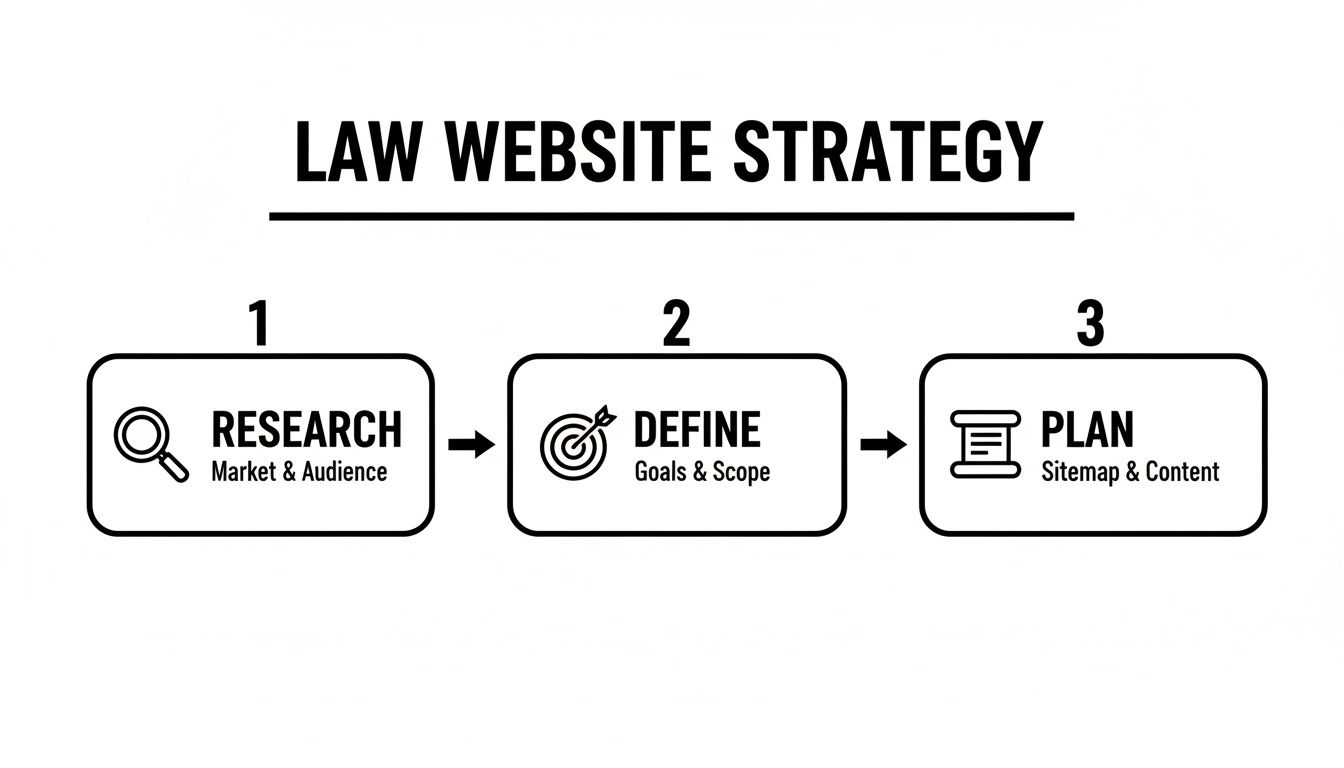
When you follow this kind of strategic flow, you're guiding the development with data and objectives, not just guesswork.
Analysing the Competitive Landscape
Finally, no strategy is complete without a thorough competitor analysis. You need to identify the top-ranking firms in your client's specific practice areas and local markets. Then, pull their websites apart to see what they're doing right and where they're falling short. How good is their content? Is their site easy to navigate? Where are the gaps you can drive a truck through?
This isn't about copying what the competition does. It's about understanding the digital benchmark in their market and then strategically positioning your client's website to be more authoritative, trustworthy, and user-friendly. You're setting the stage for them to become the market leader, not just another player.
This kind of strategic investment is becoming the norm. Recent Australian legal market reports highlight that firms are seriously boosting their tech and marketing spend as a core growth strategy. In fact, marketing and business development was the fastest-growing expense, with a combined 8.6% increase per lawyer in technology-related spending. This is driven by clear metrics, as 71% of mid-size firms now prioritise client satisfaction to protect revenue, making their websites a crucial tool for both service and acquisition. You can explore more details on Australian legal market trends in the full report.
With your strategy and content plan locked in, it’s time to bring the law firm’s website to life visually. This is where you move from abstract ideas to a tangible design that has one primary job: build immediate trust.
Remember, someone looking for a lawyer is often in a pretty stressful situation. Your design choices need to instantly tell them, "You're in the right place. We are competent, professional, and can help you."
Every detail matters here. The colour scheme, the fonts, even the style of photography—they all send a message. A modern family law practice might go for a clean, approachable look with softer blues and candid team photos. On the other hand, a top-tier corporate litigation firm will likely lean into a more traditional aesthetic with deep navy blues, classic serif fonts, and formal headshots to project authority and decades of experience.
Forging a Professional and Trustworthy Visual Identity
Think of the website's visual elements as the first handshake. They need to work in harmony to create a feeling of reassurance and credibility from the very first glance.
Here’s what to focus on:
- Colour Psychology: There's a reason blues and greys dominate the legal sector—they project trust, stability, and professionalism. The trick is to use them in a way that feels unique to the firm's brand, not just another cookie-cutter template.
- Typography: Readability is everything. If potential clients can't easily read about the firm's services, they'll just leave. Stick to clean, legible fonts like Lato or Open Sans. For a more classic feel, a serif font like Merriweather works wonders. The right font makes the content itself feel more credible.
- Professional Photography: This one is a non-negotiable. Stock photos are a massive red flag and instantly kill credibility. Investing in professional headshots and real office photos shows visitors the actual people they'll be working with, making the firm feel far more human and trustworthy.
Prioritising a Flawless Mobile-First Experience
Let's be clear: a mobile-first approach to law firm website development isn't optional anymore. So many potential clients start their search for legal help on their phones, often while on the go or in an urgent situation. If your site is a clunky, hard-to-navigate mess on a small screen, they're gone.
The stats don't lie. Mobile performance is a huge deal for Australian users, where 53% of mobile visitors will ditch a site if it doesn’t load in three seconds. What’s more, about 50% of people would rather use a company's mobile site than download an app, so that mobile web experience has to be spot on. We've seen it time and again in our own projects—when you overhaul a site to focus on mobile speed and usability, the leads and contact form submissions follow.
A great mobile experience is so much more than just a responsive layout that shrinks to fit a screen. It’s about rethinking the entire user journey for someone on a phone.
The goal is to make it incredibly easy for someone on their phone to find answers and get in touch. This means large, touch-friendly buttons, simplified navigation menus, and contact forms with minimal fields. Every element should be designed to reduce friction and guide the user toward making contact.
To get this right, you need to bake in core features that are all about conversion. For a deeper dive, check out our guide on law firm website design: https://whitelabelwordpress.com.au/law-firm-website-design/
Core Website Features for Law Firm Client Conversion
To build a website that doesn't just look good but actively generates leads, you need to integrate specific features designed for conversion. Here’s a look at the essentials and why they work.
| Feature | Primary Purpose | Key Performance Indicator (KPI) |
|---|---|---|
| Click-to-Call Buttons | Enable instant contact for mobile users, removing the barrier of manual number entry. | Number of inbound calls from the website |
| Simplified Contact Forms | Reduce friction in the lead capture process by asking for only essential information. | Form submission conversion rate |
| Practice Area Pages | Provide detailed, SEO-optimised information that demonstrates expertise and relevance. | Organic traffic and rankings for key terms |
| Client Testimonials | Build social proof and trust by showcasing positive feedback from past clients. | Time on page, bounce rate reduction |
| Attorney Profiles | Humanise the firm and highlight the experience and qualifications of individual lawyers. | Engagement with bio pages, direct enquiries |
By thoughtfully integrating these features, you transform the website from a simple online brochure into a powerful, 24/7 business development tool for the law firm.
Technical Development and SEO Best Practices on WordPress
Right, you’ve got your strategy locked in and a killer design ready to go. Now comes the technical build—the part where we turn all that planning into a living, breathing website. When it comes to law firms, there's a reason almost everyone lands on WordPress. It hits that sweet spot of flexibility, power, and SEO potential that a competitive legal practice absolutely needs.
Sure, platforms like Squarespace have their uses, but for serious law firm website development, they just don't offer the same level of control. If you want to dig deeper into the specifics, our detailed comparison of WordPress vs. Squarespace breaks down why WordPress's open-source framework is the only real choice for building a bespoke, high-performance site without hitting a ceiling.
But here’s the thing: just choosing WordPress isn’t a magic bullet. How you build on it is what separates a fast, secure, and SEO- powerhouse from a sluggish, vulnerable site that never ranks.

Custom Development Over Off-the-Shelf Themes
It’s always tempting to grab a cheap, pre-built theme to save a bit of time and money, but for a law firm, this is a classic mistake. These off-the-shelf themes are often crammed with pointless features, bloated code, and scripts you will never touch. This bloat doesn't just kill your site speed; it opens up a whole host of security holes.
The professional standard is a custom WordPress theme, built from the ground up specifically for the firm. This way, the website contains only the code it needs to do its job. The result? A leaner, faster, and dramatically more secure website that truly represents the firm's brand and meets its unique needs. A specialist in custom wordpress development australia can ensure this standard is met.
A Lean Approach to Plugins
Plugins give WordPress its power, but they are also the number one cause of performance headaches and security breaches. A rookie mistake we see all the time is piling on plugins for every tiny bit of functionality. A disciplined, "less is more" mindset is crucial here.
Stick to a core set of high-quality, well-maintained plugins for the essentials:
- Security: To fend off brute-force attacks and malware (Wordfence is a great starting point).
- Performance: Caching and image optimisation plugins are non-negotiable for speed.
- SEO: A solid SEO plugin like Yoast SEO or Rank Math to handle titles, meta descriptions, and sitemaps.
- Forms: A secure and reliable form builder for capturing those all-important client enquiries.
Keeping your plugin list lean is one of the easiest wins for maintaining site speed and shrinking the attack surface for anyone with bad intentions.
Baking SEO in from the Start
Search Engine Optimisation isn’t something you bolt on at the end. It has to be woven into the very fabric of the technical build from day one. For law firms, where competition for local and practice-area searches is fierce, this is absolutely critical.
Getting this foundation right involves a few key technical moves.
Logical URL Structure
Your website's URLs need to be clean, easy to read, and structured logically around the firm's practice areas. Think about it from a user's perspective. firmname.com.au/family-law/divorce-lawyers/ immediately tells you where you are. A messy, generic URL like firmname.com.au/service-123/ is useless for both people and search engines.
Implementing Legal Schema Markup
Schema markup is basically a translator for search engines. It's extra code you add to your pages to help Google understand your content on a deeper level. For a law firm, this is a goldmine. You can use specific schema types like LegalService and Attorney to spoon-feed Google all the important details.
By using schema, you're not just hoping Google figures it out; you're explicitly telling it: "This page is about a legal service, in this specific city, offered by these qualified lawyers." This can earn you enhanced search results, or rich snippets, which help your firm dominate the results page.
Optimising for Page Speed
Site speed is a massive ranking factor, and more importantly, a critical part of the user experience. No one is waiting around for a slow website to load. During the build, performance has to be a top priority. This means:
- Compressing Images: Using modern formats (like WebP) and smart compression to slash file sizes.
- Minifying Code: Stripping out all the unnecessary spaces and characters from CSS and JavaScript files.
- Efficient Coding Practices: Writing clean theme code that doesn't make the browser work harder than it has to.
When you combine these technical SEO practices with a lean, custom WordPress build, you create a rock-solid foundation that sets a law firm up for long-term visibility and a steady stream of new clients.
Integrating Modern Tech and Automation into the Website
A modern law firm website needs to do more than just look good; it needs to be an active business tool. We're well past the days of a digital brochure. To really deliver value, the site has to stop being a passive asset and start pulling its weight in the firm's client intake process. This is where client-centric tech and automation come in, turning the website into a true efficiency powerhouse.
Forget the generic "contact us" form that just dumps every single enquiry into one overflowing inbox. The goal here is to build intelligent systems. Think about forms that automatically route leads to the right lawyer or practice area based on what the user selects. This one change can save a massive amount of admin time and, more importantly, slash response times for potential clients.

Streamlining the Client Intake Process
The journey from a curious website visitor to a qualified lead needs to be as smooth and frictionless as possible. Automation is your best friend here, helping you eliminate the manual bottlenecks that slow this whole critical process down.
One of the most powerful tools you can integrate is an online appointment scheduler. By plugging this directly into the website, potential clients can see a lawyer's real-time availability and book a consultation on the spot. No more endless email chains or phone tag. You capture serious leads at the very moment their intent is at its peak.
Another game-changer is the strategic use of AI-powered chatbots. These aren't just a gimmick; they can work 24/7 to handle that crucial initial lead qualification.
A good legal chatbot can:
- Answer Common Questions: It can instantly tackle FAQs about services, fees, or processes, freeing up your team.
- Qualify Leads: By asking a few smart, pre-set questions, it can figure out if a visitor's problem actually fits the firm's practice areas.
- Schedule Consultations: Once a lead is qualified, the chatbot can pass them directly to the booking system.
By automating these first few touchpoints, the legal team can stop getting bogged down in repetitive admin and instead focus their valuable time on high-value conversations with people who are already pre-vetted.
This shift towards automation is a clear trend we're seeing in the Australian legal market. While a recent report found that only 5% of firms had adopted AI across their entire organisation, a much larger 38% were already using process automation. Better yet, 52% said they were actively looking for tools to improve efficiency. This shows a massive appetite for the kind of tech that makes a website work harder, proving firms are ready to invest in features that deliver a real return. You can discover more insights about law firm website design trends that are shaping the industry right now.
Enhancing Client Communication and Support
Technology integration isn't just about getting new clients; it's also about strengthening relationships with the ones you already have. A secure client portal, for example, is a feature that instantly sets a modern law firm apart from the competition.
Through a dedicated portal, clients can:
- Securely upload and download sensitive documents.
- Check on case updates and important timelines.
- Communicate directly and securely with their legal team.
This doesn't just improve the client experience by offering transparency and convenience; it also tightens up the firm's security by keeping confidential information inside a protected system. Integrating these tools is a fundamental part of effective law firm website development, turning a simple online presence into a dynamic, hardworking asset for the business.
Scaling Your Agency with White Label WordPress Development
Landing a law firm as a website client is a huge win for any digital agency. But let's be honest—the technical demands of law firm website development can stretch an in-house team to its limits. Suddenly, your crew is pulled away from what they do best, like nailing the marketing strategy or managing client relationships.
This is exactly where a smart partnership changes the game. Teaming up with a white label wordpress development provider in Australia is a powerful way to expand your agency’s capabilities without the eye-watering overheads of hiring a full-time dev team. It means you can confidently offer top-tier web development under your own brand.
Put simply, this model lets you say "yes" to more complex, high-value projects. You stay in the driver's seat, handling the client and the strategy, while your partner works their magic on the technical build behind the curtain.
So, How Does The White Label Model Actually Work?
Partnering with a white label wordpress agency isn't about just firing off tasks into the void. It’s a finely tuned collaboration designed for quality and efficiency. A good partner will have a clear, structured process that ensures the final website is a perfect match for both your client's vision and your agency's reputation.
Here’s what that typically looks like:
- Briefing and Scoping: It starts with you. You'll hand over the complete project brief—all the strategic goals, design files, and technical specs you’ve already sorted out with the law firm.
- A Clear, Fixed Quote: Your partner comes back with a detailed proposal and a fixed price for the project. This transparency is golden. It lets you set your own margin and present a final cost to your client, knowing exactly what your profit will be.
- A Single Point of Contact: You’re usually assigned a dedicated project manager. This is your go-to person, keeping communication lines clear, simple, and centralised. No crossed wires.
- Building on a Staging Site: The developer gets to work on a private staging server. This is a brilliant setup because it allows you and your client to check in on progress and give feedback without touching any live sites.
- Testing and a Smooth Launch: Once the site has been through the wringer with quality assurance testing, your partner handles the migration and launch, making sure the transition is seamless.
The whole process is designed to make your agency shine. Your client sees a flawless project delivered by your team, which builds incredible trust and reinforces your value.
The Real-World Benefits of a White Label Partnership
The upside of outsourcing your WordPress development goes way beyond just getting the coding done. It's a strategic move that can seriously fuel your agency's growth and profitability.
The most immediate win is gaining instant access to specialised expertise. A seasoned white label wordpress designer or developer lives and breathes this stuff. They understand the nuances of building secure, fast-loading sites for professional services and are already familiar with the unique compliance and security headaches of the legal industry.
By partnering with specialists, you leapfrog the entire learning curve and deliver a better product, faster. This frees up your internal team to focus on what they do best—winning and delighting clients—while the tech experts handle the heavy lifting.
Another massive plus is your newfound ability to manage more clients at once. When the technical bottleneck disappears, your capacity to take on new projects skyrockets. You can scale your revenue without having to scale your payroll. Ongoing work becomes simpler too. You can confidently offer clients comprehensive WordPress maintenance Australia plans, knowing your partner has the team in place to manage security updates, backups, and support without a hitch. This kind of wordpress outsourcing australia can transform your agency's efficiency.
In-House vs White Label WordPress Development for Agencies
Deciding whether to build out your own development team or partner with a specialist is a big decision for any agency. Here’s a quick comparison to help you weigh the options.
| Consideration | In-House Development | White Label Partnership |
|---|---|---|
| Initial Cost | High: Salaries, recruitment, software, and hardware. | Low: No upfront investment, pay-per-project model. |
| Ongoing Overheads | High: Ongoing salaries, benefits, training, and office space. | None: No fixed costs when you don't have active projects. |
| Expertise | Limited to your team's skills. Can be a challenge to find legal-specific experience. | Instant access to a deep bench of specialists with proven industry experience. |
| Scalability | Slow and expensive. Hiring is a lengthy and costly process. | Immediate. Scale up or down instantly based on your project pipeline. |
| Time to Market | Slower, as the team juggles multiple internal responsibilities. | Faster, with a dedicated team focused solely on the build. |
| Focus | Diverts agency leadership's focus to managing a dev team. | Allows you to focus 100% on clients, strategy, and business growth. |
| Risk | High. Staff turnover, skill gaps, and project delays can be costly. | Low. The partner assumes the risk for technical delivery and quality. |
Ultimately, while an in-house team offers direct control, a white-label partnership provides unparalleled flexibility, expertise, and scalability—key ingredients for growing a profitable agency.
How to Choose the Right WordPress Partner in Australia
Finding the right agency wordpress partner australia is absolutely critical to your success. The wrong choice can lead to missed deadlines and a damaged reputation. You need a partner whose standards for quality and communication are as high as your own.
As you evaluate your options, use a simple checklist:
- Proven Track Record: Have they built sites for law firms or similar professional services before? Ask to see their portfolio.
- Clear Communication: Is their process transparent, responsive, and professional? You need a partner, not just a service provider.
- High Development Standards: Do they stick to best practices for clean code, airtight security, and site performance?
- An Australian-Based Team: For local clients, having a partner in your time zone is a game-changer for quick turnarounds and real-time problem-solving. A top wordpress agency australia will provide this.
By taking a thoughtful approach to outsource wordpress development australia, you can seriously upgrade your agency’s capabilities, boost your bottom line, and deliver exceptional results that will keep your law firm clients coming back for more.
Your Top Questions About Law Firm Websites, Answered
When it comes to building a new website for a law firm, a lot of questions pop up. It makes sense—it’s a major investment and the firm's most important digital asset. Let’s cut through the noise and tackle some of the most common questions we hear from both lawyers and the agencies building their sites.
What's the Single Most Important Thing on a Law Firm's Website?
It’s easy to get caught up in flashy designs or technical features, but the most critical element is unambiguous clarity and trust.
From the second someone lands on the site, they need answers to three questions, fast:
- What do you actually do? Spell out your specific practice areas.
- Who are you for? Make it clear who you help.
- What do I do next? Give them a clear, simple way to contact you.
Think about it: potential clients are often stressed and looking for immediate reassurance. Your website's number one job is to show them they’re in the right place and that you are the expert who can solve their problem. This comes from crystal-clear messaging, easy-to-use navigation, and powerful social proof like testimonials and case results.
What's the Real Cost of a Professional Law Firm Website in Australia?
This is the big one, but "it depends" is the honest answer. A simple brochure site from a junior freelancer might only cost a few thousand dollars. However, for a high-performance, custom-built website designed to generate leads, you’re looking at a more significant investment.
For a small to mid-sized firm in Australia, a realistic budget for a custom wordpress development australia project—one that includes proper strategy, bespoke design, and foundational SEO—typically lands somewhere between $15,000 and $50,000+.
What drives that price tag?
- The complexity of the design and any unique features.
- The total number of pages, like practice areas and lawyer profiles.
- Integrations with other software, such as a CRM or practice management system.
- The depth of the SEO and content strategy from the get-go.
Don't think of it as just a cost. It's an investment in your firm's most powerful business development tool. A great website can bring in new clients worth many times its initial price.
Should We Use a Template or Get a Custom Build?
While a pre-made template looks tempting as a way to save money, a custom wordpress build is almost always the right call for any serious law firm. The real difference lies in performance, security, and what you can do with it down the line.
Off-the-shelf themes are often bloated with clunky code and features you'll never use. This slows your site to a crawl and can open up security holes. Considering 70% of legal clients find online reviews to be the most helpful factor when choosing a lawyer, a slow-loading site that hides those testimonials is a massive own goal.
A custom build is the complete opposite. It’s lean, fast, and engineered to do exactly what the firm needs it to do. It’s built for performance and security from day one, giving you a solid, scalable platform that can evolve as the firm grows. For any agency that's serious about delivering top-notch law firm website development, building custom isn't just an option—it's the only way to deliver a professional result that truly reflects the firm's credibility.
Ready to scale your agency's web development offerings without the overhead? At White Label WordPress, we provide expert, Australian-based WordPress and Shopify development services for agencies. We handle the technical build so you can focus on your clients and grow your business. Find out how our partnership can guarantee your profit margins at https://whitelabelwordpress.com.au.