Understanding Australia’s Website Design Cost

Trying to nail down the cost of a new website in Australia can feel a bit like asking, "How long is a piece of string?" The truth is, there's no single answer. A straightforward brochure-style site might set you back around $3,000, while a complex e-commerce beast could easily climb past $25,000.

Ultimately, the final price tag is a direct reflection of what you want your website to do for your business.

What Does a New Website Actually Cost in Australia?
A laptop displaying a website with an Australian map and forms on a modern desk.

Think about it like building a physical shop. A simple pop-up kiosk is going to be worlds cheaper than a multi-storey flagship store with custom fittings, heaps of staff, and top-tier security. Your website—your digital storefront—works the same way. The cost hinges entirely on its size, complexity, and all the unique features you need.

Getting a handle on this investment upfront is crucial for planning properly. A local tradie needing a simple, professional site to showcase their work has completely different needs (and a different budget) than a national retailer that needs a high-powered e-commerce solution. It's all about matching the investment to your goals.

Estimated Website Design Costs in Australia at a Glance

To give you a clearer starting point, we've put together a quick summary of typical website project costs here in Australia. Think of this as a rough guide to help you ballpark your own budget.

Website Type Typical Price Range (AUD) Best For
Basic Informational Site $3,000 – $7,000 Startups and small businesses needing a professional online presence.
Business Growth Website $7,000 – $15,000 Growing businesses focused on lead generation and custom branding.
E-commerce Store $8,000 – $25,000+ Businesses selling products online with secure payments and inventory.
Custom Web Application $25,000+ Businesses needing unique functionality like booking systems or portals.

Of course, these are just estimates. The final cost will always depend on the specifics of your project, but this table gives you a realistic idea of where your business might fit.

A Closer Look at What You Get

Let’s break down what those price ranges actually mean in practice.

  • Basic Informational Website ($3,000 – $7,000): This is your digital business card. It’s perfect for new or small businesses that just need to look professional online. You'll typically get a few key pages (Home, About, Services, Contact), a clean design from a top-tier theme, and it will work perfectly on mobile. This is a common starting point for those looking for affordable wordpress website design Australia.

  • Business Growth Website ($7,000 – $15,000): Stepping up a level, this is for businesses serious about generating leads. This budget allows for more custom design work from a wordpress web design company australia, integration with a content management system (CMS) like WordPress, a basic SEO setup, and features like a blog or a project portfolio.

  • E-commerce Store ($8,000 – $25,000+): If you're selling online, this is your territory. This budget covers building on powerful platforms like Shopify or WooCommerce. It includes everything from shopify store setup, product catalogue integration, secure payment gateways, and all the essential e-commerce functions. A good ecommerce developer australia is key here.

  • Custom Web Application ($25,000+): This is the top tier, reserved for businesses that need something truly unique. We're talking custom-built booking systems, exclusive customer portals, or complex integrations. This requires specialist custom wordpress development australia and a much bigger budget.

The biggest mistake a business can make is underinvesting in its digital foundation. A well-built website isn't an expense; it's a revenue-generating asset that works for you 24/7.

For digital agencies juggling multiple client projects, keeping these costs under control while delivering top-notch work is the name of the game. Partnering with a white label web development team can be a game-changer. It gives you access to expert developers at a predictable cost, locking in your profit margins and freeing up your team to focus on strategy and client service. This is a core part of effective digital agency outsourcing australia.

The Core Factors That Shape Your Website Budget

A flat lay showing 'Cost Factors' for website development, including scope, design, function, content, and SEO.

When you start gathering quotes for a new website, the wildly different numbers can be confusing. Why is one agency quoting a figure that’s double, or even triple, another? The answer isn't arbitrary; it all comes down to a handful of core factors that directly influence the time, skill, and resources needed to bring your vision to life.

Think of it like building a house. A simple, three-bedroom brick home will always have a different price tag than an architecturally designed, multi-level home with custom finishes. Both are houses, but the complexity, materials, and craftsmanship are worlds apart. It’s the exact same principle with websites.

Project Scope and Size

The most obvious cost driver is simply how big the website is. A compact, five-page site designed to give basic information is a fundamentally different beast to a 50-page corporate website with dedicated service pages, in-depth case studies, and a sprawling resource library.

It's a straightforward equation: more pages mean more work. This translates directly into more hours spent on:

  • Design: Every unique page layout needs individual attention to look good and be easy to use.
  • Development: A developer has to actually build and code each of those pages.
  • Content Population: Someone has to place every word, image, and video correctly on the page.

The size of your site is the bedrock of any cost calculation. A bigger site simply means more time invested at every stage, from the initial wireframes right through to the final quality checks.

Design Complexity and User Experience

Design is so much more than just picking pretty colours and fonts. It's about crafting an intuitive, seamless journey for your visitors. The level of customisation here has a huge impact on the final budget.

A website built from a high-quality, pre-made template is generally more affordable because the foundational design is already in place. It's a bit like buying a home 'off the plan'—it's efficient and cost-effective. On the other hand, creating a truly custom brand experience with a website designer australia means starting with a completely blank canvas. This journey involves deep strategy sessions, mapping out user behaviour, creating custom graphics, and designing unique layouts from scratch.

A great user experience (UX) should be invisible. It's when a visitor moves through your site, finds exactly what they need, and takes action without a single moment of confusion or frustration. Achieving that level of smoothness requires meticulous planning and expert design—it’s a direct investment in your conversion rates.

This bespoke approach demands far more time from senior designers and strategists, making it a bigger investment. But the payoff is a powerful competitive edge that a template simply can't match.

Functionality and Custom Features

Beyond how it looks, what does your website actually need to do? The answer to this question is a major piece of the cost puzzle. A basic website's job is to display information. As soon as you add interactive features, you step into the world of specialised development.

Common features that add to the price tag include:

  • E-commerce Capabilities: Getting a site ready to sell products means integrating platforms like WooCommerce or working with a shopify developer australia to set up products, payment gateways, and shipping rules.
  • Booking and Scheduling Systems: For any service business, adding a real-time booking calendar requires complex integration work.
  • Membership Portals: Building a secure, members-only area with restricted content is a custom development task.
  • Third-Party Integrations: Need your site to 'talk' to other software like your CRM, email marketing tool, or accounting system? That connection requires technical expertise to build.

Each new piece of functionality adds another layer of complexity, requiring skilled developers to make sure everything works together flawlessly and securely.

For digital agencies, quoting on these complex builds can be a tightrope walk. This is where partnering with a white label wordpress or Shopify team becomes a smart strategic move. When you outsource web development australia, you can offer advanced features to clients at a fixed, predictable cost, which protects profit margins.

The Australian market has its own cost dynamics to consider. Research shows that professionally designed websites for small Aussie businesses typically land somewhere between AUD 5,000 to AUD 25,000. This range is heavily influenced by our high cost of living and the strong demand for local tech talent. On top of that, features like CRM integrations, accessibility compliance, and professional SEO can add another AUD 5,000 to AUD 15,000 to the final bill. Getting to know more about Australian website costs and what influences them is a great way to prepare your budget.

Hourly vs. Fixed Project: Choosing Your Pricing Model

One of the first big conversations you’ll have about your website project is how you'll pay for it. The pricing model isn't just a number; it shapes the entire workflow, your budget, and ultimately, the final product. Think of it like a home renovation—you could pay a builder by the hour or agree to a fixed, all-in quote. Each has its place in the world of web design.

Getting your head around these models is key to picking one that fits your budget, timeline, and how comfortable you are with the unknown. In Australia, you'll almost always come across two main options: hourly rates or fixed-project fees.

The Flexibility of Paying by the Hour

Going with an hourly rate is a bit like hopping in a taxi and letting the meter run. You're paying for the exact time your developer or designer spends on the job, which can be fantastic for flexibility. This model really shines when the project scope is a little fuzzy or you expect things to change along the way.

Maybe you’re still brainstorming design ideas and want to experiment, or perhaps you need someone on call for ongoing wordpress website support australia and minor updates after the site is live. Hourly billing is made for these kinds of fluid, evolving needs.

The catch, of course, is budget uncertainty. If the scope isn't locked down, it's tough to nail down the final cost, which can be a real headache if you're on a tight budget. It all comes down to trust and crystal-clear communication with your web team.

The Certainty of a Fixed Project Price

A fixed-project fee is the complete opposite. It’s more like buying an all-inclusive holiday package—you agree on a specific list of deliverables for a single, upfront price. Before a single line of code is written, everyone knows exactly what’s being built and what it will cost.

This model gives you complete budget certainty, which is why it’s so popular with businesses that need to keep a close eye on their expenses. It’s the perfect fit for projects with a clearly defined scope, like a standard five-page business site or a basic e-commerce store.

The main downside here is a lack of flexibility. If you suddenly decide you need a new feature or an extra page halfway through, you’ll almost certainly need a new quote and a formal change request, which can slow things down.

Choosing a pricing model isn't just about the numbers; it's about managing risk and aligning expectations. A fixed price protects your budget, while an hourly rate protects your ability to adapt and innovate as the project unfolds.

Typical Hourly Rates in Australia

So, what can you expect to pay per hour? The rates vary quite a bit depending on who you hire and even where they’re based in Australia.

You'll find that freelancers typically charge between AUD $40 and $120 per hour. Smaller agencies often sit in the AUD $100 to $150 per hour bracket. For the expertise of larger, more established digital agencies, you could be looking at anywhere from AUD $150 to over $250 per hour. These rates are a massive driver of the total project cost, so it pays to factor them into your budget. You can get a more detailed look into how Australian web design costs are calculated to see the full picture.

For digital agencies, juggling these pricing models is just part of the job. It's a real balancing act to offer a client a fixed price while your own internal or outsourced costs are ticking away by the hour. This is exactly where partnering with a white label wordpress agency can be a game-changer. An agency wordpress partner australia can get a fixed quote from their specialist development partner, allowing them to confidently offer that same certainty to their client. It locks in their profit margin from day one and completely removes the financial risk of the project running over time. It’s a smart way to keep clients happy and the business profitable.

What to Expect at Different Budget Tiers

Okay, let's move beyond abstract numbers and talk about what your money actually gets you. The best way to get your head around website design costs is to look at real-world scenarios. We'll break down three common budget tiers to give you a practical blueprint for what you can expect.

First, it helps to understand who you're hiring, as their rates are a huge factor in the final cost.
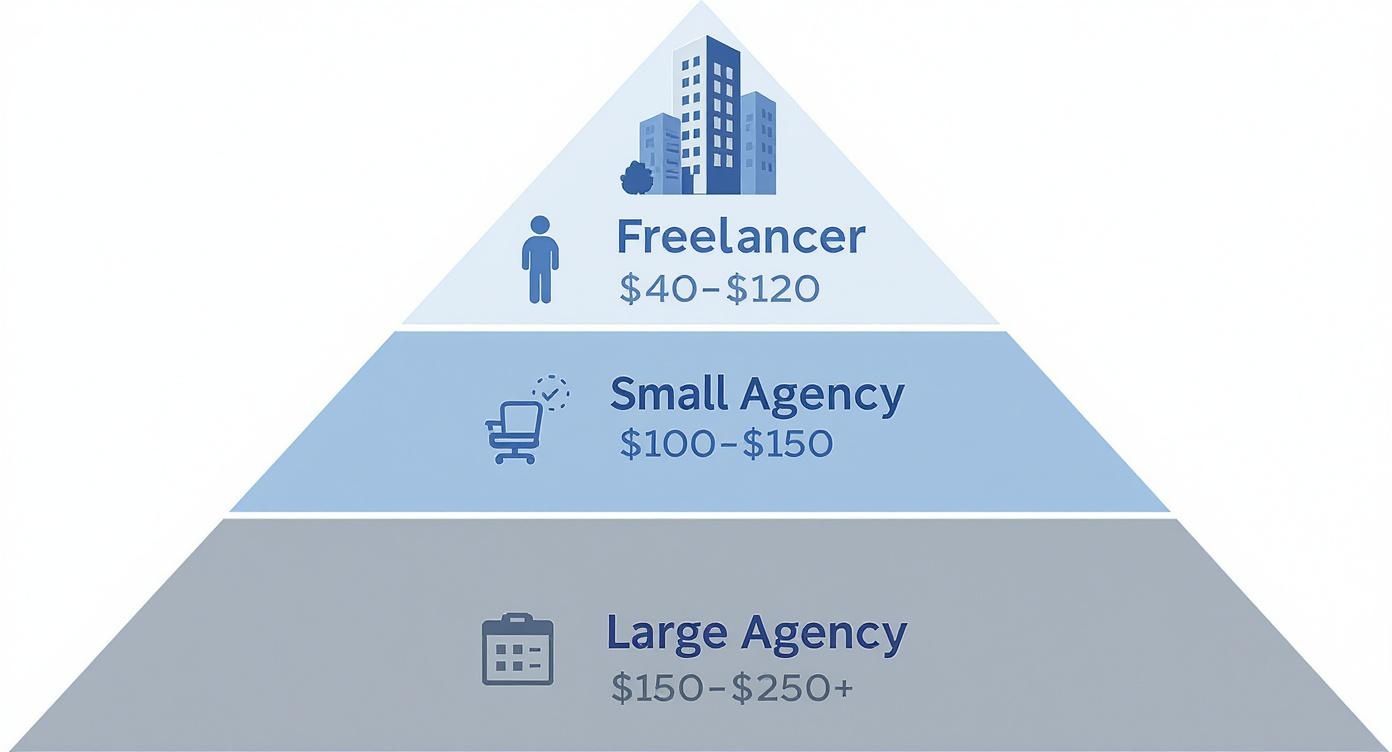
Pyramid chart illustrating hourly rates for freelancers, small agencies, and large agencies.

As you can see, freelancers are generally the most affordable option. Small agencies sit in the middle, and the big players command a premium for their large, specialised teams and deep resources. Where your project lands will depend heavily on who you choose to build it.

Tier 1: The Startup & Small Business Site

Think of this as your digital foundation—the essential online home for your business. This tier is perfect for new ventures, sole traders, or local service businesses that need a professional online presence without a huge upfront investment. The goal here is simple: establish credibility and give potential customers the information they need.

At this level, you’re almost certainly looking at a website built on a solid platform like WordPress. The process usually involves starting with a high-quality premium theme, which acts as the design framework. From there, it's customised with your brand’s colours, logo, and fonts to make it your own.

What's usually included?

  • A core set of pages: You'll get the essentials, typically 5-10 pages like Home, About, Services, and a Contact page. You might also have a simple gallery or a spot for customer testimonials.
  • Responsive Design: This is non-negotiable. Your site will look and work perfectly on desktops, tablets, and smartphones.
  • Basic SEO setup: This covers the fundamentals to get you noticed by search engines, including title tags, meta descriptions, and submitting a sitemap to Google.
  • Contact Form: A straightforward way for potential customers to reach out directly through the site.

This tier is all about getting maximum value efficiently. You end up with a polished, functional website that acts as a powerful digital business card, but without the cost of a fully custom-coded project.

Tier 2: The Growing E-commerce Store

This is where things get more serious. When your business is ready to start selling online or wants to scale its existing e-commerce operations, you’ll find yourself in this budget tier. This is for ambitious retailers who need more than just a basic "add to cart" button. The focus shifts to crafting a smooth shopping experience that actually drives sales.

Here, platforms like Shopify or WooCommerce (for WordPress) really shine. The bigger budget allows for a more advanced setup and customisation to handle the specific quirks of your business, from how products are displayed to making the checkout process as painless as possible.

A great e-commerce site doesn't just display products; it guides the customer through a carefully crafted journey. Every element, from the product filters to the payment gateway, is an opportunity to build trust and make the sale easier.

Key features you’ll see at this level:

  • Advanced Product Management: This means setting up detailed product categories, variations (like size and colour), and smart filtering options so customers can find exactly what they want.
  • Payment Gateway Integration: Securely connecting your store with popular providers like Stripe, PayPal, and Afterpay is a must.
  • Shipping and Tax Configuration: You'll get help setting up complex shipping rules based on location or order value, plus automated tax calculations to take the headache out of compliance.
  • Custom Theme Development: You might hire shopify developer australia to heavily modify an existing theme or build a more unique storefront that truly reflects your brand’s identity.

A budget in this tier is an investment in building a powerful sales engine that can grow right alongside your business.

Tier 3: The Custom Enterprise Platform

Welcome to the top end of town. This tier is for established businesses with unique operational needs that simply can't be met by an off-the-shelf solution. We're talking about custom web applications, sophisticated client portals, or deeply integrated e-commerce systems, often built on powerhouse platforms like Shopify Plus.

The focus here is on bespoke functionality, rock-solid scalability, and seamless integration with other critical business systems like your inventory management or CRM. The website design cost is highest here because it’s not just a website; it’s a custom-coded software project. It requires a dedicated team of specialist developers, UX designers, and project managers to build it from the ground up.

This involves extensive planning, custom API development, and rigorous testing to ensure the platform is secure and can perform under heavy traffic. A project of this scale is a major investment, but it's one that creates a powerful, long-term competitive advantage through technology. This is where a top-tier shopify agency australia or wordpress agency australia excels.

How Agencies Can Scale Profitably with White Label Development

As an agency owner, you know that a client’s website budget is directly tied to your own profitability. It’s a constant juggling act between delivering amazing work, managing client expectations, and not overstretching your team. This is where partnering with a white label development team can be an absolute game-changer for your growth.

Think of it this way: instead of burning out your in-house staff or saying no to big, complex projects, you can bring in specialist developers who work seamlessly under your brand. It’s like having an elite development department on call, but without the crippling overheads of salaries, benefits, and ongoing training. A white label wordpress agency can become a true extension of your team.

This model lets you quote fixed prices with confidence because your own development costs are locked in. You get a guaranteed profit margin on every single project, which takes away the financial stress of scope creep or unexpected technical roadblocks.

Access Elite Talent on Demand

One of the biggest headaches for a growing agency is finding and affording top-tier technical talent. Hiring an expert wordpress developer australia or a seasoned shopify expert australia is a massive investment of both time and money.

White label development gives you a shortcut to that specialised skill set.

  • Expand Your Services Overnight: You can immediately start offering complex services like white label wordpress development, shopify theme development, or tricky e-commerce integrations.
  • Handle Any Project: Start saying "yes" to more clients, whether they need a simple brochure site, a sophisticated online store, or a pesky wordpress bug fix.
  • Focus on Your Strengths: By handing off the technical heavy lifting, your team is free to focus on what they do best—strategy, client relationships, and brilliant creative work.

This approach transforms your agency from a niche provider into a full-service digital partner, ready to tackle a much broader range of client challenges.

Lock In Profits and Scale Seamlessly

Predictability is the secret to profitable growth. The white label model is built on fixed, pre-agreed project costs, giving you the financial certainty you need to scale your business with confidence. This is the foundation of website development for agencies australia.

Partnering with a white label agency isn't just about outsourcing tasks; it's about outsourcing risk. You gain control over your costs, protect your profit margins, and create a scalable system for delivering high-quality web projects every single time.

This financial control is huge. Imagine quoting a large Shopify or WordPress project knowing exactly what your profit will be from day one. It removes all the guesswork and protects your bottom line. You can find out more about how this works in our detailed guide to white label WordPress solutions.

The Strategic Advantage of Outsourcing

Ultimately, working with a white label wordpress agency or a white label shopify expert is a smart, strategic move that sets your agency up for long-term success. It’s about building a business model that’s more resilient, flexible, and profitable.

This kind of partnership allows you to:

  1. Manage Fluctuating Workloads: Easily scale your delivery capacity up or down to match your project pipeline, without the stress of hiring or making redundancies.
  2. Deliver Faster: Specialised teams have fine-tuned workflows, meaning they can often turn projects around much faster than an in-house team juggling a dozen other tasks.
  3. Enhance Your Reputation: When you consistently deliver technically flawless websites, you build a reputation for excellence that attracts bigger and better clients.

By embracing wordpress outsourcing australia, you’re not just managing costs—you're actively building a more agile and competitive agency. It's a proven strategy for achieving sustainable growth and cementing your brand as a market leader.

Answering Your Top Website Cost Questions

As we get to the end of this guide, you probably still have a few questions rattling around. That’s completely normal. Let's tackle some of the most common ones we hear from business owners across Australia, so you can move forward with total confidence.

How Much Should a Small Business WordPress Site Cost?

For a small Aussie business, a professional WordPress site is one of the best investments you can make. You should realistically budget somewhere between $3,000 and $7,000.

So, what does that get you? This price range typically covers a sharp, mobile-friendly site with about 5-10 essential pages—think Home, About, Services, and a Contact page. The process usually involves a skilled designer customising a premium theme to perfectly match your brand, rather than building everything from scratch. It’s the sweet spot for getting a credible, effective online presence without the hefty price tag of a fully bespoke project. For this, it is wise to hire wordpress developer australia to get it right the first time.

What Are the Hidden Ongoing Costs of a Website?

Getting your website live is a huge milestone, but it's not the finish line. There are ongoing costs to keep it humming along, and it's crucial to factor these into your budget to avoid any nasty surprises later on.

Here are the usual suspects:

  • Domain Name Renewal: This is your website’s address on the internet. It’s an annual fee, usually around $20 – $50.
  • Website Hosting: Think of this as the rent you pay for your website's plot of land online. Good quality hosting can range from $25 to $100+ per month.
  • Maintenance and Support: Your site needs regular tune-ups to stay secure and functional. Many businesses go for a wordpress maintenance australia plan, which can run between $100 and $500 a month for things like updates, security scans, and backups. Similarly, shopify maintenance australia plans are essential for e-commerce stores.
  • Premium Plugin/Theme Licences: If your site uses special tools for certain features, they often require an annual licence renewal to keep getting updates and support.

Why Do Web Design Quotes Vary So Much?

It can be baffling to see quotes for the same project that are thousands of dollars apart. The huge difference almost always boils down to two things: the scope of work and who you're hiring.

A big agency will naturally quote higher than a solo freelancer. They have more overheads—project managers, strategists, office space—and a whole team contributing. A freelancer, on the other hand, has a much leaner operation.

The level of service is the other major factor. A cheaper quote might just cover the technical build, leaving you to sort out all the content, images, and SEO yourself. A more comprehensive quote from a leading agency for wordpress development australia or shopify development australia often includes a full strategy, custom design, professional copywriting, and a solid SEO foundation. You’re not just buying a website; you’re investing in a powerful business tool.

"A cheap website can be the most expensive mistake a business makes. The real cost isn't the initial price, but the lost revenue from poor performance, bad user experience, and a lack of conversions."

The key is to look past the final number and understand exactly what’s included. If you’re still scratching your head about pricing, have a look at our extensive list of answers to frequently asked questions.

Is It Better to Hire a Freelancer or an Agency?

This is a classic 'it depends' situation. The right choice between a freelancer and an agency really hinges on your project's size, your budget, and how hands-on you want to be.

A wordpress freelancer australia is often a fantastic option for smaller jobs, fixing specific issues, or if you have a crystal-clear vision and a tighter budget. You get a personal touch and a bit more flexibility.

An agency, however, brings a whole team of specialists to the party—designers, developers, writers, and SEO experts all working together. This is perfect for bigger, more complex projects that need a deep strategic approach from day one. It costs more, but you’re paying for a wider skill set and a more robust safety net.


Ready to deliver high-quality WordPress and Shopify projects without the overheads? At White Label WordPress, we partner with agencies to provide expert, reliable white label development services. Lock in your profit margins and scale your agency with confidence. Explore our partnership opportunities today!

shopify seo services: Boost Your Store with Proven SEO Strategies

Think of Shopify SEO services as a specific game plan for getting your online store seen on search engines like Google. It's not just about general search optimisation; it’s a strategy fine-tuned for the quirks and features of the Shopify platform, all with the goal of pulling in more organic traffic and sales.

Why Your Australian Store Needs Shopify SEO Services

Picture this: you've just opened a fantastic new boutique in a quiet laneway. The fit-out is stunning, your products are amazing, but you forgot one thing – a sign. People are walking right past on the main street, completely oblivious that you even exist.

That’s exactly what your Shopify store is like without a solid SEO strategy. You’re competing in a bustling, crowded digital marketplace. Without visibility on Google, your store is effectively invisible to thousands of potential customers actively looking for what you sell.

Specialised Shopify SEO services are your digital signpost. They don’t just point in your general direction; they guide Australian shoppers directly to your virtual front door right when they're ready to buy. A well-played strategy gets your product pages, collections, and blog posts showing up at the moments that truly matter. Working with a skilled shopify developer in Australia can ensure your store is technically sound for these strategies.

The Competitive Edge in a Growing Market

The need for a platform-specific approach has never been more critical. With almost 150,000 Shopify sites running in Australia, the competition is intense. A great product on its own just doesn't cut it anymore.

Stores that invest in proper Shopify SEO gain a massive head start by attracting a reliable stream of free, high-intent visitors. This is especially important as Australian businesses are forecast to spend $1.5 billion on SEO services, a 12% jump that shows just how valuable organic search has become. If you want to dive deeper into the local landscape, you can discover more insights about Shopify SEO for Australian stores on wppro.com.au.

Think of it this way: While paid ads are like renting an audience, strong SEO is like owning your traffic source. It’s a long-term asset that builds brand authority and delivers sustainable growth, reducing your reliance on costly advertising over time.

Ultimately, putting money into professional Shopify SEO is an investment in your store's future. It turns your website from a passive product catalogue into an active, customer-attracting machine that drives revenue and builds a lasting brand presence in the Australian market. For agencies, offering these specialised services through a white label Shopify agency partner is a powerful way to provide value.

The Core Pillars of Effective Shopify SEO

To really get your head around what goes into high-impact Shopify SEO services, it’s helpful to think of your online store as a high-performance race car. It’s not just one thing that makes it win; it's a finely-tuned system where the engine, aerodynamics, and driver all work in perfect harmony. In the same way, Shopify SEO is built on three core pillars that work together to drive your store to the top of the search results.

These pillars are Technical SEO, On-Page SEO, and Off-Page SEO. Each one has a distinct job, but they’re all interconnected. Get one wrong, and the others will suffer. A balanced, holistic approach is the only way to build a powerful online presence that not only attracts customers but converts them too.

This infographic breaks down how these three components form the foundation of any solid SEO strategy for a Shopify store.

As you can see, a healthy, high-ranking store needs to be supported equally by its technical foundations, its on-page content, and its off-page authority.

To help clarify what each pillar involves, here's a quick breakdown of the key activities and their direct impact on an eCommerce business.

Shopify SEO Services Breakdown

SEO Pillar Key Activities Primary Business Impact
Technical SEO Site speed optimisation, mobile-friendliness, crawlability checks, clean URL structure, XML sitemap management. Ensures your store is accessible to search engines and provides a fast, frustration-free user experience, which reduces bounce rates.
On-Page SEO Keyword research and integration, meta tag optimisation, high-quality product descriptions, internal linking strategy. Directly matches your store's pages to customer search queries, attracting highly qualified traffic and improving click-through rates.
Off-Page SEO High-quality backlink acquisition, digital PR, brand mentions, building relationships with industry influencers. Builds your store's authority and credibility in the eyes of Google, leading to higher rankings for competitive keywords.

Each of these pillars is crucial for building a sustainable SEO strategy that delivers real, measurable results for your Shopify store. Let's dig a little deeper into each one.

Technical SEO: The Engine Room

Technical SEO is the absolute bedrock of your entire strategy—it's the engine and chassis of your race car. It’s all about optimising your site's infrastructure so that search engines can crawl, understand, and index your content without hitting any roadblocks. For a Shopify store, this is completely non-negotiable.

Here’s what’s involved:

  • Site Speed Optimisation: Making sure your pages load at lightning speed is critical. Slow sites don’t just frustrate users; they get penalised by Google. Shopify's own infrastructure gives stores a head start with a 1.8 times faster load speed, but optimisations are still key. A professional wordpress developer in australia would apply similar principles to a WordPress site.
  • Mobile-Friendliness: A huge chunk of online shopping happens on smartphones, so your store must deliver a flawless mobile experience. While modern Shopify themes are responsive out of the box, custom code and apps can sometimes throw a spanner in the works.
  • Clean URL Structure: Search engines and users both prefer simple, logical URLs. Shopify has a few structural quirks, but an expert can make sure your product and collection URLs are as clean and keyword-rich as possible.
  • XML Sitemap Submission: Your sitemap is literally a roadmap for search engines. Shopify generates one for you automatically, but it's crucial to submit it to Google Search Console to ensure all your important pages get discovered.

Think of technical SEO as making sure your store is a welcoming place for search engine bots. If they can't get in the front door and look around easily, they’ll never know what you’re selling.

On-Page SEO: The Showroom Display

If technical SEO is the engine, then on-page SEO is how you meticulously arrange your showroom. This part of the process involves optimising the actual content and HTML of your pages to make them more relevant and attractive to both search engines and real people. This is where you directly target the keywords your potential customers are punching into Google.

On-page SEO is all about creating a perfect match between what someone is searching for and the content on your page. The goal is to signal to Google, "Hey, this page is the single best answer for this person's query."

Core on-page elements for any Shopify store include:

  • Keyword Optimisation: Strategically weaving your target keywords into product titles, descriptions, page headings (like your H1s), and even image alt text.
  • Compelling Meta Tags: Writing unique, enticing title tags and meta descriptions that make people want to click on your listing in the search results.
  • High-Quality Content: Crafting detailed, original product descriptions, genuinely helpful blog posts, and informative collection pages that actually answer customer questions.
  • Internal Linking: Building a smart network of links between your own pages (for example, linking from a blog post about "winter hiking gear" to your waterproof boots product page) to spread authority and guide users through your site.

When done right, on-page SEO turns your pages into powerful magnets for specific search terms, pulling in qualified traffic that’s already in a buying mindset. While many businesses can handle the basics, agencies often need to bring in specialised partners for the more complex stuff. You can explore a range of professional white label web development services to scale your agency’s capabilities without adding to your payroll.

Off-Page SEO: Building Your Reputation

Off-page SEO covers all the actions taken outside of your website to boost your rankings. Think of it as your store's public reputation or digital word-of-mouth. It’s mostly about building authority and trust by earning high-quality backlinks from other reputable websites.

A backlink is essentially a vote of confidence from another site. When a trusted source links to your product page, it sends a strong signal to Google that your content is valuable and credible, which in turn boosts your own authority. This is often the most challenging, yet most impactful, pillar of any Shopify SEO service. Building a strong backlink profile shows search engines you're a leader in your niche—an absolute must for surviving in competitive industries. For digital agencies, leveraging an agency Shopify partner in Australia for link-building campaigns can be highly effective.

Navigating Shopify’s Unique SEO Landscape

Shopify is a fantastic platform for eCommerce, but it's not an automatic ticket to the top of Google. I like to think of it like a professional-grade kitchen. It’s got all the fancy, high-end appliances you could ever want—fast servers, SSL certificates, clean themes—but you still need a skilled chef who knows the recipes and techniques to actually cook a gourmet meal.

It's the same with Shopify. To get those top rankings, you need to deeply understand its specific strengths and, just as importantly, its limitations. A generic, one-size-fits-all SEO strategy just won't cut it; you need an approach built specifically for the Shopify ecosystem. This is where specialised Shopify SEO services come in, helping you play to the platform's advantages while cleverly navigating its inherent challenges.

Out of the box, Shopify gives you a solid foundation with impressive site speed and built-in security, both of which are major ranking factors. But it also throws a few curveballs that can easily trip up anyone who isn't prepared for them.

Capitalising on Shopify's SEO Strengths

Shopify comes loaded with several features that give store owners a real head start in the SEO race. Knowing what these are helps you build on a strong technical base right from day one.

Here’s what you get straight away:

  • Impressive Site Speed: Shopify’s entire infrastructure is built for speed. A faster website means a better user experience, which search engines absolutely love.
  • Automatic SSL Certificates: Every single Shopify store gets SSL encryption included. This builds trust with both your customers and Google by ensuring a secure, private connection.
  • Mobile-Responsive Themes: Nearly all Shopify themes are designed to be mobile-friendly from the get-go, a non-negotiable factor for ranking well in today's mobile-first world.
  • Auto-Generated Sitemaps: Shopify automatically creates and updates your XML sitemap. This makes it incredibly simple to tell search engines about your site's structure so they can crawl it efficiently.

These built-in perks handle a lot of the technical heavy lifting, freeing you or your Shopify expert Australia to focus on what really moves the needle: killer content, smart keyword strategy, and building genuine authority.

Working Around Shopify's SEO Challenges

For all its strengths, Shopify has its quirks. Getting around these limitations is a core part of any effective Shopify SEO service, and it’s what separates a true platform expert from a generalist.

The most common hurdles include:

  • A Rigid URL Structure: Shopify enforces a specific URL format, adding prefixes like /collections/ and /products/ that you can’t remove. This can make creating those clean, super-simple URLs a bit tricky.
  • Potential for Duplicate Content: The way Shopify handles product variants and collection tags can easily lead to duplicate content issues if you're not careful. This requires a solid strategy using canonical tags to avoid confusing search engines.
  • Limited Robots.txt Access: You can't directly edit the robots.txt file on Shopify. This restricts your ability to give highly specific crawling instructions to search engine bots.

A skilled Shopify developer in Australia knows exactly how to work within these constraints. For instance, they'll use clever canonicalisation strategies to solve duplication issues and carefully structure collections to work around the URL limitations, turning potential weaknesses into complete non-issues. Agencies can hire a Shopify developer in Australia on a project basis to tackle these specific technical challenges.

The Double-Edged Sword of Shopify Apps

The Shopify App Store is a goldmine, offering tools for everything from image compression to adding advanced schema markup. The right apps can seriously boost your SEO. But there’s a catch: app bloat.

Installing too many apps, especially poorly coded ones, can drag your site speed down into the mud. Every app adds extra code (JavaScript and CSS) that has to load, potentially wiping out all of Shopify's built-in performance advantages. The secret is to be strategic. Only install essential, well-optimised apps and regularly audit your store to ditch anything you no longer need. This kind of ongoing technical review is a vital part of Shopify maintenance in Australia that protects your SEO investment.

In the fierce Australian eCommerce market, getting these platform-specific details right can make all the difference. Locally, top-performing Shopify stores are hitting conversion rates above 3.2%. A professional, platform-aware SEO strategy is what gets you the visibility you need to join that top tier. For a deeper dive, you can read the full research about Shopify statistics on thehubcontent.com. At the end of the day, success on this platform comes down to a nuanced understanding—knowing which levers to pull and which limitations to gracefully work around.

Winning the Local Battle with Australian SEO

A silver laptop displaying a house photo and icons, on a sunny street with businesses and 'LOCAL AUSSIE SEO' branding.

If you're running a Shopify store in Australia, a generic SEO strategy just won't cut it. To truly connect with local shoppers, you need to be on their wavelength—using their slang, understanding their buying habits, and showing up where they’re actually searching. This is where a targeted Australian Shopify SEO service makes all the difference.

It's about more than just ranking for broad terms. A smart local strategy gets granular. It targets the specific phrases Aussies use, like "trackies" instead of "sweatpants," or adds city-specific keywords like "vegan skincare Melbourne." This kind of detail is what attracts people who are not just browsing but are ready to buy from a local business. This specialized field is often referred to as Shopify SEO Australia.

This hyper-local focus is absolutely critical. By 2025, Australia is set to be Shopify's third-largest market in the world, home to around 150,000 stores. And it's not slowing down; the number of users is expected to hit 23.14 million by 2029. With eCommerce revenue already at AU$56.07 billion in 2024, the competition is intense. A strong local presence isn't just an advantage; it's a necessity. You can read more about the rapid growth of Shopify in Australia at redsearch.com.au.

Mastering Your Local Digital Footprint

For any Shopify store with a physical shopfront or even just a defined service area, an optimised Google Business Profile (GBP) is non-negotiable. Think of it as your digital front door on Google Search and Maps. For many local customers, it's the very first time they'll interact with your brand.

A specialised shopify agency in Australia will treat your GBP with the attention it deserves. This isn't a 'set and forget' task. It involves:

  • Consistent Information: Making sure your business name, address, and phone number (NAP) are identical and accurate everywhere they appear online.
  • Engaging Content: Regularly adding high-quality photos of your products or storefront, sharing updates and offers, and, crucially, responding to every customer review.
  • Service & Product Listings: Using Google's built-in features to list exactly what you sell, making it dead simple for customers to see if you have what they need.

Think of your Google Business Profile as the most important local directory listing you'll ever have. A complete, active, and well-managed profile sends powerful trust signals to Google, which can dramatically boost your visibility in local search and the prized "map pack."

Building Authority with Australian Backlinks

Off-page SEO needs a local flavour, too. Getting backlinks is always important, but where they come from matters immensely for local search. A link from a popular Sydney-based fashion blog or a Melbourne foodie influencer carries so much more weight for an Aussie audience than a random link from an overseas site.

A huge part of local Shopify SEO services is dedicated digital PR and outreach aimed squarely at Australian publications, businesses, and influencers. This process is all about building your store’s authority right here in the local market. It signals to Google that you're a credible and relevant player in the Australian eCommerce scene. By focusing on quality, location-specific links, you build a powerful moat around your local rankings that international competitors will struggle to get across. This is a core component of effective web development in Australia.

At the end of the day, winning the local battle is about embedding your brand in the community. It means tailoring every single part of your SEO—from keywords and content to your business listings and backlink profile—to resonate directly with Australian shoppers. That's how you turn a generic online store into a trusted local favourite.

How to Choose the Right Shopify SEO Partner

Picking an agency to handle your Shopify SEO is a big deal. The right partner can become a true growth engine for your business, but the wrong one can burn through your budget and, in some cases, even harm your site's standing with Google. To make a smart choice, you need to look past the slick sales pitch and really dig into their process, their expertise with the platform, and their track record.

Think of it like hiring a specialist builder for your dream home. You wouldn't just go with the one who has the flashiest ad. You’d want to see their previous work, check their qualifications, and make sure they have a solid, transparent plan. That same level of care is essential when you're hiring someone for Shopify SEO services.

You're not just looking for an SEO generalist. You need a partner who gets the unique quirks and opportunities of the Shopify platform. They should be able to talk you through how they’d navigate Shopify’s URL structure, handle the duplicate content that product variants can create, and know which apps to use without slowing your whole store to a crawl. Many agencies find that partnering with a white label Shopify expert is an effective way to deliver this level of specialised service.

Key Questions to Ask Potential Partners

When you’re vetting a potential Shopify expert in Australia, you need to arm yourself with questions that cut through the fluff and get to the heart of their skills. Vague answers are a huge red flag. You want concrete details that show they’ve been in the trenches and know what they’re doing.

Start with these fundamentals:

  • Platform-Specific Experience: "Can you show me a few case studies from Shopify stores in our industry? What were the biggest challenges you helped them solve?"
  • Technical Know-How: "How do you typically deal with Shopify's technical quirks, like the fixed URL structure or the duplicate content issues that can pop up from collection filters?"
  • Link-Building Philosophy: "What's your approach to building backlinks? Could you give me some examples of the kinds of links you’ve earned for other e-commerce clients?"
  • Strategy and Reporting: "Beyond just traffic, what are the main KPIs you focus on for Shopify stores? Can I see a sample of your monthly report, and how do you tie your work back to actual ROI?"

These questions force a potential partner to go beyond generic SEO buzzwords and prove they have real, hands-on experience with Shopify. A confident and detailed answer is a great sign you’re talking to a genuine pro.

One of the biggest red flags to watch for is a guarantee of a "#1 ranking." No legitimate SEO professional can promise that. Google's algorithm is a complex, ever-changing beast. Instead, look for partners who promise a transparent process and a strategy focused on real business goals, like growing organic revenue—not empty guarantees.

Understanding Pricing and Deliverables

Shopify SEO services usually come in a few common pricing models, and it’s good to know the difference so you can line up your budget with what you can expect to receive.

Pricing Model Description Best For
Monthly Retainer You pay a fixed fee each month for ongoing SEO work. This usually covers everything from technical health checks to creating content and building links. Businesses that are serious about long-term, consistent growth and want a comprehensive strategy.
Project-Based A one-off fee for a clearly defined task, like a deep-dive technical audit or an overhaul of your product page content. Stores that have a specific problem to fix or want to "test drive" an agency before committing to something long-term.
Performance-Based The agency's fees are tied to hitting specific targets, like a certain percentage increase in organic traffic or sales. Companies with a high tolerance for risk. This model is pretty rare because it's so complex to track and manage fairly.

For digital agencies looking to add SEO to their services without building an in-house team from scratch, partnering with a specialist is a smart move. Exploring white label Shopify development and SEO lets you offer expert services under your own brand. Your clients get top-tier results, and you stay in control of the relationship, giving you a scalable way to access specialised talent whenever you need it. This is a key benefit of digital agency outsourcing in Australia.

Ultimately, the best partner feels like an extension of your own team. They should be open and clear in their communication, use data to back up their strategy, and be genuinely invested in helping your Shopify store achieve real, sustainable growth.

Measuring SEO Success and Proving ROI

A hand points to a laptop screen displaying SEO ROI metrics with graphs and charts.

So, you're investing in Shopify SEO services. Great move. But how do you actually know it’s paying off? Proving the return on your investment (ROI) is all about looking past the flashy, surface-level numbers and digging into the metrics that directly affect your revenue.

A good SEO partner won’t hide behind jargon or confusing data. They’ll be an open book, delivering clear, data-backed reports that draw a straight line from their work to your business goals. After all, the point of SEO isn't just to get more clicks; it's to attract more of the right people—the ones who pull out their wallets.

This means we need to stop obsessing over vanity metrics, like total website visits, and start focusing on Key Performance Indicators (KPIs) that tell a story of genuine growth. Tracking the right KPIs is how you hold your SEO provider accountable and confirm your money is working hard for you. This includes tracking improvements in Shopify conversion optimisation in Australia.

Key Performance Indicators That Truly Matter

A solid monthly report should be a strategic tool, not just a data dump. It needs to clearly map out the progress made and link every SEO activity back to actual dollars and cents. Here are the core KPIs that should always be front and centre.

  • Organic Traffic Growth: This is a fundamental starting point, but it needs context. You’re looking for a consistent, upward trend in visitors arriving from search engines, which is a clear sign your store is becoming more visible.

  • Keyword Rankings: The real gold is in the high-intent commercial keywords. Sure, ranking #1 for a generic term might feel good, but ranking on the first page for a specific phrase like "buy black leather ankle boots" is infinitely more valuable to an online store.

  • Organic Conversion Rate: This KPI tells you what percentage of your organic search visitors actually buy something. If this number is climbing, it’s a strong signal that your SEO strategy is attracting qualified customers who are ready to make a purchase.

  • Revenue from Organic Search: This is the big one—the most direct way to prove ROI. With a tool like Google Analytics, you can see exactly how much revenue your SEO efforts are generating. It’s the ultimate measure of success.

A transparent report doesn’t just show you what happened; it explains why. It should connect a surge in organic revenue back to a new blog series or show how a technical fix boosted rankings for your most important product collections.

What a Transparent Report Includes

The reports from your SEO partner should be easy to digest and completely focused on outcomes. They need to go beyond the raw data, offering genuine analysis and a clear roadmap for what’s next. This shows they’re thinking ahead and are committed to continuous improvement.

A great report will always have a clear breakdown, including:

  • An executive summary hitting the highlights of key wins and progress.
  • Detailed performance data for the crucial KPIs we just covered.
  • A transparent summary of all the work completed that month.
  • Actionable insights and strategic recommendations for the weeks ahead.

This kind of reporting transforms data from a list of numbers into a conversation about growth. You can see this approach in action in this detailed white label Shopify case study, which unpacks a real-world success story. At the end of the day, measuring success is all about connecting the dots between SEO work and tangible business outcomes, like more sales and a healthier bottom line.

Common Questions About Shopify SEO Services

Diving into Shopify SEO services always brings up a few practical questions. As a business owner, you’re probably wondering about the real-world impact—from how long it takes to see a return to whether you really need a specialist. Let's tackle some of the most common queries I hear from clients.

Getting these details straight from the start helps you set realistic expectations. It maps out the journey from your initial investment to seeing real, tangible growth in your business.

How Long Does It Take to See Results?

Look, SEO is a long game. It's a marathon, not a sprint. While we can get some quick wins from technical fixes right out of the gate, you should expect to see the first real, positive shifts in rankings and traffic within 3 to 6 months. This initial phase is all about laying a solid foundation for future growth.

The big, juicy results—like a major and sustained jump in organic revenue—typically start to show up between 6 to 12 months. The exact timeline really depends on where your store is at now, how fierce the competition is in your Australian market, and how aggressively we go after your goals.

Can I Do Shopify SEO Myself?

Absolutely. You can definitely handle basic on-page SEO tasks yourself, and Shopify’s built-in tools make it pretty straightforward. Things like writing compelling product descriptions and tweaking your page titles are great places for any store owner to start.

However, a professional Shopify SEO service brings a level of expertise that’s hard to replicate. We’re talking about the deep-dive stuff: technical SEO, sophisticated keyword strategies that target commercial intent, and building high-authority backlinks. A Shopify expert in Australia knows the platform inside and out, which means they can navigate its quirks much faster, helping you sidestep costly errors and ultimately delivering a much healthier return on your investment.

What Is the Difference Between General and Shopify SEO?

While the core principles of SEO are universal, Shopify has its own unique ecosystem. True Shopify SEO is a specialised skill that involves playing to the platform's strengths while cleverly working around its known limitations.

For instance, an expert knows exactly how to:

  • Wrangle Shopify's sometimes-tricky URL structure.
  • Prevent the duplicate content issues that pop up from product variants and collection tags.
  • Choose the right SEO apps that actually help without slowing your site to a crawl.
  • Squeeze every last drop of performance and speed out of the Shopify framework.

This specialised knowledge isn't just a nice-to-have; it's what separates a store that just exists from one that dominates the search results and drives serious growth. For ongoing help, reliable Shopify support in Australia is invaluable.


At White Label WordPress, we provide expert white label Shopify and WordPress solutions that empower your agency to deliver exceptional results. Partner with us to scale your services and guarantee profit margins on every web project. Learn more about our agency partnerships.