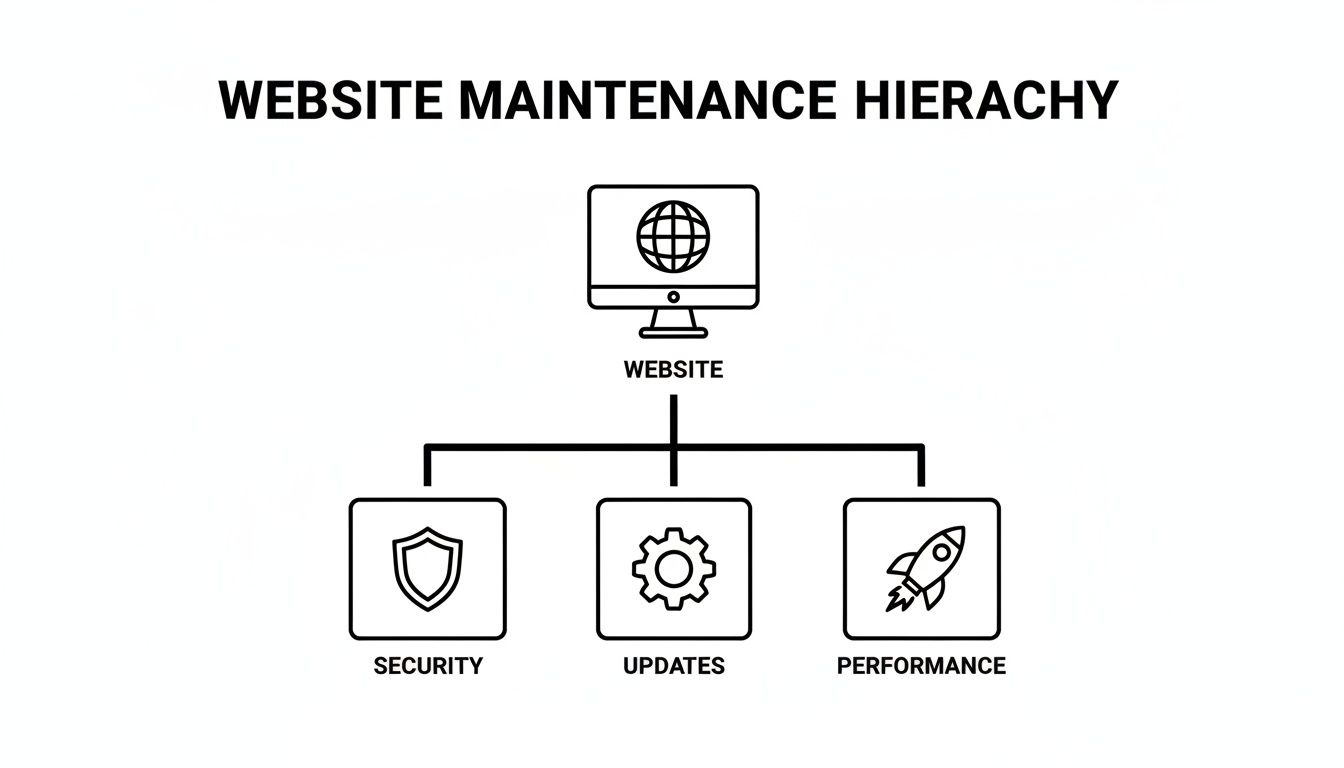
Think of your website as a crucial piece of business machinery, not just a static digital brochure. Just like you wouldn't drive a company van for 50,000 kilometres without an oil change, you can't just launch a website and expect it to run perfectly forever. It needs regular, proactive care to keep it secure, fast, and functioning as it should.
This consistent upkeep involves essential tasks like software updates, security scans, performance optimisation, and data backups. Letting these things slide isn't just a technical oversight—it's a business risk that can lead to data breaches, a terrible user experience, and ultimately, lost revenue. This is particularly true for platforms requiring specialist care, from custom wordpress development australia to a shopify store setup australia.
Why Your Website Needs Regular Maintenance

A slow, buggy, or insecure website directly hurts your brand and your bottom line. Proactive care is the only reliable way to protect this valuable digital asset and ensure it keeps working for you.
The Real Risks of Neglect
Ignoring website maintenance is a bit like ignoring a leaky roof in your office. At first, it's a minor annoyance, but eventually, that small drip becomes a major, expensive disaster. The consequences of a neglected website are just as severe, often extending far beyond a simple error message on a page.
Here’s what you’re really risking:
- Crippling Security Breaches: An out-of-date website is a hacker's dream. Breaches can mean stolen customer data, a defaced homepage, or worse, completely losing control of your site. This is a key concern for any
ecommerce developer australia. - Lost Sales and Leads: How long do you wait for a slow page to load? Your customers aren't any more patient. If your site is broken or frustratingly slow, they’ll simply go to a competitor. A
shopify conversion optimisation australiaspecialist will tell you speed is non-negotiable. - Damaged Brand Reputation: Your website is often a customer’s first impression of your business. If it's constantly down or full of errors, you look unreliable and unprofessional.
To put it simply, inaction creates vulnerabilities that can seriously cripple your operations.
The Core Pillars of Website Maintenance at a Glance
To truly grasp the importance of maintenance, it helps to break down the key areas and see what’s at stake. Each pillar supports the overall health and effectiveness of your site.
| Maintenance Area | Key Activities | Risks of Neglect |
|---|---|---|
| Updates | Applying patches to WordPress core, plugins, and themes. | Unpatched software is the #1 entry point for hackers. |
| Backups | Regular, automated off-site backups of files and databases. | Total data loss from hacks, server failures, or human error. |
| Security | Malware scanning, firewall management, and login protection. | Data theft, site blacklisting by Google, and reputational ruin. |
| Performance | Speed optimisation, database cleaning, and image compression. | High bounce rates, poor user experience, and lower search rankings. |
| Monitoring | 24/7 uptime checks and error log analysis. | Extended downtime without your knowledge, losing sales and trust. |
Neglecting any one of these pillars leaves a critical gap in your website's defences and operational readiness.
An Investment in Digital Infrastructure
Just as Australia invests heavily in its physical infrastructure to keep the country running, your business must invest in its digital infrastructure. The Australia Infrastructure Maintenance and Repair Market is projected to soar to USD 284.5 billion by 2033, a clear signal of the need to maintain essential assets. Your website is a core business asset that demands that same level of commitment.
Website maintenance isn't an optional expense; it's a non-negotiable investment in your business's stability, security, and growth. It's the insurance policy that protects your online presence from preventable disasters.
Ultimately, professional site maintenance services give you peace of mind. They ensure your WordPress or Shopify site remains a reliable, high-performing tool that supports your business goals, protects your customers, and strengthens your brand in the Australian market. Whether you need ongoing wordpress website support australia or shopify support australia, the right partner is key.
The Five Pillars of Comprehensive Website Maintenance

When you sign up for a professional website maintenance plan, you’re not just paying someone to "keep an eye" on your site. You're investing in a structured, multi-layered strategy for defence and optimisation. A genuinely robust plan is built on five essential pillars, each one tackling a critical part of your website's health, security, and performance.
Getting your head around these pillars helps you see exactly what you’re paying for and why every single component is vital. Think of it like maintaining a high-performance car—you need the engine, brakes, security system, suspension, and diagnostics all working in perfect harmony. It’s the same with your website.
1. Software and Plugin Updates
At the core of any modern website, especially a powerhouse like WordPress, is a whole ecosystem of software. You've got the core platform itself, themes that handle the look and feel, and plugins that add all the cool functionality. Developers are constantly pushing out updates for these, and they aren't just for fancy new features.
The real gold in these updates is the security patches. They close up vulnerabilities that hackers and researchers find. Running an outdated plugin is like leaving the front door of your shop unlocked overnight—it's an open invitation for trouble. A proper maintenance service makes sure everything is updated promptly and, just as importantly, safely, by testing for conflicts so an update doesn't accidentally break your site.
2. Proactive Security Monitoring
While updates close the known backdoors, you still need a 24/7 security guard on patrol for active threats. That's exactly what proactive security monitoring is. It's an active, ongoing defence against the constant barrage of automated attacks, malware, and brute-force attempts that hammer websites every second of the day.
This part of a maintenance service usually includes a few key things:
- Malware Scanning: Regular, automated sweeps of your website's files to find and remove malicious code before it can do any damage or get you blacklisted by Google.
- Web Application Firewall (WAF): Think of this as a digital bouncer that stands between your website and the internet. It filters out dodgy traffic, blocks known bad actors, and stops common hacking methods in their tracks.
- Login Protection: Simple but powerful measures like enforcing strong passwords and preventing brute-force attacks to lock down the most common way hackers try to get in.
Without this constant vigilance, your site is a sitting duck. A single security breach can lead to devastating data loss, serious legal trouble, and a complete loss of customer trust that could take years to win back.
3. Reliable Backups and Recovery
Let's be realistic: no matter how good your defences are, a wordpress bug fix australia may still be needed urgently. A server might fail, a critical update could cause a major conflict, or a simple human error could wipe out important content. When that happens, your website backups are your ultimate safety net.
But not all backups are created equal. A solid maintenance plan ensures they are:
- Regular: Backups are taken automatically and often—usually daily for a busy site like an online store.
- Redundant: Copies are stored in a secure, off-site location, completely separate from your website's server. This means if the server goes down, your backups don't go down with it.
- Reliable: The backups are tested regularly to make sure they're not corrupted and can actually be restored when you need them most.
A backup you haven't tested is just a hope. A tested backup is a recovery plan. This pillar ensures that if the worst happens, you can get back online quickly with minimal data loss and disruption to your business.
4. Performance Optimisation
Online, speed is king. A slow-loading website doesn't just annoy visitors; it actively hurts your Google rankings and kills your conversion rates. Performance optimisation is the ongoing work of fine-tuning your website so it loads as fast as humanly possible for every single person who visits. This is where a service like wordpress speed optimisation australia can make a huge difference.
The work here usually involves:
- Image Compression: Shrinking image file sizes without making them look pixelated, which dramatically speeds up page load times.
- Database Optimisation: Regularly cleaning out and organising your site’s database (this is a big one for WordPress) to help it find information faster.
- Caching Implementation: Storing ready-made, static versions of your pages so they can be served up to visitors almost instantly.
- Code Minification: Stripping all the unnecessary characters and spaces out of code files to make them smaller and quicker to download.
For any business that relies on its website, a fast site isn't a "nice-to-have"—it's a competitive necessity. You can find out more about how this works by looking into dedicated WordPress maintenance services that really focus on speed.
5. Uptime Monitoring
Finally, you need to know your website is actually online and available for your customers. Uptime monitoring is your digital lookout, constantly pinging your website from different locations all over the world to check it's live.
The moment your site goes down, an alert is fired off to the maintenance team, often before you or your customers have any idea there's a problem. This allows them to jump on it immediately, figure out what's wrong—whether it’s a server glitch, a code error, or a third-party outage—and get it fixed. It's all about minimising downtime, protecting your revenue, and keeping your professional reputation intact.
Choosing the Right Website Maintenance Plan
Picking a partner to look after your website is a big deal. It's not just about ticking a technical box; it's a serious business decision. Get it wrong, and you could be facing surprise bills, painfully slow help when things go wrong, and a partnership that just doesn't click with what you’re trying to achieve.
To navigate this, you need to look past the flashy feature lists and get down to brass tacks. It really boils down to two things: the pricing model and the Service Level Agreement (SLA). These are the nuts and bolts of the deal, defining what you pay, what you get, and what happens when you need support.
Understanding Common Pricing Models
Here in Australia, you'll generally come across two main ways that providers structure their website maintenance plans. Each one works for different types of businesses, so it pays to know the pros and cons.
-
Monthly Retainers: This is the go-to model for anyone serious about proactive care. You pay a set fee each month, and in return, you get a clearly defined list of services—think daily backups, weekly plugin updates, security scans, and performance checks. It makes budgeting a breeze and ensures your site is consistently looked after in the background.
-
Ad-Hoc (Pay-As-You-Go): With this approach, you only pay for help when you need it, usually at an hourly rate. It can feel like the cheaper option at first, and it might work for a super simple site that doesn't get much traffic. The catch? The costs can skyrocket if you have an emergency, and there's no guarantee someone can jump on it immediately, as clients on a retainer are almost always first in the queue.
For the vast majority of businesses, a monthly retainer delivers far better value and, frankly, peace of mind. It turns maintenance from a reactive, unpredictable cost into a planned operational expense. You can get a deeper dive into budgeting for these services in our complete guide to website maintenance costs.
Decoding the Service Level Agreement (SLA)
The Service Level Agreement (SLA) is, without a doubt, the most important part of any maintenance contract. It’s the formal document that spells out exactly what your provider is committing to in clear, measurable terms. It’s what turns vague promises into solid guarantees. If a provider doesn't have an SLA or it seems flimsy, that's a massive red flag.
When you're looking over an SLA, here’s what you need to zero in on:
- Scope of Services: What, precisely, is included? The SLA should list every single task, from how often backups and updates happen to the specific security scans they run.
- Response and Resolution Times: This is the big one. It defines how quickly they have to acknowledge your issue (response time) and how long they have to actually fix it (resolution time). Good SLAs will have different tiers for different problems—a "site down" emergency should get a much faster response than a minor tweak to some text.
- Communication and Reporting: How will they keep you in the loop? The agreement should detail how often you get reports (e.g., a monthly PDF summary) and the main ways to get in touch.
- Exclusions: What is not covered? This is just as important as what is. Things like building major new features, graphic design work, or fixing problems caused by other third-party services are common exclusions.
A solid SLA is your safety net. It creates a clear framework for the partnership, making sure everyone knows their responsibilities and what to expect—especially when a problem hits.
If you look at the wider infrastructure maintenance sector in Australia, you’ll see how critical these agreements are. The industry has swelled to a market size of $28.6 billion, with 3,336 businesses all relying on clear contracts to manage the nation's physical assets. Your website is your core digital asset, and it deserves the same level of professional clarity. You can read more about the trends shaping Australia's infrastructure services industry on IBISWorld. Making a smart choice now is the best way to ensure your digital shopfront stays secure, fast, and ready for business.
The Shift to Predictive Website Maintenance
For years, website care followed a simple, if stressful, script: something breaks, you panic, then you call someone to fix it. This is the classic reactive maintenance model. A buggy plugin update crashes your site, a security scan reveals you've been hacked, or a key page grinds to a halt—and only then does the repair work begin. It’s a model that always leaves you playing catch-up.
But the game is changing. The best site maintenance services are no longer just waiting for the alarm to sound. They're moving towards a smarter, predictive approach that uses data and sophisticated tools to see problems coming and stop them before they ever affect your visitors. It’s about getting on the front foot.
From Reactive to Proactive
Think of it like this: your car's dashboard warning light for low oil is a reactive signal. You're already at risk. A predictive system would be like your car's onboard computer analysing engine performance and oil viscosity to tell you, "Based on your driving patterns, you'll need an oil change in two weeks." That’s the leap we're now making with websites.
Instead of just reacting to error logs, a proactive strategy means:
- Analysing Performance Trends: Spotting minuscule, almost unnoticeable drops in page speed that could signal a bloated database or a future server issue.
- Forecasting Security Threats: Recognising subtle patterns of suspicious traffic that often precede a full-blown attack, giving your team time to harden defences.
- Simulating Updates: Testing plugin or theme updates in a secure 'sandbox' environment to catch conflicts before they can take down your live site.
Predictive maintenance turns your website care from a necessary evil into a genuine business asset. It’s the difference between mopping up after a burst pipe and having a system that alerts you to a weakening joint long before it fails.
Let's look at how these two approaches stack up. The old way isn't just about fixing things; it's about the chaos and cost that comes with unexpected downtime.
Reactive Versus Predictive Website Maintenance
| Aspect | Reactive Maintenance | Predictive Maintenance |
|---|---|---|
| Strategy | "Break-Fix" model. Wait for issues to arise, then resolve them. | "Prevent-First" model. Use data and monitoring to anticipate and prevent issues. |
| Timing | Unscheduled and often urgent. Work is done in response to a failure. | Scheduled and planned. Interventions are made based on data-driven forecasts. |
| Cost | Unpredictable. Emergency fixes are expensive, plus the cost of lost revenue. | Budgetable. Consistent monthly fees for monitoring and prevention. |
| Business Impact | High risk of downtime, lost sales, and damage to brand reputation. | Minimised downtime, stable performance, and enhanced customer trust. |
| Focus | Damage control and restoration. | Optimisation and continuous improvement. |
As you can see, the predictive approach isn't just about avoiding disaster; it's about creating a more stable, reliable, and ultimately more profitable online presence.
The Data-Driven Advantage
This forward-thinking mindset is already paying dividends across other Australian industries. The country's Predictive Maintenance Market is expected to jump from USD 254.00 million to a massive USD 1,620.05 million by 2033. This boom is led by sectors like mining, where operators use predictive tech to pre-empt equipment failures, keep operations running, and slash costs. You can find more details about Australia's predictive maintenance market growth on IMARC Group.
The very same logic now applies to your website. A skilled woocommerce developer australia or a wordpress expert australia can analyse performance data, security logs, and software updates to make precise, proactive interventions. They ensure your site stays fast, secure, and ready for business.
The diagram below shows how different maintenance arrangements work, from on-demand fixes to structured service agreements.
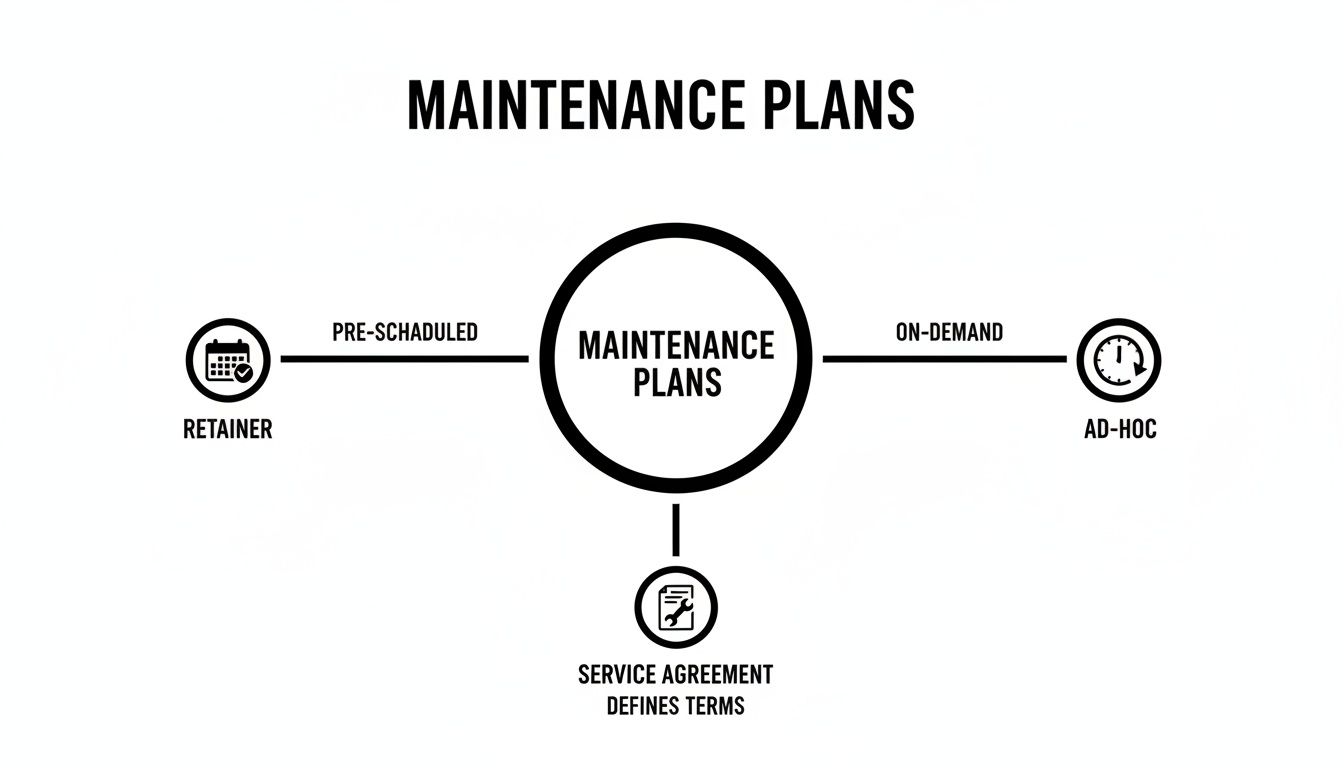
While 'pay-as-you-go' support has its place, a retainer-style service agreement is the only way to facilitate the constant monitoring that predictive maintenance demands. This isn't just about keeping the lights on; it's about keeping your website ahead of the curve and turning it into a reliable engine for your business.
A Practical Checklist for Vetting Maintenance Providers
Picking the right partner to look after your website is a big deal. It’s about much more than just comparing prices. The right provider becomes a genuine extension of your team, proactively protecting your most important digital asset. The wrong one? Well, that can lead to missed updates, agonisingly slow responses during a crisis, and a string of unexpected bills.
To make the right call, you need to evaluate them properly. This checklist is designed to help you see past the sales pitch and really dig into what a potential site maintenance services provider can do. Use these questions to find out if they have the skills and processes to be the right fit for your business.
Technical Skills and Platform Know-How
Not all websites are created equal, and your maintenance partner needs to have a deep understanding of your specific platform. A jack-of-all-trades might not grasp the nuances of a complex WooCommerce store or the unique security needs of a custom-built WordPress site. Your first task is to make sure they’re genuine specialists.
Get straight to the point and ask:
- Do you specialise in our platform? Whether your site runs on WordPress, Shopify, or something else, you need more than just a passing familiarity. You’re looking for a team that lives and breathes your technology. For example, you could ask a potential
wordpress developer australiaabout their hands-on experience with your theme framework or a tricky plugin you rely on. - Can you show me case studies or examples of similar sites you look after? This is where they prove their experience. Ask to see sites with similar complexity, traffic, or features to your own.
- How do you handle updates for custom code or complex integrations? If your site is more than just a simple template, their process for testing and rolling out updates without breaking things is absolutely critical. For instance, a
shopify liquid developer australiashould have a clear workflow for this.
Checking Their Reputation and Client Happiness
A provider’s track record is one of the best predictors of the service you’ll receive. Happy, long-term clients are the clearest sign of consistent, high-quality work. It’s time to do some digging and see what real customers have to say.
A provider's past performance is the clearest predictor of your future experience. Don't just take their word for it; seek out independent proof of their reliability and client dedication.
Follow these steps to get a feel for their reputation:
- Dig into Online Reviews and Testimonials: Look for detailed reviews on platforms like Google, Clutch, or other industry directories. Don't just glance at the star rating; read the comments. Are clients praising their communication, technical chops, or fast response times?
- Ask for Client References: A confident provider won't hesitate to let you speak directly with one or two of their current, long-term clients. It's a standard request, so don't be shy.
- Ask the References Specific Questions: When you get a reference on the phone, don’t just ask, "Are you happy?" Ask about a time when something went wrong. How quickly did the provider respond? How did they solve the problem? That will tell you far more than any polished testimonial ever could.
Nailing Down Communication and Reporting
Even the most brilliant technician is a terrible partner if they leave you in the dark. Clear, regular communication is the bedrock of a good maintenance relationship. You need to know what’s going on with your site and be confident you can get help when you need it.
Before you sign on the dotted line, get crystal clear answers on their process:
- What’s in your standard monthly report? A decent report is more than just a checklist of tasks. It should give you real insights into security scans, performance metrics, backup status, and uptime records.
- What are your official support channels and hours? Do they use a ticketing system, email, or a phone line? Make sure you understand their guaranteed operating hours, especially as they relate to the Australian time zone.
- Who will be my main point of contact? Having a dedicated account manager or a lead technician you can always reach out to provides incredible peace of mind, especially when compared to being just another number in a generic helpdesk queue.
White Label Maintenance for Digital Agencies
If you're running a digital agency in Australia, you know the rollercoaster of project-based work all too well. It's often a cycle of feast or famine. You finish a big website build, the invoice is paid, and then… crickets. The relationship ends, and you're left hunting for the next project to fill the gap.
This is exactly where offering site maintenance services can completely change your business model.
But building an in-house team to handle ongoing client work is a massive undertaking. It means hiring specialised staff, creating new systems, and being on-call for emergencies. That’s why so many savvy agencies are now looking at a much smarter, more scalable approach: white label maintenance.
A New Revenue Stream Under Your Brand
White label maintenance lets your agency sell professional WordPress or Shopify care packages as if they were your own. You find a specialist partner to handle all the technical heavy lifting—the updates, security scans, backups, and performance tweaks—while you maintain the client relationship and handle the billing. Simple as that. A white label wordpress agency or a white label shopify agency can become a powerful backend for your business.
This one shift can transform your agency's entire dynamic. You go from being a one-and-done project shop to a long-term strategic partner. Your clients get the peace of mind they need, and you get a reliable, recurring revenue stream without the massive overhead.
The benefits are pretty clear:
- Increased Client Loyalty: When you're looking after their site every month, clients have no reason to look elsewhere. You're their go-to expert.
- Enhanced Brand Authority: You're no longer just the 'website builder'. You become the full-service agency that manages the entire lifecycle of their most important digital asset.
- Predictable Monthly Income: Those maintenance retainers build a stable financial floor for your business, smoothing out the unpredictable highs and lows of project work.
Finding the Right Australian Partner
Of course, the whole model rests on finding a partner you can absolutely trust to work under your brand. They are, for all intents and purposes, an extension of your own team, so choosing the right one is critical. You need a team with proven expertise in platforms like WordPress and Shopify, like a dedicated white label wordpress maintenance australia provider or a white label shopify expert.
A great white label partner doesn't just tick off tasks on a list. They actively protect your client relationships and strengthen your agency's reputation. Their work is a direct reflection of your brand, making trust and transparency essential.
When you're checking out potential partners, dig into their communication style, reporting processes, and how well they understand the local Australian market. This isn't just about outsourcing tasks; it's about building a partnership that fuels your growth. It frees you up to focus on high-level client strategy, knowing the technical details are in expert hands.
For agencies wanting to grow even further, you could also outsource digital marketing to add even more value. By bundling services, you make your agency an indispensable part of your clients' success.
Got Questions About Site Maintenance? We’ve Got Answers.
Even after you've wrapped your head around what’s involved, it's natural to have a few lingering questions before you sign on the dotted line. Let's tackle some of the most common ones we hear from business owners, so you can feel completely confident about protecting your online presence.
What's a Realistic Budget for Maintenance?
In Australia, the cost for website maintenance can really swing depending on what you need. For a straightforward, 'brochure-style' website, you might find basic plans starting from around $100 per month.
On the other end of the spectrum, a complex eCommerce store, say on Shopify or WooCommerce, could easily be $500 per month or even more. The final figure really comes down to your site's complexity, the response times guaranteed in the Service Level Agreement (SLA), and exactly which services are on the list. Think of it less as a cost and more as an investment in keeping your site secure, fast, and reliable.
Can't I Just Do This Maintenance Stuff Myself?
The short answer is, maybe. If your website is incredibly simple and you've got the technical chops (and a lot of spare time), you could give it a go. But for the vast majority of business owners, it's a classic case of being 'penny wise and pound foolish'.
Your time is far better spent growing your business, not wrestling with plugin updates. Professional site maintenance services come armed with specialised tools, years of experience, and round-the-clock monitoring that you simply can't replicate on your own. A wordpress expert australia can spot a vulnerability and patch it correctly in minutes, saving you from a costly data breach or hours of frustrating troubleshooting.
How Often Does My Website Really Need a Check-Up?
Ideally? All the time. Good maintenance is continuous. While proactive monitoring is always on, the hands-on tasks follow a steady rhythm to make sure nothing slips through the cracks.
Here’s what that typically looks like:
- Daily or Weekly: This is for the absolute essentials. Things like off-site backups and security scans need to run this often to catch any potential problems the moment they appear.
- Monthly: This is when your core software, theme, and plugins get updated. After the updates, a thorough performance check is run to make sure everything is still humming along nicely.
A professional plan puts this entire schedule on autopilot. You get the peace of mind that your site is always protected and optimised, without having to add another long list of technical jobs to your own to-do list.
Ready to secure your website and get back to focusing on what you do best? White Label WordPress delivers expert white label maintenance and development for agencies all over Australia. We take care of the technical heavy lifting, so you can deliver incredible value to your clients.