

Think of your law firm's website as your digital front door. For many potential clients, it’s the very first interaction they'll have with your practice. It's not just an online brochure; it's your single most powerful tool for making a great first impression, building trust, and ultimately, winning new business. A well-executed website design for law firms can turn your online presence into a machine for generating clients.
Your Digital Handshake: Why a Great Law Firm Website is Non-Negotiable
Let's face it: when someone needs legal help, their first move is almost always a Google search. That makes your website the cornerstone of your entire marketing strategy. It's the central hub where potential clients, often dealing with stressful and urgent problems, come to see if you're the right fit.
A clunky, outdated, or confusing site can send them clicking away in seconds. On the other hand, a professional, polished, and easy-to-navigate website instantly communicates competence and builds confidence.
But this goes much deeper than just looking good. A strategic website is designed to do several critical jobs for your practice. It’s your chance to clearly state who you are, what you specialise in, and why you’re different from the firm down the road. The design, the words you use, and the way it’s all structured work together to answer a visitor’s two most important questions: "Do these lawyers get my problem?" and "Can I actually trust them to fix it?"
What’s the Real Job of Your Website?
Before we get into the nuts and bolts of design, we need to be crystal clear on what the site needs to achieve. A high-performing law firm website isn't just a pretty picture; it’s a business tool built to accomplish a few key things at once.
- Build Instant Credibility: Your site must scream professionalism and authority. This comes from a clean design, comprehensive lawyer profiles that show off your human side, and genuine client testimonials.
- Generate High-Quality Leads: The entire experience should gently guide a visitor towards taking the next step, whether that’s filling out a contact form, calling your office, or scheduling a consultation.
- Educate and Inform: By offering genuinely helpful content that answers common legal questions, you prove your expertise and start building a relationship before you even speak to them.
- Act as Your 24/7 Receptionist: Your website works tirelessly, day and night. It answers basic questions and captures leads long after you've gone home for the day.
This guide is your complete roadmap to building a website that nails every one of these goals. We’ll walk through everything from pinpointing your ideal client to the technical details that make a site fast and secure, ensuring your little corner of the internet becomes a major source of growth for your firm.
Defining Your Strategy Before a Single Pixel Is Placed
Jumping straight into design mockups without a clear strategy is like a barrister entering a courtroom without reviewing the case file. It’s a recipe for disaster. A high-performing website for a law firm isn’t built on aesthetics alone; it's founded on a deep understanding of your business objectives and the specific needs of the clients you serve.
Before a single pixel is placed on the screen, the most critical work happens. This is where you define what success actually looks like. Is your primary goal to generate a steady stream of enquiries for your family law practice? Or perhaps you aim to solidify your firm’s reputation as the top authority in Australian commercial litigation.
Each objective demands a different approach. A website focused on lead generation for personal injury claims will need clear, urgent calls-to-action and empathetic messaging. On the other hand, a site built for a corporate law firm might focus more on detailed case studies and thought leadership articles to attract sophisticated, high-value business clients.
Understanding Who You Are Really Speaking To
To build a website that truly connects, you have to move beyond generic demographics. Knowing your potential client is a "small business owner" isn't enough. You need to get inside their head and understand their anxieties, the questions keeping them up at night, and the signals of trust they are desperately looking for.
This is where detailed client personas become invaluable. A persona isn't just a made-up character; it's a semi-fictional representation of your ideal client, pieced together from real data and educated insights about their behaviour and motivations.
Consider these two very different personas for a family law firm:
- "Stressed Sarah," 38: She's a professional mother considering divorce. She feels overwhelmed, is worried sick about her children, and is incredibly anxious about her financial future. She’s searching on her mobile late at night for terms like "fair child custody arrangements" and "dividing assets in a divorce." She needs reassurance, clarity, and a simple, discreet way to book a confidential consultation.
- "Proactive Paul," 55: He's a high-net-worth individual planning to remarry. He’s specifically looking for a "binding financial agreement" to protect his assets. He is calm, analytical, and wants to see cold, hard evidence of expertise. He’s looking for articles on complex property settlements and detailed lawyer profiles that showcase specialised experience.
A website designed for Sarah must feel warm, reassuring, and be incredibly easy to navigate on a phone. A site for Paul needs to project authority, expertise, and precision. If you try to appeal to both with the same generic message, you'll ultimately fail to connect deeply with either.
This flowchart shows how a strategic website sits at the very centre of your firm’s growth, directly fueling both client acquisition and your hard-earned reputation.
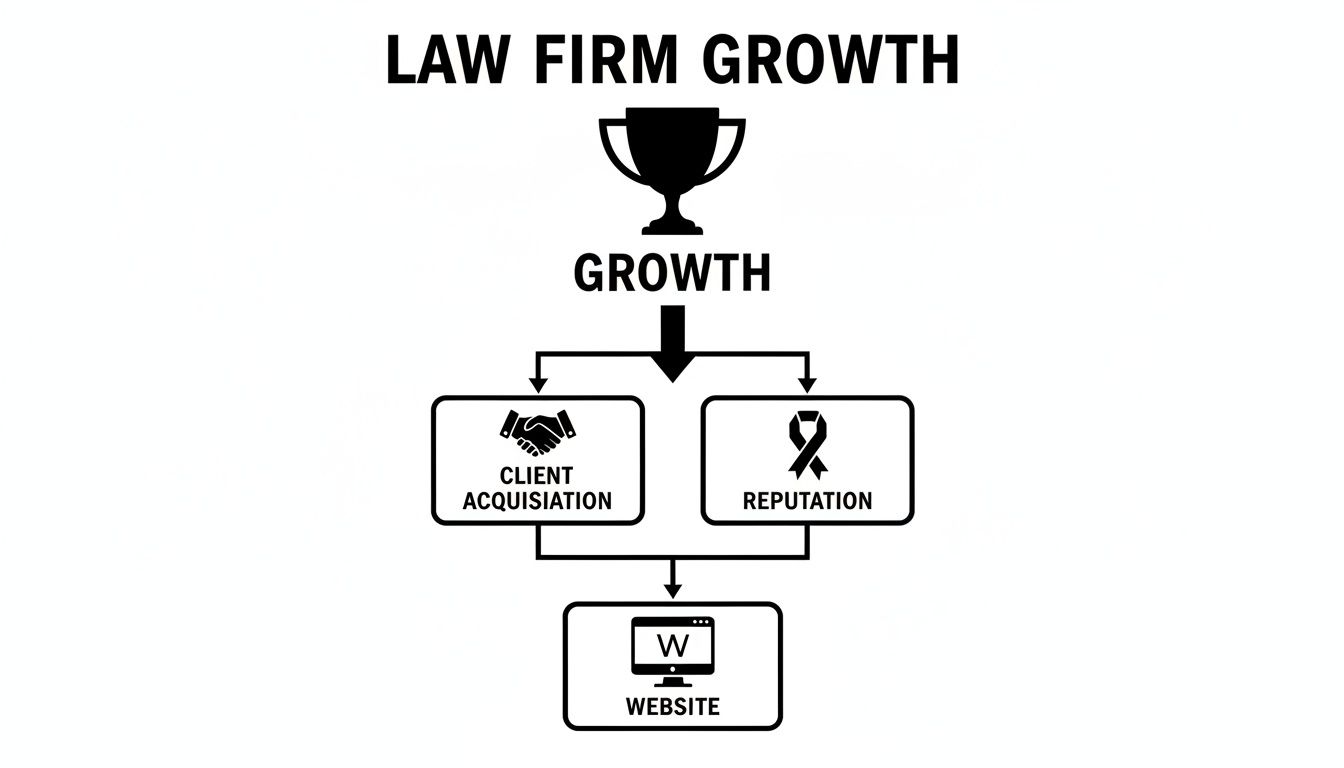
The visualisation makes it clear: your website isn't just another marketing tool. It’s the fundamental asset that underpins your firm's most important business objectives.
Mapping Goals to Actions
Once you have a firm grip on your goals and your audience, the final strategic step is to map your core practice areas directly to client pain points and the specific actions you want them to take. Every single page on your site must have a purpose.
A website without a clear user journey is like a beautiful office with no front door. Visitors might admire it from the street, but they'll never become clients because they don't know how to get inside.
Use this framework to connect your services to client needs and website goals. This ensures every design choice and piece of content serves a distinct purpose.
Mapping Practice Areas to Client Needs and Website Goals
Use this framework to align your firm's services with the specific needs of your target clients and define the primary conversion goal for each on your website.
| Practice Area | Target Client Persona (e.g., Small Business Owner) | Client's Primary Pain Point | Desired Website Action (e.g., 'Book a Consultation') |
|---|---|---|---|
| Family Law | "Stressed Sarah," 38, worried mother | "I'm overwhelmed and scared about my children's future." | 'Book a Free, Confidential Chat' |
| Commercial Litigation | CEO of a mid-sized tech company | "We're facing a contract dispute that could threaten our business." | 'Download Our Case Study on Successful Litigation' |
| Conveyancing | First-home buyer couple | "The process is confusing, and we don't want to make a mistake." | 'Get an Instant Quote' |
| Wills & Estates | "Proactive Paul," 55, high-net-worth individual | "I need to protect my assets for my family's future." | 'Request a Callback from a Specialist Lawyer' |
| Personal Injury | Injured construction worker | "How will I pay my bills if I can't work?" | 'Check Your Claim Eligibility Now' |
Knowing what you want to achieve before you start is crucial, as it fundamentally shapes your entire approach. It also helps you get a clearer picture of the potential investment required; you can find more detail in this guide to understanding website design costs. This strategic alignment is the blueprint for a successful website that actively contributes to your firm’s bottom line.
Building a Website That Inspires Trust and Action
With your strategy locked in, it’s time to shift gears and focus on what turns a casual visitor into a genuine client. In the legal world, a website has to do more than just look polished. It needs to build trust and gently guide someone—who’s often feeling stressed and overwhelmed—towards making contact. This is where smart design becomes your most powerful client-acquisition tool.
It all starts with that first impression. Your branding—the logo, your colour palette, the fonts you choose—needs to project authority and stability from the moment the page loads. Ditch the cheesy stock photos; using authentic, high-quality images of your actual team and office is far more effective. It humanises your firm and builds an immediate connection.

This digital handshake is where the battle for clients is now won or lost. Here in Australia, looking for legal help has become a digital-first activity. About one in three people start their search for a lawyer online, making a firm's website a critical pipeline for new business. This isn't just a hunch; it's backed by data showing that user experience has a direct impact on lead quality. Paid search click-through rates for various practice areas, for example, sit between 4.5% and 6.2%. You can get a deeper dive into how website performance influences legal marketing benchmarks in Practice Proof's detailed analysis.
Designing an Intuitive User Journey
When a potential client lands on your site, they’re usually looking for answers, and fast. Confusing navigation is an instant deal-breaker. The entire structure of your website has to feel so natural that anyone can find what they need in just a couple of clicks.
A logical, easy-to-use menu is the backbone of a great user experience. These key pages should be impossible to miss.
- Practice Areas: Don't just list them. Give each area of expertise its own detailed page explaining the services you offer, who you help, and what makes your approach different.
- Attorney Profiles: A dry CV won't cut it. Create compelling profiles with professional headshots, insightful biographies, and key achievements. This showcases your team's expertise and helps build a personal connection.
- Contact Us: This needs to be one of the most visible elements on every single page. Make it effortless for people to get in touch with a clear phone number, a simple contact form, and an embedded map to your office.
A great law firm website anticipates a visitor's questions and answers them before they're even asked. The design should feel less like a brochure and more like a helpful guide, leading them confidently to the solution they need—your firm.
This need for clarity extends to mobile. It’s non-negotiable. A huge chunk of your potential clients are searching on their smartphones, often in moments of real urgency. If your site is a mess to read or navigate on a mobile device, you're throwing away leads. Frustrated users will just give up and go elsewhere.
Driving Conversions with Trust Signals
Building trust isn’t something you hope for; it’s something you engineer. You need to strategically place "trust signals" across your site that prove your credibility and encourage people to take the next step.
The most powerful trust signals come straight from your past clients. Weaving compelling client testimonials and detailed case studies throughout your practice area pages offers undeniable social proof. These stories show potential clients facing similar struggles that you have a proven track record of getting results.
Finally, every page needs a purpose, and that purpose is driven by a clear call-to-action (CTA). A CTA is a direct instruction designed to get an immediate response. Vague phrases like "learn more" are weak. You need specific, action-oriented language that matches what the user wants to do.
- "Book a Free, Confidential Consultation"
- "Download Our Guide to Property Settlement"
- "Call Us Now for Immediate Assistance"
By combining professional branding, intuitive navigation, powerful trust signals, and clear CTAs, your website stops being a static online brochure and becomes a dynamic tool that actively builds confidence and drives action.
How to Attract Your Ideal Clients with SEO and Content
A beautifully designed website is worthless if your ideal clients can never find it. Think of your site as a brilliant legal argument that no one ever hears; without an audience, it has no impact. This is where Search Engine Optimisation (SEO) and a smart content strategy become your most powerful tools for bringing the right people through your digital door.
SEO is all about making your website more visible to search engines like Google. When a potential client in Perth searches for a "contract dispute lawyer," a strong SEO strategy ensures your firm appears high up in the results. This isn't about gaming the system with technical tricks; it’s about aligning your website's content with the exact phrases and questions your ideal clients are using.

Getting this right is fundamental to any successful website design for law firms, as it’s the bridge connecting your expertise directly to client needs.
Mastering Local and Niche Keywords
Let's face it, most law firms serve a specific geographic area. This makes Local SEO incredibly important. Your goal is to show up for searches that include a location, like "family lawyer Sydney" or "conveyancing services Brisbane."
It all starts with keyword research. You need to get inside the heads of potential clients and figure out the precise terms they’re typing into Google when they need help.
- Broad terms: "lawyer" (high competition, low intent)
- Specific service terms: "divorce lawyer" (better, but still very competitive)
- Location-specific terms: "divorce lawyer Parramatta" (now we're talking – highly targeted)
- Long-tail question-based terms: "how to create a binding financial agreement in NSW" (this signals someone is ready for advice and presents a perfect content opportunity)
Once you've identified these keywords, you need to weave them naturally into your service pages. This tells Google exactly what each page is about, helping it rank for the searches that actually matter.
The Power of Your Google Business Profile
Your Google Business Profile (GBP) is easily one of the most critical parts of your local SEO efforts. It’s that info box that appears in Google Maps and on the right side of the search results, showing your firm's name, address, phone number, and those all-important client reviews.
Think of an optimised and active Google Business Profile as a free, high-visibility billboard in your local community. It builds immediate trust and is often the very first impression a potential client has of your firm.
Keeping this profile complete, accurate, and regularly updated with posts and photos sends strong positive signals to Google. And don't be shy about encouraging satisfied clients to leave reviews—social proof is a massive factor in a prospective client's decision-making process.
Building Authority with Valuable Content
SEO gets potential clients to your site, but it’s great content that convinces them to stay and reach out. Content marketing for law firms isn't about the hard sell; it's about demonstrating your expertise and building trust by generously sharing your knowledge.
Think about the questions clients ask you every single day. Each one is a potential blog post, article, or guide. When you create content that provides clear, helpful answers to these common legal questions, you accomplish several key goals at once.
- It attracts organic traffic: People searching for answers land on your website, introducing them to your firm.
- It establishes authority: High-quality content positions you as the go-to expert in your practice area.
- It builds trust: By providing genuine value upfront, you start building a relationship before a client ever picks up the phone.
Beyond blog posts, think about creating detailed practice area guides or resource hubs. A solid content strategy is also supported by off-page factors; to get a better handle on this, you can explore the fundamentals of building authority through high-quality link building services.
For agencies creating these SEO-optimised websites for law firms, partnering with a provider of white label WordPress development in Australia is a smart move. It allows you to deliver technically sound, high-performing sites without the overhead of an in-house team, so you can focus on strategy and content while the technical foundation is expertly handled.
The Technical Foundation of a Modern Law Firm Website
Looks and content are only half the story. The real strength of a law firm's website lies in its technical foundation—the stuff that works tirelessly behind the scenes. It might not be the most glamorous part of the project, but getting it right is non-negotiable for protecting your clients, your reputation, and making sure the site is a genuine asset to the firm.
Think of it like the foundations of a new office building. You could have the most stunning architecture, but if the foundations are weak, it’s only a matter of time before serious cracks appear. For a law firm, those cracks can have devastating consequences.

Uncompromising Security for Client Confidentiality
For a law firm, website security isn’t just a technical box to tick; it’s an ethical duty. You're handling incredibly sensitive client information through contact forms and client portals. A single security breach could expose confidential details, leading to irreparable damage to your firm’s reputation and serious legal ramifications.
That's why robust security measures are an absolute must in modern website design for law firms. This isn't about one single tool, but rather multiple layers of defence working together.
- SSL Certificates: This is the baseline. It encrypts the data flowing between a user's browser and your site, protecting anything submitted through a form.
- Regular Software Updates: Keeping your website’s core system, theme, and plugins updated is crucial for patching security holes as soon as they’re found.
- Secure Hosting: Your choice of hosting provider matters. A good one will prioritise security with robust firewalls and regular malware scanning, adding another vital layer of protection.
Performance and Page Speed
Online, speed is synonymous with professionalism. Picture a potential client, stressed and in urgent need of legal help. The last thing they have time for is a website that takes an age to load. We know from countless studies that if a page doesn't load in a few seconds, a huge chunk of visitors will simply hit the 'back' button and find a competitor.
A slow website is the digital equivalent of putting a client on hold for ten minutes. It sends a clear message that you don't value their time and creates a poor first impression that’s almost impossible to recover from.
On top of that, fast page speeds are a huge ranking factor for Google. A zippy site doesn't just create a better user experience; it's also more likely to be rewarded with better visibility in search results, which means more potential clients finding their way to you.
Ensuring Accessibility for All Users
Web accessibility is all about building your website so that people with disabilities can use it effectively. This means considering individuals with visual, auditory, motor, or cognitive impairments. It's more than just good practice—it's an ethical and often legal requirement to provide equal access to information.
Putting accessibility standards into practice involves things like:
- Providing text alternatives for all images.
- Making sure the entire site can be navigated with just a keyboard.
- Using colour combinations with enough contrast to be easily read.
For digital agencies, juggling these technical demands requires real expertise. This is where partnering with a white label WordPress agency in Australia can be a game-changer. It ensures all these critical technical elements are handled by specialists, allowing the agency to focus on client strategy and growth. When firms debate different platforms, a deep dive into WordPress vs Squarespace for professional sites often reveals just how vital that technical control is for a legal practice.
Measuring Website Performance and Proving ROI
Launching your new website is the starting line, not the finish. A brilliant design is only valuable if it brings in real, measurable business. To understand the return on your investment, you have to move past gut feelings and get into the data. This is how you connect your digital presence directly to your firm's bottom line.
The whole process kicks off by tracking key performance indicators (KPIs). Think of these as specific, measurable signposts that tell you how well your website is hitting its goals. With free tools like Google Analytics, you can get a crystal-clear picture of what’s working and, just as importantly, where you can improve.
Key Metrics Every Law Firm Should Track
You can easily get lost in a sea of data, so it pays to focus on the metrics that actually matter for client acquisition.
-
Organic Traffic: This is simply the number of people finding you through a search engine like Google. If this number is steadily climbing, it’s a great sign your SEO strategy is paying off and more potential clients are discovering your firm.
-
Conversion Rate: This is the percentage of visitors who take a specific action—like filling out your contact form or calling the office. You could argue this is the most critical metric of all, as it directly measures how effectively your site turns a casual visitor into a genuine lead.
-
Bounce Rate: This tells you the percentage of visitors who land on a page and leave without clicking anywhere else. A high bounce rate can be a red flag. It might mean the page content wasn't what they expected, or the user experience simply wasn't up to scratch.
-
Top Performing Pages: Figuring out which pages and articles pull in the most traffic gives you incredible insight into what your audience actually cares about. This lets you double down on the content that works and overhaul the pages that aren't pulling their weight.
Connecting the Dots Between Data and Growth
The real magic happens when you connect these numbers back to your firm's actual revenue. It’s all about answering the big questions: Is our investment in website design for law firms actually generating enough quality leads? Are we pulling in the right type of clients for our most profitable practice areas?
For example, you can track precisely how many contact forms were submitted through your "Commercial Litigation" service page. By then tracking those leads through your intake system, you can calculate the exact revenue that page generated, proving its ROI beyond a doubt.
A data-driven approach transforms your website from a digital expense into a predictable business development asset. It empowers you to make informed decisions, doubling down on successful strategies and refining those that aren't delivering.
This focus on measurable outcomes is becoming standard practice in the Australian legal sector. A recent study found that 71% of midsize firms see client satisfaction as core to their growth, which all starts with a seamless digital experience.
Industry benchmarks also provide a tangible framework for setting goals. Click-through rates can sit anywhere from ~4.5% to ~6.2% for different practice areas, while conversion rates for high-intent legal keywords can climb above 10–13%. You can dig into more of this data in the 2025 Australian Midsize Law Firm Priorities Report.
This continuous cycle—measure, analyse, optimise, repeat—is what keeps your website your most powerful tool for attracting new clients and securing the long-term growth of your firm.
Got Questions About Law Firm Websites? We've Got Answers
When you're diving into a new website project for a law firm, a lot of questions pop up. It's completely normal. Getting clear on these common queries is the first step toward making smart decisions for what is arguably your firm's most critical marketing asset. Let's break down some of the most frequent questions we hear.
How Much Should a Law Firm Website Cost in Australia?
There's no single price tag, as the cost really depends on what you need. A simple site built from a pre-made template might only set you back a few thousand dollars. On the other hand, a large, completely custom website with sophisticated features like secure client portals could easily climb into the tens of thousands. The best way to think about it is as a fundamental investment in your business, not just another line item on an expense sheet.
For digital agencies, partnering with a white label WordPress developer in Australia is a brilliant way to offer high-end websites to legal clients without the massive overhead of an in-house team.
What’s the Single Most Important Feature on a Legal Website?
You could argue for days about different features, but one thing stands above all else: making it incredibly easy for a potential client to contact you. It's that simple. This means a phone number that’s impossible to miss, a straightforward contact form, and unambiguous calls-to-action on every single page.
Remember, people seeking legal advice are often stressed and overwhelmed. Your website’s primary job is to gently guide them to that first, crucial step of reaching out for help. Any obstacle, no matter how small, can mean a lost client.
How Long Does It Take to Build a New Law Firm Website?
From the first kickoff meeting to the final launch, a typical website project for a law firm will take somewhere between 8 and 16 weeks. This timeline can stretch or shrink based on a few key factors: the site's overall complexity, how much content needs to be written and organised, and how promptly the firm can provide feedback and sign off on each stage.
Nailing down a detailed strategy right at the start is the best thing you can do to keep the project moving smoothly and prevent any frustrating delays.
Should Our Firm Just Use a DIY Website Builder?
It's tempting to go the DIY route to save a bit of cash, but for a law firm, it's a risky move. Trust and professionalism are everything in the legal field, and DIY platforms rarely deliver the goods. They often fall short on custom branding, robust security, and the kind of high-level SEO needed to stand out in a very competitive market.
Investing in a professional website design for law firms ensures your online presence truly reflects the quality of your legal expertise. It’s about building a site designed to attract your ideal clients, not accidentally turn them away.
At White Label WordPress, we give agencies the power to deliver outstanding, high-performance websites for their law firm clients. When you outsource your development to our Australian-based experts, you can provide top-tier web services with guaranteed profit margins, freeing you up to focus on what you do best. Learn how our white label WordPress services can help you scale your agency.