Think of a website maintenance package like a regular service for your car. It’s not about waiting for the engine to seize up; it’s the proactive oil changes, tyre rotations, and tune-ups that keep it running smoothly and prevent expensive breakdowns down the track.
A maintenance package is a recurring service that bundles all those essential technical jobs needed to keep your website healthy, secure, and performing at its best.
Why Your Website Needs a Maintenance Plan
Getting your website live is a huge milestone, but it's really just the starting line. Without consistent care, even the most impressive site can quickly become sluggish, fall prey to hackers, or simply break. A solid maintenance plan is the best way to protect your investment and make sure your website keeps working for you.
Ignoring maintenance is a bit like ignoring the check engine light. A small, fixable problem can easily spiral into a complete disaster. For a website, that could mean anything from slow-loading pages that send potential customers packing, to a major security breach that shatters your brand's reputation.
Consider this: over 40% of all websites are built on WordPress. While the core platform is secure, outdated plugins and themes are the number one way hackers get in. A reliable wordpress maintenance australia service is crucial.
The Pillars of Proactive Care
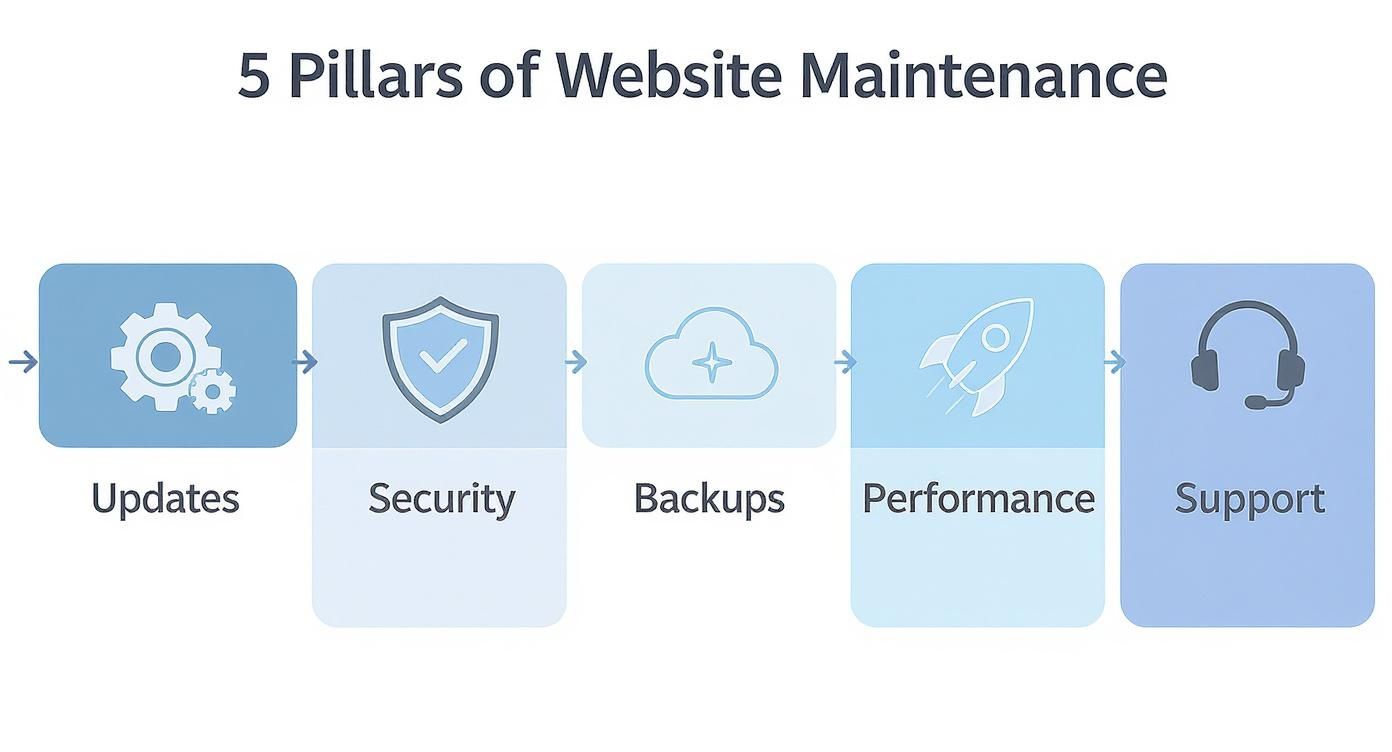
A good website maintenance package isn't just one thing; it's a combination of crucial services that work together. Here are the core pillars you should expect to see:
-
Security Monitoring: This is your 24/7 digital watchdog. It actively scans for malware, blocks brute-force login attempts, and patches up security holes before anyone can exploit them.
-
Regular Updates: The software that powers your site—the core system, plugins, and themes—is constantly being updated by developers. A maintenance plan ensures these updates are applied safely and promptly, keeping your site secure and its features working correctly.
-
Performance Optimisation: This is all about speed. It involves tasks like optimising images so they load faster, cleaning out your website's database to remove junk, and setting up caching to serve pages quickly. A fast site means a better user experience and a nice boost for your SEO. A specialist in wordpress speed optimisation australia can make a significant difference.
-
Consistent Backups: This is your ultimate safety net. The plan should include regular, automated backups of your entire site, stored somewhere safe and separate. If the worst happens, you can restore a clean version in no time.
The way these packages are structured and priced is often a reflection of what's happening in the wider tech world. For instance, Australia's IT services market is on a massive growth trajectory, expected to jump from USD 32.26 billion in 2025 to an incredible USD 77.77 billion by 2030. This boom means we’re seeing more sophisticated managed security and cloud services being bundled into maintenance plans to keep up with business needs. You can discover more insights about the Australian IT services market and how it’s shaping digital strategies.
Breaking Down What’s Actually Inside a Maintenance Plan
Think of a website maintenance package less like a simple IT cost and more like a full service plan for your car. It’s not just one thing; it’s a bundle of essential services designed to keep your most important digital asset running smoothly, securely, and efficiently. Popping the bonnet on these plans helps you see exactly where the value is.
At its core, a good plan covers all the crucial aspects of your site's health. This ensures nothing slips through the cracks, from a sneaky security flaw to a slowdown in page speed that could be quietly costing you customers.
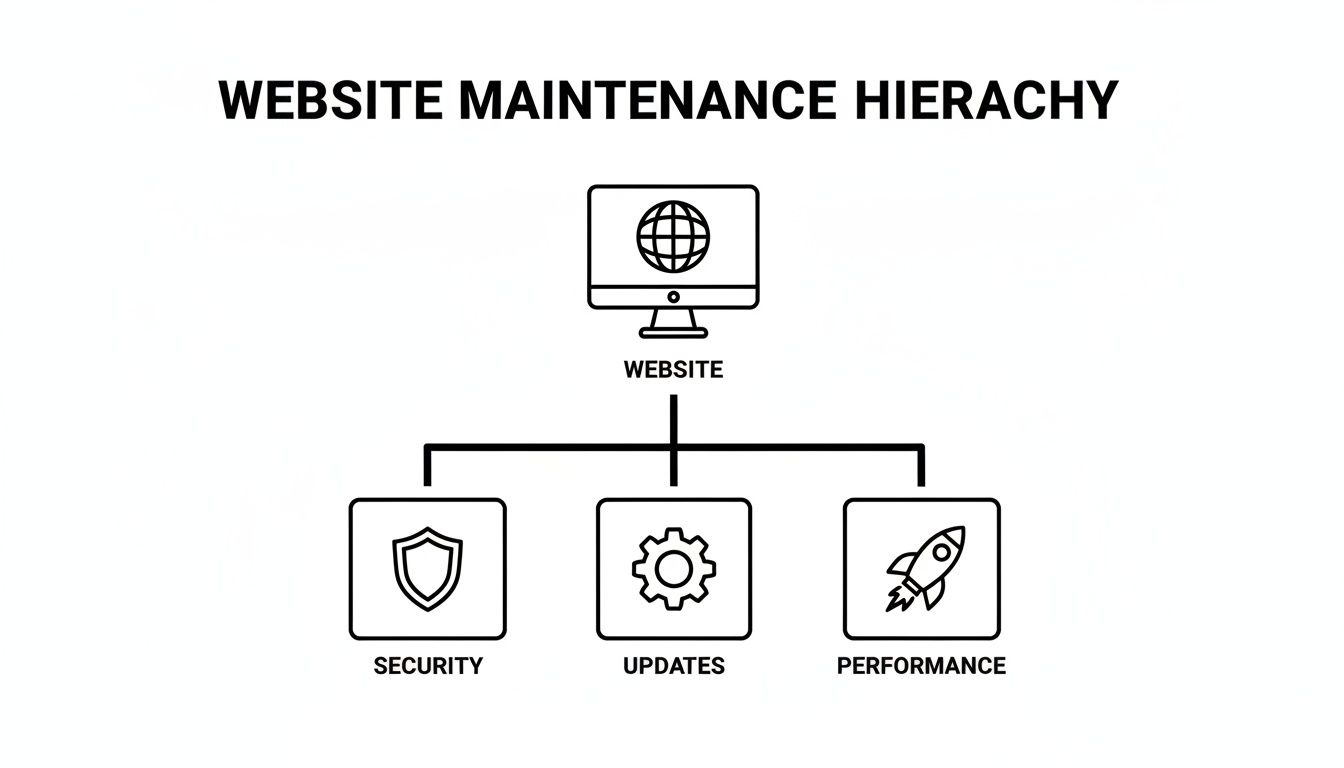
This diagram shows how everything fits together. The real strength of a maintenance plan comes from how these different services support each other.
Let's dive into what these core components actually involve.
Consistent Software and Plugin Updates
The software your website runs on—whether it's WordPress, Shopify, or something else—is always being improved. Developers are constantly releasing updates to add features, boost performance, and, most critically, patch security vulnerabilities. These updates are your site’s first line of defence.
Outdated plugins are one of the most common ways hackers get in. In fact, an incredible 93% of WordPress security breaches can be traced back to outdated software components. A maintenance plan handles this for you, applying updates as soon as they’re available and checking to make sure they don’t break anything. A professional wordpress bug fix australia service is invaluable for this. It’s peace of mind in a can.
Proactive Security Monitoring
If software updates are the locks on your doors, think of security monitoring as the 24/7 guard patrolling your property. This service is about actively looking for trouble, not just waiting for it to happen.
A robust security protocol doesn't just react to problems—it actively hunts for them. It involves continuous scanning for malware, blocking brute-force login attempts, and monitoring for suspicious activity that could signal an impending attack.
This kind of constant vigilance is what separates a safe site from a sitting duck. It's about protecting your business data, your customer information, and your hard-earned reputation.
Regular and Reliable Backups
What would you do if a server crash or a hack wiped your entire website tomorrow? Without a recent backup, you could lose everything—years of content, customer orders, and all your hard work. Regular backups are your ultimate 'undo' button.
A proper maintenance plan includes frequent, automated backups of everything: your files, your images, and your database. The crucial part? These backups are stored securely off-site. This means that even if your web server is completely compromised, you have a clean, safe copy ready to restore, slashing downtime and preventing a potential disaster.
Performance and Speed Optimisation
How fast your website loads has a massive impact on your bottom line. Google's own data shows that the chance of a visitor leaving your site (bouncing) increases by 32% if your page load time goes from just one to three seconds. A slow site doesn't just annoy people; it actively sends them to your competitors. A shopify developer australia can help with shopify seo australia by improving site speed.
Performance optimisation is a collection of behind-the-scenes tweaks to make your site fly. This usually includes:
- Image Compression: Making image files smaller without losing visual quality.
- Database Cleanup: Clearing out old post revisions, spam comments, and other junk that can clog up your database.
- Code Minification: Tidying up the code by removing unnecessary characters and spaces to make it lighter and faster.
- Cache Management: Storing static copies of your pages so they can be served to visitors almost instantly.
These technical tune-ups work together to deliver a zippy, frustration-free experience for everyone who visits your site.
Uptime Monitoring
Finally, a website is useless if no one can access it. Uptime monitoring is a simple but vital service that continuously checks if your site is online and available. The moment it detects an outage, it sends an immediate alert.
This allows your maintenance team to jump on the problem right away, often before you or your customers even realise there’s an issue. Quick response times are key to keeping your site online and ensuring you're always open for business.
To give you a clearer picture, let's look at how these services are often bundled. A basic, "essential" package will cover the absolute must-haves, while a "premium" plan will offer a more comprehensive, proactive approach to your site's health and growth.
Essential vs Premium Website Maintenance Inclusions
| Service Area | Essential Package (Standard) | Premium Package (Comprehensive) |
|---|---|---|
| Updates | Core, plugin & theme updates (monthly) | Core, plugin & theme updates (weekly/daily) + staging site testing |
| Backups | Daily off-site backups (30-day retention) | Daily off-site backups + real-time backups for e-commerce (90-day retention) |
| Security | Basic malware scanning & firewall | Advanced security scanning, brute-force protection, malware removal guarantee |
| Performance | Basic caching setup | Advanced speed optimisation, CDN integration, database optimisation |
| Monitoring | Uptime monitoring with email alerts | Uptime monitoring with instant SMS/Slack alerts + performance monitoring |
| Support | Email support (business hours) | Priority support (email, phone, chat) + monthly developer time for small jobs |
| Reporting | Basic monthly activity report | Detailed monthly report with performance analytics & strategic recommendations |
As you can see, while an essential plan keeps the lights on, a premium package is geared towards protecting and actively improving your digital investment over time. It's about shifting from a reactive "fix-it-when-it-breaks" mindset to a proactive strategy for continuous improvement.
How Predictive Maintenance Is Changing the Game
What if your mechanic called you to say, "Hey, we've been monitoring your car's diagnostics, and it looks like a specific part is showing wear. It'll probably fail in the next 1,000 kilometres." That's the exact idea behind predictive maintenance, an approach that's completely shifting how we think about website support. It's all about moving from a reactive "fix it when it breaks" model to a proactive one that stops problems before they ever start.

This modern strategy leans on data analytics and machine learning to see into the future. Instead of waiting for the dreaded site-down alert, a smart website maintenance package analyses trends and historical patterns to flag potential trouble on the horizon. This transforms website care from a chore into a genuine strategic advantage.
From Reactive Fixes to Proactive Prevention
For years, website maintenance has been a reactive game. A plugin update suddenly breaks your checkout process, a huge traffic spike from a successful ad campaign crashes your server, or worse, a security vulnerability is only found after a data breach. Each of these scenarios is stressful, costly, and leads to damaging downtime.
Predictive maintenance completely flips that script. It’s a forward-thinking method that uses data to make intelligent forecasts about what's coming.
- Forecasting Server Load: By analysing past traffic, these systems can predict an upcoming surge during a Black Friday sale, letting your team scale up server resources before the rush hits. No more crashes.
- Identifying Plugin Conflicts: Before you even click 'update,' predictive tools can simulate how a new plugin version will interact with your site, flagging conflicts that would have otherwise brought things to a grinding halt.
- Detecting Security Risks: It's more than just scanning for known viruses. These systems monitor for tiny, unusual changes in user behaviour or file activity that could be the early warning signs of a brewing security threat.
By anticipating problems, you move from a constant state of emergency response to one of controlled, strategic management. This protects not just your website's uptime, but also your budget and brand reputation.
The Financial and Strategic Advantage
This proactive mindset isn't just a technical nicety; it's a powerful business decision. Just look at the numbers. The predictive maintenance sector in Australia is projected to explode from USD 254 million in 2024 to a staggering USD 1,620.05 million by 2033. There's a good reason for that growth. Businesses are finding that these forward-looking tools can slash website downtime by up to 50% and cut maintenance costs by as much as 30% simply by catching issues before they spiral. You can discover the full market forecast for Australia's predictive maintenance sector to see just how big this shift is.
For an agency, being able to offer this kind of foresight is a massive competitive edge. A white label WordPress or Shopify partner using predictive tools can deliver a far superior service. Imagine a white label wordpress agency telling a client their e-commerce site is at risk of slowing down during the Christmas peak and recommending performance tweaks weeks in advance. That's how you build rock-solid trust and prove your value.
What This Means for Your Maintenance Package
When you’re looking at a website maintenance package, asking about their predictive capabilities should be at the top of your list. Does the provider use data to get ahead of problems, or are they just waiting for alarms to ring? A plan that includes predictive analytics is a true investment in your site’s stability and ongoing improvement.
This is especially critical for agencies partnering with a white label shopify development provider in Australia. It becomes a core part of your sales pitch. You're no longer just selling a service that fixes broken things; you're offering one that actively stops them from breaking in the first place. This forward-looking approach keeps your clients' websites healthy, keeps them happy, and cements your agency's role as a vital strategic partner.
Understanding Website Maintenance Pricing in Australia
Asking about the cost of a website maintenance package is a bit like asking, "how much for a car?" Well, are we talking about a reliable city runabout or a high-performance track car? The answer, of course, depends entirely on what you need it to do. It’s the same with your website—the price of keeping it in top shape is directly tied to its complexity and how critical it is to your business.
So, let's break down the numbers. Here in Australia, a good maintenance plan is no longer a "nice-to-have"; it's an essential investment. Typically, you'll see packages ranging anywhere from $200 to $5,000 per month. That's a huge range, I know. But it reflects the different needs of Australian businesses. A local plumber might just need a basic plan to keep the lights on, while a major online retailer will need a far more robust service with 24/7 monitoring and advanced performance work.
The goal isn't just to find the cheapest option, but to understand what's driving the price so you can find the best value for your investment.
What Factors Influence the Price Tag?
A few key things determine where a package will land on the price spectrum. The more moving parts your website has, or the more you stand to lose from downtime, the more resources it takes to keep everything running smoothly.
- Website Complexity: A simple five-page brochure site is worlds away from a sprawling ecommerce store with thousands of products, customer accounts, and complex payment gateways. More complexity means more work.
- The Technology Stack: Every platform has its quirks. A WordPress or Shopify site loaded with custom-coded plugins or specialised apps needs a much more delicate touch during updates than a site built from a standard template. This is where a woocommerce developer australia can be essential.
- How Much Traffic You Get: A website with hundreds of thousands of monthly visitors needs heavy-duty server monitoring, tighter security, and constant performance tuning. A site with low traffic simply doesn't face the same level of strain.
- The Level of Support You Need: This is a big one. A basic plan might get you email support with a 24-hour turnaround. A premium plan, on the other hand, could offer priority phone support or even a dedicated account manager you can reach almost instantly.
Think of it this way: a basic plan is like having a great mechanic you can call when you need one. A premium plan is like having a dedicated pit crew on standby, ready to jump in the second something looks off so you never even slow down.
Decoding the Different Pricing Tiers
To make it easier to choose, providers usually offer their services in tiers. The names might change, but the structure is generally pretty consistent, designed to match different business needs and budgets.
Starter or Basic Tier (Approx. $200 – $600/month)
This is the perfect starting point for small businesses, startups, and simple informational websites. It covers the absolute essentials—the non-negotiables that keep your site secure and online. It's your digital safety net.
- Monthly updates for plugins, themes, and the core platform.
- Daily or weekly backups safely stored somewhere other than your server.
- Basic security scans and uptime monitoring.
- A simple report each month showing what was done.
Business or Pro Tier (Approx. $600 – $1,500/month)
This tier is designed for growing businesses, serious lead-generation sites, and small ecommerce stores. It builds on the basics by adding proactive performance improvements and a higher level of care.
- More frequent updates (often weekly).
- Advanced security monitoring, often including a Web Application Firewall (WAF).
- Performance scans and foundational speed optimisations.
- Priority email support, plus a few hours of developer time for small tweaks and fixes.
Premium or Enterprise Tier (Approx. $1,500 – $5,000+/month)
This is the all-inclusive option for large ecommerce operations, high-traffic websites, and any business where downtime is simply not an option. It's less of a service and more of a hands-on partnership focused on peak performance and growth. If you want to dive deeper into how these costs break down, our complete guide on website maintenance cost in Australia is a great resource.
- Near real-time backups and updates tested on a staging server first.
- Guaranteed malware removal and advanced security hardening.
- Comprehensive speed optimisation, including CDN setup and database tuning.
- 24/7 priority support with a dedicated success manager.
Choosing the Right Maintenance Partner for Your Business
Handing over the keys to your website is a big deal. You're not just buying another monthly service; you’re trusting a new team with one of your most important business assets. Picking the right partner for your website maintenance package means looking past the price and really digging into their expertise, their processes, and how they fit with where you want to take your business.
Think of it like hiring a key employee. Their ability to manage your website's platform, talk to you like a human, and grow with you will make all the difference to your site's health and, frankly, your own peace of mind.
Vetting Potential Providers
Before you sign on the dotted line, you need to do your homework. A solid vetting process will help you find a competent, reliable partner who gets what it means to do business in Australia. Kick things off by looking at their technical skills and experience with your specific platform.
A great wordpress developer australia has a very different skillset to a shopify expert australia. Ask potential providers to show you examples of sites they manage that are similar to yours, both in terms of what they do and how complex they are.
Here are a few questions you should definitely be asking:
- Experience: How long have you been doing this, specifically for platforms like WordPress or Shopify?
- Team: Who’s actually going to be working on my site? Are they your own staff, or do you farm it out to freelancers?
- Process: What’s your routine for updates? Critically, do you test changes on a staging site before they go live on my actual website?
- Communication: How will you keep me in the loop? What do your reports look like, and who is my go-to person if I have a problem?
Decoding the Service Level Agreement (SLA)
The Service Level Agreement (SLA) is easily the most important part of any maintenance contract. It's not just legal boilerplate; it’s the rulebook for your relationship. This document sets out exactly what you get, guaranteed response times, and what happens when things go wrong.
Think of an SLA as your service guarantee. It should spell out what "business hours" actually means, specify response times for different issues (e.g., "site down" vs. "small visual bug"), and be crystal clear about who's responsible if your site gets hacked on their watch.
Get into the details here. Does the SLA guarantee they’ll clean up malware? What are the exact hours for emergency support? A detailed, easy-to-understand SLA is a massive green flag that you’re dealing with a professional and accountable provider.
Finding a Partner Who Can Scale With You
Your business is going to grow, so your maintenance partner needs to be able to keep up. The provider you pick today has to be able to support your success tomorrow. That simple brochure site might evolve into a complex e-commerce machine, and you need a partner with the chops to handle that change.
Look at the other services they offer. Can they handle custom wordpress development australia if you need a new feature built? Do they have experience with platform migrations if you decide to make a switch? Thinking about this stuff now saves you the major headache of finding a new provider later on.
A partner that offers a wider range of services, like those needed to outsource your digital marketing, can become a true extension of your team as you expand. It’s all about making sure your website support can match your ambition.
The Agency Secret Weapon: White Label Maintenance
For digital, design, and marketing agencies across Australia, there’s a familiar story. You’re brilliant at the creative and strategic stuff, but getting bogged down in the technical weeds of website maintenance can really drain your team’s time and energy, pulling you away from what you do best.
This is exactly where a white label website maintenance package can be a total game-changer. Think of it as having an expert technical department on standby, working silently as an extension of your own team.
You get to offer top-tier WordPress and Shopify support to all your clients, completely under your own brand, but without the headache and overheads of hiring in-house developers. You own the client relationship, while a specialist partner handles all the heavy lifting in the background. It's a simple model that turns a potential resource drain into a reliable, recurring revenue stream.
How The White Label Partnership Works
The whole process is built to be seamless. You remain the project manager and the single point of contact for your client. Meanwhile, your white label partner acts as your invisible tech team. This setup frees you up to focus on client strategy and growing your agency, knowing the technical side of things is in safe hands.
Here's a look at how that partnership typically flows.

It’s a straightforward loop: your client tells you what they need, you pass the brief to your partner, and they get the work done. You then present the finished job back to the client. The best part? Your brand stays front and centre the entire time.
By teaming up with a white label WordPress agency or white label shopify expert, you can instantly broaden what you offer. You can confidently sell everything from routine software updates and security scans to tricky bug fixes and site speed optimisation.
The Strategic Advantage for Australian Agencies
Bringing on a white label partner isn't just about outsourcing tasks; it’s a powerful strategic move that directly fuels growth, profitability, and client loyalty. It allows your agency to punch well above its weight and compete on a much larger scale, no matter the size of your current team.
A white label partnership lets an agency offer a complete, end-to-end service, cementing its role as the client's go-to digital expert. It’s all about adding massive value without adding to the payroll.
Here’s why it’s such a smart play:
- Guaranteed Profit Margins: You buy the maintenance plan at a wholesale price and sell it to your client at a retail price you set. Your profit is baked into every plan, every month.
- Enhanced Client Retention: When you’re the one keeping their website secure and running smoothly, clients have very few reasons to ever look elsewhere. You become indispensable to their business.
- Focus on Core Strengths: Your team gets to pour all its energy into what it excels at—whether that’s design, SEO, or marketing campaigns—while the tech specialists handle the rest.
For any agency serious about scaling, offering white label wordpress maintenance australia is one of the most effective ways to add a high-demand, recurring revenue service. It helps you give clients the rock-solid support they need, which in turn builds stronger relationships and a much healthier bottom line.
You can learn more about how our specialised WordPress maintenance services for agencies are designed to help you do just that.
Your Top Maintenance Questions Answered
Even after getting the rundown on what's inside a maintenance package, you probably still have a few questions swirling around. That's completely normal. Let's tackle some of the most common ones we hear from Australian business owners, so you can feel confident about your next move.
Can't I Just Do This Myself?
Look, going the DIY route can definitely seem like a good way to save a few dollars, but the real cost is your time and, frankly, the risk. While you might be comfortable hitting the ‘update’ button on a few plugins, professional maintenance is a whole different ball game. We’re talking about proactive security measures, deep performance tweaks, and having an expert on call when something inevitably goes wrong.
The biggest danger with DIY is what you don't know. A seasoned WordPress developer in Australia can spot a plugin conflict a mile away, preventing an update from crashing your entire site. They see the subtle security vulnerabilities that a standard scanning tool would simply glide over. Think of a professional package as an investment in peace of mind—it frees you up to do what you do best: run your business.
It's like this: you can top up the oil in your car, no problem. But would you try to run a full engine diagnostic yourself? A proper maintenance provider is your website's expert mechanic, making sure everything under the bonnet is running smoothly.
Isn't My Web Host Already Doing This?
This is a huge, and very common, mix-up. It's crucial to understand that web hosting and website maintenance are two completely different services that work together.
-
Web Hosting: Think of this as the physical land your website sits on. Your hosting company provides the server and the core infrastructure that keeps your site online. Their responsibility ends at keeping the server running.
-
Website Maintenance: This is all about looking after the actual house built on that land—your website. It involves updating its software (like WordPress or Shopify), protecting it from break-ins, backing everything up, and making sure it loads quickly for visitors.
Simply put, your host looks after the server; your maintenance provider looks after your actual website. This is where dedicated wordpress website support australia or shopify support australia comes in.
What Happens If My Site Gets Hacked on Your Watch?
Any decent maintenance provider will have a clear, pre-defined plan for this worst-case scenario. While no one can offer a 100% guarantee against a determined hacker, a great partner will have layers of preventative security in place, like firewalls and constant malware scanning.
If a breach does happen, their Service Level Agreement (SLA) should kick in immediately. A typical response involves isolating the hack, scrubbing the malware, restoring your site from a clean, recent backup, and then hardening security to prevent a repeat performance. In fact, most premium website maintenance packages include guaranteed malware removal as part of the deal.
At White Label WordPress, we are the expert technical team that agencies rely on to deliver these top-tier maintenance services. You can expand your service list, lock in your clients for longer, and build predictable recurring revenue with our white-label WordPress and Shopify solutions. Explore our partnership opportunities today.