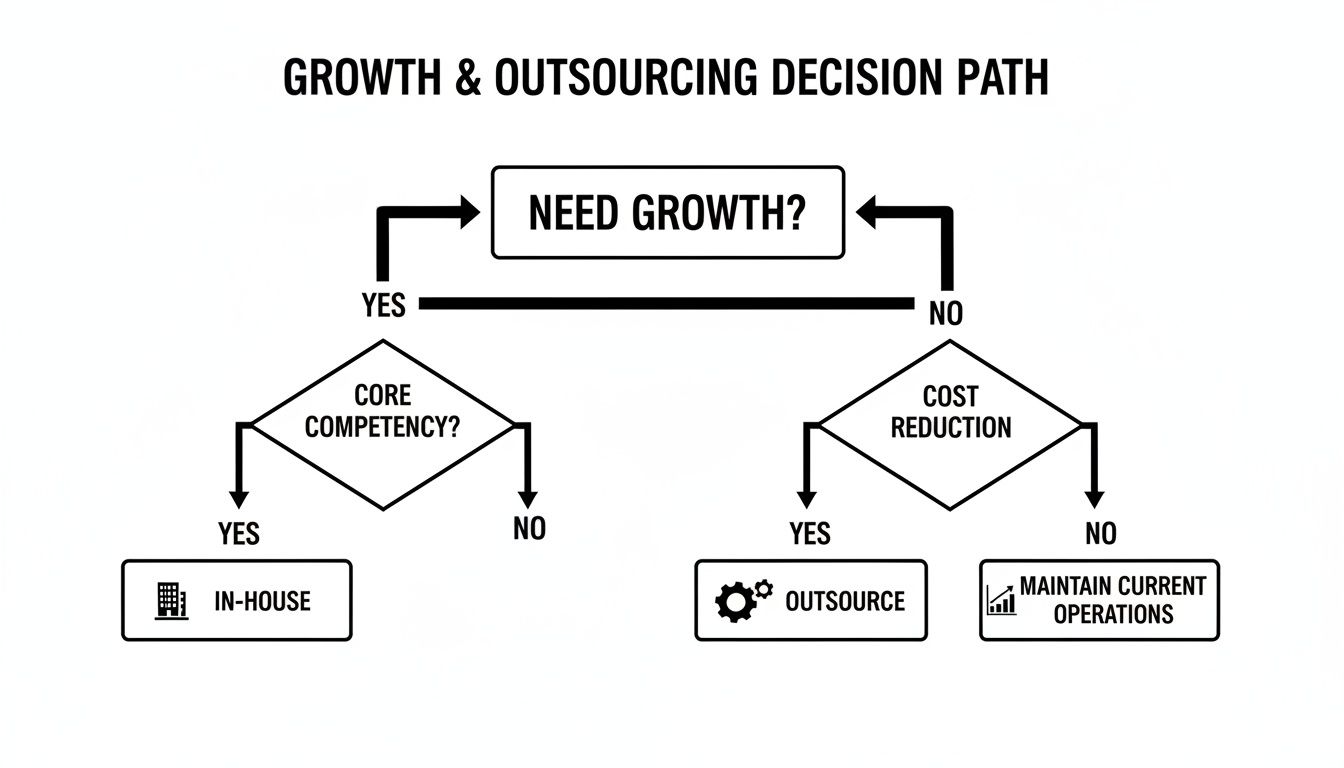
Outsourcing your digital marketing means bringing in an external partner to handle the hands-on execution. This lets your agency tap into specialised skills, scale your services on a whim, and keep your team focused on big-picture client strategy.
It's a strategic shift—less about pinching pennies and more about building a smarter, more profitable business by using expert resources like white-label WordPress developers or Shopify SEO pros when you need them.
Why Smart Australian Agencies Outsource Digital Marketing
Let's be real for a moment: trying to be a "do-it-all" agency is a one-way ticket to burnout. Juggling everything from complex WordPress development to the finer points of Shopify conversion optimisation stretches your team thin and puts a hard ceiling on your growth.
This is exactly why so many Australian agencies are changing their game plan. Instead of desperately trying to hire an in-house expert for every new trend, they’re choosing to outsource their digital marketing to partners who live and breathe this stuff.
This isn’t about finding cheap labour offshore. It's a calculated move to build a more flexible, resilient, and ultimately more profitable agency. The real win isn't just saving on salaries; it's gaining instant access to a deep pool of talent that would be a nightmare to find and hire locally. This is where a white label wordpress agency or a partner specializing in digital agency outsourcing australia becomes invaluable.
Overcoming the Local Skills Gap
Trying to find a top-notch wordpress developer australia or shopify developer australia? Good luck. It's a tough and expensive market. The local talent pool is incredibly competitive, and the true experts often get poached by big corporations with deep pockets.
When you outsource, you get to sidestep that entire headache. You can work with a white-label partner who has already done the hard work of building and training a team of specialists.
This means you can confidently say "yes" to those tricky projects you might have turned down before, such as:
- Custom WordPress Development: Building unique themes and plugins from the ground up with a wordpress development australia expert.
- WooCommerce Development: Crafting sophisticated and seamless e-commerce stores with a skilled woocommerce developer australia.
- Shopify SEO Australia: Nailing the technical SEO needed to compete in a crowded online retail space.
- WordPress Speed Optimisation: Fixing deep-seated performance issues that a generalist would struggle with.
Focusing on High-Value Strategic Work
Every hour your account manager spends wrestling with a stubborn WordPress bug is an hour they're not spending on client strategy, building relationships, or chasing new business. Outsourcing the technical grunt work frees up your core team to do what they do best—drive value for your agency. This is the core benefit of wordpress outsourcing australia.
By handing off the 'how' to a trusted partner, your agency can pour its energy into the 'why' and the 'what'—crafting brilliant strategies and delivering incredible client service. You stop being just a service provider and become a true strategic partner.
This shift allows your senior people to operate at their best, focusing on client success instead of getting bogged down in the technical weeds. You're no longer just selling hours; you're delivering real, tangible outcomes. The right agency wordpress partner australia can make this transition seamless.
The numbers back this up. The global Business Process Outsourcing market hit USD 280.64 billion in 2023 and is expected to grow at 9.6% a year through to 2030. For agencies in Australia, tapping into this global talent pool means getting expert help without the overheads of in-house staff, letting you zero in on what really matters. The appeal is simple: outsourcing offers a level of scalability and consistency that's incredibly difficult to achieve with an internal team or a handful of freelancers.
Finding the Right White-Label Partner
Picking a white-label partner is a huge decision. Get it right, and you've found a seamless, silent extension of your own crew. Get it wrong, and your agency's reputation—and bottom line—takes a direct hit. This isn't just about buying a service; you're handing over a piece of your brand.
Forget generic checklists. You're looking for a partner with proven technical chops, crystal-clear communication, and a real feel for the Australian market. This is about more than just finding someone who can code. You need a team that gets your vision and can execute it flawlessly, all under your name. When searching for a partner web agency australia, diligence is key.
So, where do you start? First, get clear on why you're outsourcing. Are you trying to scale up fast? Are you trying to trim operational costs? Or do you need to plug a skills gap with specialised expertise? The answer will shape your entire search.
This flowchart can help you pinpoint your primary motivation.
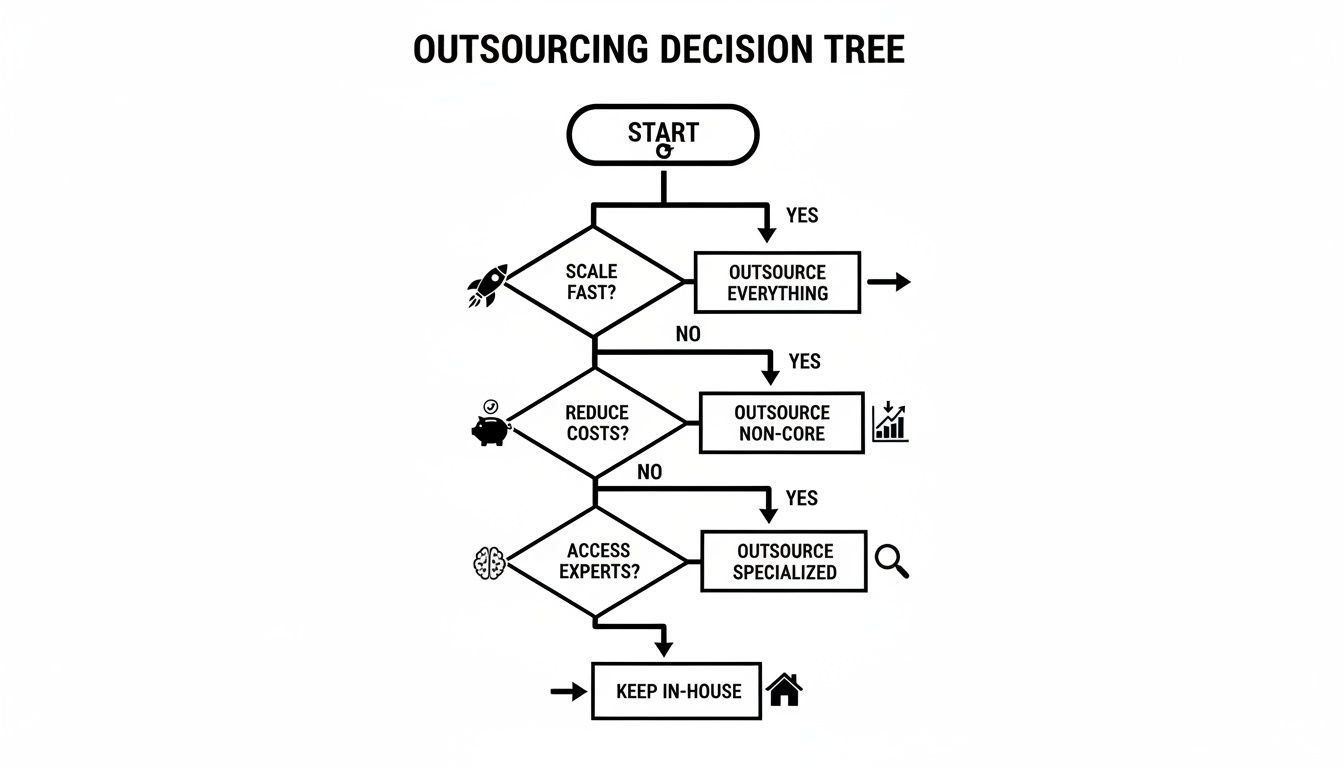
As you can see, understanding your core driver is the first step. It dictates what you should prioritise in a partner.
Evaluating Technical Expertise
Vague promises and slick sales pitches mean nothing. You need to see hard proof that your potential partner has deep, demonstrable skills on the platforms that matter to your clients—which, for most Aussie agencies, means WordPress and Shopify. A true wordpress expert australia will have a verifiable track record.
-
For WordPress: Don't just look for basic theme installations. Dig deeper. Ask to see examples of their custom WordPress development, like bespoke plugins or tricky API integrations. A solid partner should have a portfolio that shows they can handle anything from a simple WordPress bug fix to complex WordPress speed optimisation.
-
For Shopify: E-commerce is its own world. You need a Shopify expert Australia who genuinely understands the local landscape. Their work should showcase custom Shopify theme development, clever app integrations, and sophisticated shopify custom coding.
This is more important than ever. The game has changed in Australia; outsourcing is no longer just a cost-cutting play. It’s now a strategic move to access top-tier talent. In fact, nearly 60% of companies now say their main reason for outsourcing is to tap into skilled expertise. With local talent shortages hitting over 85% of digital marketing firms, finding the right partner is a competitive advantage.
Analysing Portfolios and Workflows
A portfolio tells you more than just what a partner can build; it reveals their process, their standards, and their problem-solving ability. When you’re looking at their past projects, don't just glance at the live sites. A good website designer australia will showcase a range of styles and functionalities.
Ask for the story behind them. What was the client's brief? What were the biggest hurdles they had to overcome?
Pay just as much attention to how they work. Do they live in Asana? Are they masters of Slack or Trello? A partner with a messy, disorganised workflow will bleed into your own operations and cause chaos, no matter how brilliant their developers are.
A great white-label partner doesn't just deliver code; they deliver confidence. Their processes should be so transparent and reliable that you never have to worry about what's happening behind the scenes.
This is a classic mistake I see agencies make. They get laser-focused on the hourly rate and forget that a smooth workflow and proactive communication are what actually make a partnership profitable and stress-free. For a closer look at this, our guide on what white-label WordPress is can show you how it can truly reshape your agency's operations.
To keep your evaluation structured, a scoring matrix can be incredibly helpful. It forces you to compare partners on an apples-to-apples basis across the criteria that matter most to your agency.
White-Label Partner Evaluation Matrix
| Evaluation Criterion | Partner A Score (1-5) | Partner B Score (1-5) | Notes & Red Flags |
|---|---|---|---|
| Technical Skill (WP/Shopify) | 4 | 5 | Partner A's portfolio is solid but less custom work. Partner B has deep custom plugin examples. |
| Communication Process | 5 | 3 | Partner A uses Slack & Asana, very clear. Partner B prefers email, which could be slow. Red flag: responsiveness. |
| Project Management Workflow | 4 | 3 | A has a documented process. B seems more ad-hoc, which is a risk for larger projects. |
| Portfolio Quality & Relevance | 4 | 4 | Both have good-looking sites, but Partner B has more experience in our key client industry (e-commerce). |
| Cultural Fit & Responsiveness | 5 | 4 | Felt a great connection with Partner A's team lead. Partner B was professional but less proactive in follow-up. |
| Reference Check Feedback | 5 | 3 | Partner A's references were glowing. Partner B's mentioned occasional communication lags. |
| Pricing & Value | 3 | 5 | Partner A is more expensive per hour, but their process seems more efficient. Partner B has a lower rate. |
| Total Score | 30 | 27 |
Using a matrix like this moves your decision from a "gut feeling" to a data-backed choice, highlighting potential issues before you sign any contracts.
Conducting Meaningful Reference Checks
Finally, the reference check. This is your last line of defence against a bad decision, so make it count. Don't just tick a box by asking generic questions. You need to dig for the real story.
Here are some questions that will get you far more than a "yeah, they were great":
- "Tell me about a time a project went sideways. How did they handle it and communicate the problem?"
- "How responsive are they when an urgent bug pops up out of the blue?"
- "What's their process for feedback and revisions like? Are they a real partner, or do they get defensive?"
- "On a scale of 1 to 10, how well did they operate as a true extension of your own team?"
The answers to these questions will paint a far more accurate picture than any polished proposal ever could. You're looking for a partner who isn't just technically sound, but is also reliable, a great communicator, and completely aligned with your agency’s standards. This is especially true when you plan to hire wordpress developer australia talent through an agency.
Structuring Profitable Pricing and Margins

Getting the numbers right is where your decision to outsource digital marketing really starts to pay dividends. Profitability isn't just a happy accident; it’s the direct result of smart pricing and a crystal-clear understanding of your margins. The real goal here is to move past a simple cost-plus mentality and start pricing based on the massive value you bring to the table.
Think of it this way: your white-label partner is handling the technical heavy lifting at a wholesale rate. But your agency is adding the crucial layers on top—the strategy, the project management, client hand-holding, and quality control. That’s where your true value, and your margin, is created. This is the model that makes white label wordpress services so attractive.
So, let's break down how to actually price these services for profit.
Choosing the Right Pricing Model
Most white-label partnerships, especially for things like white label WordPress development or white label Shopify projects, tend to use a few common pricing structures. Each has its pros and cons, and the best fit usually comes down to the work itself.
- Fixed Project Fees: This is your go-to for projects with a well-defined scope. Think a custom WordPress development build or a ground-up Shopify store setup. You get a fixed quote from your partner, add your margin, and give the client one clear price. It’s predictable and keeps everyone on the same page.
- Monthly Retainers: An absolute must for ongoing services. This model is perfect for WordPress maintenance Australia, shopify maintenance, or white label WordPress support. Your partner charges you a recurring fee, and you bill your client a higher retainer. Boom—a steady, predictable revenue stream for your agency.
- Hourly Rates: It's best to keep this one in your back pocket for ad-hoc tasks, small tweaks, or a tricky WordPress bug fix. While it offers flexibility, relying only on hourly rates can make quoting a nightmare and opens the door to scope creep if you don't manage it with an iron fist.
For most Australian agencies I've seen, a smart blend of these models is the ticket. Use fixed fees for the initial builds, then transition clients to retainers for ongoing support and marketing. Save the hourly rates for those one-off requests that inevitably pop up.
Calculating Your True Landed Cost
Your partner’s invoice is just the beginning. To really protect your margins, you have to calculate your landed cost—the total expense your agency racks up to get the job done. This goes way beyond just the wholesale price you're paying. A successful white label shopify agency masters this calculation.
Your landed cost is the partner’s fee PLUS the cost of your internal project management, quality assurance, and client communication. Ignoring this overhead is the fastest way to turn a seemingly profitable project into a loss leader.
Let's run a quick scenario. Say your partner quotes you $5,000 for a white label Shopify development project. Now, let’s add in your team's time:
- Partner's Fee: $5,000
- Your Project Manager's Time: 15 hours @ $80/hour = $1,200
- Your Account Manager's Time (Client Comms): 8 hours @ $100/hour = $800
- Your QA Specialist's Time: 5 hours @ $70/hour = $350
Suddenly, your True Landed Cost is actually $7,400, not the $5,000 you started with. If you'd priced based only on the partner's fee, you would have kissed $2,400 of your potential profit goodbye before the project even started.
Applying a Value-Based Markup
Once you’ve nailed down your landed cost, it’s time to apply a markup. A simple 2x markup is a decent starting point, but the agencies that really succeed aim higher. They price based on the value and the outcome for the client, not just their internal costs.
Remember, a client isn't just buying a website; they're buying a new sales engine, a flood of new leads, or a huge boost to their brand's credibility. Your price needs to reflect that outcome.
Let’s go back to our example:
- Landed Cost: $7,400
- Standard 2x Markup Price: $14,800 (this leaves you with a healthy $7,400 gross profit).
- Value-Based Price: Now, what if this new Shopify store is projected to generate $150,000 in revenue in its first year? Pricing it at $20,000 or even $25,000 is completely justifiable.
This approach shifts the conversation. You’re no longer just a reseller of technical services; you’re a strategic partner delivering a tangible return on investment. This is precisely how top agencies build incredibly profitable relationships when they outsource digital marketing.
Tapping into AI Through Your Outsourcing Partner
Let's be honest, artificial intelligence isn't some far-off concept anymore. It's here, and it’s a powerful tool your clients are starting to expect you to use. But building an in-house AI team from scratch? That’s a massive undertaking, both in time and money.
This is exactly where a tech-forward outsourcing partner becomes your agency's secret weapon.
You don't need a department of data scientists to offer sophisticated, AI-driven marketing. When you find the right white-label partner, you get immediate access to their entire AI toolkit. This lets you deliver complex results that would be incredibly expensive and time-consuming to develop on your own. For web development australia, integrating AI is now a differentiator.
It's a strategic shortcut that allows your agency to leapfrog competitors who are still trying to get their heads around the basics. Your partner handles the heavy technical lifting, and you get to present impressive, data-backed insights to your clients.
Supercharging Your Services with AI
A partner who's fluent in AI can elevate your core services from standard to seriously impressive. They can apply advanced models and tools to bring a level of precision and insight that not only wows clients but also justifies higher retainers.
Think about the practical applications:
- Next-Level SEO Analysis: Your partner can use AI for predictive keyword analysis, spotting emerging trends before they blow up and become hyper-competitive. They can also dissect competitor backlink profiles at a scale and depth that’s just not possible to do by hand.
- Hyper-Personalised Content: Forget generic content. An AI-powered partner can analyse user data to generate highly personalised email campaigns, ad copy, and landing page variations that resonate with individual customer segments.
- Predictive Campaign Analytics: It’s time to move beyond simply reporting on what happened last month. A good partner can use predictive models to forecast campaign performance, optimise ad spend in real-time, and pinpoint high-value audiences before you even launch.
This isn't just about efficiency. It's about fundamentally changing the value you bring to the table. You stop being just a service provider and become a strategic advisor armed with powerful predictive tools. For a deeper dive into modern agency strategies, our blog offers further insights.
When you tap into your partner's AI capabilities, you’re not just reselling a service. You are selling foresight, precision, and a competitive edge that clients simply can't get from an agency stuck in the old ways of doing things.
Bridging Australia's Digital Skills Gap
The rapid shift to AI is creating a real challenge for Australian agencies. It’s no surprise that 91% of marketing businesses are already using AI tools. But this trend is running headfirst into a major skills shortage.
Right now, 77% of marketers are finding it tough to hire skilled professionals in areas like data analysis and content creation. This is compounded by Australia's wider 85% skills shortage in digital fields.
Outsourcing offers a direct solution. It bridges this gap by giving you immediate access to AI-savvy experts, letting your agency deploy advanced strategies without the hiring headaches. You can read the full report on AI adoption in marketing to see the whole picture.
Choosing a partner who has already invested in these skills is the smartest way to future-proof your agency. You get all the benefits of advanced tech and specialised talent without the overheads. This frees you up to focus on what you do best: building client relationships and growing your business, confident that the technical side is being handled by experts at the top of their game.
Creating a Bulletproof Communication Workflow
Let’s be honest. When you outsource digital marketing, the biggest point of failure isn’t usually technical skill or a bad quote—it’s communication. A simple breakdown in how information flows can derail a project, frustrate a client, and eat away at your profit margins faster than anything else.
So, a solid communication workflow isn't just a nice-to-have. It’s the central nervous system of a successful partnership. It ensures nothing gets lost in translation as info moves from your client, to you, to your white-label partner, and all the way back again. It’s all about creating a predictable, repeatable system that kills ambiguity and builds trust.
Crafting Flawless Project Briefs
The project brief is your first line of defence against scope creep and costly misunderstandings. I've seen it time and again: a vague, rushed brief is a recipe for disaster. It forces your partner to make assumptions, and those assumptions rarely line up perfectly with what your client actually wants. A great brief, on the other hand, leaves zero room for error.
Your job here is to provide absolute clarity from day one. Think of this document as the single source of truth for the entire project.
A truly comprehensive brief needs to include:
- Project Goals and KPIs: What does success actually look like? Be specific. Don't just say "build a new website." Instead, aim for something like, "build a five-page Shopify site designed to increase mobile conversion rates by 15% within six months."
- Target Audience Personas: Who are we even talking to? You need to include demographics, pain points, and motivations. This context is gold for both designers and copywriters.
- Technical Specifications: Get granular. Detail the platform (e.g., wordpress website design australia), any must-have plugins, third-party integrations, and the hosting environment.
- Visual Examples: This is huge. Provide links to sites the client loves (and hates), but most importantly, explain why. Showing is always more effective than trying to describe aesthetics with words.
Centralising Communication and Project Management
Email chains are where good projects go to die. Seriously. To keep everyone on the same page, all project talk and task management must live in one central place. Using a tool like Asana, ClickUp, or Trello isn't optional when you're managing a remote partnership.
Setting up a shared project board gives everyone a real-time view of what’s happening. Your client doesn't need to see this internal workspace; it’s purely for you and your partner to stay in sync.
A shared project management tool acts as a neutral ground, providing a transparent record of all requests, feedback, and deadlines. It turns communication from a chaotic guessing game into a structured, accountable process.
This shared space should have dedicated areas for assets (like brand guidelines and logins), feedback rounds, and general Q&A. This simple step stops crucial information from getting buried in a cluttered inbox and guarantees everyone is working from the latest version. For any agency working with a white label wordpress designer, this centralised feedback loop is absolutely essential for getting revisions done efficiently.
Defining Clear Brand Guidelines
Never, ever assume your partner just "gets" your client's brand. Before they write a single line of code or design a single pixel, you need to hand them a detailed brand guidelines document. This is another one of those critical tools for ensuring consistency and slashing the time spent on needless revisions.
At a minimum, your brand guidelines should cover:
- Logos: All variations, clear space requirements, and do's and don'ts.
- Colour Palette: Primary and secondary colours with their specific hex codes.
- Typography: Web fonts, heading styles, body copy rules, and so on.
- Tone of Voice: Describe the brand's personality. Is it professional and authoritative, or fun and conversational?
- Image Style: Provide clear direction on photography, illustration, and iconography.
This document empowers your white label web development wordpress team to make smart, on-brand decisions on their own, which saves you countless hours of back-and-forth. It’s a foundational piece of the puzzle for a smooth workflow.
By establishing this kind of structured approach from the outset, you sidestep the common pitfalls that sour outsourcing partnerships. It means every project, whether it's for Shopify developers for agencies Australia or a complex WordPress build, runs like a well-oiled machine, protecting both your client relationships and your bottom line.
Thinking about outsourcing your digital marketing services? It’s a big decision, and it’s completely normal to have a few nagging questions, especially when your agency's reputation is on the line. Getting clear answers is the key to moving forward with confidence.
Let’s dig into some of the most common concerns we hear from agencies just before they take the leap with a white-label partner.
How Do I Handle Client Communication When the Work is Outsourced?
This is probably the biggest question, and the answer is simple: you remain the one and only point of contact. Always.
Your agency is the strategic leader and the face of the project. Your client hired you for your expertise, and that relationship needs to be protected.
Your white-label partner should operate as a silent, invisible extension of your own team. All their updates, reports, and work should be funnelled directly to your project manager. From there, your team packages that information and presents it to the client under your agency's branding. This setup maintains your agency's value and prevents any client confusion about who's running the show. This is the essence of working with a white label shopify expert.
What are the Biggest Risks of Using a White-Label Agency?
Let's be honest, there are risks. The main ones are inconsistent quality, poor communication (especially across different time zones), and the potential for reputational damage if a project goes south. These are serious, but they’re also entirely manageable if you’re proactive.
Here's how you get ahead of those risks:
- Do your homework, properly: Don't just take their sales pitch at face value. Dig deep into their portfolio and look for projects that mirror the kind of work you do, whether that’s white label Shopify development or complex custom WordPress development.
- Run a paid trial project: Before you sign a long-term contract, give them a smaller, low-risk project to cut their teeth on. This is the ultimate test—it gives you a firsthand look at their real-world process, communication style, and the quality of their work.
- Nail down your Service Level Agreements (SLAs): Get everything in writing. Your contract needs to be crystal clear about response times, revision turnarounds, and quality benchmarks. No grey areas.
- Build a bulletproof QA process: Nothing should ever get to a client without your team's stamp of approval first. A multi-stage internal review process is non-negotiable.
Can My Agency Actually Make Good Money with White-Label Services?
Absolutely. But there’s a catch: you have to price your services based on the value you deliver, not just the cost of the outsourced work. A simple cost-plus markup is a race to the bottom.
Think about it this way: your partner handles the technical execution at a wholesale rate. But your agency is layering on immense value through strategy, client management, creative direction, and quality assurance. That’s where your real margin is. You're not just reselling developer hours; you're selling a strategic outcome that solves a major problem for your client. This is how to profit from shopify outsourcing australia.
The biggest mistake agencies make is seeing outsourcing as just another cost to mark up. The most profitable ones see it as an investment that frees them up to sell high-value strategic packages.
Focus on what that final result is worth. A new e-commerce store isn't just a website—it's an engine for generating revenue. Price it that way.
How Do I Keep Quality High with an External Team?
Quality control doesn't start when the project kicks off; it starts with a rock-solid onboarding process. You can't leave anything to chance.
Your partner needs to be equipped with everything they need to succeed from day one. This means providing them with:
- Comprehensive brand guidelines.
- Incredibly detailed project briefs that clearly define what "done" looks like.
- Plenty of visual examples to set the standard.
This is essential for every single job, whether it's a quick WordPress bug fix or a massive white label ecommerce development australia project for an Australian client.
Then, you need that multi-stage internal review we talked about. Your team acts as the gatekeeper, signing off on everything before the client lays eyes on it. When you treat your partner’s team like an extension of your own—providing clear, constructive feedback—they stop being a vendor and become a true partner invested in maintaining your agency's high standards.
Ready to scale your agency's services without the overheads? At White Label WordPress, we provide Australian agencies with expert WordPress and Shopify development, helping you deliver exceptional results and lock in guaranteed profit margins on every project.
Discover how our white-label partnership can fuel your growth