
In the Australian legal market, a law firm's website has moved far beyond being a simple online brochure. It's now the single most important tool for winning new clients and the very first place people look to gauge credibility. For anyone searching for legal help, often under immense stress, snap judgments are made based entirely on what they see online.
This is why exceptional law firm website design isn't just a 'nice-to-have'—it's the engine for growth. A professional, intuitive site works around the clock to attract and convert the right kind of clients from their very first click.
Your Digital Handshake: Why Website Design Matters for Law Firms

Think of your website as your firm's digital handshake. It’s the first point of contact, long before a potential client ever speaks to a solicitor or reads through a single case study. That initial interaction on the screen can either build immediate trust or plant a seed of doubt.
In Australia's competitive legal space, that digital handshake needs to be firm, confident, and professional. It has to communicate authority, empathy, and deep expertise, and it only has a few seconds to do it.
The Critical Role of First Impressions
We all know first impressions count, but online, they happen in the blink of an eye. Research from local digital marketing experts consistently backs this up. One recent report found that a staggering 75% of people judge a company's credibility based purely on its website design.
For a law firm, where trust is everything, that number is impossible to ignore. A dated or poorly designed site sends a clear message: a lack of attention to detail. That’s a quality nobody wants in their legal counsel.
And it’s not just about looks. With more than half of all website traffic now coming from smartphones, performance is paramount. The same report revealed that 53% of mobile users will leave a site if it takes more than three seconds to load. A slow, clunky website is literally turning away potential clients before they've even had a chance to see what the firm offers.
A great law firm website doesn’t just provide information; it creates an experience. It reassures an anxious client, guides them to the right resources, and makes it simple to take the next step.
From Digital Brochure to Business Engine
The days of a legal website being a static online business card are well and truly over. Today, it must be a dynamic, hard-working tool designed to hit clear business goals. A strategic approach to law firm website design transforms a passive webpage into a high-performing asset that actively grows the practice.
A well-executed site will:
- Build Instant Trust: A clean, professional, and easy-to-navigate design signals competence and stability, assuring visitors they've come to the right place.
- Generate Qualified Leads: By zeroing in on specific practice areas and client pain points, the website attracts people who are actively looking for the firm’s exact services.
- Educate and Inform: Authoritative articles, clear service explanations, and helpful resources position the firm as a genuine expert in its field.
- Streamline Client Intake: Smartly placed contact forms, unmissable calls-to-action, and simple booking options make it incredibly easy for potential clients to reach out.
This guide will break down exactly how to build websites that achieve these outcomes. We'll cover the core pillars that turn a simple website into a powerful client acquisition machine.
Core Pillars of Effective Law Firm Website Design
To build a website that delivers real results, we need to focus on several key areas. Think of these as the foundational pillars holding up the entire digital strategy. Each one plays a distinct but interconnected role in building trust and driving conversions.
| Pillar | Primary Goal | Key Elements |
|---|---|---|
| Branding & Trust | Establish credibility and a professional identity. | Logo, colour scheme, typography, consistent messaging. |
| User Experience (UX) | Make the site intuitive and easy for visitors to use. | Simple navigation, mobile-first design, fast load times. |
| Conversion Pathways | Guide visitors toward taking a specific action (e.g., calling). | Clear calls-to-action (CTAs), contact forms, phone numbers. |
| Content Strategy | Demonstrate expertise and answer client questions. | Practice area pages, lawyer bios, blog posts, FAQs. |
| SEO & Visibility | Attract qualified traffic from search engines like Google. | Keyword research, on-page optimisation, local SEO. |
| Compliance & Ethics | Adhere to legal advertising rules and regulations. | Disclaimers, privacy policy, accessibility (WCAG). |
Mastering these pillars is the key to creating a digital experience that sets the stage for a successful client engagement. For agencies aiming to deliver this level of value consistently, our expert white label WordPress services provide a proven, scalable framework for building exceptional websites for law firms.
Turning Authority into a Trusted Brand Identity

Before a potential client even reads a single word about your firm's wins, your website’s design has already made its case. This visual first impression is your digital handshake—it instantly communicates your values, professionalism, and authority.
A strong brand identity isn't about flashy graphics or chasing trends. It’s about being deliberate with your design to build immediate trust. For a law firm, this means ditching the generic templates and making conscious choices that convey stability, expertise, and empathy. The goal is simple: create a digital space where a potential client feels understood and confident that you’re the right advocate for them.
It's all about translating abstract concepts like "trust" into tangible visual cues. The right blend of colours, fonts, and imagery can shape a visitor's perception in seconds, setting the perfect tone for the entire client relationship.
The Psychology of Colour in Legal Design
Colour is a powerful tool. It’s a silent communicator that can trigger specific emotions long before someone reads a headline. For a law firm, your colour palette needs to be chosen with clear intention, reflecting the firm’s personality and practice areas. This isn’t just about making things look nice; it’s about aligning the visual experience with a client’s emotional needs.
Traditional palettes in the legal world are classics for a reason:
- Deep Blues: These shades are the bedrock of trust, stability, and professionalism. It’s no surprise they’re a go-to for corporate, commercial, and financial law firms wanting to project an image of unshakable reliability.
- Greys and Charcoals: These sophisticated neutrals speak to seriousness and formality. They create a clean, modern backdrop that lets the firm’s message and expertise take centre stage without any fuss.
- Rich Burgundies or Maroons: These colours feel established, adding a sense of tradition and gravitas. You’ll often see them used by firms with a long history to subtly highlight their legacy and deep-rooted experience.
But that doesn't mean you're stuck in the past. A family law practice might use softer, more approachable tones to convey empathy. A firm specialising in intellectual property for startups could opt for more dynamic colours to signal innovation.
Choosing Typography That Shouts Credibility
The fonts you use are your firm's digital voice. A poor choice can make your content a struggle to read and quietly chip away at your professional image. Thoughtful typography, on the other hand, reinforces your authority.
The best font for a law firm website is one that is, above all, readable. Legibility isn't a minor detail; it directly impacts how people engage with your content and perceive your professionalism.
A few simple rules make all the difference when you're selecting fonts:
- Keep It Simple: Stick to a maximum of two font families—one for headings, one for body text. This creates a clean, cohesive look and stops the design from feeling cluttered and chaotic.
- Prioritise Legibility: For paragraphs of text, you can’t go wrong with clean sans-serif fonts like Open Sans or Roboto. They are incredibly easy to read on screens, which is why studies show they are almost universally used for body text on legal sites.
- Get the Size Right: Your main body text should be a minimum of 16px to 18px. This isn't just a design preference; it meets web accessibility standards and ensures your content is comfortable to read, especially for older clients or anyone on a mobile phone.
Using Imagery to Build a Real Human Connection
Let’s be honest: stock photos of gavels, scales of justice, and anonymous cityscapes are tired clichés. They’re impersonal and do nothing to build trust. Effective imagery for a law firm needs to forge a human connection and tell your firm's unique story.
The absolute best images are original, high-quality photos of your actual team in your actual office. These visuals show real people, creating an immediate sense of authenticity and approachability. Professional headshots convey competence, while candid photos of your team working together can showcase a supportive and collaborative firm culture.
If your firm focuses on specific industries, your imagery should reflect that. A firm that serves the tech sector could use clean, modern photos that evoke innovation. One focused on agribusiness law, on the other hand, should use visuals that resonate with that community. This targeted approach shows clients you truly understand their world—and that’s a powerful way to build trust before you've even had the first conversation.
Designing a Clear Path to Client Conversion

A beautiful website is a great start, but it's only half the job. If a potential client lands on the site and has no idea what to do next, the design has fundamentally failed. This is where conversion-focused law firm website design comes in, turning what could be a passive digital brochure into an active, client-generating machine. A skilled ecommerce developer in Australia understands these principles apply equally to service-based businesses, focusing on lead generation as the primary conversion.
The ultimate goal is to create a seamless journey that guides a visitor from their first Google search right through to the moment they decide to reach out. For someone in a stressful legal situation, this journey needs to be simple, reassuring, and immediate. Every button, image, and line of text must work in concert to build momentum and make contacting the firm feel like the obvious next step.
Engineering the Perfect Call-to-Action
The call-to-action (CTA) is the single most important conversion element on any law firm website. Think of it as the big, clear signpost telling visitors exactly what you want them to do. Vague or hidden CTAs are absolute conversion killers; they breed confusion and hesitation just when a user is most ready to engage.
An effective legal CTA needs to be clear, compelling, and impossible to miss. It should always use strong, action-oriented language.
- Weak CTA: "Learn More"
- Strong CTA: "Book a Free Consultation"
Placement is just as crucial. Your most important CTAs, like prominent buttons and clickable phone numbers, must be visible "above the fold"—that's the part of the page a user sees without having to scroll. This simple rule ensures that no matter where a visitor lands, their path forward is always in plain sight.
Building Unshakeable Trust Signals
Before a potential client will ever hit "submit" on a contact form, they need to feel completely confident they're making the right choice. Trust signals are the visual and textual cues that build this confidence by showcasing credibility, expertise, and a track record of success.
Your website has to answer the client's unspoken question: "Why should I trust you with something this important?" Every testimonial, award, and case result helps provide a compelling answer.
Weave these powerful trust signals throughout the entire design to dissolve any natural client hesitation:
- Client Testimonials: Feature genuine quotes from happy clients. If you can, include their name and photo. Placing these right next to contact forms can give submission rates a serious boost.
- Case Victories: Briefly highlight significant wins and successful outcomes. Using hard numbers, like settlement amounts or positive case statistics, adds a powerful layer of authority.
- Professional Affiliations: Display the logos of legal associations, industry awards, and barrister endorsements. These act as instant, third-party validation of the firm's standing.
- Lawyer Profiles: Detailed biographies with professional headshots put a human face to the firm, helping to build a more personal connection from the outset.
By integrating these elements into the very fabric of the site, you build a compelling case for the firm’s competence before a client even picks up the phone. You can see how we put this into practice in our law firm website design case studies.
Creating a Flawless Mobile Experience
Here in Australia, the vast majority of initial searches for legal help happen on a smartphone. A potential client could be doing their research on the train home from work or during a quick lunch break. If the website is clunky or difficult to navigate on their device, you've lost them for good.
A frictionless mobile experience is absolutely non-negotiable. This goes way beyond just making a desktop site shrink to fit a smaller screen. Every single interaction has to be effortless.
- Click-to-Call Functionality: Every phone number must be tappable, allowing a user to start a call with a single touch. No pinching and zooming required.
- Simplified Forms: Mobile contact forms should be short and sweet, asking only for the most essential information. Nobody wants to type out a novel with their thumbs.
- Thumb-Friendly Navigation: Buttons and menu items need to be large enough and spaced properly so they can be easily and accurately tapped.
- Fast Load Times: Mobile users are even more impatient than desktop users. Every second of loading time is a chance for them to leave, so pages need to load almost instantly.
By prioritising these mobile-first design principles, you make sure the law firm is accessible to potential clients wherever they are, turning their moment of need into a direct enquiry.
Fuelling Growth with Content and Legal SEO
A brilliant website is just the beginning. Without a consistent flow of the right kind of traffic, it's like a world-class barrister arguing a case in an empty courtroom. This is where a sharp content and Search Engine Optimisation (SEO) strategy comes in, and for any serious law firm website design, it’s absolutely non-negotiable. It’s the engine that connects the firm with real people actively searching for legal help across Australia. Whether it's WordPress or you're seeking Shopify SEO in Australia, the core principles of connecting with your audience remain the same.
The aim isn't just to get clicks; it's to attract the right people. We're talking about individuals with a specific legal issue that the firm is perfectly positioned to solve. This means we need a solid plan for creating content that not only answers their questions but also establishes authority and ranks at the top of search results for high-value keywords.
Mastering Keyword Research for Legal Niches
Great legal SEO starts with getting inside the head of a potential client and understanding exactly what they’re typing into Google. This goes way beyond broad terms like "lawyer." The real gold is in targeting specific practice areas and geographic locations, because that's where you find people with a genuine intent to hire.
You have to think like a client. They aren't just searching for a "lawyer." They’re looking for a "commercial litigation lawyer in Sydney" or an "expert family law solicitor in Melbourne." Getting this specific is how you filter out the noise and connect with the most qualified leads.
Your keyword strategy should really nail three main categories:
- Practice Area Keywords: These are the bread-and-butter terms directly tied to the firm's services (e.g., "property conveyancing," "dispute resolution," "criminal defence solicitor").
- Location-Based Keywords: Combining a service with a city or suburb is critical for pulling in local clients (e.g., "Brisbane immigration lawyer," "Parramatta employment law firm").
- Problem-Based Keywords: Many clients don't know the legal term for their issue, so they search for their problem instead (e.g., "what to do after a car accident," "how to contest a will"). Answering these questions positions the firm as a trusted expert right from the first click.
Creating Content That Embodies E-E-A-T
In the legal world, trust is everything. Google gets this, which is why it rewards websites that clearly demonstrate Experience, Expertise, Authoritativeness, and Trustworthiness (E-E-A-T). For a law firm, this isn't some abstract metric; it's the digital reflection of its professional reputation.
Every piece of content you create must be meticulously crafted to send these signals. This means going far beyond basic service descriptions and building out genuinely helpful resources.
E-E-A-T is the digital equivalent of a law firm's real-world reputation. It’s built through authoritative content, verified credentials, and positive client outcomes, all of which must be clearly visible on the website.
To really build that E-E-A-T, your content strategy should be built around:
- In-Depth Practice Area Pages: These are your cornerstone pages. They need to thoroughly explain a legal service, walk through the process, and answer every common question a potential client might have. Make them the single best resource on that topic online.
- Authoritative Blog Posts: Use the firm's blog to tackle specific legal questions, comment on recent legislative changes, and offer practical advice. For more ideas on this, check out our agency-focused articles on content strategy.
- Detailed Lawyer Biographies: This is a goldmine for E-E-A-T. Showcase the experience, qualifications, industry awards, and successful case histories of every solicitor. This directly builds trust and proves expertise.
Dominating Local Search Results
Let's face it, most Australian law firms serve their local community. That means winning in local search results is a must-do, not a nice-to-have. While the content on the site is vital, your off-page presence is what truly cements your authority in the local area.
The most powerful tool in your arsenal for this is the firm's Google Business Profile (GBP). A fully optimised GBP is often the very first interaction a potential client has with the firm online, showing up prominently in Google Maps and local search packs.
Getting the GBP right involves:
- Complete and Accurate Information: Make sure the firm's name, address, and phone number (NAP) are 100% consistent everywhere—on the website, in the GBP listing, and across all other directories.
- Strategic Category Selection: Don't just pick "Law Firm." Get specific. Choose the most relevant categories for the firm’s practice areas, like "Family Law Attorney" or "Criminal Justice Attorney."
- Actively Solicit Reviews: A steady stream of glowing client reviews is one of the most powerful signals to both Google and potential clients. It’s social proof that builds immediate trust.
- Regularly Use Google Posts: Share firm news, new blog articles, and service updates through the Posts feature. This signals to Google that the profile is active, current, and relevant.
By weaving together deep, authoritative content with a laser-focused local SEO strategy, a law firm's website goes from being a simple online brochure to a powerful, lead-generating machine.
Getting the Technical Details Right: Security, Speed, and Compliance
When you're building a website for a law firm, the technical foundation isn't just a detail—it's everything. Think of it as the digital equivalent of a law firm's secure document vault. This is a place that handles sensitive client information and upholds the firm's reputation, so cutting corners on the backend is simply not an option.
Getting the technicals right is about more than just dodging problems. It's about building a core pillar of client trust and proving your value as an agency. A site that’s fast, secure, and accessible shows your legal client you understand their world and are serious about protecting their practice and their clients. For this, you need to either hire a WordPress developer in Australia or work with a trusted partner.
Building a Digital Fortress: Website Security
For any lawyer, a data breach is the ultimate nightmare. It’s not a simple IT issue; it's a direct blow to their professional integrity. That’s why website security needs to be front and centre from day one. Every single form submission, whether it's a quick "contact us" or a detailed case evaluation, is packed with confidential data that must be locked down.
These aren't optional extras; they're the absolute baseline for any law firm site:
- SSL Certificates: This is the first and most basic step. An SSL certificate encrypts the connection between a user's browser and the website, scrambling the data so no one else can read it. That little padlock icon and the "https://" in the URL are powerful, immediate signals that tell a potential client this site is safe.
- Secure Forms: Don't just install a contact form plugin and call it a day. You need to ensure every form is built to handle data securely, using tools and server-side settings that prevent interception and protect the information submitted.
- Regular Maintenance: Proactive wordpress maintenance australia is non-negotiable. You have to stay on top of updates for the WordPress core, themes, and plugins. These updates often contain critical security patches that close loopholes before they can be exploited.
The Need for Speed: Performance Matters
Nobody likes a slow website, especially not a potential client who's likely already stressed and short on time. If a law firm's site takes more than a couple of seconds to load, they're gone. And it’s not just users you have to worry about—Google rewards fast sites with better search rankings, which directly impacts how many new clients find the firm.
A solid wordpress speed optimisation australia strategy is a must. This isn't a single fix but a combination of techniques: compressing images so they load quickly, minifying code (CSS and JavaScript), and using browser caching so the site loads almost instantly for returning visitors. Choosing a high-quality Australian web host is also a game-changer for delivering top-notch speed to local clients.
A fast website is a sign of professionalism. It communicates respect for the user's time and reflects the efficiency and attention to detail that clients expect from their legal counsel.
Meeting a Higher Standard: Compliance and Accessibility
Technical excellence goes beyond just speed and security. It also means meeting legal and ethical standards. Any modern law firm website needs to be accessible to everyone, including people with disabilities. Following the Web Content Accessibility Guidelines (WCAG) isn't just about ticking a box; it shows the firm is committed to inclusivity.
Practically, this means making sure the site can be used with just a keyboard, providing descriptive alt text for all images, and choosing colours with enough contrast for easy reading. You’ll also need a crystal-clear privacy policy that meets Australian privacy laws, explaining exactly how visitor data is collected and protected.
The best firms are already pushing the envelope. Take a look at leading Australian firms like Maddocks or Lander & Rogers, and you'll see advanced features in action. Lander & Rogers, for example, built an innovative client portal for secure document sharing. It’s features like these that deliver a real return; industry analysis shows that well-designed Australian law firm sites often pay for themselves in 6-12 months through new client enquiries. You can dig deeper into these Australian law firm website trends on sparkinteract.com.au.
To bring all these technical pieces together, here's a look at the kind of toolkit we recommend for building robust WordPress sites for law firms.
Technical Stack & Tools for WordPress Law Firm Sites
Here is our recommended toolkit for agencies building high-performance, secure, and SEO-friendly WordPress websites for Australian law firms.
| Component | Recommended Tool/Plugin | Primary Benefit |
|---|---|---|
| Hosting | WP Engine or Flywheel | Managed WordPress hosting with daily backups, built-in security, and excellent Australian server performance. |
| Theme/Framework | GeneratePress or Kadence Theme | Lightweight, accessible, and highly customisable foundations that ensure fast load times and clean code. |
| Page Builder | GenerateBlocks or Kadence Blocks | Provides design flexibility without the bloat of traditional page builders, keeping the site lean and fast. |
| Forms | Gravity Forms | Secure, reliable, and highly extensible for creating everything from simple contact forms to complex client intake questionnaires. |
| Security | Wordfence Security | A comprehensive security suite with a firewall, malware scanner, and login protection to actively defend the site. |
| Performance | WP Rocket | An all-in-one caching and optimisation plugin that simplifies speed improvements like minification and lazy loading. |
| SEO | SEOPress or Yoast SEO | Essential tools for managing on-page SEO, from title tags and meta descriptions to XML sitemaps and schema markup. |
| Accessibility | WP Accessibility | A helpful plugin for identifying and fixing common accessibility issues to help meet WCAG standards. |
| Backups | UpdraftPlus (often included with host) | Provides reliable, automated off-site backups, ensuring a quick recovery plan is always in place. |
Choosing the right tools from the start makes it dramatically easier to build a site that is not only visually impressive but also technically sound, secure, and built for long-term success.
A Scalable Model for Agency Partnerships
Let's be honest: breaking into the legal sector is a tough but potentially very rewarding gig for any digital agency. Law firms and solicitors have incredibly high standards, and delivering the calibre of law firm website design they expect means you need real expertise in compliance, security, and conversion strategies specific to their world. Building that kind of team from scratch? That’s a serious investment of time and money.
This is exactly where a smart partnership comes in. Teaming up with a white label WordPress agency is a well-trodden path to growing your agency without all the overheads. It lets you instantly add high-end, compliant websites to your service list, all presented under your own brand. It's a proven way to scale your operations without the growing pains.
The White Label Workflow
The whole point of a white label partnership is to keep things simple and put you in control. You remain the face of the project and the main point of contact for your law firm client, every step of the way. You get to focus on what you do best—managing client relationships and big-picture strategy—while your partner handles the technical heavy lifting.
Here’s what that looks like in practice:
- Project Scoping: You’ll hash out the goals with your client. Your white label partner then comes in behind the scenes, offering technical advice to make sure the project scope is realistic and watertight.
- Pricing and Proposal: The partner gives you a fixed, confidential quote for the development work. You add your margin on top and present the final proposal to the client under your agency's name.
- Development and Delivery: The white label web development WordPress team gets to work building the site. They’ll send you regular updates so you can review progress and keep your client in the loop.
- Launch and Support: Once you and your client give the final nod, your partner manages the technical side of the launch. You can also roll in ongoing white label WordPress maintenance Australia to make sure the site stays secure, updated, and running smoothly.
This kind of partnership model elevates your agency. You’re no longer just a service provider; you become a full-service digital consultant who can confidently tackle complex projects, knowing you’ve got a specialist team ready to execute.
This is all about delivering technical excellence, every single time. A good partner helps you nail these core pillars consistently.
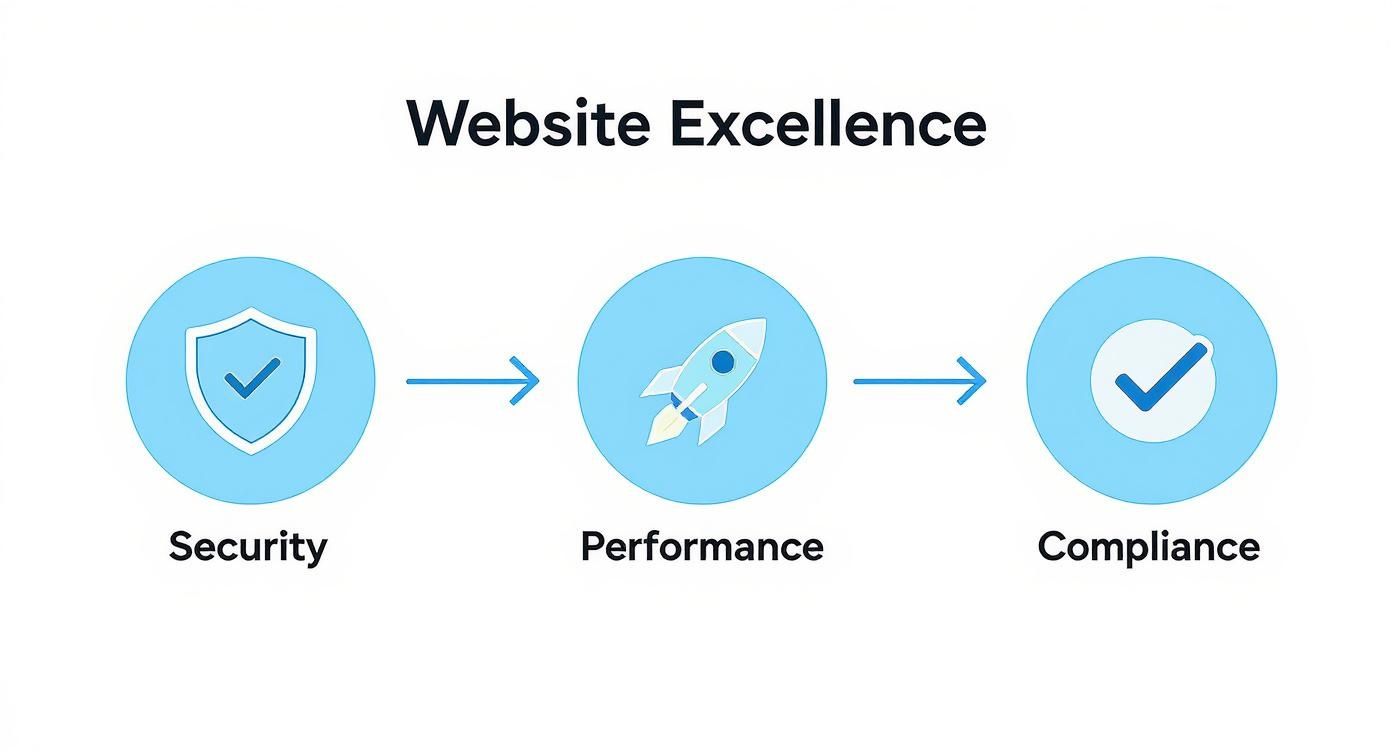
As you can see, a solid partnership ensures every website is built on a foundation of robust security, top-tier performance, and strict compliance from the ground up.
Financial and Operational Benefits
Working with a specialised agency WordPress partner Australia is much more than just farming out work; it's a strategic move that directly boosts your bottom line. Think about it: you completely sidestep the huge costs of recruiting, training, and retaining a specialised in-house development team.
When you outsource WordPress development Australia, you get on-demand access to a deep pool of expert talent, but only when you need it. This makes your business more flexible and scalable, turning website development into a highly profitable service line. Suddenly, you're in a position to confidently go after those bigger, more complex legal clients you've been eyeing.
Common Questions About Law Firm Web Design
When it comes to building a new website for a law firm, a few key questions always pop up. Whether you're an agency scoping the project or a lawyer trying to understand the process, getting clear answers upfront is crucial for setting expectations and ensuring everything runs smoothly. Many agencies partner with a website designer in Australia to handle the creative aspects while they focus on strategy.
Here, we'll tackle the most common queries we hear, giving you straight answers on costs, timelines, technology, and what truly makes a law firm's website successful.
How Much Does a Professional Law Firm Website Cost in Australia?
The investment for a law firm website really depends on what you need it to do. A solid, professional website built on a high-quality theme typically starts in the $5,000 to $10,000 range. That gets you a great-looking design, all the core pages, mobile-friendly performance, and the foundational SEO work.
If you're after a fully custom law firm website design with unique features, a detailed content strategy, and a serious SEO campaign, the investment can range from $15,000 to over $50,000. While that’s a significant number, a website built this strategically often pays for itself within 6 to 12 months by bringing in new clients. Think of it less as a cost and more as a high-return asset for a growing practice.
What Is the Most Important Element on a Law Firm Homepage?
Without a doubt, it’s a crystal-clear value proposition combined with easy-to-find contact details and a strong call-to-action (CTA). A visitor needs to land on the page and, within seconds, know exactly what you do and how you can help them with their specific legal problem.
But that core message needs backup. You have to build trust immediately. Prominently featuring testimonials, awards, and case results is the fastest way to reassure a potential client and give them the confidence to reach out.
How Long Does It Take to Build a New Law Firm Website?
You can generally expect a new law firm website project to take somewhere between 6 and 16 weeks. The final timeline really hinges on the complexity of the build.
- Simpler Websites (6-8 weeks): These projects are usually about customising a top-tier theme to match the firm's brand and content.
- Custom Builds (12-16+ weeks): A site built from the ground up, involving deep strategy, a lot of new content, and unique functionality, will naturally take longer.
Honestly, the biggest variable in any project timeline is how quickly the client can provide feedback, approve designs, and supply content. That back-and-forth is what keeps things moving.
Is WordPress the Best Platform for a Law Firm Website?
Yes, for almost every law firm we've worked with, WordPress is the perfect fit. As a leading wordpress agency australia, we’ve seen why so many top firms rely on it. It offers an incredible blend of flexibility for custom branding and design, and it’s built to be SEO-friendly right out of the box, which is a massive advantage for attracting organic traffic.
On top of that, its content management system (CMS) is so intuitive that lawyers or their staff can easily make updates themselves without having to call a developer for every little change. When you combine this with solid security practices and regular wordpress maintenance australia, you have a secure, scalable, and powerful platform to build a modern legal practice on.
At White Label WordPress, we help agencies deliver brilliant websites without the in-house headaches. Our white label WordPress and Shopify development services in Australia come with guaranteed profit margins and the technical expertise you need to scale your business. To see how we can become your go-to development partner, visit us at https://whitelabelwordpress.com.au.