
Great web design for a law firm isn’t just about making things look good. It's about building a digital front door that establishes instant credibility and turns a curious visitor into a paying client.
Think of it this way: for someone facing a stressful legal issue, your website is often the very first interaction they have with your firm. It’s their primary tool for sizing you up and deciding if you have the expertise to help them. This isn't just about aesthetics; it’s about a strategic foundation that screams authority, trustworthiness, and a deep understanding of what your clients actually need.
Building Your Law Firm's Digital Foundation

Before you even think about code or design mockups, you need to lay the groundwork. This initial phase is all about translating your firm’s real-world identity and business goals into a concrete digital strategy. It’s what separates a glorified online brochure from a genuine client-generation machine.
This process means getting specific about the core elements that will drive the entire project. For a law firm, this foundation is absolutely critical because it needs to convey professionalism and reliability from the moment the page loads. The stakes are high. In the competitive Australian legal market, a staggering 75% of people will judge a law firm's credibility based on its website design alone. This single statistic, highlighted by rgcdigitalmarketing.com.au, shows just how vital a polished digital presence is.
Defining Your Core Strategy
First things first, you need to answer some foundational questions about your firm. This isn't just a navel-gazing exercise; the answers you come up with will directly inform your website's structure, its content, and its overall tone of voice. A solid strategy ensures every single piece of your site has a clear purpose, guiding visitors exactly where you want them to go.
You'll need to lock down:
- Your Unique Value Proposition (UVP): What truly sets your firm apart? Maybe it’s your laser-focus on a niche practice area, a proven track record of winning high-stakes cases, or an unmatched client-first approach. Whatever it is, your UVP needs to be obvious.
- Your Ideal Client Profile: Who are you actually trying to reach? A corporate general counsel needing commercial litigation advice has completely different expectations than an individual navigating a messy family law dispute. You must define their pain points and what they're desperately searching for.
- Your Core Practice Areas: Clearly and simply outline what you do. This not only helps potential clients find their way but is also crucial for search engine optimisation. It’s how you get found for specific searches like "criminal defence solicitor Sydney" or "commercial property lawyer Melbourne".
Structuring for Trust and Authority
With a clear strategy in hand, you can start mapping out the website’s information architecture. This is essentially the blueprint for how all your content will be organised and displayed. For a law firm, the structure has to be dead simple and intuitive. Visitors are often stressed and short on time, so they need to find information without any friction.
When choosing a platform, it helps to know which systems are best for creating this kind of robust structure. For a deeper dive, our comparison of WordPress vs Squarespace breaks down the capabilities of different platforms.
A website isn't just a static collection of information. Every element, from your design choices to the way you present your case studies, contributes to the user's perception of your firm's credibility.
Essential Elements for a Credible Law Firm Website
| Element | Why It Matters for Law Firms | Best Practice Example |
|---|---|---|
| Professional Design | A clean, modern, and uncluttered design immediately signals competence and attention to detail—qualities clients want in their solicitor. | Using a reserved colour palette (blues, greys, whites) with high-quality, authentic imagery of the actual team, not stock photos. |
| Clear Navigation | Stressed clients need to find information fast. Intuitive menus for "Our Team," "Practice Areas," and "Contact Us" are non-negotiable. | A sticky header menu that stays visible as the user scrolls, with a prominent "Free Consultation" button. |
| Lawyer Bios | This is where you humanise the firm. Bios build personal connection and showcase the deep expertise of your legal team. | Including professional headshots, qualifications, notable cases, and a short personal statement for each solicitor. |
| Client Testimonials | Social proof is incredibly powerful in law. Positive reviews and case studies provide third-party validation of your skills. | Featuring video testimonials or detailed written reviews with the client's name and a photo (with permission). |
| Helpful Content | Publishing articles, guides, or FAQs on your practice areas demonstrates authority and helps you rank in search engines. | A family law firm writing a detailed blog post on "What to Expect in Your First Mediation Session" in Australia. |
Ultimately, a well-structured legal website does more than just present information—it builds a compelling case for why your firm is the only choice.
Every single page, from a solicitor's bio to a detailed case study, should reinforce your authority and unwavering dedication to getting the best outcome for your clients.
Designing an Experience That Builds Client Trust

A law firm's website has a tough job. It’s not just an online brochure; it needs to create a reassuring, seamless experience for people who are often showing up under a lot of stress. The design is a direct reflection of the firm's professionalism, and every little choice—from the colour palette to the font—either builds confidence or plants a seed of doubt.
A clean, polished aesthetic is the goal. It conveys competence and sophistication without feeling cold or intimidating.
This is where user experience (UX) and user interface (UI) principles, tailored for the legal sector, come into play. Potential clients need to feel understood and guided, not bombarded with information. An intuitive design means they can easily find solicitor profiles, see proof of the firm's expertise in case studies, and locate contact details without a struggle. You're aiming to create an online space that feels just as trustworthy as a face-to-face consultation.
A Mobile-First Imperative
Let's be realistic: a huge number of legal searches now happen on a mobile phone, often in moments of crisis. In fact, over 60% of people admit they'd leave a site immediately if it performed poorly on their device. For law firm web design, a mobile-first approach isn't just a good idea; it's a deal-breaker.
This is about more than just a "responsive" site that shrinks to fit a screen. A genuine mobile-first design considers every interaction from a handheld perspective:
- Tap-Friendly Navigation: Buttons, links, and menu items need to be spaced out and large enough to be tapped accurately with a thumb. No one wants to accidentally click the wrong link when they're stressed.
- Readable Text: Fonts must be clear and sized for smaller screens, eliminating the frustrating need to pinch and zoom just to read a paragraph.
- Simplified Forms: Keep contact forms short and sweet. Ask for the bare minimum needed to start a conversation, as typing on a mobile keyboard is never fun.
A fast, flawless mobile experience sends a clear message: your firm is modern, accessible, and respects a potential client's time and situation.
The Visual Language of Credibility
Long before someone reads a single word on the page, the site's visuals are already telling a story. Strategic use of imagery, typography, and colour is your secret weapon for building credibility from the first glance. Whatever you do, steer clear of generic stock photos. Authentic images of your actual team and your office create a genuine connection and establish immediate trust.
Your design choices should project an image of calm authority and expert guidance. For someone facing a legal challenge, a well-organised and professional website provides a crucial sense of stability and reassurance.
A sophisticated but simple colour palette—think blues, greys, and whites—reinforces a sense of professionalism and trustworthiness. Typography should be classic, clean, and highly legible, making sure the important information is easy to absorb. Every visual element needs to work in harmony, creating a clear path that guides the user from their initial problem to a confident call-to-action, validating your firm's expertise every step of the way.
Developing Content and SEO That Attracts Clients
Look, a slick website design is a great start, but it's only half the job. If you don't nail the content and SEO strategy, that beautiful site will just be gathering digital dust, completely invisible to people who desperately need legal help. Think of content as the engine. It's what drives your search rankings, proves you know your stuff, and convinces a visitor to actually pick up the phone.
The real aim here is to cut through the dense legal jargon and create resources that are genuinely helpful. You need a content plan that speaks directly to the fears, questions, and problems of your ideal clients right here in Australia.
Crafting Content That Converts
Your entire content strategy should pivot around your main practice areas. Every single service you offer needs its own detailed page—not just a brief mention. These pages should walk a potential client through the legal process, explain what they can expect, and answer their unspoken question: "What's in it for me?"
And a regularly updated blog? It’s not optional anymore. It’s one of your most powerful tools for showing, not just telling, your expertise.
- Answer the questions they’re actually asking. Create posts that mirror what people are typing into Google. Think things like, "What are the first steps in a divorce in NSW?" or "How does commercial leasing work in Victoria?"
- Translate legalese into plain English. Breaking down complex legal ideas shows you're an approachable expert, not an intimidating suit. This is a massive trust-builder.
- Lean into your local knowledge. Write about legal issues specific to your city or state. This is absolutely critical for local SEO and bringing in clients from your immediate area.
When you consistently put out high-value content, you're not just feeding Google what it wants. You're giving potential clients real value, which makes them far more likely to trust you when the stakes are high.
Mastering the Nuances of Legal SEO
Let's be blunt: SEO for law firms is a battlefield. It's incredibly competitive. You can't just sprinkle a few keywords on a page and hope for the best. The whole game is about proving your firm’s expertise and trustworthiness to search engines.
A massive part of that comes down to building a solid backlink profile. Every quality backlink is essentially a vote of confidence from another reputable website. For agencies that really want to get this right for their clients, looking into professional link building services in Australia can offer a serious advantage in creating the kind of authority signals that Google rewards.
For a law firm, SEO isn't just about getting found; it's about getting found by the right people. You want to show up for high-intent searches that scream, "I need a lawyer right now."
This is where optimising for long-tail keywords becomes so important. We're talking about longer, super-specific phrases like "no-win no-fee personal injury lawyer in Perth." The search volume is lower, sure, but the person searching knows exactly what they need, making them a much hotter lead.
The Power of Social Proof
Finally, you have to plaster your site with social proof. When someone is facing a legal crisis, they need to feel confident they're making the right choice. Reassurance is everything.
Make sure you weave these elements throughout the website:
- Client Testimonials: Don't just post a one-liner. Feature detailed reviews that tell a story. With permission, use the client's name and the area of law.
- Case Studies: Show off your wins. Write up brief, anonymised summaries of complex cases you’ve successfully handled. This proves you can get results.
- Awards and Credentials: Got any industry awards, accreditations, or media mentions? Get them on the site. They are instant credibility boosters.
This mix of genuinely helpful content, razor-sharp SEO, and undeniable social proof is what turns a website from a simple online brochure into a machine for generating qualified leads.
Making Sure Your Website is Secure and Compliant
When you're building a website for any business, getting the technical side right is important. For a law firm, it's absolutely non-negotiable. A site that’s slow, insecure, or hard to use isn't just a minor technical glitch; it reflects directly on the firm’s competence and can even become a serious liability.
The technical foundation of a law firm's website has to be rock-solid. It needs to be capable of handling sensitive client information while also following strict professional rules. This means taking a layered approach that puts security, compliance with Australian legal advertising standards, accessibility, and high performance at the very top of the list. Nail these elements, and you’re well on your way to building lasting client trust.
Fortifying Your Digital Defences
Client confidentiality is everything in the legal world. Your website needs to be a digital fortress, safeguarding any and all information that potential clients share. The first step, and it's a basic one, is installing an SSL (Secure Sockets Layer) certificate. This encrypts the data moving between a user's browser and your server—it's what turns http into https, giving visitors a clear signal that your site is secure.
But SSL is just the beginning. Your choice of hosting provider is absolutely critical. Don't just go for the cheapest option; look for a managed hosting solution that includes:
- Daily Backups: Non-negotiable. You need the ability to restore your site instantly if something goes wrong.
- Malware Scanning: Proactive scanning is key to finding and killing malicious code before it causes chaos.
- Firewall Protection: A good firewall acts as a digital bouncer, blocking unauthorised access attempts at the door.
Regular security audits and updates are just as important. This is where getting professional help really pays off, because consistent oversight stops vulnerabilities from being exploited. Looking into ongoing WordPress maintenance services is a smart move to ensure your site's core software, themes, and plugins are always updated, patching security holes the moment they're found.
Navigating Compliance and Accessibility
In Australia, every law firm has to play by the advertising rules set by their state or territory's Law Society. These guidelines dictate what you can and can't say when marketing your services, with a firm line against anything misleading or deceptive. All the content on your website must be factually correct and presented professionally to steer clear of any ethical minefields.
Just as crucial is web accessibility. Following the Web Content Accessibility Guidelines (WCAG) ensures that people with disabilities can use your site effectively. This isn't just about doing the right thing ethically; it's also a smart business move that opens your doors to a much wider client base.
A fast, secure, and accessible website isn't just a technical achievement; it's a powerful statement about your firm's commitment to professionalism, client care, and inclusivity.
Finally, let's talk about speed. Site speed is a massive factor for both user experience and how you rank on Google. A slow-loading website is a surefire way to frustrate a potential client and send them straight to a competitor. Aim for pages to load in under two seconds. You get there with optimised images, lean code, and quality hosting—all of which combine to create a seamless, professional experience for every single visitor.
Turning Visitors Into Leads and Scaling Agency Delivery
A stunning website is nice, but if it isn't bringing in new clients for the law firm, it's just a pretty online brochure. The real measure of success for any professional web design for law firms is its ability to turn a casual browser into a qualified lead. This takes a smart approach to conversion rate optimisation (CRO) and, for the agency building the site, a delivery model that’s both efficient and profitable.
Getting a potential client to take that next step—making contact—is all about making it incredibly easy and reassuring. Someone dealing with a legal problem is already stressed; a clunky or confusing contact process is an instant dealbreaker. Think high-impact contact forms that are dead simple, or adding live chat to give people an immediate way to reach out. These small touches can dramatically boost the chances of that first conversation happening.
Designing for Action and Conversion
The entire design of a law firm's website should be a subtle but persistent guide, leading visitors toward making contact. This is much more than just sticking a "Contact Us" link in the navigation. It's about weaving clear calls-to-action (CTAs) and lead capture points into the entire experience.
Here are a few elements I always focus on to get results:
- Unmissable CTAs: Buttons like "Request a Free Consultation" or "Speak with a Solicitor Today" need to pop. We use contrasting colours and place them strategically so they’re always within view.
- Keep Forms Simple: At the initial point of contact, only ask for what you absolutely need: name, email, phone number, and a short message. Every extra field you add is another reason for someone to give up and leave. Long, complicated forms are conversion killers.
- Integrate Live Chat: For many people, picking up the phone is a big step. A live chat box offers a low-pressure way to ask a quick question, making the firm feel far more approachable and responsive from the get-go.
This all feeds into building the trust required to get someone to reach out. A website must tick three core boxes before a visitor will feel comfortable enough to convert.
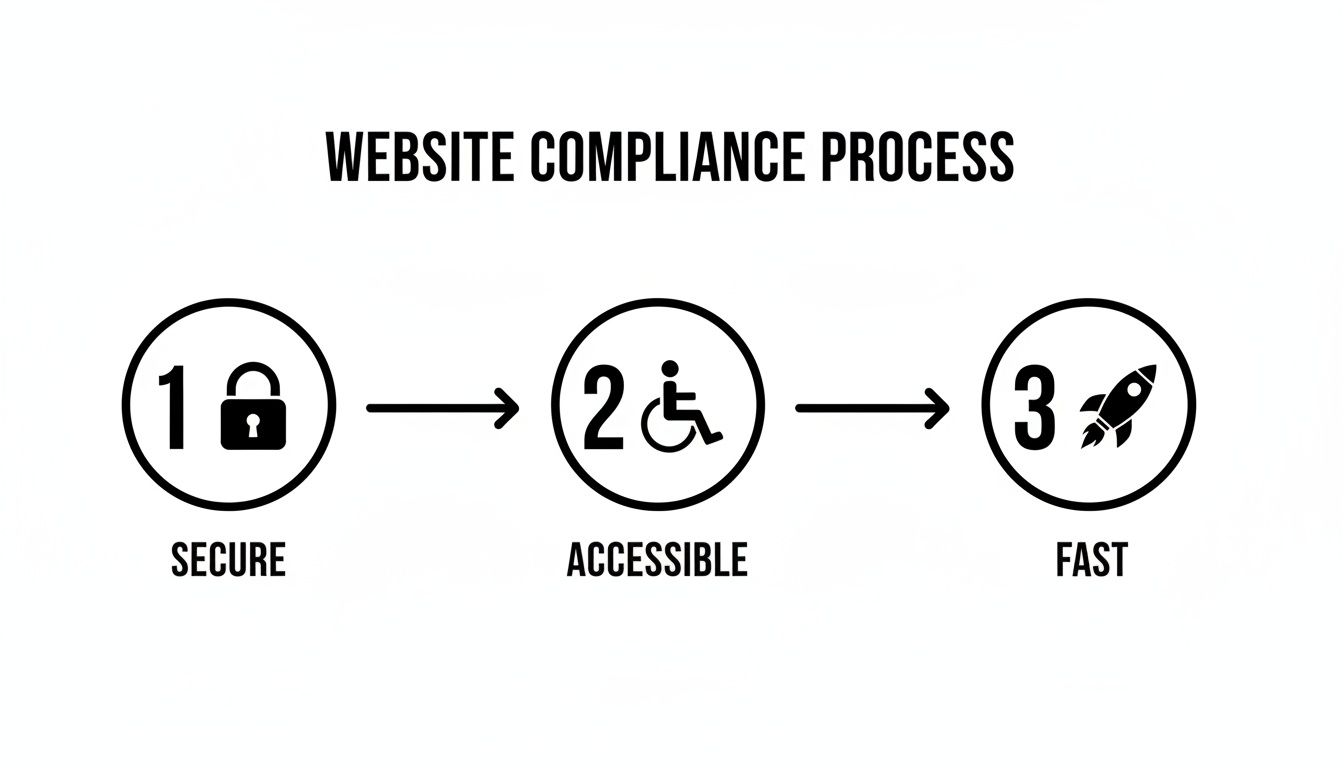
Security, accessibility, and speed aren't just technical details; they are fundamental signals of trust. Each one reassures potential clients that the firm is professional and reliable, encouraging them to make that crucial first contact.
Scaling Delivery with a White Label WordPress Agency
So, you’re a digital agency and you see the opportunity. But delivering high-quality, secure, and compliant law firm websites is a heavy lift. Building out an in-house team of expert developers is a massive, expensive undertaking. This is precisely where partnering with a white label WordPress agency becomes a game-changer.
Partnering with a white label WordPress developer lets your agency offer top-tier web development services under your own brand, but without the crippling overhead of an in-house team. Frankly, it’s the smartest way to scale your services and boost your bottom line.
For agencies, choosing between building an in-house team and partnering with a white-label provider is a critical decision. Here’s a quick breakdown of how they stack up.
In-House vs White-Label Web Development for Agencies
| Factor | In-House Development | White-Label Partnership |
|---|---|---|
| Upfront Cost | Very high (salaries, benefits, software, hardware) | Low (pay-per-project or retainer model) |
| Expertise | Limited to the skills of your team | Access to a deep bench of specialists (devs, designers, SEOs) |
| Scalability | Slow and difficult; hiring takes months | Instant; can scale up or down based on project demand |
| Overhead | High ongoing costs for payroll, training, and management | Minimal; the partner handles their own overhead |
| Time to Market | Slower, as team capacity is a bottleneck | Faster, as a dedicated team works on your project immediately |
| Focus | Diverts focus to managing a development team | Allows you to focus on sales, strategy, and client relationships |
Ultimately, outsourcing the technical work to a specialist means you can pitch and win complex projects—from custom WordPress development Australia to the kind of ongoing WordPress maintenance Australia businesses rely on—with total confidence. The white-label model creates a seamless workflow. Your partner handles the build, and your agency manages the client relationship and overarching strategy. It frees you up to focus on your core strengths: marketing, sales, and account management.
By leaning on a white label WordPress agency in Australia, you can instantly broaden your service offerings, take on bigger and better projects, and sleep well knowing every website you deliver is built for performance and lead generation. In the competitive legal space, this kind of partnership is the key to scaling your agency’s capacity and profits.
Got Questions? We've Got Answers
When you're diving into building websites for law firms, a few common questions always seem to pop up. Whether it's about budgets, features, or how to scale your own agency, let's clear the air and give you some straight answers.
What's the Real Cost of a Law Firm Website in Australia?
This is the million-dollar question, isn't it? The truth is, the cost swings wildly depending on what the firm needs.
A small, local practice might get a professional, high-quality site off the ground for around $8,000. But for a larger, multi-office firm needing custom features—think secure client portals, complex integrations, and pages upon pages of expertly written content—the investment can easily climb north of $25,000.
What drives that price? It comes down to a few key things: are we talking custom design from scratch or a high-end template? How deep are we going with SEO and content? And are there any special functions needed to really serve their clients well?
What are the Absolute Must-Have Features for a Law Firm Site?
If a law firm's website is missing certain core elements, it's just not going to work. There are a few non-negotiables. First and foremost, the site must have intuitive navigation and a flawless mobile-responsive design. People are stressed when they look for a lawyer; don't make it harder for them to find what they need, especially on their phone.
Beyond that, a successful site needs:
- Detailed solicitor profiles: These are crucial for building trust. They put a human face to the firm and highlight individual expertise.
- Clear practice area pages: No jargon. Just simple, direct explanations of the services they offer and the problems they solve.
- Visible client testimonials and case studies: This is your social proof. It shows potential clients that the firm gets real results for real people.
- Blazing-fast page load speeds: If a page takes more than a couple of seconds to load, you've lost them.
- An SSL certificate and easy-to-find contact info: Security and accessibility are table stakes.
And it’s becoming more important than ever to ensure the site meets WCAG accessibility standards. It’s not just good practice; it’s about serving everyone.
A great law firm website is where functionality and trust intersect. It needs to be easy to use, totally secure, and loaded with proof of the firm’s expertise. That’s the combination that turns a curious visitor into a new client.
How Does a White Label WordPress Agency Actually Help My Agency?
Think of a white label WordPress agency as your specialist web development team, working silently in the background. They build the high-calibre websites your law firm clients need, and you deliver them under your own brand. It's that simple.
This partnership model is a game-changer. It lets you offer top-tier white label web design Australia services without the headache and expense of hiring, training, and managing an in-house team. For agencies looking to grow, it's a proven way to scale your service offerings, take on more complex projects with confidence, and deliver fantastic results for niche clients, like law firms.
Is SEO Really That Important for Lawyers?
For a law firm, SEO isn't just important—it's everything. Almost every potential client's journey starts with a Google search. They're typing in things like "family lawyer Sydney" or "commercial litigation Melbourne" because they have an urgent problem that needs solving now.
A smart SEO strategy is what gets your client's firm to show up for those high-intent searches. And it’s so much more than just stuffing in a few keywords. It’s about deep on-page optimisation, creating genuinely helpful content that answers real questions, and building a rock-solid local search profile to attract clients in their specific area.
Without a solid SEO foundation, even the most beautifully designed website is just a billboard in the desert.
Ready to deliver exceptional law firm websites without the overhead? White Label WordPress provides expert white label WordPress and Shopify development, allowing your agency to scale profitably.
Partner with us today and guarantee your profit margins on every web project.