

Building an online store isn't just about putting products on a webpage. It's the whole shebang: the front-end design that greets your customer and the powerful back-end functionality that handles everything from payment processing and stock levels to keeping customer data safe. For a modern agency, getting this right isn't just a nice-to-have skill anymore; it's a fundamental part of the toolkit for any website designer australia.
The Booming Australian Ecommerce Market for Agencies
Let's be blunt: the way Aussies shop has completely shifted. What was once a convenience has become the norm, sparking a digital marketplace that’s growing faster than anyone could have predicted. For digital agencies, this isn't just a trend—it's one of the biggest growth opportunities we've seen in a long time. Simply building brochure websites won't cut it anymore; specialising in ecommerce is now critical for survival and profit.
This digital gold rush is exciting, but it comes with its own set of challenges. Clients don't just want a pretty website. They need a robust sales machine that can manage inventory, process payments securely, and actually bring in customers. This demands a much deeper and more specialised skill set, covering everything from choosing the right platform to fine-tuning the site for conversions. As a leading wordpress agency australia, staying ahead of this curve is crucial.
Meeting Surging Client Demand
Right now, the demand for a good ecommerce developer australia is through the roof. Businesses, from local startups to established brands, are scrambling to build or improve their online stores, and they're looking for agencies to lead the way. This is your chance to step up and deliver real, measurable value.
By building out your ecommerce expertise, you can:
- Open up new revenue streams: Think high-value custom wordpress development australia builds, complex platform migrations, and lucrative ongoing maintenance contracts.
- Land better clients: Businesses serious about ecommerce are ready to invest in expertise that delivers a tangible return. They're the clients you want.
- Get a serious competitive advantage: Specialising in a sought-after field like ecommerce immediately sets you apart from the crowd of generalist agencies.
The numbers don't lie. Not long ago, Australian ecommerce spending hit a staggering $69 billion, jumping 12% from the year before. That figure has almost doubled since before the pandemic, showing just how quickly retail has moved online. With ecommerce now accounting for roughly 20% of all retail spending, the signal for agencies couldn't be clearer: the market is huge, and it's ready. You can dive deeper into these ecommerce statistics and their impact on the Australian market.
Put it this way: if your agency isn't building high-performing online stores, you are leaving serious money on the table. The client conversation is no longer "Should I get an online store?" but "How do I make my online store sell more?" Agencies need to have the answer. This guide will give you that answer, helping you master the world of ecommerce development and build a profitable, scalable service for your clients.
Choosing the Right Ecommerce Platform for Your Clients
When you're building an online store, picking the right platform is easily the most critical decision you'll make. For an agency, this choice runs deeper than just features and functions; it dictates your entire project workflow, how you hand the site over to the client, and what your long-term support will look like. A true wordpress expert australia can navigate these choices with ease.
In Australia, the conversation almost always boils down to two heavyweights: Shopify and WooCommerce. Each offers a fundamentally different approach to ecommerce, and your job is to be the expert guide, matching the platform to your client’s business model, technical skill, and growth plans. It’s never about which one is "better" in a vacuum, but which is the best fit for the specific client sitting across the table. Get this right, and you build immense trust and set the project up for success.
Shopify: Streamlined Power and Simplicity
Think of Shopify as leasing a prime retail space in a high-end, fully managed shopping centre. It takes care of the security, hosting, and all the tricky technical maintenance behind the scenes. This lets your clients focus purely on what they do best: selling their products. A skilled shopify developer australia can leverage this platform for rapid and robust deployment.
This Software-as-a-Service (SaaS) model is Shopify's biggest drawcard. It provides a rock-solid, secure, and incredibly user-friendly environment straight out of the box. For your agency, this translates to faster build times and a much smoother handover. Clients can confidently manage products, orders, and marketing without needing to call you for every minor tweak. A good shopify agency australia will also offer shopify support australia post-launch.
A few key advantages really stand out:
- Ease of Use: The dashboard is famously intuitive, making it genuinely simple for non-technical clients to run their store independently after launch.
- Managed Hosting and Security: Shopify handles server upkeep, security patches, and PCI compliance, which dramatically cuts down on your agency's liability and support headaches.
- App Ecosystem: A massive marketplace of apps allows you to bolt on new features with ease, from loyalty programs and shopify app setup australia to sophisticated analytics tools.
This decision flow helps visualise how specialising in ecommerce, and therefore platform choice, can put your agency on a completely different growth trajectory.
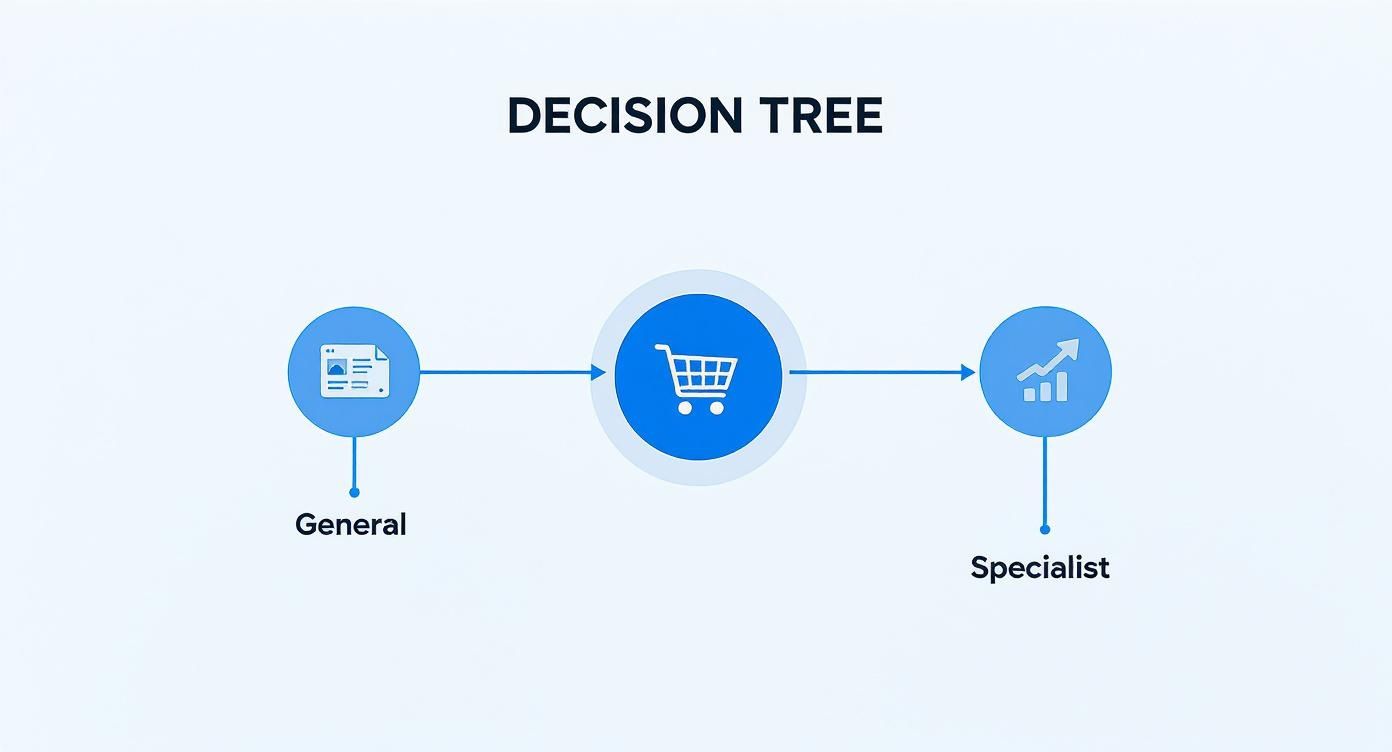
As the diagram shows, committing to ecommerce specialisation is a path toward significant growth, and deep platform expertise is what fuels that journey.
WooCommerce: Limitless Customisation and Control
If Shopify is like leasing a retail space, then WooCommerce is like owning the entire building. Built as a plugin for WordPress, it’s an open-source solution that gives you and your client total control over every single pixel and line of code. From the hosting server to the checkout process, everything is yours to customise. This is where expert woocommerce development australia truly shines.
This complete flexibility is a game-changer for clients with unique business models, complex product variations, or specific third-party integrations that just aren't possible within Shopify's ecosystem. It also shines for businesses where content is king—think sites where a powerful blog or resource hub is just as vital as the store itself. Hiring a wordpress freelancer australia can be a good option for smaller, bespoke projects.
Key Takeaway: The fundamental difference comes down to ownership versus convenience. With WooCommerce, you own and manage the entire asset, which gives you infinite potential but also demands more technical responsibility. With Shopify, you rent a powerful, managed solution that prioritises simplicity over granular control.
For agencies with strong in-house WordPress development skills, WooCommerce opens the door to crafting truly bespoke ecommerce experiences. That freedom, however, comes with the ongoing responsibility of managing hosting, security, software updates, and performance optimisation.
If you want to offer your clients the power of a managed solution without building a team from scratch, exploring a white label Shopify partnership is a smart way to scale your services.
Shopify vs WooCommerce: A Comparison for Australian Agencies
To guide your clients effectively, you need a clear-eyed view of how these platforms stack up from an agency perspective. This table breaks down the key differences that will directly impact your project scope, client happiness, and ultimately, your bottom line.
| Feature | Shopify | WooCommerce (WordPress) |
|---|---|---|
| Hosting & Security | Fully managed and baked into the monthly fee. High reliability and PCI compliance are standard. | Self-hosted. You or the client are responsible for sourcing hosting, SSL certificates, and security updates. |
| Ease of Client Handover | Excellent. The admin interface is famously intuitive, which means minimal training is required. | Good. It's familiar for anyone who has used WordPress, but it can feel complex for truly non-technical clients. |
| Customisation | Limited. You can customise through themes and apps, but core platform functionality is locked. | Unlimited. Being open-source means you have full control to modify absolutely anything you want. |
| Total Cost of Ownership | Predictable monthly fees plus transaction percentages and ongoing costs for premium apps. | The plugin itself is free, but you must budget for hosting, premium plugins, and developer time for maintenance. |
| SEO Capabilities | Strong. It offers solid SEO features out of the box, though with some limits on URL control. | Exceptional. You get the full power of WordPress and incredible plugins like Yoast for total SEO control. |
Ultimately, your recommendation will hinge on a deep understanding of your client's needs. Are they a startup that needs a quick shopify store setup australia and manage the store themselves? Shopify is often the answer. Are they an established business with complex requirements and a need for deep content integration? WooCommerce is likely the better long-term fit.
How White-Label Partnerships Drive Agency Growth
For many digital agencies in Australia, the explosion in demand for complex ecommerce projects is a classic Catch-22. You absolutely want to say "yes" to those bigger, more profitable builds, but hiring a full-time team of specialist developers is a huge financial gamble. This is precisely where a white-label partnership becomes your agency's secret weapon for growth. An agency wordpress partner australia can be a game-changer.
Instead of turning down great work or scrambling to hire, you can team up with a specialised development crew that works entirely behind the scenes, under your brand. Think of them as an extension of your own agency—a dedicated technical powerhouse you can call on whenever you need them. This model lets you offer advanced website development ecommerce services, from shopify custom coding australia to tricky WooCommerce integrations, without the crippling overheads of salaries, super, and training. This is a key benefit of digital agency outsourcing australia.

It’s a strategic move that turns outsourcing from a simple cost-cutting measure into a powerful engine for business development. You keep complete control over the client relationship, the project management, and all the creative decisions. Your clients just see a brilliant project delivered seamlessly under your agency's banner, which only reinforces your brand's authority. Finding the right shopify developers for agencies australia can unlock new revenue streams.
Demystifying the White-Label Workflow
So, how does this actually work in practice? The whole process is designed to be smooth, efficient, and completely invisible to your end client. It follows a clear, collaborative path that keeps your brand front and centre and guarantees a top-notch result. A white label wordpress agency can make this process seamless.
The workflow usually breaks down into a few key stages:
- Initial Briefing and Scoping: You bring the client brief to your white-label partner. Together, you’ll nut out the project scope, technical needs, and timeline, and they’ll give you a fixed quote for the development work.
- Your Agency Sets the Final Price: With the partner's wholesale cost sorted, you add your agency's margin for project management, strategy, and client service. This becomes the final proposal you present to your client.
- Development and Communication: The white-label team gets to work on the build. All communication flows directly through you, so you're always the single point of contact for your client.
- Quality Assurance (QA) and Revisions: The partner does their own thorough testing. You then review everything to make sure it meets your agency's quality standards before showing it to the client for feedback.
- Project Handover: Once the client gives the final thumbs-up, the partner hands over all assets and logins to you. You then manage the launch and the final handover, cementing your role as their go-to expert.
This model is becoming incredibly effective as more businesses jump into the online marketplace. The Australian online shopping industry has seen massive growth, with market revenue climbing to an estimated $64.9 billion. There are now around 116,000 online businesses in the sector, which has been expanding at a compound annual growth rate of 7.5% in recent years. This points to a huge pool of potential clients crying out for expert development. You can dig into more data on the growth of Australian online businesses on ibisworld.com.
The Strategic Advantages of Outsourcing Development
Partnering with a white label ecommerce development australia specialist isn't just a way to get projects built; it’s a smart decision that directly fuels your profitability and makes you more agile. Your agency can immediately broaden its service offerings and confidently pitch for projects that were once completely out of reach.
A white-label partnership allows you to sell sophisticated technical solutions today, using the revenue to fund your growth tomorrow. It's about scaling intelligently, minimising risk, and focusing your internal resources on what you do best—strategy, creativity, and client relationships.
By removing the technical bottleneck, you free up your team to focus on the high-value work they excel at. This lets you serve more clients more effectively, building a rock-solid reputation as a full-service agency that delivers exceptional results, every single time.
Building a High-Conversion Ecommerce Website

Choosing a great ecommerce platform is really just the first step. The real art and science of website development ecommerce is turning that foundation into a powerful sales engine that converts casual browsers into loyal customers. It’s a delicate dance between intuitive design, rock-solid security, and technical precision. This is where a top wordpress web design company australia can make all the difference.
Agencies that nail these core components are the ones that deliver serious value. They’re not just building online shops; they’re creating meticulously engineered experiences with one clear goal—driving conversions and making money for their clients. A key part of this is shopify conversion optimisation australia.
Designing an Intuitive User Experience
You’ve got milliseconds to make a good first impression. A confusing layout, clunky navigation, or a page that takes an eternity to load is the fastest way to kill a sale. A truly great user experience (UX) is almost invisible; it guides the shopper from discovery to checkout without them even noticing the mechanics.
This all comes down to prioritising clarity and simplicity at every turn. Some of the most critical elements of a high-conversion UX are:
- Effortless Navigation: Think logical menus, clear product categories, and smart search filters. The goal is to help customers find exactly what they’re looking for with zero frustration.
- High-Quality Visuals: Professional product photography and videos are non-negotiable. Showcasing items from multiple angles helps build trust and allows customers to picture the product in their own hands.
- Clear Calls-to-Action (CTAs): Use prominent, action-focused buttons like "Add to Cart" and "Buy Now". Make the next step in the buying journey obvious and compelling.
Ultimately, you want to make the whole process of shopping easy and, dare I say, enjoyable. When the path to purchase is smooth, higher conversion rates are the natural result.
The Non-Negotiable Mobile-First Approach
Here in Australia, shopping on a smartphone isn't some emerging trend—it’s the norm. With a huge chunk of online purchases happening on mobile devices, having a "mobile-friendly" site just doesn't cut it anymore. Your development process must be built around a mobile-first mindset.
This means designing the experience for the smallest screen first, then scaling it up for desktops. A responsive design that simply squishes a desktop site onto a phone screen is a recipe for disaster—tiny text, impossible-to-tap buttons, and a checkout process that makes people give up. True mobile-first design ensures the site is fast, touch-friendly, and perfectly optimised for on-the-go browsing from the ground up.
Integrating Secure and Trusted Payment Gateways
Nothing shatters customer confidence faster than a checkout page that looks clunky or insecure. Integrating trusted, instantly recognisable payment gateways is absolutely fundamental to building that all-important trust.
It’s also crucial to offer a variety of payment options. By including major credit cards, PayPal, Afterpay, and digital wallets like Apple Pay and Google Pay, you cater to every customer's preference and significantly reduce cart abandonment. Every gateway needs to be seamlessly integrated and locked down with SSL encryption to protect sensitive customer data.
Trust is the currency of ecommerce. A secure, professional checkout process isn't just a feature—it's a promise to your customer that their information is safe, which directly impacts their decision to complete a purchase.
Optimising for Search and Speed
What's the point of an amazing online store if nobody can find it? Ecommerce SEO is a specialised skill that goes way beyond simply stuffing keywords onto a page. It involves fine-tuning every part of the site to rank well in search results and attract qualified buyers. Good shopify seo australia can make a significant difference to a store's visibility.
Here’s where you need to focus your attention:
- Product Page Optimisation: Write unique, descriptive titles, meta descriptions, and product details that genuinely answer customer questions while targeting relevant search terms.
- Structured Data: Implement schema markup for products, reviews, and pricing. This helps search engines understand your content and can lead to those eye-catching rich snippets in the search results.
- Site Speed: Every second counts. A slow-loading site doesn't just annoy users; it gets penalised by Google. You need to optimise images, write efficient code with wordpress speed optimisation australia in mind, and invest in quality hosting to ensure lightning-fast performance.
The Australian market’s ongoing shift to digital commerce highlights just how important visibility is. In a recent month, seasonally adjusted online retail sales in Australia reached approximately $4.7 billion, a 4.9% increase from the previous year. With online sales now accounting for 12.7% of total retail, making sure your clients' stores are fast and findable is paramount. You can dig into these Australian retail trade figures from the ABS for more detail.
For agencies looking to build this technical expertise without the overhead of an in-house team, partnering with a white label WordPress developer can be a smart move. It gives you access to the specialised skills needed to deliver high-performance, SEO-friendly stores, ensuring every site you launch is built on a solid foundation for organic growth.
How to Price Ecommerce Projects for Profitability
Building a high-conversion ecommerce site is one thing; pricing it so your agency actually makes a profit is a completely different ball game. The financial side of website development ecommerce needs a clear, structured approach to protect your margins and build a sustainable business.
Without a solid pricing strategy, you’re just asking for scope creep to devour your profits, turning what should be an exciting project into a financial headache. The goal is to get past the guesswork and use a system that accounts for every part of the job, not just the build itself but also the project management, client comms, and strategy sessions you pour your time into.
Choosing the Right Pricing Model
Before you can even think about a number, you have to decide how you're going to charge. In the agency world, ecommerce projects usually fall into one of three buckets. Each one has its place, depending on the project's complexity and your relationship with the client.
-
Fixed-Price Projects: This is the most common approach. You give the client a single, upfront cost for a very clearly defined scope of work. It’s perfect for projects with predictable steps, like a standard Shopify store setup or a straightforward WooCommerce build from a wordpress developer australia. Clients love knowing the final cost from day one, and you know exactly what revenue to expect.
-
Time and Materials: Got a complex project where the final scope is a bit fuzzy? This model is your friend. You simply bill the client for the actual hours your team works at an agreed-upon hourly rate. It’s a great fit for shopify theme development australia, tricky integrations, or for clients who know they’ll want to make changes as you go.
-
Monthly Retainers: This is the key to predictable, recurring revenue. Retainers are perfect for ongoing work after the site goes live, like wordpress maintenance australia or shopify support australia. You charge a set monthly fee for a block of hours or specific services like performance monitoring, security updates, and conversion optimisation.
Scoping Projects to Protect Your Margins
The single biggest threat to your profitability is scope creep. It’s that slow, sneaky addition of "just one more little thing" that was never part of the original plan. Your best defence? A ridiculously detailed scope.
Before a quote ever leaves your drafts, break the entire project down into granular, billable phases. For a typical ecommerce build, that list should look something like this:
- Discovery and Strategy: All the initial meetings, research, and technical planning.
- UX/UI Design: Wireframing, prototyping, and creating the final visual mockups.
- Development: The actual front-end and back-end coding and platform configuration.
- Content and Product Entry: Loading the initial batch of products and website content.
- Quality Assurance (QA) and Testing: The nitty-gritty of bug hunting across different browsers and devices, including services like wordpress bug fix australia.
- Launch and Handover: Deploying the site to the live server and training the client.
By attaching estimated hours to each of these phases, you build a realistic project total that covers every bit of work you'll do.
Pricing with a White-Label Partner
When you outsource web development australia, your pricing strategy needs a small tweak, but the core logic is the same. Your white-label partner will give you a fixed, wholesale cost for their development work. Your job is to then build your agency's value right on top of that.
Key Takeaway: The partner's cost is your starting line, not the finish line. A healthy—and totally standard—margin to add for your agency's project management, client handling, and strategy is between 30% and 50%. This ensures you’re properly paid for the crucial role you play in making the project a success.
Let's say your white label wordpress agency quotes you $10,000 for a complex WooCommerce site. You should be quoting your client somewhere in the $13,000 to $15,000 range.
This covers your partner's fee while generating a solid profit margin for all the value your agency brings to the table. It’s a transparent and reliable way to make ecommerce a consistently profitable service for your business.
Launching and Supporting a Successful Online Store
So, you’ve built a stunning online store. The design is slick, the code is clean, and the client is thrilled. But the real work? It’s just getting started. A successful launch and proactive, ongoing support are what turn a great build into a genuine, money-making asset for your client. This final stretch is where your agency truly proves its worth and builds relationships that last.
Think of the launch like a grand opening for a physical shop. You wouldn’t just unlock the doors and hope for the best. You need a meticulous pre-flight checklist. This means getting the client to do a final round of user acceptance testing (UAT), running a thorough SEO audit to make sure Google can find them from day one, and double-checking that all security measures, like SSL certificates, are locked in. A little bit of diligence here prevents a lot of headaches later and makes sure the grand opening goes off without a hitch.
Creating Long-Term Value After Launch
Once those digital doors swing open, the game changes. You’re no longer a builder; you’re an optimiser. An ecommerce site isn't a static brochure; it's a living, breathing part of the business that needs constant attention to stay in top form. This is a massive opportunity for your agency to provide real, ongoing value and lock in that sweet, predictable recurring revenue.
The foundation of any good post-launch support plan rests on a few key pillars:
- Regular Software Updates: Keeping the engine running—WordPress, WooCommerce, and all those essential plugins—is non-negotiable for security and performance. This is the core of wordpress website support australia.
- Security Monitoring: You need to be the guard at the gate, proactively scanning for malware and closing vulnerabilities before they become a problem. This protects your client’s business and their customers' private data.
- Performance Tuning: Site speed is everything. Regularly optimising the site keeps it snappy, which is crucial for keeping customers happy and search engines even happier.
- Conversion Rate Optimisation (CRO): This is where the magic happens. By digging into user data and smoothing out bumps in the customer journey, you can directly help your client make more money over time.
Think of it like servicing a high-performance car. You wouldn't buy a Ferrari and then skip its tune-ups. An ecommerce site is the same. It needs regular, expert maintenance to prevent breakdowns and ensure it’s always firing on all cylinders. This is what shopify maintenance australia is all about.
Building Lasting Partnerships with Support Retainers
The best way to deliver all this value is through structured maintenance and support retainers. These packages are what elevate your agency from a one-off project provider to an essential long-term partner. When you’re looking after their site every month, you’re not just creating a stable revenue stream for yourself; you're embedding your agency into their success story.
Offering these retainers is a natural next step after the build. You can structure a range of valuable ongoing services, from basic upkeep to comprehensive support plans, that fit different client needs and budgets. By positioning your agency as a true partner invested in their growth, you ensure the ecommerce stores you build don't just launch—they thrive. A good partner web agency australia relationship is built on this long-term value.
Your Top Ecommerce Development Questions, Answered
If you’re running an agency in Australia, you've probably noticed that ecommerce projects bring up their own unique set of questions. Getting straight answers is the only way to scope projects properly, keep clients happy, and actually make a decent profit. Let's dig into the common hurdles agencies face.
When Should My Agency Actually Use a White-Label Partner?
The short answer? The moment a client asks for something your team can't comfortably handle in-house. It could be a request for a custom Shopify app, a tricky API integration, or a massive Shopify migration Australia project.
It's also a smart move when you're ready to scale. Partnering up lets you take on more ecommerce work without the headache and overhead of hiring full-time specialists. You can grow your revenue and confidently say 'yes' to those bigger, more lucrative projects that used to feel out of reach. This is a key advantage of wordpress outsourcing australia.
What’s the Real Difference Between Shopify and WooCommerce?
At its core, the choice between Shopify and WooCommerce boils down to one thing: control versus convenience.
Shopify is a fully-hosted, all-in-one platform. It takes care of security, hosting, and updates, which makes it incredibly simple for clients to manage. A Shopify expert Australia can launch a store fast, but you're working within Shopify's ecosystem, so deep, code-level customisation has its limits.
WooCommerce, on the other hand, is a plugin for WordPress, meaning it's self-hosted. This gives you complete freedom. You (and your client) control everything from the server to the source code. A WooCommerce developer Australia can build a truly unique, bespoke store, but that freedom means you're also on the hook for maintenance, security, and performance.
How Can We Price Ecommerce Projects and Still Guarantee a Profit?
Nailing your pricing always starts with a rock-solid scope of work. Before you even think about sending a quote, break the entire project down into clear phases: discovery, design, development, content loading, and testing. From there, you can assign a realistic number of hours to each part.
When you're teaming up with a white label web design Australia partner, get their wholesale cost first. Then, add your agency's margin on top—usually around 30-50%—to cover your project management and client communication. It’s also wise to build in a 15-20% contingency buffer for those "just in case" moments.
What Are the Most Critical SEO Factors for a New Store?
For a store just starting out, you want to focus on the fundamentals that make the biggest impact. Here’s where to start:
- A Logical Site Structure: Your category and product pages need to be organised in a way that’s intuitive for shoppers and easy for search engine crawlers to follow.
- On-Page Optimisation: Get the basics right. Write unique product titles, compelling meta descriptions, and descriptive image alt text that naturally include your target keywords.
- Wicked-Fast Page Speed: Speed is a massive ranking factor, especially on mobile. Make sure the site loads in the blink of an eye.
- Structured Data (Schema): This is non-negotiable for ecommerce. Implementing Schema markup for products helps Google understand your page content, which powers those eye-catching rich snippets in search results and can seriously boost your click-through rates.
Ready to grow your agency’s ecommerce services without the overheads? At White Label WordPress, we’re the expert Shopify and WordPress development team behind agencies just like yours. We deliver exceptional results under your brand, so you can lock in your profit margins on every single project.
Find out how we can help at https://whitelabelwordpress.com.au.