
Let’s get one thing straight: your website isn't a "set it and forget it" asset. Think of it more like a high-performance car. You wouldn't drive it for years without changing the oil or checking the tyres, would you? Website maintenance packages are precisely that—the essential, ongoing servicing that keeps your digital storefront in peak condition.
So, What Exactly Is a Website Maintenance Package?
In simple terms, a website maintenance package is a service agreement, usually on a retainer, where a team of experts handles all the technical heavy lifting your site needs to stay healthy, secure, and fast. This isn't about content updates or a flashy redesign; it's the critical, behind-the-scenes work that stops things from going spectacularly wrong.
Without this proactive care, your website is left exposed. Slow load times can kill conversions—even a three-second delay can cause your bounce rate to jump by 32%. Worse yet, outdated plugins are a hacker's favourite playground, responsible for a staggering 93% of all WordPress vulnerabilities.
Proactive Care vs. Reactive Panic
Imagine your eCommerce store crashing during the Black Friday rush. The lost sales, the customer complaints, the frantic search for a developer who can fix it right now… it's a costly nightmare. That's the break-fix approach in a nutshell—waiting for disaster to strike before you act.
Website maintenance packages flip that script entirely. It's about having a dedicated team that works to prevent problems before they ever surface.
A solid maintenance plan means you’re not just fixing problems as they appear—you’re stopping them from ever happening. It’s the difference between a routine check-up and emergency surgery.
This proactive mindset is vital for any Australian business, especially those built on platforms like WordPress or Shopify. Partnering with a specialised WordPress maintenance Australia provider or a Shopify maintenance Australia expert means you get support tailored to the local market, keeping your site optimised for Aussie customers and search engines.
Ultimately, these packages are an investment in stability and peace of mind. They ensure your site remains a reliable, secure asset that drives business growth, not a ticking time bomb of technical debt.
To put it in perspective, here's a quick look at why this kind of proactive care is non-negotiable for any serious online business.
At a Glance: Why Website Maintenance Is Non-Negotiable
| Core Service Component | Why It Protects Your Business |
|---|---|
| Regular Updates | Closes security loopholes found in outdated WordPress, Shopify, and plugin versions. |
| Security Monitoring | Actively scans for malware and blocks hacking attempts before they cause damage. |
| Performance Audits | Keeps your website loading fast, protecting user experience and SEO rankings. |
| Consistent Backups | Provides a safety net to quickly restore your site after a crash or data loss. |
Each of these services acts as a layer of defence, working together to keep your digital operations smooth and secure.
What’s Actually Inside a Comprehensive Maintenance Plan?
A solid website maintenance package isn't just a simple to-do list; it’s a living, breathing system of defence and optimisation that works for you 24/7. To really get why it’s so valuable, we need to pop the bonnet and look at how each moving part keeps your site healthy, secure, and fast. Think of it as a complete strategy where every component makes the others stronger.
The diagram below breaks it down into the three core pillars that any quality maintenance plan must support: health, security, and performance.
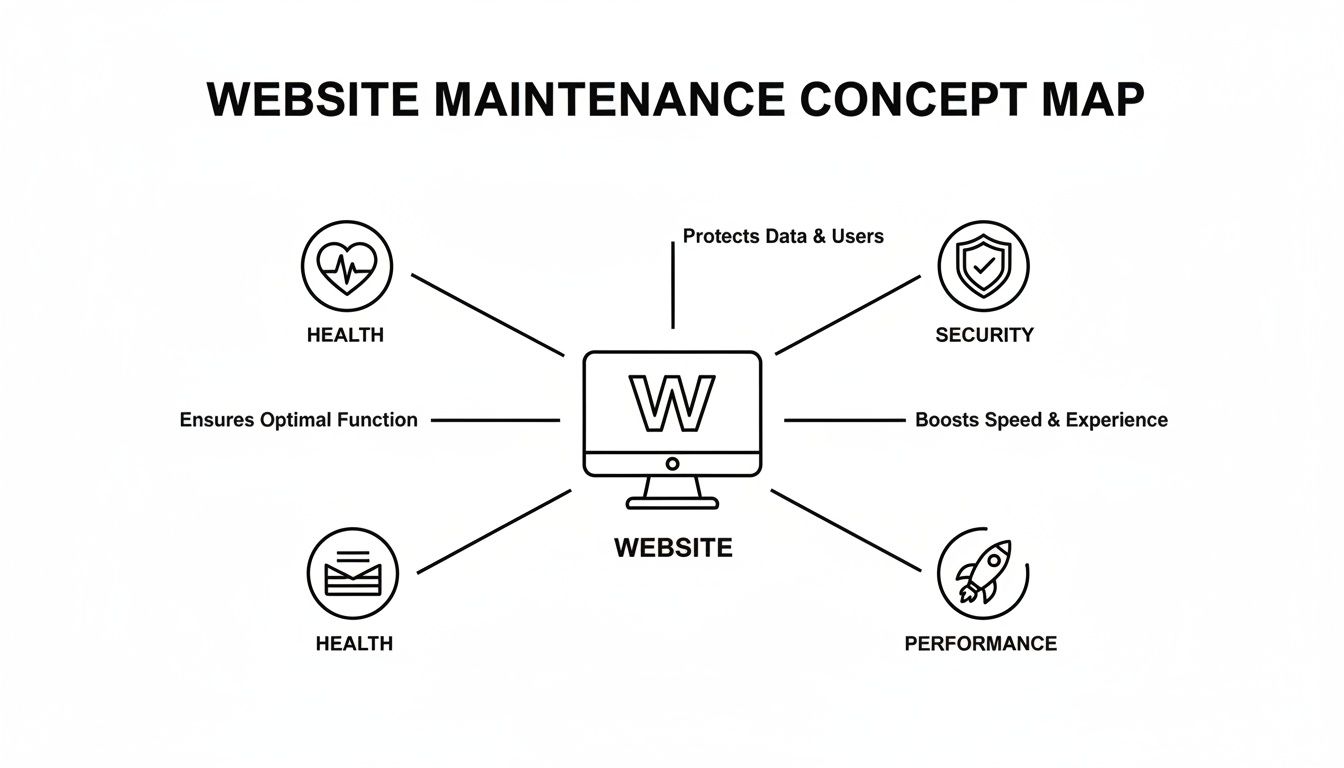
As you can see, a well-maintained website isn't about excelling in just one area. It’s about finding a continuous balance across all three. If you let one pillar weaken, the others will inevitably start to crumble too, which is why a comprehensive approach is non-negotiable.
Core Software and Security Updates
At the absolute heart of any maintenance plan are consistent software updates. This is less about getting flashy new features and more about locking down your security. Platforms like WordPress and Shopify, plus all their themes and plugins, are always evolving. When developers find a security loophole, they release an update—a patch—to seal it up.
Leaving a plugin outdated is like hanging a "welcome" sign on your front door for hackers. An eye-watering 93% of WordPress vulnerabilities are directly traced back to plugins, making timely updates your first and most critical line of defence.
A professional maintenance provider does more than just hit the 'update' button. They test every update in a safe, separate 'staging' environment first. This crucial step ensures a new plugin version doesn't clash with your theme or break a critical function, preventing the fix itself from causing a new problem. This is a standard practice for any reputable WordPress developer in Australia.
Proactive Security and Monitoring
Beyond just keeping things updated, a robust plan brings active security monitoring to the table. This means using tools like firewalls and malware scanners to actively hunt for and block threats as they happen. It’s like having a dedicated security guard patrolling your digital storefront around the clock.
These systems are always on the lookout for suspicious activity, including:
- Brute-force login attempts: Bots hammering your login page trying to guess your password.
- Malicious code injections: Sneaky attempts to slip in code that could steal customer data.
- Distributed Denial-of-Service (DDoS) attacks: Coordinated attacks designed to flood your server and knock your site offline.
This constant vigilance means potential threats are caught and neutralised long before they can do any real damage to your reputation or your revenue.
Backups, Performance, and Uptime
Even with the world's best security, disasters can happen. A server can fail, or a clever attack might slip through. That’s where reliable, off-site backups save the day. A quality maintenance package includes automated, frequent backups of your entire website—all the files and the database—stored securely on a different server. If the worst happens, you can restore a clean, working version of your site with minimal downtime.
Next up is performance optimisation, which is all about speed. This involves tasks like compressing images so they load faster, cleaning up your database to keep it nimble, and tweaking code for maximum efficiency. Given that bounce rates can skyrocket by 32% if your site takes just three seconds to load, speed is directly tied to your bottom line.
Finally, uptime monitoring makes sure your site is actually online and available. Automated checks 'ping' your website every few minutes. The moment it goes down, your maintenance team gets an instant alert and can start fixing the issue, often before you or your customers even realise there’s a problem. A huge part of this is having reliable and scalable web hosting services, as the server itself is the foundation of your site's uptime. Together, these elements form a powerful safety net, protecting your most important digital asset from every angle.
Navigating Website Maintenance Costs in Australia
So, how much should you budget to keep your website in top shape? Trying to pin down a standard cost for website maintenance packages in Australia can be a bit like asking, "How much does a car service cost?" The answer is always, "Well, it depends."
The final price tag is tied directly to your website's specific needs. A simple brochure website is like a reliable sedan that just needs a regular oil change, while a complex WooCommerce store with thousands of products is more like a high-performance vehicle requiring specialised attention. The more complex the engine, the more involved the upkeep. This is where a skilled woocommerce developer Australia can be invaluable.
Unpacking the Pricing Factors
A few key variables will always influence what you can expect to pay for a professional maintenance plan. The more moving parts your website has, the more hands-on expertise is needed to keep it running smoothly and securely.
Here’s a look at what providers are weighing up when they put a quote together:
- Platform Complexity: A custom-built site or a platform heavy with plugins—think a large WordPress or Shopify store—is naturally more work to maintain than a simple, static website.
- Website Size and Traffic: Big sites with lots of pages, content, and high visitor numbers need more powerful server resources, more frequent backups, and closer monitoring.
- Level of Support: Do you just need someone available during business hours, or is your site critical enough to require 24/7 emergency support? The guaranteed response time in your Service Level Agreement (SLA) is a huge factor in the cost.
- Scope of Services: A bare-bones plan might just cover updates and backups. A premium package, on the other hand, will often include WordPress speed optimisation Australia services, detailed SEO reporting, and proactive security measures.
Example Maintenance Package Tiers and Pricing
To give you a clearer picture, most Australian providers package their services into tiers. This setup helps you find a plan that fits your budget and technical needs, so you’re not paying for bells and whistles you don't actually use.
Here’s a table showing what you might typically find.
| Package Tier | Typical Inclusions | Estimated Monthly Cost (AUD) |
|---|---|---|
| Basic (Starter) | Core software updates, weekly backups, basic security scans, uptime monitoring. | $75 – $250 |
| Business (Growth) | All Basic features, plus daily backups, performance optimisation, monthly reports, and priority support. | $250 – $800 |
| Premium (Enterprise) | All Business features, plus real-time backups, advanced security firewall, 24/7 emergency support, and dedicated developer hours. | $800+ |
This tiered structure makes comparing different offers much more straightforward. If you're looking for more detail, you can explore a full breakdown of the factors that influence your website maintenance cost in our complete guide.
Viewing Maintenance as Insurance, Not an Expense
It's easy to see a monthly maintenance fee as just another line item on the expense sheet. A better way to think about it, though, is as an insurance policy for your most important digital asset. The proactive monthly investment is a tiny fraction of what a major disaster could cost you.
Just think about the fallout from a hacked website: the emergency developer fees to fix the mess, the lost sales from being offline, and the long-term damage to your brand's reputation. A single security breach can easily run into thousands of dollars to repair, not to mention the stress and chaos it causes.
The Australian market shows that businesses are getting the message. Recent figures show website maintenance in Australia typically ranges between AUD $200 to AUD $5,000 per month, depending on the site's complexity and support requirements. This wide range proves that businesses are increasingly willing to invest in proactive care to prevent a catastrophe down the line.
Ultimately, a good maintenance package isn’t a cost centre—it’s a smart investment in your business’s continuity, security, and your own peace of mind.
How to Choose the Right Maintenance Partner
Finding the right provider for your website maintenance packages isn't like hiring just another vendor. It's much closer to bringing on a trusted business partner. You’re looking for a team that not only gets your digital goals but also has the technical chops to protect your online investment. This single choice will shape your site's security, performance, and day-to-day reliability.

First things first, you need to verify their expertise. If your business runs on WordPress, you absolutely need a WordPress expert Australia. The same goes for eCommerce – a Shopify store needs a seasoned Shopify expert Australia who lives and breathes the platform's quirks. A generalist just won't have the deep-seated knowledge to troubleshoot tricky, platform-specific problems when they inevitably crop up.
Evaluating Technical Expertise and Processes
Beyond knowing the platform, you need to get a feel for how they actually work. The real difference between a professional service and someone just ticking boxes lies in their processes for handling updates, security threats, and emergencies. A reliable partner will have a clear, documented plan for every critical task.
To really vet a potential partner, ask them some direct questions about their workflow:
- Update Process: Do you test plugin and theme updates on a separate staging server before pushing them live? This is non-negotiable; it’s the only way to prevent a routine update from crashing your entire website.
- Security Protocols: What specific tools are you using for malware scanning and firewall management? And more importantly, what’s the game plan if a security breach happens?
- Backup and Recovery: How often do you take backups, where are they stored (the answer should always be off-site), and what's your guaranteed time to restore the site if it goes down?
These aren't just technical questions; they reveal a provider’s commitment to best practices. A confident, detailed answer is a very good sign, while vague responses should set off alarm bells.
Communication, Reporting, and SLAs
All the technical skill in the world means nothing without clear communication. Your maintenance partner should send you regular, easy-to-digest reports showing what work they’ve done. That transparency is what builds trust and proves you’re getting real value for your money.
A Service Level Agreement (SLA) is your most important document. It’s not just a contract; it’s a written promise that defines guaranteed response times, uptime commitments, and the exact scope of support. Without a clear SLA, you have no guarantee of how or when issues will be addressed.
Finally, think about how this fits into your bigger picture. For marketing agencies, finding a great maintenance provider is a strategic way to outsource digital marketing tasks and free up your team to focus on client growth. Partnering with a white label WordPress agency even lets you resell expert maintenance under your own brand, opening up a new revenue stream without the overhead.
By properly vetting their expertise, processes, and communication, you’ll find a partner who does more than just maintain your site—they’ll actively contribute to its long-term success.
The Agency Playbook for White Label Maintenance
For any marketing or web development Australia agency, launching a client's website is just the beginning. The real work starts after go-live, but building an in-house technical team to handle ongoing care is a massive operational headache and a serious financial drain. This is where white label website maintenance steps in as a powerful strategy for growth.
Think about it: you could offer expert, comprehensive maintenance services to every client, all under your own brand, without hiring a single developer. That’s the genius of the white label model. You find a specialist partner—like a dedicated white label Shopify agency—who handles all the technical nitty-gritty behind a curtain.
Your agency owns the client relationship, you set the price, and you get all the credit. Your partner does the heavy lifting, from security scans to plugin updates. It's the smartest way to instantly expand your services and create a predictable, recurring revenue stream.
Unlocking New Revenue Streams Without the Overhead
The real appeal of reselling website maintenance packages is just how simple and profitable it is. You're not just tacking on another service; you're building a scalable profit centre from day one. The model couldn't be more straightforward: your white label partner gives you a fixed wholesale price, and you sell it to your clients at whatever margin you choose.
This approach gives your agency some serious advantages:
- Guaranteed Profit Margins: With your costs fixed, you know exactly how much you’ll make on every single maintenance plan you sell. No surprise expenses or ballooning salaries eating into your bottom line.
- Zero Technical Headaches: Your team gets to stay focused on what they do best—design, marketing strategy, and growing client accounts. Meanwhile, technical experts handle the complex, time-consuming work of updates, backups, and security.
- Increased Client Stickiness: When you offer ongoing maintenance, you become an indispensable part of your client's business long after the project launch. This makes them far less likely to ever look elsewhere for support.
By partnering with a specialist, your agency can immediately say "yes" to more complex client needs. You gain the capabilities of a full-scale development team without the associated costs, risks, or management burden.
This model allows you to tap into a booming market. The broader Australian services market shows a clear trend towards outsourcing specialised tasks. In fact, the Australia on-demand professional services market is projected to grow at a compound annual growth rate of 18.30% between 2026 and 2035. This signals that Australian businesses are more comfortable than ever trusting experts to handle critical functions, a trend you can explore further with research into Australia's on-demand services market.
Choosing Your White Label Partner
Picking the right partner is absolutely critical to making this work. You need a team that feels like a seamless extension of your own. When you're weighing up potential providers, always prioritise specialists over generalists. If most of your clients run on WordPress, find a partner with deep expertise in WordPress development Australia.
Likewise, if you serve eCommerce clients, partnering with a white label Shopify expert ensures you can offer the highly specialised support they need. This focus guarantees a higher quality of service, which reflects directly on your agency's brand and reputation. A great place to start is by looking into providers who offer tailored WordPress maintenance services designed specifically for agencies.
Your ideal partner should provide clear communication, transparent reports you can rebrand for your clients, and a rock-solid process for handling emergencies. By outsourcing the technical work to a specialist you trust, you can confidently build a profitable maintenance division, deepen client loyalty, and set your agency up for long-term, scalable growth.
Shifting From Reactive Fixes to Proactive Growth
The best defence has always been a good offence. For years, website maintenance was stuck in a reactive ‘break-fix’ cycle. Businesses would only call for help after their site crashed, got hacked, or a critical feature stopped working. This approach is like waiting for a flat tyre before you even think to check your air pressure—it’s stressful, expensive, and guarantees downtime when you can least afford it.
Thankfully, that entire model has been turned on its head. Modern website maintenance packages have moved away from just reacting to problems. Instead, they’re all about a proactive, strategic approach focused on prevention and growth. It's no longer about fixing what’s broken; it’s about making sure things never break in the first place. This is where the real value is for any business that takes its online presence seriously.
The Power of Predictive Care
This shift isn't unique to the web world. It mirrors a broader trend you see across many industries: the move towards predictive maintenance. Think about a factory. Instead of waiting for a vital machine to grind to a halt, manufacturers use constant monitoring and data to predict when a part might fail and replace it beforehand.
Modern website care, provided by a reliable WordPress agency Australia, works on the exact same principle. It uses advanced tech to keep a constant eye on your site, catching potential security holes or performance dips long before they ever affect a single visitor.
This proactive mindset is quickly becoming the standard for Australian businesses. The predictive maintenance market in Australia generated USD $226.7 million in 2023 and is expected to rocket to USD $1,615.3 million by 2030, fuelled by a massive 22.86% annual growth rate. This data clearly shows that businesses value preventing problems over scrambling to solve them, a trend you can learn more about by exploring the Australian predictive maintenance market.
For agencies, this is a powerful way to frame the conversation when upselling clients from a basic plan to a high-value retainer. You're no longer just selling a technical service; you're offering a strategic partnership that actively protects and improves their most valuable digital asset. This builds incredible trust and turns a one-off project into a long-term relationship.
To truly shift from reactive fixes to proactive growth, it pays to take a holistic view of your business's online presence. Discover further strategies for growing a small business in Australia to ensure your entire operation is built for sustainable success. By investing in proactive care, you’re not just buying insurance—you’re laying the foundation for a more resilient and profitable future.
Common Questions About Website Maintenance
Even when you understand the value of a good maintenance plan, a few practical questions always seem to pop up. It's completely normal. Let's walk through the most common ones so you can feel confident about your decision.
How Often Does My Website Need Maintenance?
The honest answer? It depends on your website's complexity and how much traffic it gets. A busy eCommerce store with hundreds of daily transactions needs a lot more hands-on attention than a simple five-page business site.
That said, the undisputed industry standard is monthly professional maintenance. A monthly check-in is the sweet spot. It's frequent enough to catch security holes before they turn into major breaches and to apply software updates before they stack up and cause conflicts. This rhythm keeps your site secure, fast, and running smoothly.
Can I Just Do My Own Website Maintenance?
It’s tempting to try and save a few dollars by doing it yourself, and sure, anyone can click the "update" button on a plugin. But the real question you have to ask is: what's your plan when that simple update crashes your entire site?
A professional service is about so much more than just clicking buttons. They use staging sites to test updates in a safe environment first. They have sophisticated tools for security scans that go far deeper than a free plugin. Most importantly, they have the experience to fix complex problems in minutes, not days. The time you’d sink into doing this properly is massive, and the risk of getting it wrong—think lost sales from downtime or a permanent data loss—is just too high for most businesses. If you need help, it's better to hire WordPress developer Australia professionals to manage it correctly.
A maintenance plan is for upkeep and protection, not for building new things. Think of it like servicing your car's engine – that’s a separate job from asking the mechanic to install a new sound system.
What Is Not Included in a Standard Package?
This is a brilliant question because it's all about managing expectations. A standard website maintenance package is laser-focused on keeping your existing website healthy, secure, and performing at its best. It’s not a bucket of hours for new development work.
Typically, these tasks fall outside a standard plan and are quoted as separate projects:
- New Feature Development: Building a custom calculator or adding an online course platform.
- Major Redesigns: Completely changing the look, feel, and layout of your website.
- Content Creation: Writing blog posts, adding new service pages, or sourcing images.
- SEO Strategy and Execution: While solid maintenance is the foundation of technical SEO, running a full-blown SEO campaign is its own specialised service. A team specialising in Shopify SEO Australia would handle this.
Knowing this distinction from the start helps you budget properly and appreciate maintenance for what it truly is: essential insurance for your most important digital asset.
At White Label WordPress, we provide expert, behind-the-scenes maintenance that lets your agency offer comprehensive support under your own brand. Build recurring revenue and client loyalty without the technical overhead. Discover our white label solutions.