
Think of a website maintenance service as the dedicated pit crew for your digital storefront. It’s the essential, ongoing work that keeps your site secure, lightning-fast, and running smoothly long after the initial launch. It's really all about proactive care—spotting and fixing the small cracks before they turn into catastrophic failures that could torpedo your brand and your bottom line.
Why Website Maintenance Is Non-Negotiable
Getting a new website live is a massive achievement, but it's just the starting line, not the finish. A classic mistake is to treat a website like a glossy brochure—once it's printed, you're done. But a website isn't static. It's a living, breathing asset that needs constant attention to perform well and actually deliver a return on your investment.
Skipping this crucial upkeep is like buying a brand-new car and then never bothering with an oil change or rotating the tyres. Sure, it runs perfectly at first. But under the hood, performance starts to lag, security risks pop up, and sooner or later, you're stranded on the side of the road with a major breakdown. A proactive website maintenance service is what stops this from happening.
The Four Pillars of Proactive Maintenance
At its heart, website maintenance isn't one single job. It’s a suite of regular tasks designed to protect and optimise your digital real estate. These tasks all fall under four crucial pillars that support your site's overall health.
- Security: This is your 24/7 guard duty. It means constantly scanning for threats, patching vulnerabilities, and managing firewalls to keep hackers and malware out. One little breach can shatter customer trust and cost a fortune.
- Updates: The software that runs your website—whether it's the core CMS like WordPress, its plugins, or the theme—is always evolving. Regular updates are non-negotiable; they fix bugs, close security gaps, and keep everything playing nicely together.
- Backups: This is your get-out-of-jail-free card. With regular, automated, and off-site backups, you have a safety net. If an update goes wrong or you get hit by an attack, you can restore your site in minutes, not days.
- Performance: A slow website is a dead website. Performance maintenance involves everything from database optimisation and image compression to code tweaks that ensure snappy load times. After all, around 40% of users will bounce if a site takes more than three seconds to load.
From Cost Centre to Strategic Partnership
For agencies, offering website maintenance is more than just an add-on; it’s a smart business decision. It helps you pivot from a one-and-done project provider to a long-term, trusted partner in your client’s journey. This creates a steady, predictable revenue stream that smooths out cash flow and boosts your client lifetime value. When you understand the key elements of modern website design, you realise just how critical consistent upkeep is to preserving that initial investment.
By framing maintenance as a proactive strategy instead of a reactive cost, you're not just fixing problems—you're preventing them. You're safeguarding your client's investment and positioning yourself as an indispensable advisor. It's about keeping things from breaking in the first place, and that is the foundation of any solid digital strategy.
What's Really Inside a Website Maintenance Plan?
A professional website maintenance service is far more than just a vague promise to "keep an eye on things." It’s a specific, disciplined set of tasks designed to protect and enhance a valuable digital asset. The best way to think about it is like a scheduled service for a high-performance car. Every single check is deliberate, systematic, and absolutely crucial for ensuring the vehicle runs smoothly, safely, and at peak efficiency.
Just as a skilled mechanic follows a detailed checklist, a proper maintenance plan breaks down website care into distinct, high-value actions. It's not about waiting for something to break; it's a proactive strategy covering everything from fortifying security to boosting site speed. Let’s pop the bonnet and have a look at the core components that make a maintenance plan truly effective.
Proactive Security Monitoring
First up, and arguably the most important, is security. This isn’t about scrambling to fix a hack after the damage is done; it's about building a fortress to prevent one from ever happening in the first place. Think of proactive security monitoring as a 24/7 digital security guard for your client's website, constantly patrolling for any hint of suspicious activity.
This involves several critical layers of protection:
- Automated Scans: Regular, automated scans tirelessly search for malware, viruses, and any other malicious code that might have been snuck into the site's files.
- Firewall Management: A Web Application Firewall (WAF) acts as a bouncer at the door, filtering out malicious traffic and common attack patterns before they can even reach the website.
- Vulnerability Patching: The service actively monitors for newly discovered weak spots in the website’s software and applies patches immediately to close those security gaps for good.
This constant vigilance isn't just a nice-to-have anymore. The sheer volume of automated attacks makes professional oversight essential, creating a strong business case for services like white label WordPress maintenance in Australia. The numbers don't lie: nearly 13,000 WordPress websites are hacked every single day around the world. That works out to about nine sites compromised every minute, which really drives home why professional security is no longer an optional extra.
Critical Software Updates
A website is built on layers of software—the core system (like WordPress), various plugins that add functionality, and a theme that controls the design. Each of these moving parts receives regular updates from its developers to fix bugs, roll out new features, and, most importantly, patch security holes. A huge part of any website maintenance service is managing this update process with precision.
Putting off updates is one of the biggest risks a site owner can take. An outdated plugin can quickly become a wide-open backdoor for attackers. But simply clicking the "update" button can be risky too, as it can sometimes cause conflicts that break the site. Professional maintenance from a partner like a white label WordPress agency involves a safe, controlled process: testing updates on a staging server first before pushing them to the live site to guarantee a smooth, error-free transition.
A well-managed update protocol is the digital equivalent of routine vaccinations. It methodically protects the website from known threats and ensures all its interconnected parts continue to function together in a healthy, stable ecosystem.
Bulletproof Backups and Recovery
No matter how strong your security is, you always need a "what if" plan. That's where backups come in. They are the ultimate safety net, providing a complete copy of the website that can be restored if anything goes wrong—from a server crash or a nasty hack to a simple human error.
A truly bulletproof backup strategy isn't just about having a single copy stashed away. It's a systematic approach.
- Frequency: Backups should be taken daily, or even more often for dynamic sites like e-commerce stores, to minimise any potential data loss.
- Location: Copies must be stored "off-site" on a separate, secure server. Storing backups on the same server as the live site is like keeping your spare house key under the doormat—if one is compromised, so is the other.
- Redundancy: Multiple versions of backups should be kept, allowing you to restore the site from various points in time.
- Recovery Plan: Having a backup is only half the battle. A good maintenance plan includes a tested recovery process to get the site back online quickly and efficiently, keeping downtime to an absolute minimum.
Performance Optimisation
Finally, a comprehensive plan focuses on speed and user experience. A slow, clunky website doesn't just frustrate visitors; it gets penalised by search engines. Performance optimisation is the ongoing process of fine-tuning the site to make sure it loads as fast as humanly possible.
This usually involves tasks like:
- Database Cleaning: Over time, a website's database can get bloated with digital clutter like old post revisions, spam comments, and drafts. Regularly cleaning this out makes the database more efficient, leading to faster load times.
- Image Compression: Large, unoptimised images are one of the biggest culprits of slow websites. Maintenance involves compressing new and existing images without sacrificing visual quality.
- Caching Implementation: Caching stores static versions of a site's pages. This allows them to be delivered to visitors almost instantly, without the server needing to rebuild the page from scratch every single time.
Each of these four pillars—security, updates, backups, and performance—works in concert to create a stable, secure, and high-performing digital asset. This is the real anatomy of a professional service that delivers tangible, measurable value to clients.
How White Label Services Fuel Agency Growth
For a lot of digital agencies, offering a proper website maintenance service can feel like a classic catch-22. You know your clients desperately need it, and that sweet recurring revenue is hard to ignore. But the thought of building an in-house team to manage it? That's a whole other beast, involving huge overheads, non-stop training, and the notoriously difficult hunt for good technical people.
This is precisely where smart agencies are finding a massive strategic advantage. Instead of building it all from the ground up, they're partnering with white label providers. Think of it as a turn-key solution that lets you plug in a fully-staffed, expert maintenance department overnight, without hiring a single person.
It's like having a team of seasoned WordPress or Shopify developers on standby, ready to jump on every update, security patch, and performance tweak—all flying your agency's flag. Whether it's for white label WordPress or white label Shopify projects, that's the real magic of a white label partnership.
This visual breaks down the hierarchy of essential maintenance tasks. It shows how critical functions like security and updates are all built on the non-negotiable foundation of solid backups.
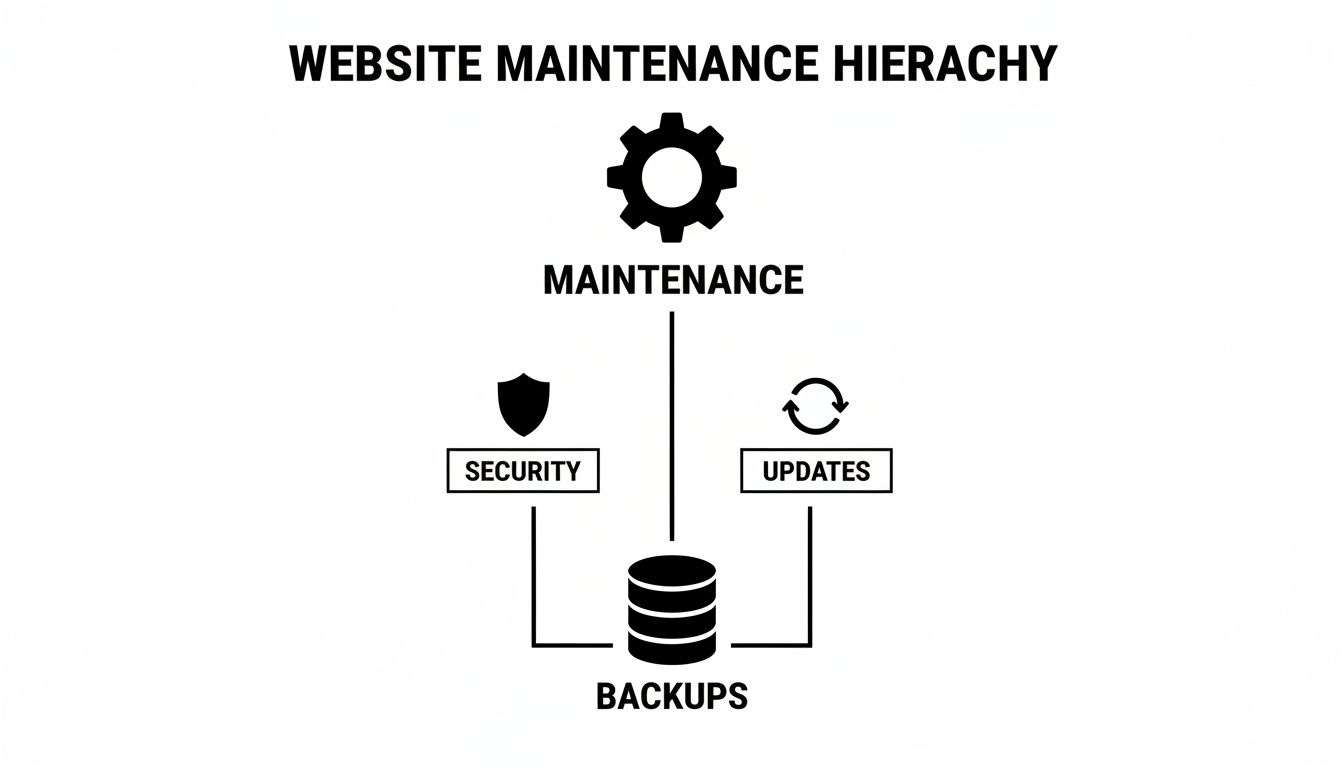
It’s a simple but powerful reminder: without reliable backups, even the best security measures are a gamble. It really highlights how interconnected a truly comprehensive service is.
Achieve Profitability and Scalability
One of the biggest draws of a white label model is the financial predictability it brings. When you work with a white label WordPress development provider or a Shopify agency Australia, you get their services at a fixed wholesale cost. You then simply add your own margin and resell these services to your clients, locking in a predictable profit on every single plan you sell.
No surprise salary costs, no budget blowouts for software licences. This structure completely sidesteps the financial drain of running an in-house team and turns website maintenance from a potential headache into a reliable, high-margin revenue stream.
Better yet, this model is built to scale with you.
- When things get busy: You can onboard a dozen new maintenance clients without breaking a sweat. Your white label partner just absorbs the extra workload.
- During a quiet spell: You’re not left paying for staff to sit around. Your costs naturally scale down with demand, keeping your agency lean and efficient.
For a growing agency in Australia that needs to stay agile, that kind of flexibility is a total game-changer.
A white label partnership isn't just about outsourcing tasks; it's about outsourcing complexity. It allows you to expand your service offerings and scale your revenue without scaling your operational headaches, giving you a direct path to more profitable growth.
Focus on Your Core Strengths
Let's be honest. Every hour your project manager spends trying to fix a broken plugin is an hour they're not spending on what they do best—the strategic work that actually grows your agency. By handing off the technical heavy lifting to a specialist partner, you free up your team to focus on high-value activities.
Your designers can get back to designing beautiful interfaces. Your strategists can map out brilliant campaigns. Your account managers can build stronger client relationships. Instead of being dragged into reactive, technical firefighting, your team can proactively drive the results that keep clients happy and bring new ones through the door.
Partnering with a provider for white label WordPress maintenance in Australia gives you access to expert-level talent on demand. You get the skills of a senior wordpress developer australia or a shopify expert australia without the recruitment nightmares and eye-watering salary costs. It means you can confidently sell complex, robust solutions, knowing you have the technical firepower to deliver perfectly, every time—all while presenting a single, unified brand to your clients.
How to Choose the Right White Label Partner
Picking a white label partner is a massive decision. You’re not just handing off a to-do list; you're putting your client relationships and hard-won reputation in someone else's hands. Get it right, and they become a seamless extension of your team. Get it wrong, and you’re looking at chaos, broken client trust, and a real hit to your business.
This isn’t something you can decide by just glancing at a price sheet. It’s about finding a partner whose technical skills, communication style, and way of working genuinely align with your own agency’s standards. A real partnership, whether for white label Shopify development or WordPress development Australia, is built on reliability, transparency, and a mutual drive to deliver great work.
Evaluating Technical Expertise and Processes
First things first, you need to look under the bonnet. Any provider can talk a big game about their expertise, but you have to dig into their actual processes and skills. A top-notch partner will have solid, documented procedures for all the critical tasks that make up a professional website maintenance service.
Get ready to ask some direct questions.
- Update Procedures: How do they actually handle updates for plugins, themes, and core software? The only right answer involves testing everything on a staging server first. Pushing updates straight to a live site is just asking for trouble.
- Emergency Response: What's their battle plan when a site gets hacked or the server goes down? You need to know their guaranteed response times and the exact steps they’ll take to get things back online, fast.
- Specialised Skills: Do they have real specialists on their team? For example, if WordPress is your bread and butter, you’ll want to know you have access to a skilled
wordpress developer australiawho gets the local landscape.
Communication Protocols and Support Systems
Technical chops are only half the story. The way a partner talks to you and supports your team is just as crucial. In a white label relationship, they are your crew behind the curtain, which means clear, efficient communication is absolutely non-negotiable.
A great white label partner over-communicates. They are proactive with updates and easy to reach when you need them. Weak communication from your partner will always trickle down to your clients, and that’s a risk you just can't take.
Look for a partner with a proper, centralised support system—think a dedicated project portal or a ticketing platform. This is how you ensure requests are logged, tracked, and properly resolved without anything getting lost in a messy email inbox. If their support system is just a bunch of scattered emails or chat messages, run the other way.
Transparent Reporting and Accountability
Finally, trust is built on transparency. A reputable white label provider will give you regular, detailed reports that show you exactly what work they’ve been doing. These aren’t just for your files; they're gold. You can rebrand them and send them to your clients to prove the ongoing value of their maintenance plan.
These reports should clearly lay out:
- Completed Tasks: A clear log of all updates, backups, and security scans.
- Performance Metrics: Hard data on site speed, uptime, and other key performance stats.
- Security Status: A summary of any nasty threats that were detected and blocked.
This level of detail keeps your partner accountable and gives you the ammo you need for meaningful, data-driven chats with your clients about their website's health. The Australian market for these services is strong, with website maintenance costs in Australia ranging anywhere from $200 to over $5,000 a month depending on the site's complexity. Partnering with a provider who gives you crystal-clear reporting helps you justify that investment. Plus, making the right choice frees up your team to focus on strategy, which is the whole point when you outsource digital marketing tasks.
How to Structure Your Maintenance Packages and Pricing
If you want to successfully sell a website maintenance service, your packages need to be crystal clear about the value you're offering. Clients have to immediately see what they’re getting for their money and why it's a smart business decision.
The most effective way I've seen this done is with a tiered pricing structure. It just works. By offering a few distinct packages, you let clients self-select the option that best fits their needs and budget, which makes the whole sales process smoother. A good old three-tier system—think 'Essential,' 'Growth,' and 'Performance'—is a proven model. Each level builds on the one before it, adding more value for a higher price and naturally guiding clients toward the best solution for them.
Designing Your Tiered Packages
Crafting compelling tiers is all about being strategic with what you include. You want your entry-level plan to feel like an absolute no-brainer, while making your higher-end packages irresistible for clients who are serious about their online presence.
Here’s a typical breakdown that works well:
-
The Essential Plan: Think of this as the basic 'site insurance' every website owner needs. It covers the non-negotiables: daily backups, weekly software updates for the core, themes, and plugins, plus constant uptime monitoring and security scans. This is the baseline protection that keeps the lights on.
-
The Growth Plan: This one is for clients who are actively looking to improve their site, not just maintain it. It includes everything from the Essential plan, but you’ll also throw in performance optimisation (like database cleaning and image compression), monthly health reports, and maybe a small block of time for content updates or minor fixes.
-
The Performance Plan: This is your premium, all-in-one package for e-commerce stores and businesses that rely heavily on their website for revenue. It’s got all the features from the other plans, plus proactive performance monitoring, SEO health checks, conversion rate optimisation tips, and priority support for when they need you most.
Don't pitch these as costs. Frame them as investments. The Essential plan protects their asset. The Growth plan improves it. The Performance plan helps it make more money. This shifts your role from a simple technician to a genuine strategic partner in their success.
Calculating Your Pricing for Profit
Since you're using a white label partner to do the heavy lifting, pricing is a fairly straightforward (but crucial) calculation. Your goal is to set a retail price that gives the client fantastic value while locking in a healthy, predictable profit margin for your agency.
A good rule of thumb is to mark up the white label cost by 50% to 100%. So, if your provider charges you $80 a month for a plan, you’d sell it to your client for somewhere between $120 and $160 per month. This simple formula makes sure you're profitable right out of the gate. For a deeper dive into setting the right price, check out our guide on website maintenance costs.
The opportunity here in Australia is massive. WordPress is the undisputed king of content management systems, powering 43.6% of all websites globally as we head into 2025. Locally, that translates to 594,645 websites built on WordPress, which is a huge pool of potential clients who need exactly this kind of service. The latest Australian market statistics really put the scale of the WordPress ecosystem into perspective.
Proven Sales Tactics for Maintenance Plans
How you sell your maintenance plans is just as important as what's in them. Stop treating maintenance as an optional extra and start baking it right into your client process.
-
Bundle It with Every New Project: The absolute best time to sell a maintenance plan is when you're selling the website itself. Frame it as the final, essential step of the project. It's like handing over the keys to a new car and including the first year of scheduled servicing—it just makes sense.
-
Frame It as 'Site Insurance': This analogy is incredibly effective because everyone gets it. A client wouldn't leave a valuable physical asset uninsured, so why on earth would they leave their most important digital one completely unprotected?
By structuring your offers clearly, pricing for solid profit, and embedding maintenance into your sales DNA, you can turn it from a nice little add-on into a core, high-margin revenue stream for your agency.
Got Questions About Website Maintenance? You're Not Alone.
Even when you lay out the benefits clearly, clients (and even agencies) will always have questions about website maintenance. That’s perfectly normal. It’s a good sign, actually—it means they’re taking it seriously.
Let’s walk through the most common questions that pop up. Getting these answers straight will help you build trust and show why proper maintenance isn't just a cost, but a critical investment.
How Often Does a Website Really Need Maintenance?
The honest answer? All the time. Good website maintenance isn't something you do once a month and forget about. It's an ongoing process, kind of like the security team at a shopping centre—they're always on patrol, not just on Tuesdays.
But the tasks themselves happen on different schedules. Here’s a typical breakdown:
- Daily: The absolute essentials, like security scans and backups, need to happen every single day. For an e-commerce store, this is non-negotiable. Losing a day's worth of orders because a backup failed is a nightmare no one needs.
- Weekly: This is the sweet spot for checking and applying software updates for the CMS core, plugins, and themes. And a quick reminder: this should always be done on a staging site first. Pushing a bad update live is a rookie mistake that can take a whole site down.
- Monthly: This is when you can dig a little deeper. We’re talking about performance tune-ups, database clean-ups, and running detailed reports to make sure everything is humming along nicely.
A professional maintenance service automates and manages this entire rhythm, so you can be sure nothing ever slips through the cracks.
Can't My Clients Just Do This Themselves?
Technically, yes. In the same way, I could technically try to fix the plumbing in my own house. But the real question is, should I?
The risk is huge, and it's a terrible use of my time. The same goes for your clients. Professional maintenance isn't just about clicking the 'update' button. It requires specialised tools, a proven process, and the experience to know what to do when an update inevitably breaks something.
For a business owner, every hour they spend trying to figure out a plugin conflict is an hour they’re not spending on sales or marketing. For an agency, trying to juggle this for dozens of clients is a direct path to burnout. That’s where a partner like a white label wordpress agency becomes a lifesaver, letting you deliver top-tier service without stretching your own team thin.
It's not about whether a client can do it, but whether they should. Outsourcing to a specialist means the job gets done right, protecting their most valuable digital asset while they focus on running their business.
Wait, Isn't This What My Web Hosting Is For?
This is probably the biggest point of confusion we see, so it’s vital to get it clear. Web hosting and website maintenance are two very different things that simply work together.
Here’s an analogy I like to use:
Web hosting is like renting the block of land for your shop. It provides the physical space and connects the power and water. Without it, your shop simply can't exist.
Website maintenance is the team you hire to run the shop. It's the security guard at the door, the crew that cleans up every night, the technician who fixes the air-conditioning, and the manager who makes sure the shelves are stocked. They actively keep the place safe, clean, and running smoothly—things the landlord just doesn’t do.
Your host provides the server. Your maintenance plan takes care of everything on that server.
How Should We Price Our Maintenance Plans?
Nailing your pricing comes down to a simple formula: your wholesale cost, your desired profit, and the value you're providing. A markup of 50% to 100% on what you pay your white label partner is a solid, industry-standard starting point.
For instance, if a great plan from your white label wordpress maintenance australia partner costs you $70 a month, you could confidently price it for your client somewhere between $140 and $200.
It often helps to create a few tiers (think Basic, Pro, Elite) to match different client needs. But no matter the price, always frame it as what it is: a small, essential investment to protect their most important sales and marketing tool.
At White Label WordPress, we help agencies across Australia offer expert WordPress and Shopify maintenance services, without having to build a new department. You can instantly add a new, reliable revenue stream with guaranteed profit margins, and let your team get back to what they do best. Find out how our white label partnerships work and start growing your agency today.