
Think of website support and maintenance as everything that happens after a site goes live to keep it running smoothly, securely, and effectively. It’s the proactive, ongoing work that protects a site from digital threats, keeps users happy, and ensures it remains a valuable asset. For Australian digital agencies, packaging this up as a service is a proven way to build a stable, recurring revenue stream.
Why Website Maintenance Is Your Agency's Best Growth Strategy
If you're still relying solely on one-off projects, you're likely familiar with the feast-or-famine cycle. It's a tough way to run a business, making cash flow unpredictable and long-term planning almost impossible. That's precisely why the smartest agencies in Australia are shifting their focus to make website support and maintenance a core part of their business model.
This isn't just about locking in predictable income, though. It’s about changing the very nature of your client relationships. You stop being a one-and-done vendor and become an indispensable partner, the trusted guardian of one of their most critical marketing assets.
Protecting Your Client's Investment
For your clients, ongoing maintenance isn't just another line item on an invoice; it's an insurance policy for their digital storefront. A professional website is a major investment, but without proper care, its value can plummet. To really sell this service, you first need to get your head around exactly what web maintenance and support entails.
Here’s where you deliver tangible value:
- Security: Regular updates to platforms like WordPress and their plugins are your first line of defence, patching the security holes hackers love to exploit. This is a key service for any WordPress agency in Australia.
- Performance: A slow website kills conversions and SEO rankings. Consistent optimisation keeps the site snappy and responsive.
- Functionality: You’re on the lookout for broken links, contact forms that don’t submit, and all the little glitches that frustrate users and lose your clients business.
The Rising Cost of Neglect in Australia
Down here in Australia, the conversation has shifted. Website support is no longer a 'nice-to-have'; it's a direct response to very real, measurable financial risks.
A recent report from the Office of the Australian Information Commissioner highlighted a sobering statistic: 1,113 notifiable data breaches. That's a staggering 25% jump in just one year, with many breaches traced back to compromised websites. This puts a huge responsibility on agencies managing WordPress and Shopify sites.
At the same time, local businesses are investing anywhere from AUD 5,000 to AUD 25,000 on a new website build, plus thousands more in ongoing costs. Letting that asset fall into disrepair isn't just careless—it’s throwing good money after bad.
When you frame website maintenance as an essential partnership, you're not just selling a technical add-on. You're selling peace of mind, risk mitigation, and the ongoing success of your client's business online. And in the process, you're building a more stable and profitable future for your own agency.
How To Package And Price Your Maintenance Services
When it comes to creating compelling website support packages, the trick isn't to just list a bunch of technical tasks. You need to sell solutions to your client's real-world problems. Ditching the generic, one-size-fits-all approach lets you build offerings that clients actually understand and value, making your service an easy 'yes'.
The key is to design tiered packages that map directly to the different stages of a client's business journey. A good way to think about it is 'Essential Care' for foundational security, 'Growth Pro' for businesses that are actively scaling, and 'Performance Plus' for those who rely heavily on their website for revenue.
This simple framework helps you position a website for what it truly is: a valuable investment that carries inherent risks. Your maintenance service is the essential protection that safeguards it.
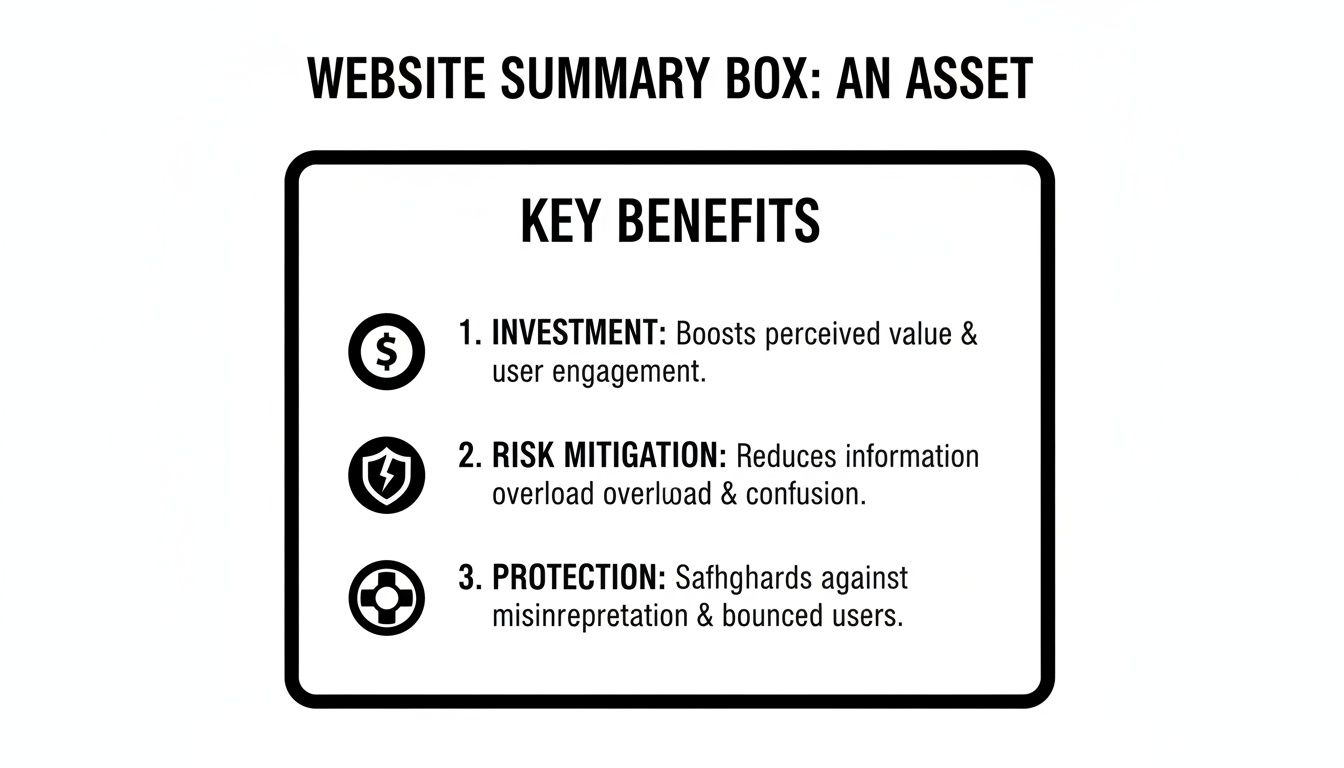
This shift in perspective changes the conversation from a grudge purchase to a smart investment, positioning your ongoing support as a critical part of their business strategy.
Designing Your Service Tiers
Let’s get practical and break down what you should include at each level. Remember, the goal is to create clear value and differentiation. Avoid simply listing the plugins you'll update; focus on the outcomes you deliver.
- Essential Care: This is your non-negotiable baseline. Think core security, daily or weekly backups, and all the necessary software updates. You can frame this as the "peace of mind" package that protects their initial investment from common threats and technical decay.
- Growth Pro: This tier is built for clients who are actively using their site for marketing and lead generation. It includes everything in 'Essential Care' but adds in performance monitoring, uptime checks, and a small bank of monthly support hours for minor content changes or bug fixes.
- Performance Plus: Aimed squarely at e-commerce stores or lead-gen powerhouses, this premium tier is all about proactive optimisation. It bundles all previous services with advanced features like conversion rate optimisation (CRO) insights, advanced security scanning, and dedicated, prioritised support.
This tiered structure makes it incredibly easy for a client to self-select the plan that best fits their needs and budget. It also creates a natural upsell path as their business grows. Whether you're a WordPress agency in Australia or a Shopify expert in Australia, this model just works.
Sample Website Maintenance Service Tiers
To give you a clearer picture, here’s a sample table outlining how these tiers could look. This structure helps clients instantly see the added value as they move up the plans.
| Feature | Essential Care (AUD 150/mo) | Growth Pro (AUD 450/mo) | Performance Plus (AUD 900+/mo) |
|---|---|---|---|
| Core Software Updates | ✔️ Weekly | ✔️ Weekly | ✔️ Weekly |
| Off-site Backups | ✔️ Daily | ✔️ Daily | ✔️ Daily (Real-time option) |
| Security Monitoring | ✔️ Basic | ✔️ Advanced | ✔️ Advanced + Malware Removal |
| Uptime Monitoring | ❌ | ✔️ 24/7 | ✔️ 24/7 |
| Performance Scans | ❌ | ✔️ Monthly | ✔️ Weekly |
| Support Hours | ❌ | 1 hour/month | 3 hours/month |
| Client Reporting | Monthly Basic | Monthly Detailed | Monthly Strategic |
| CRO & UX Insights | ❌ | ❌ | ✔️ Quarterly |
| Priority Support | ❌ | ❌ | ✔️ Yes |
| Target Client | Brochure sites, startups | Growing businesses, marketers | E-commerce, high-traffic sites |
This is just a starting point, of course. You can and should tweak the features and pricing to fit your agency’s specific skills and your clients' unique demands.
Setting The Right Price
Pricing your packages is always a balancing act. You have to consider market rates, the value clients perceive, and your own profit margins—especially if you're using a white label WordPress maintenance partner. The good news is that here in Australia, the market has matured. Clients are starting to understand that ongoing support is just a standard cost of owning a serious business asset.
Local pricing data shows that support and maintenance now make up a substantial chunk of total website ownership costs. One guide suggests ongoing care can range anywhere from AUD 200 to AUD 5,000 per month, depending on the site's complexity. Even smaller sites often budget AUD 50–1,000 monthly for core tasks like hosting, updates, and backups.
When you think about a professional business website costing AUD 7,000–10,000 to build, it's easy to see how ongoing care can represent 20–40% of the multi-year cost. You can dive deeper into the numbers to fully understand the total website maintenance cost.
Don't compete on being the cheapest. Compete on being the most valuable. When you clearly articulate the risks of neglect—downtime, lost sales, data breaches—your packages transform from an expense into an investment in stability.
Choosing A Pricing Model
There are two main models that work exceptionally well for agency services, each with its own pros and cons.
Monthly Retainer Model
This is the most common and straightforward approach. Clients pay a fixed fee each month for a clearly defined set of services. It’s a win-win: you get predictable revenue for your agency, and the client gets a predictable cost. This model is perfect for your 'Essential Care' and 'Growth Pro' tiers.
Value-Based Tiers
For your 'Performance Plus' package, it’s worth considering value-based pricing. Instead of just covering your costs and adding a standard markup, you tie the price directly to the value and ROI you deliver. For a WooCommerce developer Australia managing a high-volume online store, a maintenance package that includes conversion optimisation could be priced based on the additional revenue it helps generate.
Ultimately, the goal is to create profitable packages that practically sell themselves. By aligning your tiers with real client needs and pricing them based on the tangible value you provide, you can turn a simple technical service into an indispensable partnership. This is the foundation of a successful, recurring revenue stream, whether you deliver the work in-house or through a trusted white label WordPress agency.
Building an Efficient Maintenance Workflow and Tech Stack
A profitable website support and maintenance service isn't built on good intentions; it runs on a slick, efficient system. Without a solid operational backbone, you’re just inviting chaos, missed tasks, and shrinking profit margins. This is where you map out repeatable processes and pick the right tools to make your maintenance offering both scalable and successful.
The real goal here is to automate as much as you can without losing that human touch and high standard of care. This frees up your team to focus on high-value tasks and client communication, rather than getting bogged down in repetitive manual checks. Think of a well-defined workflow as your agency's best defence against scope creep and burnout.
Choosing Your Core Tech Stack
Your technology stack is the engine room of your maintenance service. The right tools can manage dozens, or even hundreds, of client sites with minimal manual grunt work. For most Australian agencies working with WordPress or Shopify, the stack usually centres around three key functions.
Here are the essentials:
- Centralised Management: Tools like ManageWP or MainWP are non-negotiable for anyone handling multiple WordPress sites. They give you a single dashboard to perform bulk updates, monitor site health, and generate client reports, saving countless hours.
- Bulletproof Backups: Don't just rely on hosting provider backups alone—that’s a rookie mistake. A dedicated service like BlogVault or UpdraftPlus provides far more reliable, independent, and easily restorable backups. This is your ultimate safety net for when, not if, something goes wrong.
- Proactive Security: Security monitoring is a cornerstone of any good maintenance plan. Services like Sucuri or Wordfence continuously scan for malware, blacklist issues, and protect against brute-force attacks. This lets you spot and fix threats before your client even knows they exist.
This combination of tools forms a powerful foundation. It allows a small team, or even a single account manager, to effectively look after a large portfolio of client websites.
Mapping Your Repeatable Workflow
Once your tech stack is sorted, the next job is to translate those tools into a repeatable, step-by-step process. This is how you make sure nothing ever falls through the cracks, bringing consistency and quality control to your service.
A solid cybersecurity strategy is fundamental here. For a deeper understanding of how to protect small to medium-sized businesses, it’s worth checking out this essential SMB cyber defence guide.
Your workflow should cover the entire client journey, from the moment they sign on the dotted line to ongoing support requests.
- A Structured Client Onboarding: This is your first and most critical step. You'll need to securely collect all necessary credentials, run an initial comprehensive site audit to find any pre-existing issues, and get the site hooked up to all your management, backup, and security tools.
- Scheduled Maintenance Cycles: Define your routine. This usually involves weekly checks for plugin, theme, and core updates, which absolutely must be tested on a staging site before being pushed live. Monthly tasks might include database optimisation and a quick review of performance metrics.
- A Clear Support Ticket Triage: Chaos begins where clear ticket handling ends. Use a simple helpdesk system—even a dedicated email inbox with labels works when you're starting out—to categorise incoming requests by urgency. This ensures critical issues like a site outage are jumped on immediately, while minor content edits are scheduled properly.
A documented workflow is more than just a checklist; it's your agency's intellectual property. It ensures every client receives the same high level of service, regardless of who on your team is doing the work.
Integrating a White Label Partner
For many agencies, bringing in a white label WordPress agency or Shopify outsourcing Australia partner is the smartest way to scale. But for this to work, the integration has to be seamless. Your client should never feel like they're being passed off to a third party.
This requires some careful planning. First, you have to align your ticketing systems. Your white label partner should act like an extension of your own team, with support requests being passed to them discreetly behind the scenes.
Next, you need to nail the reporting. Most quality white label providers offer unbranded, customisable reports. Your job is to take that raw data and wrap it in your own branding, adding your own insights. This constantly reinforces your agency's value and keeps that direct client relationship strong. For agencies keen to expand their offerings without the overhead, exploring professional WordPress maintenance services from a partner can be a genuine game-changer.
If you master this integration, you get access to a deep pool of technical expertise while keeping your operations lean and your client relationships rock-solid.
Scaling Your Agency With A White Label Partner
Let's be honest, hiring a dedicated in-house technical team is a slog. It’s slow, incredibly expensive, and you’re constantly battling to find and keep good talent. This is precisely where a white label partner becomes your secret weapon, giving you the power to scale your capabilities without blowing out your headcount.
Outsourcing your WordPress and Shopify support isn’t just about getting rid of the jobs you don’t want to do. It’s about instantly plugging into a team of specialists who can handle everything from a 3 AM emergency fix to a complex performance audit. All of this comes at a fixed, predictable cost that actually protects your profit margins.

It’s a strategic move. You get to focus on your core strengths—nailing client relationships, building strategy, and doing brilliant creative work—while a trusted partner handles the technical heavy lifting completely behind the scenes.
The Financial Case For Outsourcing
The numbers really do tell the story here. If you look at the broader Australian IT and hosting stats, you can see exactly why so many agencies are making this shift. The local web hosting market was recently valued at around AUD 3.67 billion and is tipped to grow at an 11% compound annual rate. What's driving that? A huge demand for managed hosting, uptime guarantees, and proper 24/7 tech support.
On a bigger scale, the Australian IT services market is projected to hit US$37.84 billion in revenue, with IT outsourcing as the biggest piece of that pie. For a digital agency, partnering up for white label WordPress maintenance is just a smart, specialised slice of this much larger trend. You can dig deeper into the Australian web hosting market data over at expertmarketresearch.com.au.
Choosing The Right Australian White Label Provider
Of course, not all partners are created equal. Finding the right white label WordPress agency is absolutely critical, because your reputation is on the line. This is one area where you can't afford to skip the due diligence.
Here’s a practical checklist to help you find a great fit:
- Aussie-Based Team: Is their team actually local? You need people who understand the Australian market and, just as importantly, work in your time zone. This is a game-changer for clear communication and emergency support.
- Proven Platform Chops: Don't be shy—ask for case studies, specifically for WordPress and Shopify. You need a partner who is a genuine WordPress expert Australia or a seasoned Shopify developer Australia, not a jack-of-all-trades.
- Seamless Communication: How will they plug into your workflow? Look for a partner with crystal-clear processes for ticketing, project management, and reporting that can all be branded as your own.
- A Rock-Solid SLA: A vague Service Level Agreement is a massive red flag. It needs to spell out response times, resolution targets, and exactly what counts as a "critical" incident. No ambiguity.
A great white label partner doesn't just tick off tasks. They act as a silent extension of your own team. Their job is to make you look good, protect your client relationships, and help you grow your agency profitably.
Building A Partnership That Fuels Growth
Once you’ve found your provider, the real work begins: building a strong working relationship. Think of it less like a vendor and more like a strategic alliance. Your partner needs to get your agency’s standards, understand your clients’ expectations, and be aligned with your goals.
A huge part of this is weaving their services into your own offerings. While they're handling the technical website support and maintenance, you're freed up to focus on upselling higher-margin strategic services. Many agencies find that when they outsource digital marketing and technical tasks, they have the bandwidth to build more holistic—and profitable—client relationships.
Ultimately, the key is to see your white label provider as a strategic lever for growth. They build the technical foundation that allows you to confidently sell more website support and maintenance packages, take on more clients, and build a far more resilient and profitable agency.
How To Sell Maintenance And Upsell Existing Clients
You've put in the hard work to craft and price your maintenance packages, but they won't just fly off the shelf on their own. The real trick is to weave them into the very fabric of your agency's sales process. It’s about making them a natural, non-negotiable part of every client relationship you build.
This isn't about a hard sell or pushy tactics. It’s about education and positioning the immense value of ongoing care from the very first conversation.
The most effective way I've found to do this is to treat website support and maintenance as the final, critical phase of the project itself—the part that guarantees the client's investment actually pays off for years to come.
Bake It Into Every New Proposal
Stop tacking maintenance on at the end like an optional extra. It needs to be a core line item in every single new website proposal you send out.
Try framing it as "Post-Launch Care & Security" or "Ongoing Performance Management." This small change shifts the focus to the benefits they receive, not just the tasks you perform.
I’ve found a simple analogy works wonders here. Explain that launching a website without a care plan is like buying a brand-new car and then refusing to ever get it serviced. Sure, it runs perfectly at first, but neglect inevitably leads to a breakdown and far more expensive emergency repairs down the road.
Here’s a practical way to structure it in your proposals:
- The Project Build: The one-off cost to design and develop the website.
- Post-Launch Care (12 Months): The monthly retainer for your 'Essential Care' plan, presented as part of the total first-year investment.
This approach normalises the idea of maintenance from day one. It becomes an expected, professional part of the partnership. Plus, it ensures every new site you build is properly looked after, which protects both your client’s asset and your agency’s hard-earned reputation.
Re-Engaging Past Clients With A Value-First Approach
Now, what about that portfolio of sites you've already launched and waved goodbye to? These clients are sitting on a goldmine of potential recurring revenue. Reaching out requires a bit more finesse because you need to re-engage them in a way that demonstrates immediate, tangible value.
A brilliant way to open the door is by offering a complimentary "Website Health Check." This isn't a sales pitch; it's a genuine value-add that uncovers real risks and opportunities.
Your outreach email can be simple and direct:
"Hi [Client Name],
Hope you're doing well.
As a thank you to our past clients, we're offering a complimentary Website Health Check this month. We'll run a quick audit on [ClientWebsite.com.au] to check for outdated plugins, potential security holes, and any performance issues that might be hurting your visitor experience.
There's no obligation at all. We just want to make sure the asset we built for you is still performing at its best.
Would you be open to us running this check and sending you a one-page summary?"
This low-pressure, high-value offer almost always gets a positive response. The report you generate then becomes the perfect, data-backed conversation starter for introducing your new maintenance plans as the clear solution to the problems you've uncovered.
The Maintenance Plan As Your Ultimate Upsell Gateway
This is where the real magic happens. Selling maintenance isn't just about the recurring revenue; it's the perfect foot in the door for higher-value, more strategic work. A client on a monthly care plan is no longer a past project—they are an active, engaged partner.
This ongoing relationship gives you consistent touchpoints and a stream of performance data, creating completely natural opportunities for upselling.
- From Maintenance to SEO: Your monthly report shows their site is now secure and fast. The next logical question is, "Great, now how do we get more people to see it?" This is your seamless entry point to pitch Shopify SEO Australia or WordPress SEO services.
- From Updates to New Features: While performing your routine checks, you might spot that the checkout process is a bit clunky. A skilled WooCommerce developer in Australia on your team could then propose a small project to streamline that flow and boost conversions.
- From Performance Reports to CRO: Maybe your performance scans reveal a high bounce rate on a key landing page. This is the perfect opening to start a conversation about conversion rate optimisation (CRO) and A/B testing to improve their return on investment.
By turning a simple technical service into a strategic partnership, you evolve from being a one-and-done website builder into an indispensable growth partner. This is how you lock in long-term client loyalty and value.
Answering the Tough Questions About Maintenance Plans
Even with the perfect service packages laid out, you're bound to run into some tricky questions from clients and even your own team. Getting ahead of these common concerns is the key to building a maintenance service that’s not just profitable, but also one you can sell with complete confidence.
Let's break down some of the most frequent hurdles agencies face and how to clear them.
How Do I Handle a Client Who Thinks They Don't Need Maintenance?
This is a classic. It almost always comes from a place of not understanding the risks, rather than a genuine belief that their site is invincible. The trick is to pivot the conversation away from cost and towards risk management.
You wouldn't buy a brand new commercial vehicle and then decide to skip the oil changes, right? A website is a crucial business asset, and it needs the same preventative care to keep it running smoothly and securely.
A great way to make this real for them is to offer a complimentary, no-obligation site audit. This lets you show, not just tell. You can point to tangible risks like outdated plugins with known security holes or slow page load times that are actively tanking their search rankings.
Think of website maintenance as an insurance policy for their digital storefront. Use real-world stats about the rising cost of data breaches in Australia or the revenue lost from just a few hours of downtime. Suddenly, it's not an abstract "cost" anymore—it's a practical solution protecting their business.
When you present clear, data-backed evidence, the discussion shifts from a difference of opinion to a straightforward business decision.
What Is a Fair Service Level Agreement to Offer?
Your Service Level Agreement (SLA) is all about setting clear, professional expectations. A fair SLA gives your clients peace of mind while protecting your team from unrealistic demands. It’s about being transparent, not over-promising.
For most agencies, a solid starting point looks something like this:
- Standard Requests: For non-urgent tasks like content updates or small tweaks, a 4-8 business hour response time is a great standard.
- Critical Issues: When the sky is falling—think site outages or a security breach—a 1-2 hour response time during business hours is a strong benchmark that shows you're on top of it.
It's absolutely vital to define what you classify as "critical" in your contract to avoid any grey areas. Be crystal clear about your support hours (e.g., 9 am-5 pm AEST, Monday to Friday) and explain the process for out-of-hours requests, which might come with extra fees. This clarity is the bedrock of a healthy client relationship and prevents scope creep down the line.
Can I Offer Maintenance for Websites I Didn't Build?
Absolutely! But it comes with one non-negotiable first step: a paid, comprehensive site audit.
Taking on a website built by another developer without a thorough inspection is like buying a used car without popping the bonnet. You could be inheriting a world of trouble.
The audit accomplishes two crucial things. First, it protects your agency. It uncovers any gremlins hiding in the code, security vulnerabilities, or performance bottlenecks before you become responsible for them.
Second, it immediately positions you as a diligent expert. You can package your findings into a professional 'Site Health Report'. This report doesn't just justify your maintenance plan and pricing; it also outlines any one-off fixes needed to get the site up to a manageable standard. This process ensures you're not adopting a lemon and sets a professional tone from day one.
How Do I Report Value to Clients Each Month?
When it comes to website support and maintenance, your monthly report is your single most powerful retention tool. It makes all the invisible work you do highly visible, constantly reminding clients of the value you provide. The goal is to keep it simple, visual, and focused on outcomes.
Your report should be more than just a laundry list of tasks. It should tell a story of protection and performance. A great report usually includes:
- The number of plugin, theme, and core updates you successfully applied.
- Any security threats that were blocked or neutralised.
- Confirmation of successful off-site backups (peace of mind!).
- Key uptime and performance metrics, like improvements in page speed.
If their plan includes development or support hours, add a quick summary of how that time was used. This kind of proactive, transparent communication turns a simple maintenance plan into an indispensable partnership, making it an easy choice for clients to renew month after month.
At White Label WordPress, we provide the specialised technical team that allows your agency to confidently offer and scale profitable website support services. Focus on your clients while we handle the heavy lifting. Learn more at https://whitelabelwordpress.com.au.