
Ever had a client ask for something just a little outside your team's skillset? It’s a classic agency dilemma. You don't want to say no, but you also don't have the in-house resources. This is where white labeling comes in, and it's simpler than you might think.
Imagine a brilliant local baker who makes incredible cakes but doesn't have a shopfront. A nearby café buys these unbranded cakes, puts them in their own custom boxes, and sells them to their customers. The café gets to offer amazing cakes under its own brand, and the baker gets to do what they do best: bake. That, in a nutshell, is the core idea behind white labeling.
What Does White Labeling Actually Mean?
At its heart, white labeling is when one company creates a product or service, and another company rebrands it to sell as its own. The term itself comes from the image of a product with a blank (white) label, waiting for a reseller to slap their own logo and branding on it. For digital agencies across Australia, this model can be a game-changer.
Let's say your marketing agency is a powerhouse in SEO and content strategy, but you don't have a dedicated team for complex white label WordPress development or building sophisticated white label Shopify stores. Instead of turning away a lucrative project or going through the expensive process of hiring a new team, you can partner with a specialised development firm.
This partnership lets you confidently offer a complete range of services under your own brand. Your client deals only with you, completely unaware that a trusted agency WordPress partner in Australia is handling the technical heavy lifting behind the scenes. You own the client relationship and project management, while your white label partner focuses on delivering a top-notch product.
The Key Players in a White Label Partnership
To really get how it works, it helps to understand the roles each person plays. A successful partnership is all about clear responsibilities, which ultimately creates a seamless and professional experience for your client.
Here’s a quick summary of who does what in a typical white label relationship so you can see how the process works.
| Component | Description |
|---|---|
| The Producer/Provider | This is the expert company that actually creates the service. Think of a specialised white label WordPress agency or a white label Shopify expert that builds incredible websites day in and day out. |
| The Reseller/Agency | This is you. You buy the unbranded service from the producer, package it under your own brand, and sell it directly to your clients. |
| The End Client | This is your customer. They purchase the final, branded product from you, assuming your agency handled everything from start to finish. |
It’s a win-win-win situation. The producer gets a consistent stream of work without having to spend a cent on sales or marketing. Your agency instantly expands its service offerings, boosting revenue and keeping clients happy. And the client gets a fantastic end product from the agency they already know and trust.
How White Labelling Works for Web Development Agencies

So, how does this all work in the real world? In practice, white labelling is a powerful way for digital agencies to grow. It's the secret to offering complex services like WordPress or Shopify development without the massive headache and cost of hiring, training, and managing an in-house tech team. It lets you fill the gap between what you do best and what your clients increasingly need.
Let’s say you run a graphic design firm in Australia. A fantastic client comes to you with an e-commerce project that needs a custom Shopify build from scratch. Instead of saying "no" and losing the work, you partner with a white label Shopify expert. You’re still the one in charge – you manage the client relationship, direct the project's strategy, and handle all the communication. As far as the client is concerned, you're their only point of contact.
In the background, your partner agency is busy with the heavy lifting: the technical development, coding, and setup. To your client, it looks like your agency just delivered a stunning, high-performance website. This not only gets the job done but also deepens their trust in your brand's capabilities.
The Step-by-Step Process
The entire process is built to be smooth and completely invisible to your client. It follows a pretty standard path that protects your brand's reputation and ensures a quality result every time.
- Project Briefing: You get the client's requirements and pull together a detailed project brief. You then share this brief with your white label partner, who comes back with a fixed-price quote and a clear timeline for the development work.
- Development Phase: Your partner gets to work building the site. Think of them as a silent extension of your team. They send all progress updates directly to you, and never to the client. You then share these updates with your client, using your own branded reports.
- Review and Revisions: Once the build is ready, your partner hands it over to you for review. This is your chance to request any tweaks and changes to make sure it’s a perfect match for the client’s vision before you present it.
- Final Delivery: You deliver the finished website to your client under your own agency’s banner. You handle the launch, provide the training, and get all the credit for a job well done.
This model is especially popular in the WordPress world. With WordPress powering a massive 43.2% of all websites globally, its dominance in the Australian digital market is undeniable. For agencies, this is a huge opportunity to offer a high-demand service without taking on all the overheads that come with it.
A successful white label relationship is built on trust and flawless communication. Your partner isn't just a supplier; they are an invisible part of your delivery team, committed to upholding your agency's standards of quality.
This kind of strategic partnership gives you the confidence to chase bigger, more technical projects. It's interesting to see how this model helps agencies in different fields; you can explore solutions specifically for PPC agencies, who often use a similar approach for their client tools. By bringing in a white label partner, you can dramatically expand your service offerings, a key advantage we break down in our guide to white label WordPress services.
The Real-World Benefits of a White Label Partnership
Choosing a white label partner isn't just about farming out a few tasks; it’s a strategic move that can completely reshape your agency's growth trajectory. The benefits are real and hit everything from your service menu to your bank account.
Think about it: what if you could add a full suite of professional web development services to your offerings, literally overnight? This means you can finally stop turning away clients and start confidently quoting on those bigger, more complex projects you used to pass on.
Instantly Expand Your Service Offerings
The most obvious win is the immediate boost to your capabilities. A design agency can suddenly offer custom WordPress development Australia, or an SEO firm can start providing sophisticated white label Shopify development.
But this is about more than just adding a few bullet points to your services page. It’s about becoming a genuine one-stop shop for your clients. When you can handle all their needs under your own roof, you deepen those relationships and seriously increase their lifetime value.
Protect Your Profit Margins with Fixed Costs
Let's be honest, one of the biggest headaches in agency life is the constant worry over project budgets. Scope creep and unforeseen technical glitches can vaporise your profit in a heartbeat. A white label partnership puts an end to that uncertainty.
A key part of the white labeling meaning for agencies is financial predictability. You receive a fixed-price quote from your partner, allowing you to build in your desired markup with complete confidence.
This model lets you lock in your profit margin before a single line of code is even written. You agree on a set fee for a specific outcome, killing the risk of spiralling costs and making sure every single project is profitable.
Eliminate Crippling Overheads
Building an in-house development team is a huge financial undertaking. You’re on the hook for salaries, benefits, pricey software licences, and continuous training. Working with a white label WordPress agency partner sidesteps all of that.
Your overheads stay lean because you only pay for development when you actually sell a project. This frees up a ton of capital that you can pump back into things that really grow your business, like sales and marketing.
Accelerate Project Delivery and Scale on Demand
Specialised white label teams live and breathe this stuff. They have their processes dialled in and possess a depth of technical knowledge that’s hard to replicate, meaning they can often deliver top-quality work much faster than an in-house generalist could. This speed keeps your clients happy and your project pipeline flowing smoothly.
But perhaps the biggest advantage of all is the power to scale. You can handle a sudden flood of new projects without the chaos of hiring, or you can ease back during slower months without the pain of layoffs. Australian digital agencies are catching on fast as the market expands. White label partnerships give them the confidence to chase any WordPress or Shopify opportunity, knowing a crack team is ready to build it. This allows agencies to grow revenue without a proportional increase in operational complexity, a huge advantage in a competitive market. You can read more about this trend and other digital marketing statistics in Australia.
This kind of flexibility means your agency's capacity is no longer the bottleneck holding back your growth. You can finally say "yes" to almost any opportunity that lands on your desk.
White Labeling vs. Private Labeling vs. Outsourcing
It's easy to get these terms tangled up, but figuring out the key differences is crucial for your agency’s strategy. They all involve bringing in a third party to get the job done, but the real distinctions lie in the branding, control, and who gets the credit.
Think of private labeling like Coles or Woolies creating their own brand of cereal. They commission a factory to produce a specific recipe just for them. Coles dictates the flavour, the box design, everything – and you can only buy that cereal at their stores. It’s exclusive.
Then there's outsourcing. This is more like hiring a specialised accounting firm to manage your payroll. You’re delegating a business function. Their name might even show up on reports, and everyone knows they're a separate company handling that task for you. To really get a handle on it, it's worth weighing the pros and cons of offshore outsourcing to see where it fits.
The core of the white labeling meaning is its invisibility. The entire model is designed to make your agency look like the hero, with the partner operating completely behind the scenes.
This is where white labeling is a completely different beast. It's a ready-made product or service—like white label WordPress support—built by one company but designed to be sold by many different agencies, all under their own distinct brands.
Comparing Key Differences
To clear up any lingering confusion, let's look at a straight comparison of how these three models stack up for an agency owner here in Australia.
The table below provides a clear breakdown of these three common business models to help you decide which approach best fits your agency's goals.
Comparing White Label, Private Label, and Outsourcing
| Aspect | White Labeling | Private Labeling | Outsourcing |
|---|---|---|---|
| Branding | Your agency's brand is applied to a pre-existing service. | Your brand is on a product made exclusively for you. | The third-party provider's brand may be visible. |
| Exclusivity | The service is not exclusive and is sold to other agencies. | The product is unique and exclusive to your business. | The task is delegated; exclusivity is not the goal. |
| Client Interaction | Your partner remains completely invisible to the end client. | The manufacturer is unknown to the end consumer. | The third party may interact directly with the client. |
| Best For | Quickly expanding service offerings under your brand. | Creating a unique, branded product line you control. | Delegating specific business functions or tasks. |
Ultimately, the choice comes down to your agency's specific needs. If your goal is to quickly and seamlessly add new, proven services to your lineup without building them from scratch, white labeling is almost always the answer.
How to Implement a White Label Strategy
Alright, you understand what white labelling is. Now for the fun part: making it work for your agency. Moving from knowing the theory to actually putting it into practice needs a clear plan. This is your playbook for rolling out white label services smoothly, making sure the partnership boosts your brand while staying completely invisible to your clients.
First things first: you absolutely must choose the right partner. Don't rush this. A great partner is like a silent extension of your team, so checking them out for technical skill, reliability, and how they communicate is non-negotiable. Look for a provider who gets the Australian market and has a solid portfolio of work you can look at, especially for white label WordPress or white label Shopify projects.
This chart breaks down how white labelling stacks up against other common business models, which can help clear things up.
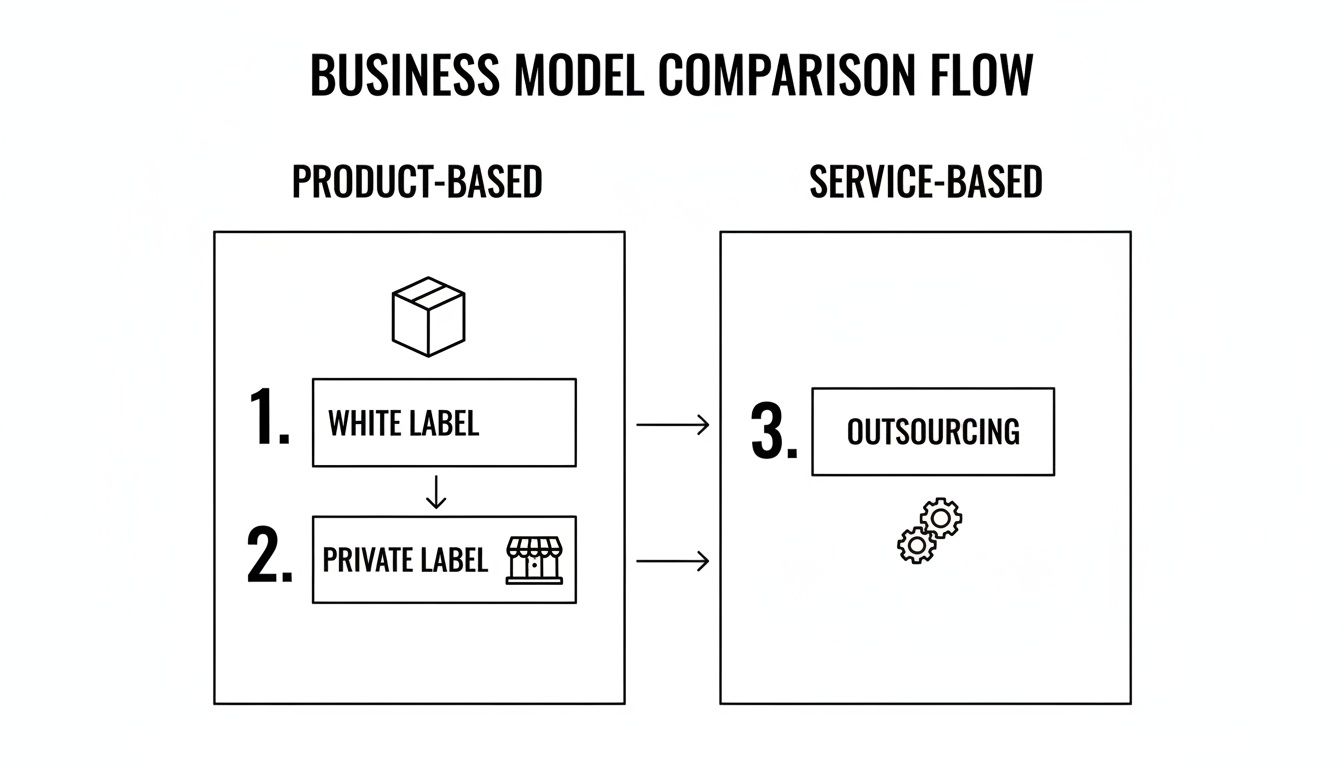
As you can see, the secret sauce of white labelling is the complete brand integration. This makes it a perfect fit for agencies who want to resell services without a hitch.
Structuring Your Pricing and Profit
Once you've got a partner in mind, it's time to talk money. The real beauty of white labelling is the financial predictability it brings to the table.
Your partner will give you a fixed price for the project. From there, it's your job to add your own markup before you quote your client. This markup needs to cover your time spent on project management, client comms, and, of course, your profit margin.
A healthy and pretty standard markup is between 50% and 100%. This can shift depending on how complex the job is and the value you're adding. The crucial thing is that you lock in your profit before a single line of code is written, which gets rid of the financial headaches that come with project delays or scope creep.
Establishing Legal Safeguards
Never, ever kick off a project without getting the legal side sorted. These documents aren't just a formality; they’re your safety net, protecting your agency, your client, and your intellectual property.
- Non-Disclosure Agreement (NDA): This is a must-have. It’s a legally binding contract that stops your white label partner from ever contacting your client directly or letting slip that they’re involved. It keeps the whole arrangement confidential.
- Service Level Agreement (SLA): This document gets into the nitty-gritty. It spells out project timelines, how you'll communicate, the quality of work expected, and how revisions will be handled. It sets clear expectations from the get-go and keeps everyone accountable.
Managing Projects Seamlessly
Solid project management is the glue that holds the white label relationship together and keeps it invisible to your client. You are their one and only point of contact. Every piece of communication—from the initial brief to progress updates and the final handover—flows from your partner, to you, and then on to your client, all under your agency's brand.
This setup makes you look like the expert who’s in total control. It's a cornerstone of successful digital agency outsourcing in Australia because it builds massive trust with your clients and cements your brand's authority. For agencies wanting to grow, you can learn more about how to outsource digital marketing the right way while keeping your brand front and centre.
Get these steps right, and you can turn white labelling into a seriously powerful and profitable growth engine for your agency.
Real-World Success: How Australian Agencies Are Winning with White Labelling
The theory behind white labelling is great, but what does it actually look like in practice? That’s where it all comes together. Seeing how real Aussie agencies are using these partnerships to solve genuine business problems and grow their revenue is what truly makes the concept click.
These aren't just abstract ideas—they're practical strategies being used right now to overcome some of the biggest hurdles agencies face. Let's dive into a couple of real-world scenarios.
The Brisbane SEO Firm That Cracked the Code on Client Retention
Imagine a small, sharp SEO agency in Brisbane. They were wizards at getting their clients ranked, but they kept running into the same frustrating roadblock: their clients’ websites were a mess. Slow, clunky, and poorly built WordPress sites were actively working against their SEO efforts, and it was costing them clients.
Instead of trying to build a web development team from scratch, they made a smarter move. They teamed up with a specialist in white label WordPress speed optimisation.
The impact was immediate and powerful. The agency started selling a new, high-value "Technical SEO & Performance" package. Their white label partner handled all the technical heavy lifting behind the scenes, and the SEO firm simply presented the glowing performance reports as their own fantastic work.
The result? Client retention shot up by over 30% in the first six months. They weren’t just stopping clients from leaving; they were solving a fundamental problem that made their core service more effective, which allowed them to bump up their average retainer value.
The Melbourne Design Agency That Landed a Whale
Now, let's head to Melbourne. There’s a brilliant design agency famous for creating beautiful brand identities. While their creative work was award-winning, they were constantly forced to say "no" to bigger, more profitable projects that involved complex e-commerce builds, especially on Shopify Plus. The high-level coding skills just weren't in their wheelhouse.
Partnering with a white label Shopify development agency was a complete game-changer for them. Suddenly, they could pitch for those large-scale, complex Shopify projects with total confidence. Their team would nail the design and user experience, and their new partner would build it all, handling the custom code and tricky app integrations.
This one decision allowed them to land a major retail client they never could have helped before, adding a massive six-figure project to their books. It’s a perfect example of smart scaling. You can see more examples of how these partnerships deliver real growth with a trusted provider of white label web design in Australia.
These stories aren't exceptions; they show a clear, practical path to expanding your services, delighting your clients, and growing your agency's bottom line.
Your White Label Questions, Answered
Making the jump to a white label partnership is a big move for any agency owner, so it's only natural to have a few questions rattling around. Let's clear up some of the most common concerns we hear, so you can move forward with confidence.
Can I Guarantee My Client Will Never Know?
Yes, you absolutely can. The whole point of a good white label partnership is discretion—it’s built right into the foundation of the model.
Any reputable partner, especially a white label WordPress agency in Australia, will operate under a strict Non-Disclosure Agreement (NDA). Think of them as a silent extension of your own team. All the work, from project files to progress updates, is channelled through you, under your brand. Your client will never know they exist; the core white labeling meaning is all about that invisibility.
What Happens If the Quality Isn't Up to Scratch?
This is a critical question, and one you should definitely ask before signing on the dotted line. A professional white label provider will have a rock-solid process for quality assurance and revisions.
Before you commit, make sure their Service Level Agreement (SLA) clearly spells out how revisions are handled. The standard process works like this: they deliver the work to you first. You review it, request any changes, and only when you're 100% happy do you present the final, polished product to your client. This gives you complete quality control and protects your hard-earned reputation.
Is It Really Cheaper Than Hiring an In-House Developer?
When you look at the total cost of employment, white labeling almost always comes out on top. It's easy to forget that an in-house developer is more than just a salary. You've also got to factor in superannuation, sick leave, software licences, hardware, and ongoing training costs.
With a white label web development partner, you pay a fixed, per-project fee. No overheads, no hidden costs. This turns a major fixed expense into a variable one that scales directly with your revenue. You only pay when you have a billable project, which is a fantastic way to protect your profit margins and gain some serious financial flexibility.
At White Label WordPress, we provide the expert development you need to grow your agency with guaranteed profit margins. Learn how our white label WordPress and Shopify services can help you scale.