
Think of white labelling this way: you’re a fantastic restaurant known for its incredible dishes, but you don't actually bake your own bread. Instead, you partner with the best artisan baker in town. They deliver phenomenal sourdough every morning, you serve it under your restaurant's brand, and your customers rave about your amazing bread. They never need to know about the baker.
That’s white labelling in a nutshell for your agency. It's a strategic partnership that allows a digital agency outsourcing australia to scale its services efficiently.
What White Labelling Really Means for Your Agency
Let’s be direct. White labelling allows your agency to offer highly specialised services—like complex WordPress or Shopify development—without having the in-house team to build it all from scratch. You partner with a specialist provider, like an agency wordpress partner australia or a Shopify expert, who does the heavy lifting behind the scenes.
To your client, it’s completely seamless. They see your brand, your project management, and your name on the final invoice. You're the one delivering the brilliant work, period.
Expand Your Services Instantly
For Australian agencies, the real power of white labelling is the ability to instantly bolt on new, high-demand services. You can start offering sophisticated eCommerce stores built by a woocommerce developer australia or ongoing website maintenance tomorrow, skipping the massive upfront investment in hiring, training, and new infrastructure.
It means you can finally say "yes" to more client projects and become a genuine one-stop shop for all their digital needs.
A white label partnership lets you sell a finished, expert-level product as your own. You’re using the skills of a specialised third-party provider while keeping total control over the client relationship and your brand. It’s the fastest way to scale your agency’s capabilities without adding to your overheads.
Lock in Profit and Focus on Growth
Financially, this model is incredibly stable. Your white label partner will almost always give you a fixed quote for the work. This means you know your exact profit margin before a single line of code is written, completely sidestepping the risk of scope creep destroying your bottom line. You get to secure your profit on every single project.
Ultimately, this frees up your most precious resource: time. With the technical work handled by a partner web agency australia, your team can focus on what they do best—building incredible client relationships, developing sharp strategies, and actually growing the business.
For a deeper look into this approach, our guide to white label WordPress offers more practical insights for agency owners. White labelling isn't just a form of outsourcing; it’s a strategic move to boost your profitability, scalability, and speed-to-market, helping you deliver top-tier results to your clients every single time.
White Label vs Private Label vs Reseller: What's the Real Difference?
If you're running an agency in Australia, you've probably heard the terms white label, private label, and reseller thrown around. They're often used interchangeably, but getting them wrong can lead you down a completely different strategic path.
Think of it this way: each model is a different way to partner up and offer more to your clients, but they come with their own rulebooks on branding, control, and how much work you need to put in. Getting this right from the start is crucial, especially when considering models like white label shopify development.
This flowchart lays out the core decision you're facing when thinking about expanding your services.
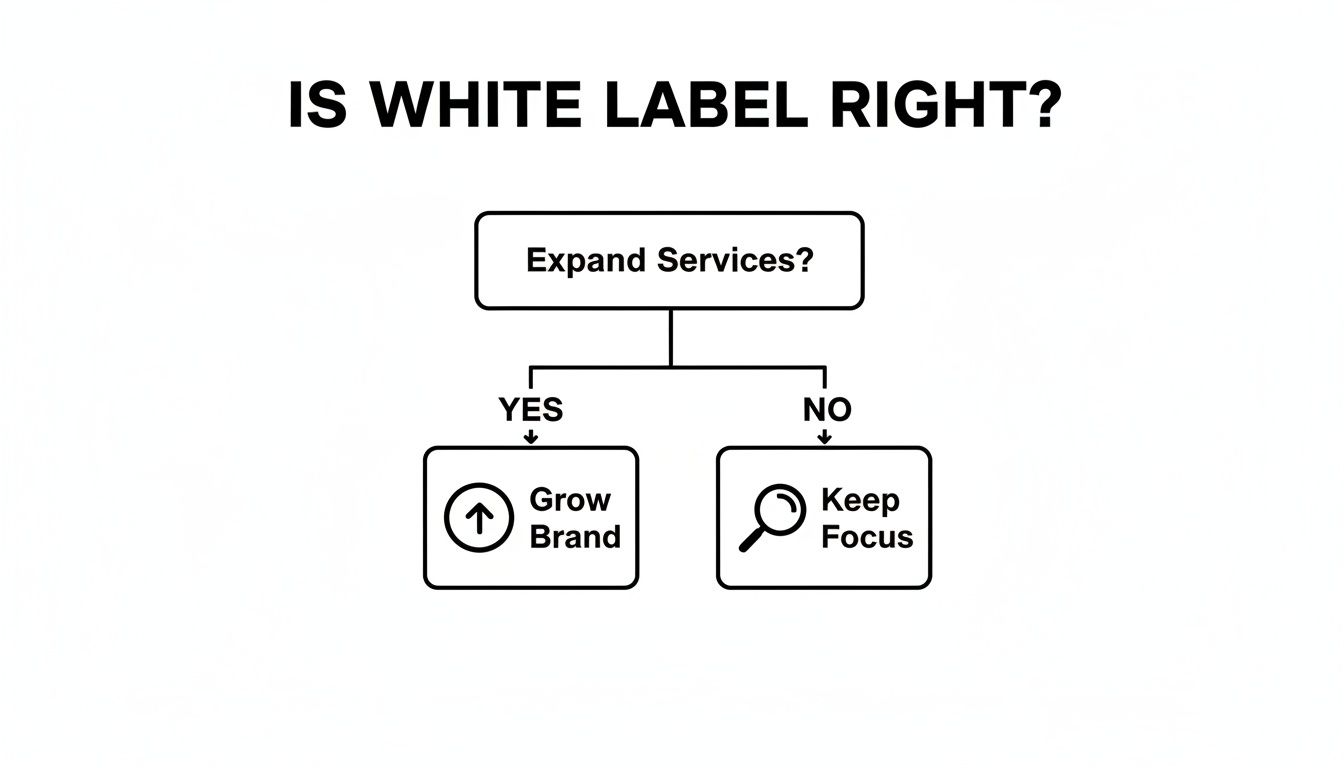
As you can see, if the goal is to grow your own brand by adding new services, white labelling is the most direct route to get there.
The White Label Model: Your Brand, Their Engine
This is the go-to model for most service agencies, and for good reason. White labelling lets you take a high-quality, ready-made service—like white label WordPress development or white label Shopify support—and put your own brand on it.
Essentially, a specialist partner does the heavy lifting in the background, but your client only ever sees your name. It's fast, reliable, and lets you focus on what you do best: managing client relationships and growing your business. For many, this is the core of wordpress outsourcing australia.
The Private Label Model: An Exclusive Offering, Just For You
Private labelling is a whole other level. Here, a provider creates a service or product exclusively for your agency. You get a massive say in the features, specs, and design, meaning you end up with something truly unique that none of your competitors can offer.
It’s like commissioning a bespoke suit instead of buying off the rack. This gives you a serious competitive edge, but be prepared for a much bigger upfront investment and a longer timeline to get it off the ground.
The Reseller Model: The Straightforward Sales Play
The reseller model is the simplest of the lot. You’re essentially acting as a sales agent for another company’s product, selling it under its original brand. You’re not trying to rebrand it; you’re just an official channel to sell it through.
Your main job is to market and sell, usually for a commission. It requires almost no investment, but the trade-off is lower profit margins and no brand-building benefit for your own agency.
At the end of the day, it all comes down to your primary goal. White labelling is for scaling your brand with proven services. Private labelling is for creating an exclusive, custom offering. Reselling is for generating affiliate income without any brand ownership.
To really nail down the differences, let's put these three models head-to-head.
Choosing Your Partnership Model: White Label vs Private Label vs Reseller
The right choice depends entirely on your agency's goals, resources, and how much control you want. This table breaks down what you get with each approach.
| Attribute | White Label | Private Label | Reseller |
|---|---|---|---|
| Branding | Your agency's brand is applied to a third-party product. | A unique product is created exclusively for your brand. | You sell a product under the original manufacturer's brand. |
| Exclusivity | Non-exclusive. The same product is sold by other agencies. | Exclusive. The product is unique to your agency. | Non-exclusive. You are one of many potential resellers. |
| Control | Low control over product features; high control over branding. | High control over product specifications and design. | No control over the product; you only control your sales process. |
| Time-to-Market | Fast. The product is ready to be sold immediately. | Slow. Requires a full custom development cycle. | Fast. You can start selling as soon as the agreement is signed. |
| Investment | Low. No development costs, just marketing and sales efforts. | High. Significant upfront investment in custom development. | Very Low. Minimal setup costs, focused on sales activities. |
For most Australian agencies looking to grow without taking on massive risk, the white label model hits the sweet spot. It offers the perfect blend of speed, affordability, and brand control, letting you expand your service list without the headache of building everything from the ground up. This is particularly true for services like white label ecommerce development australia.
How a White Label Partnership Actually Works
Knowing the definition of white labelling is one thing, but seeing how it plays out in the real world is where it all clicks. The process isn't some complex, mysterious affair. In fact, a good partnership feels less like outsourcing and more like having a world-class development team just down the hall, working as a seamless extension of your own agency.
From the moment your client gives you the green light to the final handover, the entire workflow is designed to keep you firmly in the driver's seat of the client relationship. Let’s walk through what a typical project journey looks like from your perspective.
Stage 1: The Initial Client Request and Scoping
It all begins when a client—new or existing—comes to you with a web development project. It might be a custom wordpress development australia site or a tricky Shopify build. You’ll do what you always do: gather their requirements, focusing on their business goals and what they want to achieve.
Once you have a solid brief, you bring it to your white label partner. This is where the collaboration really kicks in. You’ll work together to scope the project in detail, nailing down every feature, function, and design element. Your partner brings the technical expertise, asking the crucial questions to make sure nothing gets missed. They then deliver a fixed-price quote for the entire build.
Think of this fixed cost as your wholesale price. You simply add your agency's markup to create the final proposal for your client, locking in your profit margin right from the start.
Stage 2: Your Brand Leads All Communication
Throughout the entire project, you are the only point of contact for your client. You run the kick-off meetings, you present the design mock-ups, and you deliver all the progress updates. Your white label partner operates completely in the background, a silent but powerful engine driving everything forward.
A successful white label partnership is built on one core principle: your agency is always the hero in the client’s story. The partner’s job is to give you the tools and technical firepower to make you look brilliant, without ever stepping into the spotlight.
This structure is vital. It protects your client relationships and reinforces your brand as the expert provider. Your client’s trust is with you, not with some third-party developer they’ve never even heard of.
Stage 3: The Silent Development and Review Cycles
While you’re managing the client, your white label partner is busy with the technical build. They’re the ones handling all the coding, development, and integration work. This division of labour is at the heart of the white labelling meaning; you focus on client strategy and communication, while they focus purely on execution.
Your partner will give you regular updates and access to a staging server where you can review the work as it progresses. This is your chance to provide feedback and request tweaks long before the client ever lays eyes on it. This internal review process ensures the project perfectly matches the brief and meets your agency's high standards.
The workflow generally follows these key steps:
- Discovery & Quoting: You and your partner define the scope and agree on a fixed cost.
- Design & Approval: Your team creates the designs, or the partner builds from your wireframes. You get the client’s sign-off.
- Development: The partner builds the site on a private staging environment, hidden from public view.
- Internal QA: You review the completed build, providing feedback for any revisions needed.
- Client Review: You present the polished, near-final site to the client for their feedback.
- Final Revisions & Launch: The partner implements the last changes and handles the technical side of migration and launch.
Stage 4: Handover and Ongoing Support
Once the client gives their final, happy approval, the project moves into the handover stage. Your partner packages up all the project files, credentials, and any necessary documentation for you. You then present this to your client as the final deliverable from your agency.
But the relationship doesn't have to end there. Many agencies continue the partnership by offering white label WordPress maintenance or white label Shopify support as a recurring revenue service. Your partner handles all the technical upkeep behind the scenes, and you bill your client monthly. It's a fantastic way to create a stable, profitable, long-term engagement.
This is a common way savvy agencies effectively outsource digital marketing components to scale their service offerings. By following this practical blueprint, you can tap into deep technical expertise on demand, all while maintaining full control and delivering exceptional results under your own trusted brand.
The Strategic Benefits of White Labelling for Australian Agencies
For an Aussie agency, thinking about white labelling isn't just about outsourcing a task here or there—it's a serious growth strategy. It lets you completely rethink what your business can offer, how you operate, and how fast you can grow, all without the headaches that usually come with expansion.
Let's be honest, most agencies grapple with the same core challenges: gaps in the team's skillset, project costs that blow out, and the massive overhead of keeping a large, specialised team on the payroll. When you properly understand the white labelling meaning, you find a much smarter, more profitable way to run your business.
Instantly Expand Your Service Offerings
Imagine this: a potential client asks for a complex white label Shopify build or a custom white label WordPress development project. Instead of saying "no," you can confidently say "yes"—even if you don't have a single developer on staff. That's the power of a white label partnership.
You can immediately bolt on high-demand, high-value services to your agency's menu. This doesn't just make you more appealing to new clients; it also means you can do more for the ones you already have. You become the go-to partner they need for everything, so they have no reason to look elsewhere.
The real magic is agility. Instead of spending six months trying to hire a senior developer, you get access to an entire team of experts overnight. This speed lets you jump on opportunities while your competitors are still writing job ads.
Secure Financial Predictability and Protect Your Margins
Scope creep is the silent killer of agency profits. A project that seemed straightforward can quickly turn into a nightmare of extra hours and vanishing margins. White labelling is your best defence against this.
Your white label partner gives you a fixed, upfront price for the entire project. You know your exact cost before you even draft the client proposal. This means you can price your services with complete confidence, locking in a healthy profit margin from the get-go.
- No Unexpected Costs: That fixed price means no nasty surprises or bills for extra dev hours.
- Guaranteed Profit: You set your markup and know exactly what you’ll make from day one.
- Simplified Quoting: You can fire off accurate client proposals faster than ever.
This kind of financial certainty turns your cash flow from a rollercoaster into a predictable stream, making it far easier to forecast revenue and invest in other parts of the business, like sales and marketing.
Eliminate Recruitment and Overhead Costs
Building and keeping a skilled in-house tech team is one of the biggest expenses an agency has. It's not just the salaries; it's the recruitment fees, ongoing training, software licences, new hardware, and all the rest. It adds up, fast.
A white label model completely wipes this financial burden off your plate. You get to sidestep the entire costly and time-consuming cycle of hiring, onboarding, and managing technical staff. You tap into top-tier talent only when you need it, turning a huge fixed cost into a flexible variable one that moves in line with your revenue. Operating this lean is a massive competitive advantage.
Scale Your Agency On-Demand
Agency life is rarely a steady cruise; it’s all peaks and troughs. A white label partnership gives you the incredible flexibility to dial your delivery capacity up or down to perfectly match your pipeline.
Land a massive new client? Your partner can throw more resources at the project to get it done. Hit a quiet patch? You’re not stuck paying salaries for a team sitting on their hands. This means you can chase growth aggressively without ever worrying about being overstaffed or under-resourced. It’s exactly why so many agencies in Australia now choose to outsource WordPress development—it gives them an agility that a traditional in-house team just can't match.
The demand for solid WordPress infrastructure is clear in the Australian web hosting market, with specialised providers supporting huge numbers of sites, especially in Sydney and Melbourne. This robust local ecosystem means Aussie agencies are increasingly looking for white label partners not just for development, but for ongoing hosting, maintenance, and support too. You can find out more about the mature WordPress hosting landscape in Australia and see how agencies are tapping into it.
Refocus Your Team on High-Value Activities
When a trusted partner is handling all the technical heavy lifting, your core team is freed up to focus on the things that actually grow the business. They can pour their energy into the activities that deliver the best return.
Suddenly, they have more time for:
- Client Strategy: Digging deeper into client needs and delivering real strategic value.
- New Business Development: Getting out there and actively winning new work.
- Marketing Your Agency: Building your own brand to attract more inbound leads.
- Client Relationships: Strengthening partnerships and keeping clients happy for the long haul.
By letting someone else handle the "how," you empower your team to own the "why" and "what." It’s how you shift from being just another service provider to becoming an essential strategic partner for your clients.
Choosing the Right White Label Partner for Your Agency
Picking a white label partner is one of the biggest calls you'll make for your agency. This isn't just about finding a supplier; it's about building a genuine partnership with a team that acts as a seamless, trusted extension of your own. Get it right, and your partner becomes a silent engine for growth. Get it wrong, and you risk damaging client relationships and, worse, your own brand's reputation.
For an Aussie agency, the stakes are even higher. You need someone who not only has the technical chops but also truly understands the local market. This checklist is designed to walk you through the vetting process, helping you find a partner who is reliable, profitable, and in it for the long haul.

Technical Expertise and Platform Specialisation
First things first: your potential partner has to be an absolute gun in the platforms your clients are asking for. Don’t just take their word for it—you need to dig deep into their technical skills. A provider claiming to offer white label WordPress development, for instance, should have a portfolio bursting with complex, custom builds, not just a few tweaked templates.
The sheer dominance of WordPress is impossible to ignore. It powers a massive slice of the internet. That's why deep, verifiable expertise in this platform isn't a "nice-to-have"; it's essential. The same goes for eCommerce. If you’re planning to offer online stores, your partner needs to show a rock-solid command of platforms like Shopify, from shopify theme development right through to complex app integrations.
Communication and Project Management Systems
Smooth, consistent communication is the glue that holds a white label relationship together. You need a partner whose internal processes mesh perfectly with yours, making the whole workflow feel effortless.
It's time to ask some direct questions about how they operate:
- What project management tools are they on? (e.g., Asana, Jira, Trello)
- Who is my dedicated point of contact? Will I be speaking to the same person every time?
- What’s a realistic turnaround time for my emails and calls?
- How do you handle urgent fixes or last-minute scope changes from the client?
Transparency is non-negotiable. A great partner gives you a clear window into project progress at all times, so there are never any nasty surprises for you or your client. They should make you feel completely informed and in control, never left in the dark wondering what's going on.
Portfolio, Pricing, and Local Market Understanding
A flashy portfolio is great, but you need to look past the pretty pictures. Ask for detailed case studies that break down the specific problems they solved and the results they delivered. Really assess their design quality, the technical execution under the hood, and the variety of projects they’ve handled. When it comes to pricing, push for transparent, fixed-cost proposals that allow you to protect your profit margins without any ambiguity.
The Australian market is fiercely competitive. A partner who understands local search behaviour and market nuances gives you a massive leg up. Pairing expert white label web development for eCommerce with a team that genuinely gets the Aussie market creates an incredibly powerful offering for your clients.
Finally, get a feel for their understanding of Australian business culture and consumer expectations. A partner who is either based here or has extensive experience working with Australian businesses will build solutions that actually connect with your clients and their customers. That's a real competitive advantage.
Still Have Questions About White Labelling?
Taking the leap into a white label partnership is a big decision, and it’s completely normal to have a few questions about how it all works on the ground. For many Aussie agency owners, it's the nitty-gritty details that make all the difference. Let's tackle some of the most common questions we hear, so you can see exactly how this model plays out in the real world.
My aim here is to pull back the curtain on the entire process. We'll look at the big ones: client comms, scope changes, and the legal side of things. Getting clear on these points is often the final piece of the puzzle, giving you the confidence to see how white labelling can really kickstart your agency's growth.
How Do I Handle Client Communication?
This is usually the first question people ask, and for good reason. The answer, however, is beautifully simple: you handle all of it. The whole point of a white label partnership is that your agency stays front and centre. You’re always the one leading the conversation.
Your white label partner is your silent team in the background. They’ll never speak to your client, and their name won’t appear on a single document. You’ll be the one running discovery calls, presenting the slick new designs, and sending through progress updates. Your partner’s job is to give you everything you need to shine in those meetings and look like the rockstar you are.
This setup is designed to do two crucial things:
- Protect Your Brand: Your client gets a seamless, consistent experience that feels 100% like it came from you.
- Strengthen Your Relationship: You maintain and build on the trust you’ve already established with your client.
What Happens if the Project Scope Changes?
Ah, scope creep. It’s the ghost in the machine for almost every web project. Any decent white label partner knows this and has a solid, predictable process for dealing with it. When a client asks for a new feature or a major change that wasn’t in the original plan, the steps are clear and transparent.
First, you’ll chat with your partner about what the client wants. They'll dive in, figure out the technical side of things, and calculate the extra work required. Then, they’ll shoot back a separate, fixed-price quote just for that new piece of work.
You're never left guessing or hit with surprise costs. The entire process is built to protect your profit by clearly defining and costing any new work before it gets started. You simply take that quote, add your agency's markup, and present it to the client. Easy.
This turns what could be a chaotic headache into a simple, profitable add-on. You stay in control, the client is happy, and your margins are always safe.
How Do Non-Disclosure Agreements (NDAs) Work?
Confidentiality is everything. You need to know that your agency’s IP and your client’s private information are locked down tight. This is where solid legal agreements come in.
It’s usually a two-part setup that keeps everyone protected:
- Your Agency & Your Partner: You’ll sign a mutual NDA directly with your white label partner. This is a legally binding contract that stops them from sharing your business details, client info, or project secrets. It also contractually prevents them from ever trying to poach your clients.
- Your Agency & Your Client: You just use your standard NDA with your client, the same way you would for any other project.
This double-layered legal protection creates a watertight seal. Your partner is legally and professionally bound to be a silent, invisible part of your team, guaranteeing complete discretion and protecting your most important asset—your client relationships.
What Level of Technical Knowledge Do I Need?
This is a big one, especially for agencies that are strong on creative, marketing, or strategy but light on code. The great news? You don’t need to be a WordPress developer or a Shopify guru to make a white label partnership work. You main job is to be a brilliant project manager and communicator.
Your partner has the heavy technical lifting covered. Your role is to be the bridge, translating your client’s business goals into a clear project brief. You need to understand what your client is trying to achieve, not how the PHP and JavaScript make it happen. A great partner will act as your technical translator, explaining things in plain English so you can confidently relay them to your client.
Really, you just need to be great at:
- Drilling down into what a client really needs and documenting it.
- Clearly communicating project goals and feedback.
- Managing timelines and client expectations.
Your partner’s job is to fill in the tech gaps. This exact division of labour is what makes the white label model so powerful for agencies wanting to offer more without the massive overhead of an in-house dev team.
Ready to expand your agency’s services and guarantee your profit margins on every web project? White Label WordPress is your silent, expert partner for WordPress and Shopify development in Australia. We handle the technical work, so you can focus on what you do best—growing your business.
Discover how we can help you scale by visiting us at https://whitelabelwordpress.com.au.